Module 20: Torch Olympics (Capstone)
The framework you wrote now has to run end-to-end, on one model, with every optimization stacked and every number defended. The capstone is where profiling, quantization, compression, acceleration, memoization, and benchmarking land on a single inference pipeline and produce a schema-validated submission.json with platform metadata, warmup-controlled latencies, and their mean, standard deviation, and median. Optimizations interact at runtime; this is where you measure whether they actually compound on silicon.
CAPSTONE | Difficulty: ●●●● | Time: 6-8 hours | Prerequisites: 01-13 and 19 (14-18 recommended)
This capstone assumes you’ve built a complete framework end-to-end:
- Core framework (Modules 01-13) — required
- Optimization techniques (Modules 14-18) — recommended
- Benchmarking methodology (Module 19) — required
The baseline benchmark and submission run on Modules 01-13 and 19 alone. The optimization workflow layers in Modules 14-18; without them you can still benchmark and submit a baseline.
Overview
Nineteen modules in, you have a working ML framework. Tensors, autograd, transformers, quantization, pruning, profiling — every line written by you. The Olympics is where you put it on the scale.
In production ML, an unmeasured claim is no claim at all. This capstone gives your framework the same treatment MLPerf and Papers with Code give a real submission: a baseline measurement, an optimization pass, an apples-to-apples comparison, and a schema-validated artifact someone else can verify. You’ll write the model it measures, run the supplied harness against your own code, and ship a submission.json that stands on its own.
When you finish, you won’t just have a framework. You’ll have evidence.
Commands
# first time
tito module start 20

# later sessions
tito module resume 20

# when your tests pass
tito module complete 20
Your notebook is modules/20_capstone/capstone.ipynb.
Learning objectives
- Implement the two-layer MLP that the supplied benchmarking infrastructure measures for accuracy, latency, throughput, and memory
- Master the three pillars of reliable benchmarking: repeatability, comparability, and completeness
- Understand performance measurement traps (variance, cold starts, batch effects) and how to avoid them
- Connect your TinyTorch implementation to production ML workflows (experiment tracking, A/B testing, regression detection)
- Generate schema-validated JSON submissions that enable reproducible comparisons and community sharing
What you’ll build
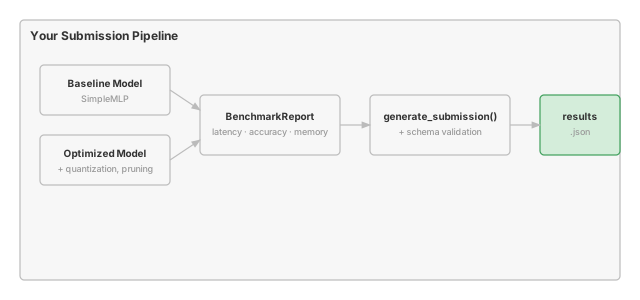
The pattern you’ll enable:
# Professional ML workflow
report = BenchmarkReport(model_name="my_model")
report.benchmark_model(model, X_test, y_test, num_runs=100)

submission = generate_submission(
    baseline_report=baseline_report,
    optimized_report=optimized_report,
    techniques_applied=["quantization", "pruning"]
)
save_submission(submission, "submission.json")
What you’re not building yet
Out of scope for this capstone:
- CI/CD pipelines that benchmark on every commit
- Multi-hardware comparison across CPU/GPU/TPU
- Plotting dashboards for accuracy-vs-latency curves
- Leaderboard aggregation across community submissions
You are building the measurement and reporting foundation everything else stands on. Automation and visualization layer on top — but only if the numbers underneath are trustworthy.
What you write
The notebook arrives with the surrounding code already written and explained. You write 2 functions, each marked # YOUR CODE HERE and followed by a test cell:
SimpleMLP.__init__- Initialize simple MLP with random weights.
SimpleMLP.forward- Forward pass through the network.
The Torch Olympics
Module 20 is also the course’s competition. You take your framework, benchmark a baseline and an optimized candidate on the same inputs, and enter the results in five classroom events.
The Five Classroom Events
Module 20 defines these event names and eligibility checks in OlympicEvent and qualifies_event():
| Event | Identifier | Eligibility |
|---|---|---|
| Latency Sprint | LATENCY_SPRINT |
Accuracy at least 85% |
| Memory Challenge | MEMORY_CHALLENGE |
Accuracy at least 85% |
| Accuracy Contest | ACCURACY_CONTEST |
Median latency below 100 ms and reported model size below 10 MB |
| All-Around | ALL_AROUND |
Valid measurements; compare accuracy, latency, and storage separately |
| Extreme Push | EXTREME_PUSH |
Accuracy at least 80% |
Every event requires finite accuracy in [0, 1], positive median latency, and positive model storage. The model_size_mb field stores array bytes divided by \(10^6\); use that same field when checking the size threshold. The report also measures batch throughput, separately from single-sample latency.
The Rules of Competition
Use the following practices to make classroom comparisons reproducible:
1. Record the Dataset and Check Event Eligibility
A model that runs in zero milliseconds but predicts randomly is useless. For a TinyDigits classroom challenge, evaluate on the 200-example test split shipped in datasets/tinydigits/test.pkl. The separate training split contains 1,000 examples. Both contain \(8 \times 8\) grayscale digits with float32 pixel values already normalized to [0, 1].
BenchmarkReport.benchmark_model() evaluates the X_test and y_test arrays you supply; it does not load a fixed dataset. Record the dataset, split, and preprocessing alongside your results. Module 20’s introductory benchmark uses 100 synthetic samples to demonstrate the API, so its results are not TinyDigits accuracy measurements.
2. Build-From-Scratch Invariant
Run your models on the TinyTorch components you built. Use the same evaluation inputs for the baseline and candidate, and document each transformation. Schema validation checks the report structure; it does not inspect model implementations or enforce a classroom policy.
3. Repeatability & Warmup Invariant
BenchmarkReport runs untimed warmup forwards before recording single-sample latency. The default is 100 timed runs, with mean, standard deviation, and median latency reported. Batch throughput is timed separately. Keep the model in evaluation mode and compare runs on the same machine; num_runs is configurable and must be positive.
Compare the Measurements
All-Around keeps accuracy, latency, storage, and throughput separate. There is no built-in composite efficiency formula or automatic ranking. When you provide baseline and optimized reports, generate_submission() records the latency ratio, storage ratio, and accuracy change. Inspect all three before choosing a candidate.
Submitting to the Torch Olympics
The capstone competition uses the programmatic tinytorch.olympics engine you implement in this module to generate schema-validated submissions. To inspect the Olympic competition banner and verify your framework:
tito olympics logo
tito module test 20
Use the Python workflow below to benchmark your baseline and optimized candidate models on the standard test workload, verify event eligibility against the five Olympic standards, and produce your verifiable submission.json.
Python API Integration
Use your trained baseline model and evaluation arrays. For TinyDigits, load the shipped test split described in the datasets guide, flatten each image to 64 features for an MLP, or add a channel axis for a CNN. The pixel values are already in [0, 1].
from tinytorch.olympics import (
    BenchmarkReport,
    OlympicEvent,
    qualifies_event,
    generate_submission,
    validate_submission_schema,
    save_submission,
)
from tinytorch.core.tensor import Tensor

# Supply your trained model, a Tensor of test inputs, and integer test labels.
# Example for an MLP: X_test = Tensor(test_images.reshape(-1, 64))
if hasattr(model, "eval"):
    model.eval()
report = BenchmarkReport(model_name="baseline")
metrics = report.benchmark_model(model, X_test, y_test, num_runs=100)

print(f"Accuracy: {metrics['accuracy'] * 100:.2f}%")
print(f"Median latency: {metrics['latency_ms_median']:.2f} ms")
print(f"Storage field: {metrics['model_size_mb']:.3f}")
print(f"Latency Sprint eligible: {qualifies_event(metrics, OlympicEvent.LATENCY_SPRINT)}")

# Schema validity and event eligibility are separate checks.
submission = generate_submission(
    baseline_report=report,
    student_name="Ada Lovelace",
)
assert validate_submission_schema(submission)
save_submission(submission, "submission.json")
To compare an optimized candidate, benchmark it on the same inputs and pass its report as optimized_report, along with a techniques_applied list. Saving a JSON file is a local operation; it does not upload the results.
How you know it works
tito module complete stops at the first step that fails:
- the unit tests inside your notebook run;
- your code is exported into
tinytorch.olympics; - the integration tests run against that exported package, together with the modules before it;
- the module is recorded as done, and
tito module statusshows it.
Unit tests in your notebook (8). Each prints a ✅ line when it passes.
- SimpleMLP
- BenchmarkReport
- qualifies_event
- Submission Generation
- Schema Validation
- Submission with Optimization
- Improvements Calculation
- JSON Serialization
Integration tests after export (25).
tests/20_capstone/test_capstone_core.pytests/20_capstone/test_capstone_integration.pytests/20_capstone/test_event_policy.pytests/20_capstone/test_source_validation.py
When it fails
A bare NotImplementedError with no message means a cell reached a function you have not written yet: the notebook ships each one as # YOUR CODE HERE followed by raise NotImplementedError(). The messages below are ones this module actually prints when an implementation is present but wrong.
Expected 283 parameters, got 253-
From
test_unit_simple_mlp. A layer has the wrong input width.fc2takes the hidden size,Linear(hidden_size, output_size), because it readsfc1’s output.
Finished? Read why
The reasoning behind this module (why it is built this way, what it costs, and how production frameworks differ) is the chapter The Capstone: From an Optimization to a Checkable Report in the companion book, TinyTorch: From Tensors to Transformers (PDF). The book prints complete reference implementations, so read it after you finish the module, not while you are working on it.
What’s next
Twenty modules ago, Tensor was an empty class. Now it has autograd behind it, a transformer on top of it, a quantizer that compresses it, and a benchmark report that proves what it can do. You didn’t read about how PyTorch is built. You built it.
The submission.json you ship from this module is the first artifact in a long career of them. Every system you’ll deploy from here forward gets the same treatment: baseline, optimize, measure, justify.
Where to take the framework next:
Table 2 collects suggested directions for extending the framework beyond the capstone.
| Direction | What to build | What it teaches |
|---|---|---|
| Push the optimizers | Benchmark milestone models (TinyDigits CNN, Transformer) end-to-end through Modules 14-18 | How real optimizations interact under measurement |
| Scale to a team | Wire MLflow or Weights & Biases into the same BenchmarkReport flow |
How professional experiment tracking grows from this same skeleton |
| Publish results | Convert your schema into a Papers with Code submission | How reproducibility becomes a community contract |
| Automate regression detection | Run the benchmark on every commit in CI | How performance is defended, not just achieved |
The last page, You Built Something Real, steps back from the code. It looks at what you actually learned by writing all of it: which abstractions paid off, which trade-offs you’ll keep meeting, and how this framework you built compares to the production systems that inspired it. Read it with your submission.json open.