Foundation Tier (Modules 01-08)
Build the mathematical core that makes neural networks learn.
What You’ll Learn
The Foundation tier teaches you how to build a complete learning system from scratch. Starting with basic tensor operations, you’ll construct the mathematical infrastructure that powers every modern ML framework: data loading, automatic differentiation, gradient-based optimization, and training loops.
By the end of this tier, you’ll understand:
- How tensors represent and transform data in neural networks
- Why activation functions enable non-linear learning
- How data loaders efficiently feed training data to models
- How backpropagation computes gradients automatically
- What optimizers do to make training converge
- How training loops orchestrate the entire learning process
Module Progression
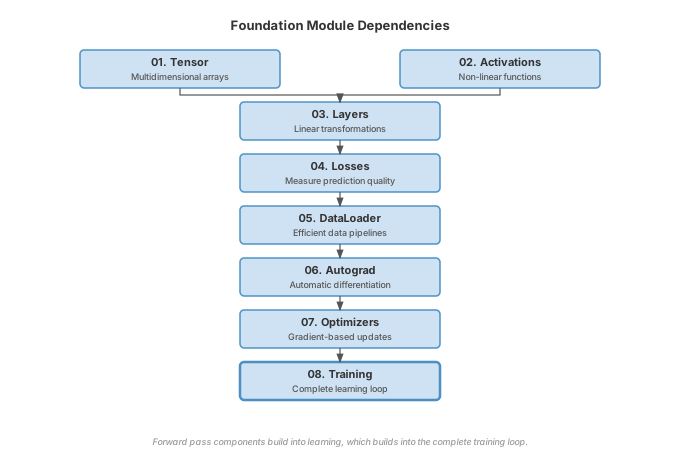
Why This Order?
The Foundation tier follows a deliberate Forward Pass → Learning → Training progression that mirrors how neural networks actually work:
Phase 1: Forward Pass Components (01-04)
Tensors (01) → Activations (02) → Layers (03) → Losses (04)
You must build things in the order data flows through them:
- Tensors are the data structure: you cannot do anything without them
- Activations transform tensors non-linearly: needed before layers can create interesting functions
- Layers combine tensors and activations into parameterized transformations
- Losses measure how wrong predictions are: needed before you can learn
At this point, you can do a complete forward pass: input → layer → activation → loss.
Phase 2: Learning Infrastructure (05-07)
DataLoader (05) → Autograd (06) → Optimizers (07)
Now you need the infrastructure to learn from data:
- DataLoader provides efficient data batching: real training needs this before autograd
- Autograd computes gradients automatically: the engine that makes learning possible
- Optimizers use gradients to update parameters: SGD, Adam, and friends
Phase 3: Complete Training (08)
Training (08) integrates everything into a complete learning loop.
This order is not arbitrary: it is the minimal dependency chain. You cannot build optimizers without autograd (no gradients), cannot build autograd without losses (nothing to differentiate), and cannot build losses without layers (no predictions). Each module unlocks the next.
Module Details
01. Tensor - The Foundation of Everything
What it is: Multidimensional arrays with automatic shape tracking and broadcasting.
Why it matters: Tensors are the universal data structure for ML. Understanding tensor operations, broadcasting, and memory layouts is essential for building efficient neural networks.
What you’ll build: A NumPy-backed tensor class supporting arithmetic, reshaping, slicing, and broadcasting, just like PyTorch tensors.
Systems focus: Memory layout, broadcasting semantics, operation fusion
02. Activations - Enabling Non-Linear Learning
What it is: Non-linear functions applied element-wise to tensors.
Why it matters: Without activations, neural networks collapse to linear models. Activations like ReLU, Sigmoid, and Tanh enable networks to learn complex, non-linear patterns.
What you’ll build: Common activation functions with their gradients for backpropagation.
Systems focus: Numerical stability, in-place operations, gradient flow
03. Layers - Building Blocks of Networks
What it is: Parameterized transformations (Linear, Dropout, Sequential) that learn from data.
Why it matters: Layers are the modular components you stack to build networks. Understanding weight initialization, parameter management, and forward passes is crucial.
What you’ll build: Linear (fully-connected) layers with proper initialization and parameter tracking.
Systems focus: Parameter storage, initialization strategies, forward computation
04. Losses - Measuring Success
What it is: Functions that quantify how wrong your predictions are.
Why it matters: Loss functions define what “good” means for your model. Different tasks (classification, regression) require different loss functions.
What you’ll build: CrossEntropyLoss, MSELoss, and other common objectives with their gradients.
Systems focus: Numerical stability (log-sum-exp trick), reduction strategies
05. DataLoader - Efficient Data Pipelines
What it is: Infrastructure for loading, batching, and shuffling training data efficiently.
Why it matters: Real ML systems train on datasets that don’t fit in memory. DataLoaders handle batching, shuffling, and parallel data loading, which are essential for efficient training.
What you’ll build: A DataLoader that supports batching, shuffling, and dataset iteration with proper memory management.
Systems focus: Memory efficiency, batching strategies, I/O optimization
06. Autograd - The Gradient Revolution
What it is: Automatic differentiation system that computes gradients through computation graphs.
Why it matters: Autograd is what makes deep learning practical. It automatically computes gradients for any computation, enabling backpropagation through arbitrarily complex networks.
What you’ll build: A computational graph system that tracks operations and computes gradients via the chain rule.
Systems focus: Computational graphs, topological sorting, gradient accumulation
07. Optimizers - Learning from Gradients
What it is: Algorithms that update parameters using gradients (SGD, Adam, AdamW).
Why it matters: Raw gradients don’t directly tell you how to update parameters. Optimizers use momentum, adaptive learning rates, and other tricks to make training converge faster and more reliably.
What you’ll build: SGD with momentum, Adam, and AdamW.
Systems focus: Update rules, momentum buffers, numerical stability
08. Training - Orchestrating the Learning Process
What it is: The training loop that ties everything together: forward pass, loss computation, backpropagation, parameter updates.
Why it matters: Training loops orchestrate the entire learning process. Understanding this flow (including batching, epochs, and validation) is essential for practical ML.
What you’ll build: The training-epoch loop at the center of a supplied training framework that adds progress tracking, validation, and model checkpointing.
Systems focus: Batch processing, gradient clipping, learning rate scheduling
What You Can Build After This Tier
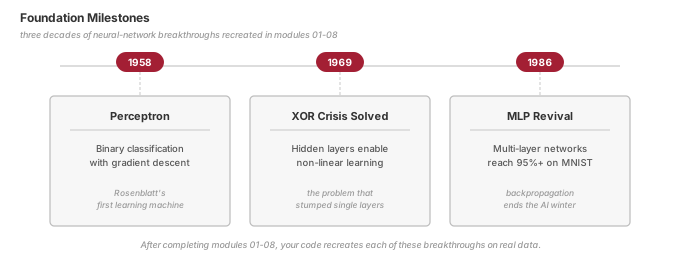
After completing the Foundation tier, you’ll be able to:
- Milestone 01 (1958): Recreate the Perceptron’s forward pass with your own layers
- Milestone 02 (1969): Demonstrate the XOR limitation that nearly ended neural-network research
- Milestone 03 (1986): Build multi-layer perceptrons that solve XOR and train on TinyDigits
Prerequisites
Required:
- Python programming (functions, classes, loops)
- Basic linear algebra (matrix multiplication, dot products)
- Basic calculus (derivatives, chain rule)
Helpful but not required:
- NumPy experience
- Understanding of neural network concepts
Time Commitment
Per module: 3 to 8 hours; each module page gives its own estimate
Total tier: 33-49 hours, the sum of the per-module estimates for modules 01-08
Recommended pace: 1-2 modules per week
Learning Approach
Each module follows the Build → Use → Reflect cycle:
- Build: Implement the component from scratch (tensor operations, autograd, optimizers)
- Use: Apply it to real problems (toy datasets, simple networks)
- Reflect: Answer systems thinking questions (memory usage, computational complexity, design trade-offs)
Next Steps
Ready to start building?
tito module start 01      # opens the Module 01 notebook
tito module complete 01   # runs its tests, exports it, records progress
The Quick Start walks through the whole loop once.
Or explore other tiers:
- Architecture Tier (Modules 09-13): CNNs, transformers, attention
- Optimization Tier (Modules 14-19): Production-ready performance
- Torch Olympics (Module 20): Compete in ML systems challenges