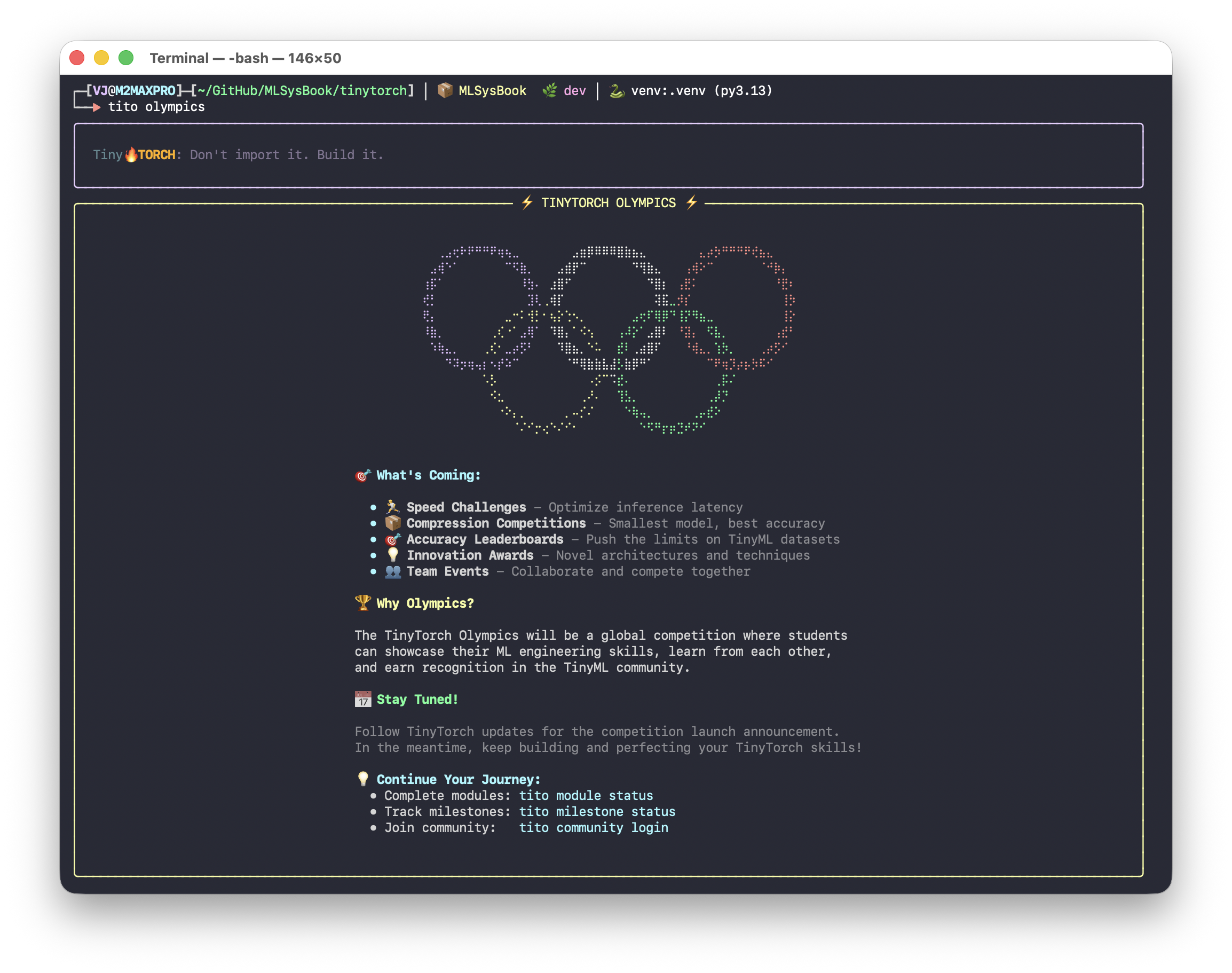
Torch Olympics (Module 20)#
The ultimate test: Build a complete, competition-ready ML system.
What Is the Torch Olympics?#
The Torch Olympics is TinyTorchâs capstone experienceâa comprehensive challenge where you integrate everything youâve learned across 19 modules to build, optimize, and compete with a complete ML system.
This isnât a traditional homework assignment. Itâs a systems engineering competition where youâll:
Design and implement a complete neural architecture
Train it on real datasets with YOUR framework
Optimize for production deployment
Benchmark against other students
Submit to the TinyTorch Leaderboard
Think of it as: MLPerf meets academic research meets systems engineeringâall using the framework YOU built.
What Youâll Build#
graph TB
FOUNDATION[ Foundation<br/>Tensor, Autograd, Training]
ARCHITECTURE[ïž Architecture<br/>CNNs, Transformers]
OPTIMIZATION[â±ïž Optimization<br/>Quantization, Acceleration]
FOUNDATION --> SYSTEM[ Production System]
ARCHITECTURE --> SYSTEM
OPTIMIZATION --> SYSTEM
SYSTEM --> CHALLENGES[Competition Challenges]
CHALLENGES --> C1[Vision: CIFAR-10<br/>Goal: 80%+ accuracy]
CHALLENGES --> C2[Language: TinyTalks<br/>Goal: Coherent generation]
CHALLENGES --> C3[Optimization: Speed<br/>Goal: 100 tokens/sec]
CHALLENGES --> C4[Compression: Size<br/>Goal: <10MB model]
C1 --> LEADERBOARD[ TinyTorch Leaderboard]
C2 --> LEADERBOARD
C3 --> LEADERBOARD
C4 --> LEADERBOARD
style FOUNDATION fill:#e3f2fd,stroke:#1976d2,stroke-width:2px
style ARCHITECTURE fill:#f3e5f5,stroke:#7b1fa2,stroke-width:2px
style OPTIMIZATION fill:#fff3e0,stroke:#f57c00,stroke-width:2px
style SYSTEM fill:#fef3c7,stroke:#f59e0b,stroke-width:4px
style LEADERBOARD fill:#c8e6c9,stroke:#388e3c,stroke-width:4px
Competition Tracks#
Track 1: Computer Vision Excellence#
Challenge: Achieve the highest accuracy on CIFAR-10 (color images) using YOUR Conv2d implementation.
Constraints:
Must use YOUR TinyTorch implementation (no PyTorch/TensorFlow)
Training time: <2 hours on standard hardware
Model size: <50MB
Skills tested:
CNN architecture design
Data augmentation strategies
Hyperparameter tuning
Training loop optimization
Current record: 82% accuracy (can you beat it?)
Track 2: Language Generation Quality#
Challenge: Build the best text generation system using YOUR transformer implementation.
Evaluation:
Coherence: Do responses make sense?
Relevance: Does the model stay on topic?
Fluency: Is the language natural?
Perplexity: Lower is better
Constraints:
Must use YOUR attention + transformer code
Trained on TinyTalks dataset
Context length: 512 tokens
Skills tested:
Transformer architecture design
Tokenization strategy
Training stability
Generation sampling techniques
Track 3: Inference Speed Championship#
Challenge: Achieve the highest throughput (tokens/second) for transformer inference.
Optimization techniques:
KV-cache implementation quality
Batching efficiency
Operation fusion
Memory management
Constraints:
Must maintain >95% of baseline accuracy
Measured on standard hardware (CPU or GPU)
Single-thread or multi-thread allowed
Current record: 250 tokens/sec (can you go faster?)
Skills tested:
Profiling and bottleneck identification
Cache management
Systems-level optimization
Performance benchmarking
Track 4: Model Compression Masters#
Challenge: Build the smallest model that maintains competitive accuracy.
Optimization techniques:
Quantization (INT8, INT4)
Structured pruning
Knowledge distillation
Architecture search
Constraints:
Accuracy drop: <3% from baseline
Target: <10MB model size
Must run on CPU (no GPU required)
Current record: 8.2MB model with 92% CIFAR-10 accuracy
Skills tested:
Quantization strategy
Pruning methodology
Accuracy-efficiency trade-offs
Edge deployment considerations
How It Works#
1. Choose Your Challenge#
Pick one or more competition tracks based on your interests:
Vision (CNNs)
Language (Transformers)
Speed (Inference optimization)
Size (Model compression)
2. Design Your System#
Use all 19 modules youâve completed:
from tinytorch import Tensor, Linear, Conv2d, Attention # YOUR code
from tinytorch import Adam, CrossEntropyLoss # YOUR optimizers
from tinytorch import DataLoader, train_loop # YOUR infrastructure
# Design your architecture
model = YourCustomArchitecture() # Your design choices matter!
# Train with YOUR framework
optimizer = Adam(model.parameters(), lr=0.001)
train_loop(model, train_loader, optimizer, epochs=50)
# Optimize for production
quantized_model = quantize(model) # YOUR quantization
pruned_model = prune(quantized_model, sparsity=0.5) # YOUR pruning
3. Benchmark Rigorously#
Use TinyTorchâs benchmarking tools:
# Quick validation (ensures setup works)
tito benchmark baseline
# Full performance evaluation (Module 20 capstone)
tito benchmark capstone
Note: Advanced benchmarking commands for accuracy, speed, size, and memory measurement are planned for future releases.
4. Submit to Leaderboard#
Coming Soon! The submission and leaderboard system is under development.
# Check your current Olympics status
tito olympics status
# View the Olympics logo
tito olympics logo
Submission commands will be available in a future release.
Leaderboard Dimensions#
Your submission is evaluated across multiple dimensions:
Dimension |
Weight |
What It Measures |
|---|---|---|
Accuracy |
40% |
Primary task performance |
Speed |
20% |
Inference throughput (tokens/sec or images/sec) |
Size |
20% |
Model size in MB |
Code Quality |
10% |
Implementation clarity and documentation |
Innovation |
10% |
Novel techniques or insights |
Final score: Weighted combination of all dimensions. This mirrors real-world ML where you optimize for multiple objectives simultaneously.
Learning Objectives#
The Torch Olympics integrates everything youâve learned:
Systems Engineering Skills#
Architecture design: Making trade-offs between depth, width, and complexity
Hyperparameter tuning: Systematic search vs intuition
Performance optimization: Profiling â optimization â validation loop
Benchmarking: Rigorous measurement and comparison
Production Readiness#
Deployment constraints: Size, speed, memory limits
Quality assurance: Testing, validation, error analysis
Documentation: Explaining your design choices
Reproducibility: Others can run your code
Research Skills#
Experimentation: Hypothesis â experiment â analysis
Literature review: Understanding SOTA techniques
Innovation: Trying new ideas and combinations
Communication: Writing clear technical reports
Grading (For Classroom Use)#
Instructors can use the Torch Olympics as a capstone project:
Deliverables:
Working Implementation (40%): Model trains and achieves target metrics
Technical Report (30%): Design choices, experiments, analysis
Code Quality (20%): Clean, documented, reproducible
Leaderboard Performance (10%): Relative ranking
Example rubric:
90-100%: Top 10% of leaderboard + excellent report
80-89%: Top 25% + good report
70-79%: Baseline metrics met + complete report
60-69%: Partial completion
<60%: Incomplete submission
Timeline#
Recommended schedule (8-week capstone):
Weeks 1-2: Challenge selection and initial implementation
Weeks 3-4: Training and baseline experiments
Weeks 5-6: Optimization and experimentation
Week 7: Benchmarking and final tuning
Week 8: Report writing and submission
Intensive schedule (2-week sprint):
Days 1-3: Baseline implementation
Days 4-7: Optimization sprint
Days 8-10: Benchmarking
Days 11-14: Documentation and submission
Support and Resources#
Reference Implementations#
Starter code will be provided for each track.
Coming Soon: The olympics init command for initializing competition projects is under development.
Community#
Discord: Get help from other students and instructors
Office Hours: Weekly video calls for Q&A
Leaderboard: See what others are achieving
Forums: Share insights and techniques
Documentation#
Milestone System: Historical context
Benchmarking Guide: Measurement methodology
Optimization Techniques: Compression and acceleration strategies
Prerequisites#
Required:
All 19 modules completed (Foundation + Architecture + Optimization)
Experience training models on real datasets
Understanding of profiling and benchmarking
Comfort with YOUR TinyTorch codebase
Highly recommended:
Complete all 6 historical milestones (1957-2018)
Review optimization tier (Modules 14-19)
Practice with profiling tools
Time Commitment#
Minimum: 20-30 hours for single track completion
Recommended: 40-60 hours for multi-track competition + excellent report
Intensive: 80+ hours for top leaderboard performance + research-level analysis
This is a capstone projectâexpect it to be challenging and rewarding!
What Youâll Take Away#
By completing the Torch Olympics, youâll have:
Portfolio piece: A complete ML system you built from scratch
Systems thinking: Deep understanding of ML engineering trade-offs
Benchmarking skills: Ability to measure and optimize systematically
Production experience: End-to-end ML system development
Competition experience: Leaderboard ranking and peer comparison
This is what sets TinyTorch apart: You didnât just learn to use ML frameworksâyou built one, optimized it, and competed with it.
Next Steps#
Ready to compete?
# Check your Olympics status
tito olympics status
# View the Olympics logo
tito olympics logo
Full competition commands (init, submit, leaderboard) are coming soon!
Or review prerequisites:
Foundation Tier (Modules 01-07)
Architecture Tier (Modules 08-13)
Optimization Tier (Modules 14-19)