Milestone 05: The Transformer Era (2017-2022)
Architecture Tier Capstone | Difficulty: ●●●● | Time: 20-30 min | Prerequisites: Modules 01-08, 10-13
- How autoregressive next-token prediction produces emergent language capabilities
- The mathematical and systems foundation behind ChatGPT (2020-2022)
- How causal self-attention masks turn sequence training into parallel teacher forcing
- How micro-transformers generalize from natural language to formal programming syntax
- Why interactive generation demands systems optimizations like the KV-cache (Module 18)
Overview
In 2017, the Transformer replaced recurrence with attention. By 2020-2022, scaling autoregressive transformers produced the generative AI revolution.
In 2017, Vaswani et al. published “Attention Is All You Need”, proving that self-attention alone, with no recurrence and no convolution, could capture long-range sequence dependencies in parallel. In 2020, Brown et al. (OpenAI) published “Language Models are Few-Shot Learners” (GPT-3), demonstrating that optimizing a simple objective, predicting the next token, on vast text corpora produced emergent reasoning, in-context learning, and conversational abilities without task-specific fine-tuning.
In late 2022, OpenAI launched ChatGPT, demonstrating to the entire world that this generative transformer foundation could interact seamlessly with human thought.
Behind modern LLMs sit two foundational pillars:
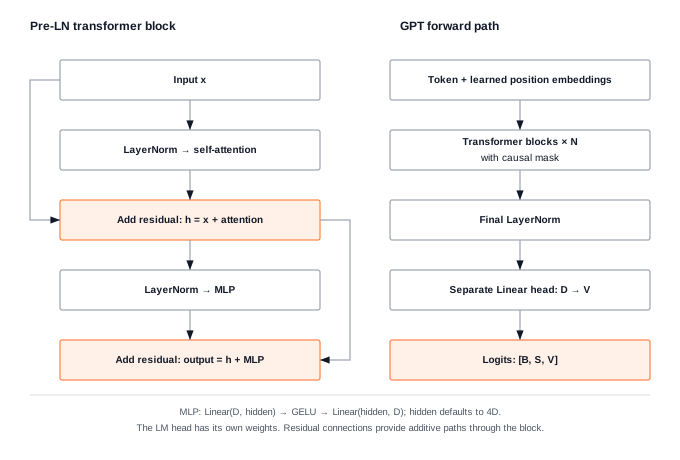
- The Generative Architecture (2017-2020): A causal, decoder-only transformer trained on next-token cross-entropy loss with teacher forcing.
- The Systems Serving Stack (2022): KV-caching (Module 18), INT8 quantization (Module 15), and hardware acceleration (Module 17) that turn an otherwise memory-bandwidth-choked model into a real-time, interactive service.
In this milestone, you assemble and train TinyGPT from scratch on Shakespeare, TinyCopilot code generation, and conversational concepts using exclusively the neural network and autograd primitives you authored across TinyTorch!
What You’ll Recreate
Milestone 05 runs in four parts:
- Part 1 (
01_tinygpt_shakespeare.py- Default):- Decoder-Only Architecture (
TinyGPT):- Token and Learned Positional Embeddings (Module 11)
- Causal Multi-Head Self-Attention with lower-triangular masking (Module 12)
- Feed-Forward MLP with 4x expansion and GELU activation (Modules 02 and 03)
- Deep Pre-LayerNorm Residual Highway (Module 13)
- Un-embedding Language Model Projection Head (Module 03)
- Autoregressive Generation Pipeline:
- Temperature-scaled sampling and top-\(k\) token filtering.
- Decoder-Only Architecture (
- Part 2 (
02_vaswani_attention.py- Attention Proof):- Three synthetic sequence challenges (reversal, copying, prefix-controlled routing) that verify cross-position attention routing in isolation.
- Part 3 (
03_tinycopilot.py- TinyCopilot Code Generation with TinyPy):- Train TinyGPT on algorithmic source code across mathematical algorithms, sorting, and deep learning primitives.
- Rigorous compiler validation: Verifies generated completions with Python’s Abstract Syntax Tree (
ast.parse) compiler gate.
- Part 4 (
04_tinygpt_chat.py- Conversational Q&A & Overfitting Detective):- Train conversational TinyGPT on TinyTorch concepts (
tinytalks_tinytorch.txt). - Run the Overfitting Detective experiment to observe the empirical divergence between training loss (rote memorization) and held-out validation loss.
- Tokenizes with a word-level tokenizer defined in the script, not your Module 10 tokenizer; your
CharTokenizerruns in Parts 1 and 3.
- Train conversational TinyGPT on TinyTorch concepts (
Prerequisites
Table 1 lists the modules you need to have completed before starting.
| Module | Component | What It Provides |
|---|---|---|
| 01-03 | Tensors & Layers | Tensor, GELU activation, Linear projection |
| 04 | Losses | Multi-dimensional sequence CrossEntropyLoss |
| 05 | DataLoader | TensorDataset and mini-batch DataLoader |
| 06-07 | Autograd & Optimizers | Reverse-mode tape autograd, AdamW optimizer |
| 08 | Training | Trainer loop abstraction |
| 10 | Tokenization | CharTokenizer for character-level vocabulary (Parts 1 and 3) |
| 11 | Embeddings | Token + Learned Positional Embeddings |
| 12 | Attention | Multi-Head Self-Attention |
| 13 | Transformers | Pre-LN TransformerBlock & generation utilities |
Running the Milestone
Before running, ensure you have completed Modules 01-08 and 10-13. Check your progress:
tito module statusBy default tito runs the two required parts in order, Part 1 (TinyGPT on Shakespeare) and Part 2 (Attention Sequence Routing). Milestone 05 completes once both have passed. Parts 3 and 4 are optional extensions, recorded separately; --all runs all four.
tito milestone run 05
# Or using convenience aliases:
tito milestone run transformer
tito milestone run tinygpt
Run one part at a time (each command records only that part):
Part 2 (Attention Sequence Routing):
tito milestone run 05 --part 2Part 3 (TinyCopilot Code Generation, optional):
tito milestone run 05 --part 3Part 4 (Conversational Concepts & Overfitting Detective, optional):
tito milestone run 05 --part 4Direct script options:
# Rapid test on bundled offline Shakespeare sample:
python3 milestones/05_2017_transformer/01_tinygpt_shakespeare.py --quick

# TinyCopilot on a smaller crop of the same TinyPy corpus (20,000 training tokens instead of 35,000):
python3 milestones/05_2017_transformer/03_tinycopilot.py --quick

# Conversational chat and Overfitting Detective:
python3 milestones/05_2017_transformer/04_tinygpt_chat.py --quick
python3 milestones/05_2017_transformer/04_tinygpt_chat.py --interactive
Expected Results
Table 2 records the loss convergence and generation metrics.
| Part | Script | Task | Success Criteria | Time |
|---|---|---|---|---|
| 1 (Required) | 01_tinygpt_shakespeare.py |
Shakespeare Next-Token Prediction | Final training loss < 1.20, measured after training; best loss on held-out text it never trains on at least 0.35 below a counted bigram model; causality probe (changing later tokens leaves earlier predictions unchanged). Samples are printed but coherence is not scored | ~15-20s (12 epochs on CPU) |
| 2 (Required) | 02_vaswani_attention.py |
Sequence Routing | Passes reversal (>95%), copying (>95%), mixed (>90%) | A few seconds (2-4 epochs) |
| 3 (Optional) | 03_tinycopilot.py |
TinyCopilot Code Generation | Final training loss < 1.0, measured after training; causality probe; at least 1 of 7 prompts with names absent from the training text parses as valid Python. Each prompt is scored on a greedy completion; the sampled completion is display only | ~25-35s (10 epochs on CPU) |
| 4 (Optional) | 04_tinygpt_chat.py |
Conversational Q&A & Overfitting | Train loss < 0.60, measured after training; lowest held-out loss at least 0.50 below the untrained model’s; causality probe; a train/test gap above 0.30, reported as the overfitting finding rather than as success | ~20-30s (10 epochs on CPU) |
Before training, Parts 1, 3, and 4 check that YOUR CrossEntropyLoss forward matches a NumPy computation on one batch, and that a repeated token gives different predictions at different positions (so YOUR positional encoding is doing its job). Every loss the gates read is then computed in NumPy from the model’s logits after training, not taken from YOUR loss or Trainer: training can still converge with a wrong loss forward, because the gradient comes from Module 06’s backward. After training, Parts 1, 3, and 4 also read the attention weights YOUR scaled_dot_product_attention returns: if every earlier token gets nearly the same weight (entropy at least 0.90 of uniform; trained models measure 0.55 to 0.71), the run fails.
The Aha Moment: Next-Token Prediction Creates Language
When you train an image classifier, one image maps to one label. If you do that with a language model, a 32-token window produces only a single training signal.
With teacher forcing and a causal mask, every single position in the window predicts the token that follows it. In one single forward pass, 32 positions are trained simultaneously in parallel:
\[\mathcal{L} = -\frac{1}{S} \sum_{t=1}^{S} \log P(x_{t+1} \mid x_1, \dots, x_t)\]
During autoregressive inference, the model reuses the exact same weights token-by-token:
- Model forward pass on prompt tokens \(\to\) logits \([1, S, V]\)
- Extract the last logit row \(\mathbf{z}_{S} \in \mathbb{R}^V\)
- Scale by temperature \(T\) and filter out low-probability tails with top-\(k\)
- Sample next token ID and append to the prompt
- Repeat for \(N\) tokens
Your Code Powers This
Table 3 names the TinyTorch components that power this milestone.
| Component | Your Module | What It Does |
|---|---|---|
Tensor |
Module 01 | Strided multi-dimensional data buffer and tape autograd |
GELU |
Module 02 | Smooth Gaussian Error non-linearity for transformer MLPs |
Linear |
Module 03 | Attention projections (\(W_Q, W_K, W_V, W_O\)), MLP layers, and LM head |
CrossEntropyLoss |
Module 04 | Stable multi-dimensional sequence loss with shift-by-max |
DataLoader |
Module 05 | Mini-batch slicing with sequence stride |
Autograd |
Module 06 | Exact reverse-mode backpropagation across deep layers |
AdamW |
Module 07 | Decoupled weight decay optimizer for transformer stability |
Trainer |
Module 08 | Standardized training epoch execution |
CharTokenizer |
Module 10 | Character-level tokenization mapping text to vocabulary IDs |
EmbeddingLayer |
Module 11 | Token and learned positional embeddings |
MultiHeadAttention |
Module 12 | Causal self-attention preventing future information leakage |
TransformerBlock |
Module 13 | Pre-LayerNorm residual block combining attention and MLP |
generate |
Module 13 | Autoregressive sampling loop with temperature and top-\(k\) |
No PyTorch. No HuggingFace. Just YOUR code.
Systems Bridge: The Prefix Bottleneck
When generating 50 tokens from a 10-token prompt:
- Step 1 processes 10 tokens
- Step 2 processes 11 tokens
- Step 50 processes 59 tokens
Across all 50 generation steps, the model evaluates over 1,700 position rows to produce just 50 tokens! Every step redundantly recomputes the Key and Value matrices for tokens that never change.
This \(O(S^2)\) prefix recomputation bottleneck is the exact motivation for the Key-Value Cache (KV-cache) built in Module 18 and benchmarked in Milestone 06 (MLPerf).
Read Why
The companion book’s chapter Synthesis II: Convolution, Attention, and Generated Text covers Milestones 04 and 05, comparing convolutional spatial inductive biases with transformer sequence modeling and detailing the autoregressive sampling mathematics. Read it in TinyTorch: From Tensors to Transformers (PDF).
What’s Next
You’ve built and trained TinyGPT from scratch. In the Optimization Tier (Modules 14–19), you’ll profile its performance bottlenecks (Module 14), quantize weights to INT8 (Module 15), compile operations (Module 17), and implement the KV-cache (Module 18) to accelerate generation before proving it in Milestone 06: MLPerf Benchmarks!