Module 12: Attention

NoteModule Info

ARCHITECTURE TIER | Difficulty: ●●●○ | Time: 5-7 hours | Prerequisites: 01-08, 10-11

Prerequisites: Modules 01-08 and 10-11 means you should understand: - Tensor operations and shape manipulation (Module 01) - Activations, particularly softmax (Module 02) - Linear layers and weight projections (Module 03) - Autograd for gradient computation (Module 06) - Tokenization and embeddings (Modules 10-11)

If you can explain why softmax(x).sum(axis=-1) equals 1.0 and how embeddings convert token IDs to dense vectors, you’re ready.

🎧 Audio Overview

Listen to an AI-generated overview.

🚀 Launch Binder

Run interactively in your browser.

Open in Binder →

📄 View Source

Browse the source code on GitHub.

View on GitHub →
🔥 Slide Deck · AI-generated
1 / -
Loading slides...

Overview

The attention mechanism revolutionized deep learning by solving a fundamental problem: how can models focus on relevant information when processing sequences? Before attention, models like RNNs compressed entire sequences into fixed-size hidden states, creating an information bottleneck. Attention changes this by allowing every position in a sequence to directly access information from every other position, weighted by relevance.

You’ll build scaled dot-product attention and multi-head attention from scratch, the exact mechanisms powering GPT, BERT, and modern transformers. By implementing the core formula Attention(Q, K, V) = softmax(QK^T / √d_k) V with vectorized matrix operations, you’ll witness the O(n²) memory complexity that makes attention both powerful and challenging at scale. This hands-on implementation reveals why research into efficient attention variants like FlashAttention is crucial for production systems.

Learning Objectives

TipBy completing this module, you will:
  • Implement scaled dot-product attention with vectorized operations that reveal O(n²) memory complexity
  • Build multi-head attention for parallel processing of different relationship types across representation subspaces
  • Master attention weight computation, normalization, and the query-key-value paradigm
  • Understand quadratic memory scaling and why attention becomes the bottleneck in long-context transformers
  • Connect your implementation to production frameworks and understand why efficient attention research matters at scale

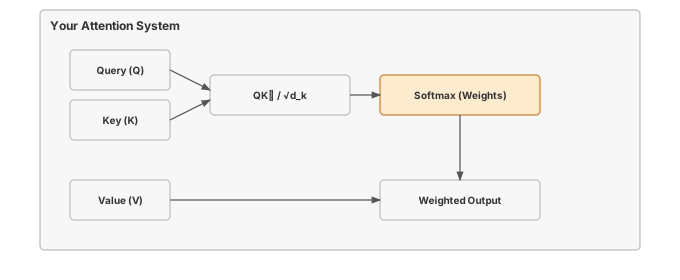
What You’ll Build

flowchart LR
    subgraph "Your Attention System"
        A["Query (Q)<br/>What to look for"]
        B["Key (K)<br/>What's available"]
        C["Value (V)<br/>What to retrieve"]
        D["Similarity Scores<br/>QK^T / √d_k"]
        E["Attention Weights<br/>softmax(scores)"]
        F["Weighted Output<br/>weights @ V"]
    end

    A --> D
    B --> D
    D --> E
    E --> F
    C --> F

    style A fill:#e1f5ff
    style B fill:#e1f5ff
    style C fill:#e1f5ff
    style D fill:#fff3cd
    style E fill:#f8d7da
    style F fill:#d4edda

Implementation roadmap:

Part What You’ll Implement Key Concept
1 scaled_dot_product_attention() Core attention mechanism with QK^T similarity
2 Attention weight normalization Softmax converts scores to probability distribution
3 Causal masking support Preventing attention to future positions
4 MultiHeadAttention.__init__() Linear projections and head configuration
5 MultiHeadAttention.forward() Split, attend, concatenate pattern

The pattern you’ll enable:

# Multi-head attention for sequence processing
mha = MultiHeadAttention(embed_dim=512, num_heads=8)
output = mha(embeddings, mask)  # Learn different relationship types in parallel

What You’re NOT Building (Yet)

To keep this module focused, you will not implement:

  • Full transformer blocks (that’s Module 13: Transformers)
  • Positional encoding (you built this in Module 11: Embeddings)
  • Efficient attention variants like FlashAttention (production optimization beyond scope)
  • Cross-attention for encoder-decoder models (PyTorch does this with separate Q vs K/V inputs)

You are building the core attention mechanism. Complete transformer architectures come next.

API Reference

This section provides a quick reference for the attention functions and classes you’ll build. Use this as your implementation guide and debugging reference.

Scaled Dot-Product Attention Function

scaled_dot_product_attention(Q, K, V, mask=None) -> (output, attention_weights)

Computes the fundamental attention operation that powers all transformers.

Parameters: - Q: Query tensor (batch_size, seq_len, d_model) - what each position is looking for - K: Key tensor (batch_size, seq_len, d_model) - what’s available at each position - V: Value tensor (batch_size, seq_len, d_model) - actual content to retrieve - mask: Optional (batch_size, seq_len, seq_len) - 1.0 for allowed positions, 0.0 for masked

Returns: - output: Attended values (batch_size, seq_len, d_model) - attention_weights: Attention matrix (batch_size, seq_len, seq_len) showing focus patterns

MultiHeadAttention Class

Multi-head attention runs multiple attention mechanisms in parallel, each learning to focus on different types of relationships.

Constructor:

MultiHeadAttention(embed_dim, num_heads) -> MultiHeadAttention

Creates multi-head attention with embed_dim // num_heads dimensions per head.

Core Methods:

Method Signature Description
forward forward(x, mask=None) -> Tensor Apply multi-head attention to input
parameters parameters() -> List[Tensor] Return all trainable parameters

Attributes: - embed_dim: Total embedding dimension - num_heads: Number of parallel attention heads - head_dim: Dimension per head (embed_dim // num_heads) - q_proj, k_proj, v_proj: Linear projections for queries, keys, values - out_proj: Output linear layer to mix information across heads

Core Concepts

This section covers the fundamental ideas you need to understand attention deeply. These concepts apply to every transformer-based model in production today.

Query, Key, Value: The Information Retrieval Paradigm

Attention models sequence processing as an information retrieval problem. Think of it like searching a database: you have a query describing what you need, keys that describe what each entry contains, and values representing the actual data. When you search “machine learning papers,” the search engine compares your query against document descriptions (keys) to determine relevance, then returns the actual documents (values) weighted by how well they match.

The same pattern applies to transformers. For each position in a sequence, the query asks “what information do I need?”, keys describe “what information do I have?”, and values contain the actual representations to retrieve. The beauty is that queries, keys, and values are all learned projections of the same input embeddings, allowing the model to discover what aspects of meaning to search for and retrieve.

Here’s how your implementation creates these three components through linear projections:

# From MultiHeadAttention.__init__
self.q_proj = Linear(embed_dim, embed_dim)  # Learn what to search for
self.k_proj = Linear(embed_dim, embed_dim)  # Learn what to index by
self.v_proj = Linear(embed_dim, embed_dim)  # Learn what to retrieve

# From MultiHeadAttention.forward
Q = self.q_proj.forward(x)  # Transform input to queries
K = self.k_proj.forward(x)  # Transform input to keys
V = self.v_proj.forward(x)  # Transform input to values

Each linear projection learns a different perspective on the input. During training, the model discovers that queries might emphasize semantic meaning, keys might emphasize syntactic roles, and values might emphasize contextual information, all optimized end-to-end for the task.

Scaled Dot-Product Attention: Similarity as Relevance

The core attention computation answers a simple question: how similar is each query to each key? The dot product between vectors naturally measures similarity, where higher values indicate more aligned directions in embedding space. For a query at position i and key at position j, the dot product Q[i] · K[j] quantifies their relevance.

But raw dot products grow with embedding dimension, creating numerical instability in softmax. With 512-dimensional embeddings, dot products can reach hundreds, causing softmax to saturate (output probabilities near 0 or 1 with tiny gradients). Scaling by 1/√d_k normalizes the variance, keeping values in a stable range regardless of embedding dimension.

Your implementation computes this using vectorized matrix operations:

# From scaled_dot_product_attention (lines 303-319)
d_model = Q.shape[-1]

# Compute all query-key similarities at once using matmul
# This is mathematically equivalent to nested loops computing Q[i] · K[j]
# for all i,j pairs, but vectorized for efficiency
K_t = K.transpose(-2, -1)  # Transpose to align dimensions
scores = Q.matmul(K_t)     # (batch, seq_len, seq_len) - the O(n²) matrix

# Scale by 1/√d_k for numerical stability
scale_factor = 1.0 / math.sqrt(d_model)
scores = scores * scale_factor

The resulting scores tensor is the attention matrix before normalization. Element [i,j] represents how much position i should attend to position j. The vectorized matmul operation computes all n² query-key pairs simultaneously—while much faster than Python loops, it still creates the full O(n²) attention matrix that dominates memory usage at scale.

Attention Weights and Softmax Normalization

Raw similarity scores need to become a probability distribution. Softmax transforms scores into positive values that sum to 1.0 along each row, creating a proper weighted average. This ensures that for each query position, the attention weights over all key positions form valid mixing coefficients.

The softmax operation exp(scores[i,j]) / Σ_k exp(scores[i,k]) has important properties. It’s differentiable, allowing gradients to flow during training. It amplifies differences: a score of 2.0 becomes much more prominent than 1.0 after exponentiation. And it’s translation-invariant: adding the same constant to all scores doesn’t change the output (exploited for numerical stability).

Here’s the complete attention weight computation with masking support:

# From scaled_dot_product_attention

# Apply causal mask if provided (set masked positions to large negative)
if mask is not None:
    mask_data = mask.data
    adder_mask = (1.0 - mask_data) * MASK_VALUE  # MASK_VALUE = -1e9
    adder_mask_tensor = Tensor(adder_mask, requires_grad=False)
    scores = scores + adder_mask_tensor

# Softmax converts scores to probability distribution
softmax = Softmax()
attention_weights = softmax(scores, dim=-1)  # Normalize along last dimension

# Apply to values: weighted combination
output = attention_weights.matmul(V)

The mask addition is clever: for positions where mask=0 (masked), we add -1e9 to the score. After softmax, exp(-1e9) is effectively zero, so masked positions get zero attention weight. For positions where mask=1 (allowed), adding zero leaves scores unchanged. This preserves differentiability while enforcing hard constraints.

Multi-Head Attention: Parallel Relationship Learning

Single-head attention learns one similarity function between queries and keys. But sequences have multiple types of relationships: syntactic dependencies, semantic similarity, positional patterns, long-range coreference. Multi-head attention addresses this by running multiple attention mechanisms in parallel, each with different learned projections.

The key insight is splitting the embedding dimension across heads rather than duplicating it. For embed_dim=512 and num_heads=8, each head operates on {python} mha_head_dim dimensions. This keeps parameter count constant while allowing diverse specialization. One head might learn to focus on adjacent tokens (local syntax), another on semantically similar words (meaning), another on specific positional offsets (structured patterns).

Your implementation handles this through reshape and transpose operations:

# From MultiHeadAttention.forward

# Project to Q, K, V (each is batch, seq, embed_dim)
Q = self.q_proj.forward(x)
K = self.k_proj.forward(x)
V = self.v_proj.forward(x)

# Reshape to separate heads: (batch, seq, num_heads, head_dim)
Q = Q.reshape(batch_size, seq_len, self.num_heads, self.head_dim)
K = K.reshape(batch_size, seq_len, self.num_heads, self.head_dim)
V = V.reshape(batch_size, seq_len, self.num_heads, self.head_dim)

# Transpose to (batch, num_heads, seq, head_dim) for parallel processing
Q = Q.transpose(1, 2)
K = K.transpose(1, 2)
V = V.transpose(1, 2)

# Apply attention to all heads at once
attended, _ = scaled_dot_product_attention(Q, K, V, mask=mask_reshaped)

# Transpose back and concatenate heads
attended = attended.transpose(1, 2)  # (batch, seq, num_heads, head_dim)
concat_output = attended.reshape(batch_size, seq_len, self.embed_dim)

# Mix information across heads with output projection
output = self.out_proj.forward(concat_output)

The reshape-transpose-attend-transpose-reshape dance separates heads for independent processing, then recombines their outputs. The final output projection learns how to mix information discovered by different heads, creating a rich representation that captures multiple relationship types simultaneously.

Causal Masking: Preventing Information Leakage

In language modeling, predicting the next token requires a strict causality constraint: position i can only attend to positions 0 through i, never to future positions. Without this, the model could “cheat” by looking at the answer during training. Causal masking enforces this by zeroing attention weights for all positions j > i.

The implementation uses a lower triangular mask: ones below and on the diagonal, zeros above. For a sequence length of 4, the mask looks like:

[[1, 0, 0, 0],   # Position 0 can only see itself
 [1, 1, 0, 0],   # Position 1 sees 0 and 1
 [1, 1, 1, 0],   # Position 2 sees 0, 1, 2
 [1, 1, 1, 1]]   # Position 3 sees all positions

When combined with the masking logic in attention (adding -1e9 to masked scores before softmax), this creates a structured sparsity pattern: exactly half the attention matrix becomes zero. This is crucial for autoregressive models like GPT, where generation must proceed left-to-right without access to future tokens.

Computational Complexity: The O(n²) Reality

Attention’s power comes from all-to-all connectivity: every position can attend to every other position. But this creates quadratic scaling in both computation and memory. For sequence length n, the attention matrix has n² elements. The vectorized Q @ K^T operation computes all n² similarity scores in one matrix multiplication, softmax normalizes n² values, and applying attention to values multiplies n² weights by the value vectors.

The memory cost is particularly severe. For GPT-3 with 2048-token context, a single attention matrix stores 2048² = {python} complexity_elements float32 values, requiring {python} complexity_mb. With 96 layers, attention matrices alone need {python} complexity_gpt3_attn_gb, excluding activations, gradients, and other tensors. This quadratic wall is why long-context AI remains an active research challenge.

Operation Time Complexity Memory Complexity Dominates When
QK^T O(n² × d) O(n²) Long sequences
Softmax O(n²) O(n²) Always stores full matrix
Weights @ V O(n² × d) O(n × d) Output reuses attention weights
Total O(n² × d) O(n²) n > d (long sequences)

For comparison, feed-forward networks in transformers have O(n × d²) complexity. When sequence length n exceeds embedding dimension d (common in modern models), attention’s O(n²) term dominates, making it the primary bottleneck. This explains why research into efficient attention variants like sparse attention, linear attention, and FlashAttention is crucial for production systems.

Common Errors

These are the errors you’ll encounter most often when implementing attention. Understanding them will save hours of debugging.

Shape Mismatch in Attention

Error: ValueError: Cannot perform matrix multiplication: (2, 4, 64) @ (2, 4, 64). Inner dimensions must match

When computing Q @ K^T, the key tensor needs transposing. The matrix multiplication Q @ K has shape (batch, seq_len, d_model) @ (batch, seq_len, d_model), which fails because the inner dimensions are both d_model. You need Q @ K.transpose() to get (batch, seq_len, d_model) @ (batch, d_model, seq_len), producing the correct (batch, seq_len, seq_len) attention matrix.

Fix: Always transpose K before the matmul: scores = Q.matmul(K.transpose(-2, -1))

Attention Weights Don’t Sum to 1

Error: AssertionError: Attention weights don't sum to 1

This happens when softmax is applied to the wrong axis. Attention weights must form a probability distribution over key positions for each query position. If you apply softmax along the wrong dimension, you’ll get values that don’t sum to 1.0 per row.

Fix: Use softmax(scores, dim=-1) to normalize along the last dimension (across keys for each query)

Multi-Head Dimension Mismatch

Error: ValueError: embed_dim (512) must be divisible by num_heads (7)

Multi-head attention splits the embedding dimension across heads. If embed_dim=512 and num_heads=7, you’d get 512/7=73.14 dimensions per head, which doesn’t work with integer tensor shapes. The architecture requires exact divisibility.

Fix: Choose num_heads that evenly divides embed_dim. Common pairs: (512, 8), (768, 12), (1024, 16)

Mask Broadcasting Errors

Error: ValueError: operands could not be broadcast together with shapes (2,1,4,4) (2,4,4)

Multi-head attention expects masks with a head dimension. If you pass a 3D mask (batch, seq, seq) but the implementation expects 4D (batch, heads, seq, seq), broadcasting fails. The mask needs reshaping to add a dimension that broadcasts across all heads.

Fix: Reshape mask: mask.reshape(batch, 1, seq_len, seq_len) to broadcast over heads

Gradient Flow Issues

Error: Loss doesn’t decrease during training despite correct forward pass

This can happen if you create new Tensor objects incorrectly, breaking the autograd graph. When applying masks or performing intermediate computations, ensure tensors maintain requires_grad appropriately.

Fix: Check that operations preserve gradient flow: Tensor(result, requires_grad=True) when needed

Production Context

Your Implementation vs. PyTorch

Your TinyTorch attention and PyTorch’s nn.MultiheadAttention implement the same mathematical operations. The differences are in implementation efficiency, features, and flexibility. PyTorch uses highly optimized C++ kernels, supports additional attention variants, and integrates with production training systems.

Feature Your Implementation PyTorch
Core Algorithm Scaled dot-product attention Same mathematical operation
Multi-Head Split-attend-concat pattern Identical architecture
Backend NumPy (Python loops) C++ CUDA kernels
Speed 1x (baseline) 50-100x faster on GPU
Memory Optimization Stores full attention matrix Optional FlashAttention integration
Batch First (batch, seq, embed) Configurable via batch_first=True
Cross-Attention Self-attention only Separate Q vs K/V inputs supported
Key Padding Mask Manual mask creation Built-in mask utilities

Code Comparison

The following comparison shows equivalent attention operations in TinyTorch and PyTorch. Notice how the high-level API and shape conventions match almost exactly.

from tinytorch.core.attention import MultiHeadAttention
from tinytorch.core.tensor import Tensor
import numpy as np

# Create multi-head attention
mha = MultiHeadAttention(embed_dim=512, num_heads=8)

# Input embeddings (batch=2, seq=10, dim=512)
x = Tensor(np.random.randn(2, 10, 512))

# Apply attention
output = mha.forward(x)  # (2, 10, 512)

# With causal masking
mask = Tensor(np.tril(np.ones((2, 10, 10))))
output_masked = mha.forward(x, mask)
import torch
import torch.nn as nn

# Create multi-head attention
mha = nn.MultiheadAttention(embed_dim=512, num_heads=8,
                             batch_first=True)

# Input embeddings (batch=2, seq=10, dim=512)
x = torch.randn(2, 10, 512)

# Apply attention (PyTorch returns output + weights)
output, weights = mha(x, x, x)  # Self-attention: Q=K=V=x

# With causal masking (upper triangle = -inf)
mask = torch.triu(torch.ones(10, 10) * float('-inf'), diagonal=1)
output_masked, _ = mha(x, x, x, attn_mask=mask)

Let’s walk through the key differences:

  • Line 1-2 (Imports): TinyTorch separates attention into its own module; PyTorch includes it in torch.nn. Both follow modular design patterns.
  • Line 4-5 (Construction): API is nearly identical. PyTorch adds batch_first=True for compatibility with older code that expected (seq, batch, embed) order.
  • Line 8 (Input): Shape conventions match exactly: (batch, seq, embed). This is the modern standard.
  • Line 11 (Forward Pass): TinyTorch uses mha.forward(x) with x as both Q, K, V (self-attention). PyTorch makes this explicit with mha(x, x, x), allowing cross-attention where Q differs from K/V.
  • Line 14-15 (Masking): TinyTorch uses 0/1 masks (0=masked). PyTorch uses additive masks (-inf=masked). Both work, but PyTorch’s convention integrates better with certain optimizations.
TipWhat’s Identical

The mathematical operations, architectural patterns, and shape conventions are identical. Multi-head attention works the same way in production. Understanding your implementation means understanding PyTorch’s attention.

Why Attention Matters at Scale

To appreciate why attention research is crucial, consider the scaling characteristics of modern language models:

  • GPT-3 (96 layers, 2048 context): ~{python} complexity_gpt3_attn_gb just for attention matrices during forward pass, {python} complexity_gpt3_train_gb with gradients during training
  • GPT-4 (estimated 120 layers, 32K context): Would require {python} complexity_gpt4_gb for attention alone without optimization, exceeding single-GPU memory
  • Long-context models (100K+ tokens): Attention becomes computationally prohibitive without algorithmic improvements

These constraints drive modern attention research:

  • FlashAttention: Reformulates computation to reduce memory from O(n²) to O(n) without approximation, enabling 8x longer contexts
  • Sparse Attention: Only compute attention for specific patterns (local windows, strided access), reducing complexity to O(n log n) or O(n√n)
  • Linear Attention: Approximate attention with linear complexity O(n), trading accuracy for scale
  • State Space Models: Alternative architectures (Mamba, RWKV) that avoid attention’s quadratic cost entirely

The attention mechanism you built is mathematically identical to production systems, but the O(n²) wall explains why so much research focuses on making it tractable at scale.

Check Your Understanding

Test yourself with these systems thinking questions. They’re designed to build intuition for the performance characteristics you’ll encounter in production ML.

Q1: Memory Calculation

For sequence length 1024, how much memory does a single attention matrix require (float32)? What about sequence length 2048?

Sequence length 1024: - Attention matrix: 1024 × 1024 = {python} q1_elements_a elements - Memory: {python} q1_elements_a × 4 bytes = {python} q1_mb_a

Sequence length 2048: - Attention matrix: 2048 × 2048 = {python} q1_elements_b elements - Memory: {python} q1_elements_b × 4 bytes = {python} q1_mb_b

Scaling factor: Doubling sequence length quadruples memory (2² = {python} q1_scale_factor×)

For GPT-3 ({python} q1_gpt3_layers layers, 2048 context): - {python} q1_gpt3_layers layers × {python} q1_gpt3_mb_b = {python} q1_gpt3_total_gb just for attention matrices! - This excludes Q/K/V projections, gradients, and all other tensors.

Q2: Attention Bottleneck

A transformer layer has attention (O(n² × d)) and feed-forward network (O(n × d²)). For embed_dim=512, at what sequence length does attention dominate?

Complexity comparison: - Attention: O(n² × d) = O(n² × 512) - FFN: O(n × d²) = O(n × 512²) = O(n × {python} q2_d_squared)

Crossover point: n² × 512 > n × {python} q2_d_squared - Simplify: n > {python} q2_d_squared / 512 = {python} q2_crossover

When n > {python} q2_crossover, attention becomes the memory bottleneck.

Real-world implications: - Short sequences (n=128): FFN dominates, 262K vs 8K operations - Medium sequences (n=512): Break-even point - Long sequences (n=2048): Attention dominates, 2M vs 262K operations - This is why GPT-3 (2048 context) needed attention optimization!

Q3: Multi-Head Efficiency

Why use 8 heads of 64 dimensions instead of 1 head of 512 dimensions? Parameters are the same—what’s the systems difference?

Parameter count (both are identical): - 8 heads × 64 dims: Linear(512→512) for Q, K, V, Out = 4 × (512×512 + 512) weights+biases - 1 head × 512 dims: Same projection parameters

Key differences:

1. Parallelization: - 8 heads can process in parallel on modern GPUs (separate CUDA streams) - Each head’s smaller matmul operations utilize GPU cores more efficiently

2. Representation diversity: - 8 heads learn 8 different similarity functions (syntax, semantics, position, etc.) - 1 head learns a single monolithic similarity function - Training discovers specialization automatically

3. Cache efficiency: - Smaller head_dim (64) fits better in GPU cache/shared memory - Larger single head (512) causes more cache misses

4. Gradient flow: - Multiple heads provide diverse gradient signals during backpropagation - Single head has one gradient path, slower learning

Empirical result: 8 heads consistently outperform 1 head despite same parameter count. Diversity matters!

Q4: Causal Masking Computation

Causal masking zeros out the upper triangle (roughly half the attention matrix). Do we save computation, or just ensure correctness?

In your implementation: NO computation saved

Your code computes the full attention matrix, then adds -1e9 to masked positions:

scores = Q.matmul(K_t)  # Full n² computation
scores = scores + adder_mask_tensor  # Masking happens after

Why no savings: - Q.matmul(K_t) computes all n² scores - Masking only affects softmax, not the initial computation - We still store and normalize the full matrix

To actually save computation, you’d need: 1. Sparse matrix multiplication (skip masked positions in matmul) 2. Only compute lower triangle of scores 3. Specialized CUDA kernels that exploit sparsity

Production optimizations: - PyTorch’s standard attention: Also computes full matrix (same as yours) - FlashAttention: Uses tiling to avoid full matrix but doesn’t exploit sparsity - Sparse attention (BigBird, Longformer): Actually skips computation for sparse patterns

Memory could be saved: Store only lower triangle (n²/2 elements), but requires custom indexing

Q5: Gradient Memory

Training attention requires storing activations for backpropagation. How much memory does training need compared to inference?

Forward pass (inference): - Attention matrix: n² values

Backward pass (training) additional memory: - Gradient of attention weights: n² values - Gradient of Q, K, V: 3 × (n × d) values - Intermediate gradients from softmax: n² values

With Adam optimizer (standard for transformers): - First moment (momentum): n² values - Second moment (velocity): n² values

Total multiplier for attention matrix alone: - Forward: 1× (attention weights) - Backward: +2× (gradients) - Optimizer: +2× (Adam state) - Total: {python} q5_multiplier× inference memory

For GPT-3 scale (96 layers, 2048 context): - Inference: 96 × {python} q5_attn_mb = {python} q5_inference_gb - Training: 96 × {python} q5_attn_mb × {python} q5_multiplier = {python} q5_training_gb just for attention gradients and optimizer state!

This excludes Q/K/V matrices, feed-forward networks, embeddings, and activations from other layers. Full GPT-3 training requires 350+ GB.

Further Reading

For students who want to understand the academic foundations and explore the research that created modern transformers:

Seminal Papers

  • Attention Is All You Need - Vaswani et al. (2017). The paper that introduced transformers and the multi-head attention mechanism you just built. Shows how attention alone, without recurrence, achieves state-of-the-art results. arXiv:1706.03762

  • BERT: Pre-training of Deep Bidirectional Transformers - Devlin et al. (2018). Demonstrates how bidirectional attention (no causal mask) enables powerful language understanding. arXiv:1810.04805

  • Language Models are Unsupervised Multitask Learners (GPT-2) - Radford et al. (2019). Shows how causal attention with your masking pattern enables autoregressive language modeling at scale. OpenAI

  • FlashAttention: Fast and Memory-Efficient Exact Attention - Dao et al. (2022). Addresses the O(n²) memory bottleneck you experienced, achieving 2-4× speedups without approximation. arXiv:2205.14135

Additional Resources

  • Blog post: “The Illustrated Transformer” by Jay Alammar - Visual explanations of attention mechanics that complement your implementation
  • Interactive tool: BertViz - Visualize attention patterns in trained models to see the specialization you enabled with multi-head attention
  • Textbook: “Speech and Language Processing” (Jurafsky & Martin, Chapter 9) - Formal treatment of attention in sequence-to-sequence models

What’s Next

NoteComing Up: Module 13 - Transformers

Build complete transformer blocks by combining your attention mechanism with feed-forward networks, layer normalization, and residual connections. You’ll assemble the architecture behind GPT, BERT, and modern language models.

Preview - How Your Attention Gets Used in Future Modules:

Module What It Does Your Attention In Action
13: Transformers Complete transformer blocks TransformerLayer(attention + FFN + LayerNorm)
13: Transformers Positional encoding Attention on position-aware embeddings
13: Transformers Stacked layers attention → FFN → attention → FFN...

Get Started

TipInteractive Options
WarningSave Your Progress

Binder sessions are temporary. Download your completed notebook when done, or clone the repository for persistent local work.

Back to top