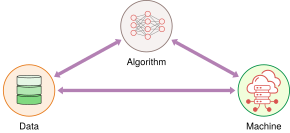
$$
\newcommand{\AbsoluteConicImageEntry}{B}
\newcommand{\AbsoluteConicImageMatrix}{\mathbf{B}}
\newcommand{\AbsoluteConicVector}{\mathbf{b}}
\newcommand{\AcceleratedEpisodeTime}{T'}
\newcommand{\AcceleratedFractionSpeedup}{G}
\newcommand{\AccelerationNoiseDensityMatrix}{\mathbf{Q}_c}
\newcommand{\AccelerationNoiseSpectralDensity}{q_c}
\newcommand{\AccelerationWhiteNoise}{w}
\newcommand{\AcceleratorBatchTime}{T_{\text{GPU}}}
\newcommand{\AcceleratorConsumptionRate}{R_{\text{accel}}}
\newcommand{\AcceleratorCount}{N_{\text{GPU}}}
\newcommand{\AcceleratorDataConsumptionRate}{R_{\text{consumption}}}
\newcommand{\AcceleratorGain}{G_{\text{accel}}}
\newcommand{\AcceleratorHourlyPrice}{R_{\text{GPU/hr}}}
\newcommand{\AcceleratorMemoryBandwidth}{\text{BW}_{\text{accelerator}}}
\newcommand{\AcceleratorRailVoltage}{V_{\text{rail}}}
\newcommand{\AcceleratorSecondsPerQuery}{S_{\text{GPU/query}}}
\newcommand{\AcceleratorSupplyCurrent}{i}
\newcommand{\AcceleratorTargetQueryRate}{R_{\text{GPU,target}}}
\newcommand{\AcceleratorsPerNode}{G_{\text{node}}}
\newcommand{\AccelerometerBias}{b_a}
\newcommand{\AcceptanceFraction}{\alpha}
\newcommand{\AcceptanceIntervalLowerLimit}{L}
\newcommand{\AcceptanceIntervalUpperLimit}{U}
\newcommand{\AcceptanceProbability}{p_{\text{acc}}}
\newcommand{\AcceptedInfluences}{\text{Inf}}
\newcommand{\AcceptedInputSet}{\mathcal{A}_{\tau}}
\newcommand{\AcceptedLabelCount}{d}
\newcommand{\AcceptedOutcomePayoff}{V}
\newcommand{\AcceptedSampleCount}{X}
\newcommand{\AcceptedTaskMeanCost}{C_{\text{succ}}}
\newcommand{\AcceptedTasks}{N_{\text{acc}}}
\newcommand{\AcceptingStateSet}{F}
\newcommand{\AccessAttemptTime}{t}
\newcommand{\AccountQueryDistribution}{p_{\text{user}}}
\newcommand{\AccumulatedProcessNoiseCovariance}{\mathbf{Q}_d}
\newcommand{\AccumulatedSyncTime}{T_{\text{sync}}}
\newcommand{\AccumulatedUpdateTime}{T_{\text{effective}}}
\newcommand{\AccumulationStepCount}{k}
\newcommand{\AccuracyAfterDeployment}{\text{Accuracy}}
\newcommand{\AccuracyDecayRate}{\gamma}
\newcommand{\AccuracyPayoffPerQuery}{V}
\newcommand{\AchievedBrakingDeceleration}{a}
\newcommand{\AchievedKernelBandwidth}{\text{BW}_{\text{effective}}}
\newcommand{\AcquisitionEpoch}{t_{\text{acq}}}
\newcommand{\ActVariationalObjective}{\mathcal{L}_{\text{ACT}}}
\newcommand{\ActionBinCount}{B}
\newcommand{\ActionChunk}{\mathbf{A}}
\newcommand{\ActionChunkHorizon}{H}
\newcommand{\ActionChunkIndex}{k}
\newcommand{\ActionDimension}{d_a}
\newcommand{\ActionExecutionRate}{f_{\text{exec}}}
\newcommand{\ActionFilterCutoffFrequency}{f_{\text{cutoff}}}
\newcommand{\ActionLowerBound}{\mathbf{a}_{\min}}
\newcommand{\ActionMagnitudeBound}{a_{\max}}
\newcommand{\ActionRangeMaximum}{a_{\max}}
\newcommand{\ActionRangeMinimum}{a_{\min}}
\newcommand{\ActionRecoverableFraction}{\rho_{a}}
\newcommand{\ActionResidualVector}{\mathbf{r}}
\newcommand{\ActionSpace}{\mathcal{A}}
\newcommand{\ActionTokenPrefix}{a_{<j}}
\newcommand{\ActionUpperBound}{\mathbf{a}_{\max}}
\newcommand{\ActivationCheckpointCount}{n_{\text{ckpt}}}
\newcommand{\ActivationFunction}{f}
\newcommand{\ActivationInput}{x}
\newcommand{\ActivationLipschitzBound}{L_{\phi}}
\newcommand{\ActivationMatrix}{\mathbf{A}}
\newcommand{\ActivationMemory}{M_{\text{activations}}}
\newcommand{\ActivationPayloadSize}{M_{\text{act}}}
\newcommand{\ActivationStagingTime}{t_{\text{activate}}}
\newcommand{\ActivationVector}{\mathbf{a}}
\newcommand{\ActiveContactIndex}{k}
\newcommand{\ActiveControlTorque}{\mathbf{u}_{\text{active}}}
\newcommand{\ActiveInferencePower}{P_{\text{active}}}
\newcommand{\ActiveLeaseCount}{N_{\text{active}}}
\newcommand{\ActiveMotionDuration}{T_{\text{motion}}}
\newcommand{\ActiveParameterCount}{P_{\text{model}}}
\newcommand{\ActivePrefillRequestSet}{\mathcal{P}_{\text{active}}}
\newcommand{\ActiveSchemaSet}{\mathcal{S}}
\newcommand{\ActiveTargetTokenCount}{N_{\text{active}}}
\newcommand{\ActorAccelerationBound}{a_{k,\max}}
\newcommand{\ActorBodyRadius}{r}
\newcommand{\ActorUpdateDelayCount}{d}
\newcommand{\ActuatedJointAccelerations}{\ddot{\mathbf{q}}_j}
\newcommand{\ActuatedJointBiasForces}{\mathbf{h}_j}
\newcommand{\ActuatedJointCoordinates}{\mathbf{q}_j}
\newcommand{\ActuationSelectionBaseBlock}{\mathbf{S}_b}
\newcommand{\ActuationSelectionMatrix}{\mathbf{S}}
\newcommand{\ActuatorAxisCount}{N_{\text{axes}}}
\newcommand{\ActuatorBiasEffort}{u_{\text{bias}}}
\newcommand{\ActuatorCyclePeriod}{t_{\text{cycle}}}
\newcommand{\ActuatorDutyCycle}{D_{\text{cycle}}}
\newcommand{\ActuatorEffort}{u}
\newcommand{\ActuatorOffTime}{t_{\text{off}}}
\newcommand{\ActuatorOnTime}{t_{\text{on}}}
\newcommand{\ActuatorResponseTime}{T_{\text{act}}}
\newcommand{\ActuatorTorqueLowerBound}{\mathbf{u}_{\min}}
\newcommand{\ActuatorTorqueUpperBound}{\mathbf{u}_{\max}}
\newcommand{\AdamFirstMoment}{m}
\newcommand{\AdamMomentDecayRate}{\beta}
\newcommand{\AdamSecondMoment}{v}
\newcommand{\AdaptationEnergyAllowance}{E_{\text{slack}}}
\newcommand{\AdaptationInvestmentCost}{C_{\text{invest}}}
\newcommand{\AdaptationLatencyIncrease}{\Delta L_{\text{lat,fg}}^{\text{wc}}}
\newcommand{\AdaptationModule}{g_{\psi}}
\newcommand{\AdaptationPeakMemory}{M_{\text{peak}}}
\newcommand{\AdaptationPowerIncrement}{P_{\text{update}}}
\newcommand{\AdaptationWindowEnergy}{E_{\text{update}}}
\newcommand{\AdaptedHiddenActivation}{\mathbf{h}'}
\newcommand{\AdaptedTaskCost}{C_{\text{task, adapt}}}
\newcommand{\AdapterActivationFunction}{\sigma}
\newcommand{\AdapterDownProjectionMatrix}{\mathbf{A}}
\newcommand{\AdapterIndex}{k}
\newcommand{\AdapterInitializationStandardDeviation}{\sigma}
\newcommand{\AdapterRank}{r}
\newcommand{\AdapterScalingFactor}{\gamma}
\newcommand{\AdapterUpProjectionMatrix}{\mathbf{B}}
\newcommand{\AdjacentNeighboringDataset}{X'}
\newcommand{\AdjacentQueryResult}{v'}
\newcommand{\AdmissibleBacklogCount}{n}
\newcommand{\AdmissibleControlSet}{\mathcal{U}_{\text{adm}}}
\newcommand{\AdmissibleDisturbanceSet}{\mathcal{W}}
\newcommand{\AdmissionCheckCount}{n_{\text{chk}}}
\newcommand{\AdmissionCheckIndex}{i}
\newcommand{\AdmissionDecisionEvent}{e_{\text{auth}}}
\newcommand{\AdmissionInclusivePrebrakeDelay}{T_{\text{true}}}
\newcommand{\AdmissionRouteYield}{Y}
\newcommand{\AdmittedAttemptCap}{N}
\newcommand{\AdmittedCommand}{u}
\newcommand{\AdmittedContactForce}{F^*}
\newcommand{\AdmittedControlCommand}{\mathbf{u}}
\newcommand{\AdmittedSpeedCommand}{v^*}
\newcommand{\AdmittedTargetPosition}{\hat{\mathbf{p}}_{\text{target}}}
\newcommand{\AdmittedWorkUnitCount}{m}
\newcommand{\AdvantageStabilizer}{\epsilon_{\text{stab}}}
\newcommand{\AdversarialDisturbance}{\mathbf{d}}
\newcommand{\AdversarialExample}{x_{\text{adv}}}
\newcommand{\AdversarialInputLength}{n}
\newcommand{\AdversarialPenaltyWeight}{\lambda_{\text{adv}}}
\newcommand{\AdversarialPerturbation}{\boldsymbol{\delta}_{\text{adv}}}
\newcommand{\AdversarialPerturbationBudget}{\epsilon_{\text{adv}}}
\newcommand{\AdversaryLoss}{\mathcal{L}_{\text{adv}}}
\newcommand{\AffordanceFrame}{\mathcal{F}_{\text{affordance}}}
\newcommand{\AffordanceSuccessEstimate}{V_{\text{policy}}}
\newcommand{\AgeBlindTravel}{\Delta x_{\text{blind}}}
\newcommand{\AgeCheckInstant}{t_{\text{curr}}}
\newcommand{\AggregateSlotWork}{W}
\newcommand{\AggregatedRecoveryDataset}{\mathcal{D}}
\newcommand{\AggregatedSurrogateLoss}{\epsilon_N}
\newcommand{\AggregationLearnedPolicy}{\hat{\pi}}
\newcommand{\AggregationLearnerStateDistribution}{d_{\hat{\pi}_i}}
\newcommand{\AggregationRoundCount}{N}
\newcommand{\AggregationRoundIndex}{i}
\newcommand{\AggregationRoundTrajectorySet}{\mathcal{T}}
\newcommand{\AiStandaloneSensitivity}{S_{\text{AI}}}
\newcommand{\AisleTravelSpeed}{v_{\text{aisle}}}
\newcommand{\AisleWidth}{w}
\newcommand{\AlertCheckCount}{N_{\text{tests}}}
\newcommand{\AlertFalsePositiveRate}{\alpha_{\text{fp}}}
\newcommand{\AlgorithmTaxonomyAxis}{\mathsf{Algorithm}}
\newcommand{\AliasedVibrationFrequency}{f_{\text{alias}}}
\newcommand{\AliasingHarmonicIndex}{k}
\newcommand{\AllGatherCompletionTime}{T_{\text{allgather}}}
\newcommand{\AllOnesVector}{\mathbf{1}}
\newcommand{\AllReduceCompletionTime}{T_{\text{allreduce}}}
\newcommand{\AllReduceMinimumBandwidthTime}{T_{\text{bandwidth}}^{\text{min}}}
\newcommand{\AllRunsPassEstimate}{\widehat{r}}
\newcommand{\AllToAllCompletionTime}{T_{\text{alltoall}}}
\newcommand{\AllToAllExchangeTime}{T}
\newcommand{\AllocatedBlockCount}{N_{\text{blocks}}}
\newcommand{\AllocatedHazardRate}{\lambda_{\text{alloc}}}
\newcommand{\AllocatedWallTime}{T_{\text{wall}}}
\newcommand{\AllowableRailDroop}{\Delta V_{\text{droop, max}}}
\newcommand{\AllowableRailExcursion}{\Delta V_{\max}}
\newcommand{\AllowableWindingTemperatureRise}{\Delta T_{\max}}
\newcommand{\AllowedTokenSet}{\mathcal{V}_{\text{allow}}}
\newcommand{\AllowedViolationFraction}{V^{\text{allow}}}
\newcommand{\AlphabetByte}{b}
\newcommand{\AlternateModelInput}{x'}
\newcommand{\AmbientDimension}{D}
\newcommand{\AmbientTemperature}{T_{\text{amb}}}
\newcommand{\AmortizedTurnCost}{\bar{C}_{\text{turn}}}
\newcommand{\AngularAcceleration}{\boldsymbol{\alpha}}
\newcommand{\AngularClearance}{\theta_{\text{clear}}}
\newcommand{\AngularClearanceRate}{\dot{\theta}_{\text{clear}}}
\newcommand{\AngularFrequency}{\omega}
\newcommand{\AngularSpeed}{\omega}
\newcommand{\AngularVelocity}{\boldsymbol{\omega}}
\newcommand{\AngularVelocityDerivative}{\dot{\boldsymbol{\omega}}}
\newcommand{\AnnualQueryVolume}{Q_{\text{annual}}}
\newcommand{\AnonymitySetSize}{k_{\text{anon}}}
\newcommand{\AntiWindupTrackingTimeConstant}{T_t}
\newcommand{\AntialiasingFilterVariance}{s}
\newcommand{\ApiAccount}{u}
\newcommand{\ApparentContrast}{C}
\newcommand{\AppearanceRealityGap}{\Delta_{\text{vis}}}
\newcommand{\AppliedForce}{F}
\newcommand{\AppliedLoadCycleCount}{n}
\newcommand{\ApproachChannelCount}{K_a}
\newcommand{\ApproachDirection}{\hat{\mathbf{a}}_{\text{approach}}}
\newcommand{\ApproachPosition}{x}
\newcommand{\ApproachPredicate}{P_{\text{approach}}}
\newcommand{\ApproachSpeed}{v_{\text{app}}}
\newcommand{\ApprovalCatchFraction}{q}
\newcommand{\ApprovalHeldTrajectories}{N_{\text{held}}}
\newcommand{\ApproximatingDistribution}{q}
\newcommand{\ArbitrationFieldBitCount}{B_{\text{arb},i}}
\newcommand{\ArcObstacleDistance}{d_{\text{arc}}}
\newcommand{\ArchitectureResourceCost}{C}
\newcommand{\ArchitectureSearchSpace}{\mathcal{A}}
\newcommand{\ArcsineEffectSize}{h}
\newcommand{\ArgumentLegConfidence}{r}
\newcommand{\ArgumentLegCount}{m}
\newcommand{\ArithmeticIntensity}{I}
\newcommand{\ArmStoppingDeceleration}{a_{\text{arm}}}
\newcommand{\ArmSuccessProbability}{p}
\newcommand{\ArmingSettleDuration}{t_{\text{settle}}}
\newcommand{\ArrivalOffsetTravel}{\Delta x}
\newcommand{\ArrivalRate}{\lambda_{\text{arr}}}
\newcommand{\ArrivalStampOffset}{\Delta t_{\text{recv}}}
\newcommand{\ArrivalTimestamp}{t_{\text{recv}}}
\newcommand{\ArtifactVersion}{v}
\newcommand{\AssessedContactForceLimit}{F_{\text{limit}}}
\newcommand{\AssignedJobGpu}{g}
\newcommand{\AssociationCostEntry}{c}
\newcommand{\AssuranceClaim}{C}
\newcommand{\AsymptoticTightBound}{\Theta}
\newcommand{\AtmosphericExtinctionCoefficient}{\beta_{\text{atm}}}
\newcommand{\AttackStepsPgd}{K_{\text{PGD}}}
\newcommand{\AttackedTrialCount}{n}
\newcommand{\AttainableComputeRate}{R_{\text{attain}}}
\newcommand{\AttemptCleanupCost}{C_{\text{cleanup}}}
\newcommand{\AttemptCost}{C_{\text{attempt}}}
\newcommand{\AttemptCycleDuration}{t_{\text{cyc}}}
\newcommand{\AttemptDuration}{t_{\text{att}}}
\newcommand{\AttemptGenerationTime}{T_{\text{gen}}}
\newcommand{\AttemptPassProbability}{p}
\newcommand{\AttemptRuntimeOverheadCost}{C_{\text{runtime}}}
\newcommand{\AttemptVerificationCost}{C_{\text{verify}}}
\newcommand{\AttentionHeadCount}{N_{\text{heads}}}
\newcommand{\AttentionHeadDimension}{d_{\text{head}}}
\newcommand{\AttentionHeadOutput}{\mathbf{O}}
\newcommand{\AttentionKeyMatrix}{\mathbf{K}}
\newcommand{\AttentionOutputMatrix}{\mathbf{O}}
\newcommand{\AttentionOutputProjectionMatrix}{\mathbf{W}_{O}}
\newcommand{\AttentionQueryMatrix}{\mathbf{Q}}
\newcommand{\AttentionScoreEntry}{S_{ij}}
\newcommand{\AttentionScoreMatrix}{\mathbf{S}}
\newcommand{\AttentionScoreRow}{\mathbf{S}_{i, \cdot}}
\newcommand{\AttentionScoreSummand}{S_{ik}}
\newcommand{\AttentionScoreTile}{\mathbf{S}_{ij}}
\newcommand{\AttentionValuesMatrix}{\mathbf{V}}
\newcommand{\AttentionValuesProjectionMatrix}{\mathbf{W}_{V}}
\newcommand{\AttentionValuesSourceMatrix}{\mathbf{X}_{V}}
\newcommand{\AttentionValuesVector}{\mathbf{v}}
\newcommand{\AttentionWeightEntry}{A_{ij}}
\newcommand{\AttentionWeightMatrix}{\mathbf{A}}
\newcommand{\AttentionWeightVector}{\mathbf{a}}
\newcommand{\AttitudeError}{\theta_{\text{att}}}
\newcommand{\AttributionFeatureCount}{n_{\text{feat}}}
\newcommand{\AuditGroupRecordCount}{n_{\text{records}}}
\newcommand{\AuthorityExposureLevel}{A}
\newcommand{\AutocorrelationLagIndex}{k}
\newcommand{\AutoencoderReconstructionError}{\mathcal{L}_{\text{rec}}}
\newcommand{\AutomatedResetTime}{t_{\text{reset,auto}}}
\newcommand{\AutomatonStateSet}{Q}
\newcommand{\AutomatonTransitionFunction}{\delta}
\newcommand{\AutonomousExecutionComputeCost}{C_{\text{compute}}}
\newcommand{\AutoscalingDecisionTime}{T_{\text{decide}}}
\newcommand{\AutoscalingDetectionTime}{T_{\text{detect}}}
\newcommand{\AutoscalingResponseTime}{T_{\text{response}}}
\newcommand{\AvailabilityObjective}{S_{\text{availability}}}
\newcommand{\AvailableBrakingDistance}{D_{\text{avail}}}
\newcommand{\AvailableDeceleration}{a}
\newcommand{\AvailableObservations}{\mathcal{O}_{\text{avail}}}
\newcommand{\AverageCopperLossPower}{\bar{P}_{\text{loss}}}
\newcommand{\AverageOnlineRegret}{\gamma_N}
\newcommand{\AveragePower}{P_{\text{avg}}}
\newcommand{\AverageStateVisitationDistribution}{\bar{d}}
\newcommand{\AxiBurstLength}{A_{\text{len}}}
\newcommand{\AxisGridPointCount}{N}
\newcommand{\AzimuthAngle}{\theta_{\text{az}}}
\newcommand{\BackEmfVoltage}{e_{\text{bemf}}}
\newcommand{\BacklashAngle}{\theta_{\text{backlash}}}
\newcommand{\BackwardEulerEigenvalue}{\lambda_{\text{BE}}}
\newcommand{\BackwardEulerTransitionMatrix}{\mathbf{A}_{\text{BE}}}
\newcommand{\BackwardPassTime}{T_{\text{backward}}}
\newcommand{\BackwardReachableTube}{\mathcal{R}}
\newcommand{\BalanceDivergenceTime}{\tau_{\text{fall}}}
\newcommand{\BallRadius}{r}
\newcommand{\BallVolume}{V_D}
\newcommand{\Bandwidth}{\text{BW}}
\newcommand{\BankConflictPenalty}{\Delta t_{\text{conflict}}}
\newcommand{\BarrierConstraintBound}{b_{\text{cbf}}}
\newcommand{\BarrierConstraintCount}{K_b}
\newcommand{\BarrierConstraintNormal}{\mathbf{a}_{\text{cbf}}}
\newcommand{\BarrierFunction}{h}
\newcommand{\BarrierFunctionRate}{\dot{h}}
\newcommand{\BarrierHalfSpaceControlSet}{\mathcal{U}_{\text{safe}}}
\newcommand{\BarrierMargin}{\delta}
\newcommand{\BarrierNormalizationScale}{h_{\text{scale}}}
\newcommand{\BarrierProjectionLagrangian}{L_{\text{Lag}}}
\newcommand{\BarrierProjectionMultiplier}{\lambda}
\newcommand{\BarrierRelativeDegree}{r}
\newcommand{\BaseAbscissaVelocity}{\dot{x}}
\newcommand{\BaseAccelerationCommand}{a}
\newcommand{\BaseBatchSize}{B_{\text{base}}}
\newcommand{\BaseCameraRotation}{\mathbf{R}_{\text{base}}^{\text{cam}}}
\newcommand{\BaseCameraTransform}{\mathbf{T}_{\text{base}}^{\text{cam}}}
\newcommand{\BaseCameraTranslation}{\mathbf{t}_{\text{base}}^{\text{cam}}}
\newcommand{\BaseFlangeTransform}{\mathbf{T}_{\text{base}}^{\text{flange}}}
\newcommand{\BaseForwardSpeed}{v}
\newcommand{\BaseFramePoint}{\mathbf{p}_{\text{base}}}
\newcommand{\BaseHeadingRate}{\dot{\theta}_{\text{head}}}
\newcommand{\BaseJointInertiaCoupling}{\mathbf{M}_{bj}}
\newcommand{\BaseLateralPosition}{y_{\text{base}}}
\newcommand{\BaseLateralVelocity}{\dot{y}}
\newcommand{\BaseLayerCount}{N_{L,0}}
\newcommand{\BaseLearningRate}{\eta_{\text{base}}}
\newcommand{\BaseLongitudinalPosition}{x_{\text{base}}}
\newcommand{\BaseLongitudinalVelocity}{\dot{x}}
\newcommand{\BaseOdometrySpeed}{v}
\newcommand{\BaseOrdinateVelocity}{\dot{y}}
\newcommand{\BasePosition}{\mathbf{p}_{\text{base}}}
\newcommand{\BasePromptLength}{S_{\text{base}}}
\newcommand{\BaseStoppingDistance}{d_{\text{base}}}
\newcommand{\BaseToCameraTransform}{\mathbf{T}_{\text{cam} \leftarrow \text{base}}}
\newcommand{\BaseTrainingComputeCost}{C_{\text{compute}}}
\newcommand{\BaseTrajectoryTokenCount}{N_{\text{base}}}
\newcommand{\BaseTravelDistance}{d}
\newcommand{\BaseTravelSpeed}{v_{\text{base}}}
\newcommand{\BaseWidthMultiplier}{w_{\text{mult},0}}
\newcommand{\BaseWristTransform}{\mathbf{T}_{\text{base} \leftarrow \text{wrist}}}
\newcommand{\BaseYawRateBias}{\omega_{\text{bias}}}
\newcommand{\BaselineAcceptanceEstimate}{\hat{p}_{\text{base}}}
\newcommand{\BaselineControllerAction}{\mathbf{a}_t^{\text{base}}}
\newcommand{\BaselineConversionRate}{p_0}
\newcommand{\BaselineFeatureMean}{\mu_{\text{base}}}
\newcommand{\BaselineFeatureStandardDeviation}{\sigma_{\text{base}}}
\newcommand{\BaselineIntervalLowerLimit}{l_{\text{base}}}
\newcommand{\BaselineIntervalUpperLimit}{u_{\text{base}}}
\newcommand{\BaselineLowerLimitDistance}{\delta^-_{\text{base}}}
\newcommand{\BaselineOnlyAcceptedTaskCount}{b}
\newcommand{\BaselineOnlyCorrectCount}{n_{\text{base}}}
\newcommand{\BaselinePolicyAcceptanceProbability}{p_{X}}
\newcommand{\BaselinePolicyCost}{C_{X}}
\newcommand{\BaselineStateDistribution}{d^{\pi_{\text{base}}}}
\newcommand{\BaselineTaskCost}{C_{\text{task, base}}}
\newcommand{\BaselineToolCallDistribution}{p_{b}}
\newcommand{\BaselineTrackingError}{e_{\text{track}}}
\newcommand{\BaselineTrainingDuration}{T_{\text{hours}}}
\newcommand{\BaselineTrajectoryGoodput}{\mathcal{G}_{b}}
\newcommand{\BaselineUpperLimitDistance}{\delta^+_{\text{base}}}
\newcommand{\BatchArrivalRate}{\lambda_{\text{batch}}}
\newcommand{\BatchAxisLabel}{b}
\newcommand{\BatchBufferMemory}{M_{\text{batch}}}
\newcommand{\BatchCostPerAcceptedTask}{C_{\text{eff,batch}}}
\newcommand{\BatchDataVolume}{D_{\text{vol}}^{(\text{batch})}}
\newcommand{\BatchExampleIndex}{n}
\newcommand{\BatchFetchTime}{T_{\text{fetch}}}
\newcommand{\BatchFillArrivalCount}{k}
\newcommand{\BatchFixedOverheadTime}{T_{\text{fixed}}}
\newcommand{\BatchFlushStartTime}{t_{\text{start}}}
\newcommand{\BatchFormationDelay}{L_{\text{lat,form}}}
\newcommand{\BatchIndex}{k}
\newcommand{\BatchLabelComponent}{y_{ij}}
\newcommand{\BatchLatencyEnvelope}{L_{\text{lat,envelope}}}
\newcommand{\BatchLoss}{\mathcal{L}_{\text{batch}}}
\newcommand{\BatchMaxOutputLength}{S_{\text{max}}}
\newcommand{\BatchMaximumDeviationMultiple}{k}
\newcommand{\BatchMeanOutputLength}{\bar{S}}
\newcommand{\BatchNormMean}{\mu_{\mathcal{B}}}
\newcommand{\BatchNormOutput}{y}
\newcommand{\BatchNormRunningMean}{\boldsymbol{\mu}_{\mathcal{B}}}
\newcommand{\BatchNormRunningStandardDeviation}{\boldsymbol{\sigma}_{\mathcal{B}}}
\newcommand{\BatchNormStandardDeviation}{\sigma_{\mathcal{B}}}
\newcommand{\BatchOperations}{O_{\text{batch}}}
\newcommand{\BatchPredictedProbability}{\hat{y}_{ij}}
\newcommand{\BatchProcessingTime}{T_{\text{process}}}
\newcommand{\BatchRolloutCount}{N_{\text{batch}}}
\newcommand{\BatchScalingFactor}{k}
\newcommand{\BatchServiceTime}{T_{\text{svc}}}
\newcommand{\BatchSize}{B}
\newcommand{\BatchTransferTime}{T_{\text{transfer}}}
\newcommand{\BatchedDecodeStepTime}{t_{\text{step}}}
\newcommand{\BatchedEventIndex}{i}
\newcommand{\BatchedRequestLatency}{L_{\text{lat,batch}}}
\newcommand{\BatchingLatencyBudget}{L_{\text{lat,budget}}}
\newcommand{\BatchingQueueWait}{L_{\text{lat,wait}}}
\newcommand{\BatchingWindow}{T_{\text{window}}}
\newcommand{\BatteryCellResistance}{R_{\text{cell}}}
\newcommand{\BeamDivergenceAngle}{\delta\theta_{\text{div}}}
\newcommand{\BeamWidth}{W}
\newcommand{\BearingRay}{\mathbf{r}}
\newcommand{\BeatFrequency}{f_b}
\newcommand{\BehaviorCloningHorizon}{S}
\newcommand{\BehaviorCloningLoss}{\mathcal{L}_{\text{BC}}}
\newcommand{\BehaviorDistribution}{b}
\newcommand{\BehaviorPolicyVersion}{\text{ver}_b}
\newcommand{\BeliefErrorBound}{E}
\newcommand{\BeliefInvalidationHorizon}{T_{\text{inv}}}
\newcommand{\BeliefState}{b}
\newcommand{\BellmanBackupTarget}{y}
\newcommand{\BellmanErrorLoss}{\mathcal{L}_{\text{Bellman}}}
\newcommand{\BelowThresholdIndicator}{\mathbf{1}_{\{|(\mathbf{W}_{\text{sparse}})_{ij}| \leq \delta_{\text{prune}}\}}}
\newcommand{\BestEffortWireBitCount}{B_{\text{BE,wire}}}
\newcommand{\BetterArmSuccessProbability}{p_{\text{high}}}
\newcommand{\BetweenTaskStandardDeviation}{\sigma_{\text{task}}}
\newcommand{\BevPillarFeature}{\mathbf{V}_{\text{BEV}}}
\newcommand{\BevPillarXIndex}{X}
\newcommand{\BevPillarYIndex}{Y}
\newcommand{\BiasFeedbackFactor}{\alpha_{\text{fb}}}
\newcommand{\BiasVector}{\mathbf{b}}
\newcommand{\BilledAllocationTime}{T_{\text{total}}}
\newcommand{\BinaryActivationVector}{\mathbf{a}}
\newcommand{\BinaryClassifier}{h}
\newcommand{\BinaryWeightVector}{\mathbf{w}}
\newcommand{\BinomialSuccessCount}{X}
\newcommand{\BipedTiltAcceleration}{\ddot{\theta}_{\text{tilt}}}
\newcommand{\BisectionBandwidth}{\text{BW}_{\text{bisect}}}
\newcommand{\BitFlippedFloatNumber}{x_{\text{corrupt}}}
\newcommand{\BitTime}{T_{\text{bit}}}
\newcommand{\BlackoutClockConversionError}{\Delta t_{\text{one-sigma scenario}}}
\newcommand{\BlendDeadline}{t_{\text{blend}}}
\newcommand{\BlendedCommandJerk}{j_{\text{cmd}}}
\newcommand{\BlendedControlCommand}{\mathbf{u}_{\text{blend}}}
\newcommand{\BlendedInputTokenPrice}{c_{\text{in}}}
\newcommand{\BlendingTransitionWindow}{\tau_{\text{blend}}}
\newcommand{\BlindTravelDistance}{d_{\text{blind}}}
\newcommand{\BlockCheckTime}{T_{\text{ver}}}
\newcommand{\BlockCoordinateX}{b_x}
\newcommand{\BlockCoordinateY}{b_y}
\newcommand{\BlockCoordinateZ}{b_z}
\newcommand{\BlockEdgeVoxelCount}{n_{\text{blk}}}
\newcommand{\BlockMaximum}{M}
\newcommand{\BlockMaximumLevel}{z}
\newcommand{\BlockMaximumLimitDistribution}{G}
\newcommand{\BlockMaximumNormalizingScale}{a}
\newcommand{\BlockMaximumNormalizingShift}{b}
\newcommand{\BlockMetadataSize}{s_{\text{meta}}}
\newcommand{\BlockQuantizationScale}{s_b}
\newcommand{\BlockRangeMaximum}{x_{\max,i}}
\newcommand{\BlockRangeMinimum}{x_{\min,i}}
\newcommand{\BlockSampleCount}{n}
\newcommand{\BlockedWorkerCount}{N_{\text{blocked}}}
\newcommand{\BlockingCallTimeout}{T_{\text{out}}}
\newcommand{\BlockingTaskIndex}{k}
\newcommand{\BodyAcceleration}{\dot{v}}
\newcommand{\BodyDisplacement}{x}
\newcommand{\BodyEndEffectorTransform}{\mathbf{T}_{BE}}
\newcommand{\BodyFramePoint}{\mathbf{p}_{\text{body}}}
\newcommand{\BodyFramePointCovariance}{\boldsymbol{\Sigma}_{\text{body}}}
\newcommand{\BodyLidarTransform}{\mathbf{T}_{bl}}
\newcommand{\BodyReferenceFrame}{\mathcal{F}_B}
\newcommand{\BodyRegionMass}{m_H}
\newcommand{\BodySpeed}{v}
\newcommand{\BoltzmannConstant}{k_B}
\newcommand{\BoltzmannStateEnergy}{E}
\newcommand{\BoltzmannTemperature}{T}
\newcommand{\BootstrapQuantileFunction}{Q}
\newcommand{\BootstrapReplicateCount}{B_{\text{boot}}}
\newcommand{\BootstrapReplicateIndex}{r}
\newcommand{\BottomedOutContactStiffness}{k_{\infty}}
\newcommand{\BouligandContingentCone}{T_{\mathcal{C}}}
\newcommand{\BoundaryConditionVector}{\mathbf{b}}
\newcommand{\BoundaryLayerTime}{t_{\text{fast}}}
\newcommand{\BoundedRegimeTimestamp}{t_{\text{bounded}}}
\newcommand{\BoxMaximumHorizontalCoordinate}{x_{\text{max}}}
\newcommand{\BoxMaximumVerticalCoordinate}{y_{\text{max}}}
\newcommand{\BoxMinimumHorizontalCoordinate}{x_{\text{min}}}
\newcommand{\BoxMinimumVerticalCoordinate}{y_{\text{min}}}
\newcommand{\BrakeChopperResistance}{R_{\text{brake}}}
\newcommand{\BrakeCommandForce}{F_{\text{cmd}}}
\newcommand{\BrakeResistorPulseEnergy}{E_{\text{pulse}}}
\newcommand{\BrakingDistance}{d_{\text{brake}}}
\newcommand{\BrakingForce}{F_{\text{brake}}}
\newcommand{\BrakingOnsetContactForce}{F_{\text{cmd}}}
\newcommand{\BrakingWork}{W_{\text{brake}}}
\newcommand{\BreadthCriticalPathLatency}{T^{\text{breadth}}}
\newcommand{\BreadthPeakKvCacheMemory}{M_{\text{KV}}^{\text{breadth}}}
\newcommand{\BreakEvenAcceptanceProbability}{p'}
\newcommand{\BreakEvenBrakingDeceleration}{a}
\newcommand{\BreakEvenParseFailureRate}{p_{\text{break}}}
\newcommand{\BreakEvenTaskCount}{N^*}
\newcommand{\BreakEvenUtilization}{u^*}
\newcommand{\BreakerCooldownInterval}{T_{\text{cool}}}
\newcommand{\BreakerFailureFraction}{r}
\newcommand{\BreakerMinimumSampleCount}{n_{\min}}
\newcommand{\BreakerOutcomeIndex}{i}
\newcommand{\BreakerOutcomeWindow}{W}
\newcommand{\BreakerTripThreshold}{r_{\text{trip}}}
\newcommand{\BridgeTraceResistance}{R_{\text{trace}}}
\newcommand{\BroadcastColumnElement}{A}
\newcommand{\BroadcastColumnTensor}{\mathbf{A}}
\newcommand{\BroadcastCompletionTime}{T_{\text{broadcast}}}
\newcommand{\BroadcastRowElement}{b}
\newcommand{\BroadcastRowTensor}{\mathbf{B}}
\newcommand{\BroadcastTableSize}{s_{\text{table}}}
\newcommand{\BspLearningRate}{\eta_{\text{BSP}}}
\newcommand{\BsplineBasisFunction}{B}
\newcommand{\BudgetEvaluationTime}{\tau}
\newcommand{\BudgetFreeBalance}{F}
\newcommand{\BudgetNodeIndex}{k}
\newcommand{\BudgetReservedFunds}{R}
\newcommand{\BudgetSettledCharges}{E}
\newcommand{\BudgetedAcceptanceProbability}{q_{\pi}}
\newcommand{\BufferDependencyEdgeSet}{E}
\newcommand{\BufferDependencyGraph}{G}
\newcommand{\BufferDependencyVertexSet}{V}
\newcommand{\BufferIndex}{i}
\newcommand{\BulkDecouplingCapacitance}{C_{\text{bulk}}}
\newcommand{\BumplessTransferBlend}{\alpha}
\newcommand{\BumplessTransferBlendAcceleration}{\ddot{\alpha}}
\newcommand{\BumplessTransferBlendRate}{\dot{\alpha}}
\newcommand{\BumplessTransferBlendSlope}{\alpha'}
\newcommand{\BumplessTransferProgress}{\hat{t}}
\newcommand{\BumplessTransferStartInstant}{t_{\text{start}}}
\newcommand{\BurstArrivalCount}{N_{\text{burst}}}
\newcommand{\BurstSurvivalTime}{t_{\text{limit}}}
\newcommand{\BusBitRate}{R_{\text{bit}}}
\newcommand{\BusCapacitorEnergy}{E_C}
\newcommand{\BusCapacitorVoltage}{V_C}
\newcommand{\BusSerializationTime}{t_{\text{bus}}}
\newcommand{\ButterflyAllReduceTime}{T_{\text{butterfly}}}
\newcommand{\ByteAlphabet}{\Sigma}
\newcommand{\ByteString}{u}
\newcommand{\ByzantineClientCount}{f}
\newcommand{\ByzantineFaultCount}{f}
\newcommand{\CableFlexCycleCount}{n_{\text{cable}}}
\newcommand{\CableRatedFatigueLife}{L_{\text{cable}}}
\newcommand{\CacheMissStallFraction}{f}
\newcommand{\CachedInputTokenCount}{n_{\text{cache}}}
\newcommand{\CachedInputTokenPrice}{c_{\text{cache}}}
\newcommand{\CalibratedAcceptanceEstimate}{\hat{p}}
\newcommand{\CalibrationBinCount}{N_{\text{bins}}}
\newcommand{\CalibrationBinExampleSet}{B_m}
\newcommand{\CalibrationBinIndex}{m}
\newcommand{\CalibrationConstraintMatrix}{\mathbf{V}}
\newcommand{\CalibrationDataDistribution}{p_{\text{cal}}}
\newcommand{\CalibrationDataset}{\mathcal{C}_{\text{cal}}}
\newcommand{\CalibrationExampleCount}{n_{\text{cal}}}
\newcommand{\CalibrationModelPoint}{\mathbf{M}}
\newcommand{\CalibrationPoseIndex}{k}
\newcommand{\CalibrationRotationAxisCount}{N}
\newcommand{\CalibrationSceneIndex}{j}
\newcommand{\CalibrationTemperature}{T_{\text{cal}}}
\newcommand{\CalibrationViewCount}{N}
\newcommand{\CallLatency}{T_{\text{call}}}
\newcommand{\CallPostprocessingTime}{T_{\text{post}}}
\newcommand{\CallPreparationTime}{T_{\text{prep}}}
\newcommand{\CallTailProbability}{p_{\text{tail}}}
\newcommand{\CallUsefulWorkTime}{W}
\newcommand{\CameraCenterArcPosition}{x_{\text{rot}}}
\newcommand{\CameraExtrinsicRotation}{\mathbf{R}_{bc}}
\newcommand{\CameraExtrinsicTransform}{\mathbf{T}_{bc}}
\newcommand{\CameraExtrinsicTranslation}{\mathbf{p}_{bc}}
\newcommand{\CameraFrameDepth}{Z_c}
\newcommand{\CameraFrameHorizontalCoordinate}{X_c}
\newcommand{\CameraFramePeriod}{T_{\text{sample}}}
\newcommand{\CameraFramePoint}{\mathbf{p}_c}
\newcommand{\CameraFramePointCovariance}{\boldsymbol{\Sigma}_c}
\newcommand{\CameraFrameVerticalCoordinate}{Y_c}
\newcommand{\CameraIdentifierEmbedding}{\mathbf{e}_{\text{cam}}}
\newcommand{\CameraImage}{\mathbf{I}}
\newcommand{\CameraImuTimeOffset}{\Delta t_{\text{imu}}}
\newcommand{\CameraIntrinsicCalibrationMatrix}{\mathbf{K}}
\newcommand{\CameraIntrinsicInverseTranspose}{\mathbf{K}^{-\top}}
\newcommand{\CameraLateralStandardDeviation}{\sigma_{x_c}}
\newcommand{\CameraMountTiltAngle}{\theta_{\text{ext}}}
\newcommand{\CameraObjectTransform}{\mathbf{T}_{\text{camera}}^{\text{object}}}
\newcommand{\CameraOpticalCenter}{\mathbf{o}}
\newcommand{\CameraReferenceFrame}{\mathcal{F}_{\text{cam}}}
\newcommand{\CameraRotationColumn}{\mathbf{r}}
\newcommand{\CameraSampleTimestamp}{t_{\text{cam}}}
\newcommand{\CameraSkewCoefficient}{\gamma}
\newcommand{\CameraTargetTransform}{\mathbf{T}_{\text{cam}}^{\text{target}}}
\newcommand{\CameraToWorldRotation}{\mathbf{R}_{WC}}
\newcommand{\CameraToWorldTransform}{\mathbf{T}_{WC}}
\newcommand{\CameraToWorldTranslation}{\mathbf{t}_{WC}}
\newcommand{\CampaignActiveTime}{T_{\text{active}}}
\newcommand{\CanHighLineVoltage}{V_{\text{CANH}}}
\newcommand{\CanLowLineVoltage}{V_{\text{CANL}}}
\newcommand{\CanaryAllocationFraction}{\rho}
\newcommand{\CanaryInterventionRate}{\lambda_{\text{canary}}}
\newcommand{\CanaryLabelDelay}{t_{\text{label}}}
\newcommand{\CanarySpeedBound}{v_{\text{canary}}}
\newcommand{\CanaryStageDuration}{T_{\text{stage}}}
\newcommand{\CanaryTrafficFraction}{p_{\text{stage}}}
\newcommand{\CandidateAcceptanceEstimate}{\hat{p}_{\text{cand}}}
\newcommand{\CandidateActionVector}{\hat{\mathbf{a}}}
\newcommand{\CandidateArchitecture}{a}
\newcommand{\CandidateAvailabilityEstimate}{\widehat{q}}
\newcommand{\CandidateAvailabilityProbability}{q}
\newcommand{\CandidateCheckingCost}{v}
\newcommand{\CandidateClientCount}{K_{\text{candidates}}}
\newcommand{\CandidateControlCommand}{\mathbf{u}^{\text{cand}}}
\newcommand{\CandidateControlCommandDerivative}{\dot{\mathbf{u}}^{\text{cand}}}
\newcommand{\CandidateDefectRate}{\epsilon}
\newcommand{\CandidateGenerationCost}{g}
\newcommand{\CandidateIndex}{i}
\newcommand{\CandidateIntervalLowerLimit}{l_{\text{cand}}}
\newcommand{\CandidateIntervalUpperLimit}{u_{\text{cand}}}
\newcommand{\CandidateLowerLimitDistance}{\delta^-_{\text{cand}}}
\newcommand{\CandidateOnlyAcceptedTaskCount}{c}
\newcommand{\CandidatePolicyAcceptanceProbability}{p_{Y}}
\newcommand{\CandidatePolicyAction}{\mathbf{a}_t^{\text{cand}}}
\newcommand{\CandidatePolicyCost}{C_{Y}}
\newcommand{\CandidatePoolSize}{N}
\newcommand{\CandidateProposal}{p}
\newcommand{\CandidateRoutingPolicy}{Y}
\newcommand{\CandidateScoreVector}{\mathbf{c}}
\newcommand{\CandidateScoringCost}{c_{\text{infer}}}
\newcommand{\CandidateScoringError}{\epsilon}
\newcommand{\CandidateSkill}{a}
\newcommand{\CandidateSpeedCommand}{v_{\text{cand}}}
\newcommand{\CandidateTailCompletionTime}{\widehat{T}_{c,0.99}}
\newcommand{\CandidateToolCallDistribution}{p_{c}}
\newcommand{\CandidateTrackingErrorStandardDeviation}{\sigma_{\text{track}}}
\newcommand{\CandidateTrajectoryGoodput}{\mathcal{G}_{c}}
\newcommand{\CandidateUpperLimitDistance}{\delta^+_{\text{cand}}}
\newcommand{\CandidateUtility}{U}
\newcommand{\CandidateUtilityMean}{\mu}
\newcommand{\CandidateUtilityStandardDeviation}{\sigma_{U}}
\newcommand{\CandidateViolationCount}{V_{c}}
\newcommand{\CandidateWinCount}{j}
\newcommand{\CapabilityGrant}{\Gamma}
\newcommand{\CaptureAgeEmbedding}{\mathbf{e}_{\Delta t}}
\newcommand{\CaptureSampleIndex}{t_0}
\newcommand{\CaptureSampleKalmanGain}{\mathbf{G}_{t_0}}
\newcommand{\CaptureSampleMeasurementMatrix}{\mathbf{H}_{t_0}}
\newcommand{\CaptureSamplePredictedCovariance}{\mathbf{P}_{t_0|t_0-1}}
\newcommand{\CaptureSamplePredictedEstimate}{\hat{\mathbf{x}}_{t_0|t_0-1}}
\newcommand{\CaptureSampleUpdatedCovariance}{\mathbf{P}_{t_0|t_0}}
\newcommand{\CaptureSampleUpdatedEstimate}{\hat{\mathbf{x}}_{t_0|t_0}}
\newcommand{\CaptureTimestamp}{t_{\text{capture}}}
\newcommand{\CapturedSensorObservation}{\mathbf{z}_{t_0}}
\newcommand{\CartesianAcceleration}{\ddot{\mathbf{p}}}
\newcommand{\CartesianPosition}{\mathbf{p}}
\newcommand{\CartesianXCoordinate}{x}
\newcommand{\CartesianYCoordinate}{y}
\newcommand{\CartesianZCoordinate}{z}
\newcommand{\CascadeEscalationProbability}{p_{\text{escalate}}}
\newcommand{\CascadeGateCost}{g}
\newcommand{\CascadeGateDuration}{v}
\newcommand{\CascadeInferenceEnergy}{E_{\text{cascade}}}
\newcommand{\CascadeTaskCost}{C_{\text{cascade}}}
\newcommand{\CascadeTaskDuration}{T_{\text{cascade}}}
\newcommand{\CascadeTierCost}{c^{\text{tier}}}
\newcommand{\CascadeTierDuration}{t}
\newcommand{\CascadeTierIndex}{j}
\newcommand{\CascadedBarrierCertificate}{\psi}
\newcommand{\CascadedBarrierClassKFunction}{\alpha}
\newcommand{\CascadedBarrierDerivative}{\dot{\psi}}
\newcommand{\CaseAmbientThermalResistance}{R_{\text{th,case-amb}}}
\newcommand{\CaseTemperature}{T_{\text{case}}}
\newcommand{\CaseThermalCapacitance}{C_{\text{case}}}
\newcommand{\CaseThermalTimeConstant}{\tau_{\text{th,case}}}
\newcommand{\CatalogDefinitionTokens}{S_{\text{catalog}}}
\newcommand{\CatalogStagingCallCount}{N}
\newcommand{\CategoryRecordCount}{n}
\newcommand{\CausalInterventionMask}{\mathcal{M}}
\newcommand{\CausalMediator}{M}
\newcommand{\CausalTokenPosition}{s}
\newcommand{\CbsRuntimeBudget}{Q}
\newcommand{\CellOccupancyProbability}{p}
\newcommand{\CenterCount}{k}
\newcommand{\CentralizedTrainingEnergy}{E_{\text{centralized}}}
\newcommand{\CentroidalAngularMomentum}{\mathbf{h}_{\text{ang}}}
\newcommand{\CentroidalAngularMomentumDerivative}{\dot{\mathbf{h}}_{\text{ang}}}
\newcommand{\CentroidalLinearMomentum}{\mathbf{h}_{\text{lin}}}
\newcommand{\CentroidalLinearMomentumDerivative}{\dot{\mathbf{h}}_{\text{lin}}}
\newcommand{\CentroidalMomentum}{\mathbf{h}_G}
\newcommand{\CentroidalMomentumMatrix}{\mathbf{A}_G}
\newcommand{\CentroidalMomentumMatrixDerivative}{\dot{\mathbf{A}}_G}
\newcommand{\CentroidalMomentumRate}{\dot{\mathbf{h}}_G}
\newcommand{\CertifiedCommandWindow}{\mathbf{u}^*_{t:t+H-1}}
\newcommand{\CertifiedControlAction}{\mathbf{u}^*}
\newcommand{\CertifiedRadius}{R}
\newcommand{\ChainRuleInput}{x}
\newcommand{\ChainRuleIntermediate}{u}
\newcommand{\ChainRuleOutput}{v}
\newcommand{\ChainedOperationCount}{n_{\text{ops}}}
\newcommand{\ChanceAnnotatorAgreement}{p_e}
\newcommand{\ChannelAuthorityState}{S}
\newcommand{\ChannelCommand}{u}
\newcommand{\ChannelStoredEnergy}{E_{\text{channel}}}
\newcommand{\CharacteristicPolynomial}{p}
\newcommand{\CharacteristicPolynomialCoefficient}{c}
\newcommand{\ChassisThermalResistance}{R_{\text{th,chassis}}}
\newcommand{\CheapConfigurationAttemptCost}{c_{\text{small}}}
\newcommand{\CheapConfigurationPassProbability}{p_{\text{small}}}
\newcommand{\CheckIntervalStepCount}{m}
\newcommand{\CheckPassProbability}{p^{\text{chk}}}
\newcommand{\CheckSlotTime}{T}
\newcommand{\CheckedSignal}{x}
\newcommand{\CheckedSignalLimit}{L_{\text{limit}}}
\newcommand{\CheckpointAttemptDuration}{T_{\text{att}}}
\newcommand{\CheckpointExtraPauseTime}{T_{\text{pause}}}
\newcommand{\CheckpointInterval}{T_{\text{ckpt}}}
\newcommand{\CheckpointLoadTime}{T_{\text{load}}}
\newcommand{\CheckpointLogPosition}{j_{\text{ckpt}}}
\newcommand{\CheckpointOrdinalIndex}{m}
\newcommand{\CheckpointOverheadFraction}{f_{\text{ckpt}}}
\newcommand{\CheckpointOverheadRatio}{w}
\newcommand{\CheckpointRecoveryOverheadTime}{T_{\text{overhead}}}
\newcommand{\CheckpointRestoreTime}{T_{\text{restore}}}
\newcommand{\CheckpointStride}{k}
\newcommand{\CheckpointSuffixReadTime}{T_{\text{read}}}
\newcommand{\CheckpointWasteFraction}{W}
\newcommand{\CheckpointWriteTime}{T_{\text{write}}}
\newcommand{\ChildBatchSize}{n_{\text{batch}}}
\newcommand{\ChildBudgetAllocation}{C_{\max,C}}
\newcommand{\ChildCapabilityGrant}{\Gamma_{\text{child}}}
\newcommand{\ChildFreeBalance}{F_{C}}
\newcommand{\ChildPruningProbability}{p_{\text{prune}}}
\newcommand{\ChildReservedFunds}{R_{C}}
\newcommand{\ChildSettledCharges}{E_{C}}
\newcommand{\ChinchillaIrreducibleLoss}{E}
\newcommand{\ChirpDuration}{T_c}
\newcommand{\ChirpSlope}{S}
\newcommand{\ChopperClampVoltage}{V_{\text{clamp}}}
\newcommand{\ChopperTurnOffVoltage}{V_{\text{clamp,off}}}
\newcommand{\ChopperTurnOnVoltage}{V_{\text{clamp,on}}}
\newcommand{\ChunkActionDimension}{d_{\text{chunk}}}
\newcommand{\ChunkEnsemblingWeight}{w}
\newcommand{\ChunkExecutionHorizon}{H_{\text{exec}}}
\newcommand{\ChunkImitationLoss}{\mathcal{L}_{\text{chunk}}}
\newcommand{\ChunkLease}{T_{\text{lease}}}
\newcommand{\ChunkReactionLatency}{T_{\text{reaction}}}
\newcommand{\ChunkRenewalPeriod}{T_{\text{chunk}}}
\newcommand{\ChunkRenewalRate}{f_{\text{replan}}}
\newcommand{\ChunkStepIndex}{i}
\newcommand{\ClampedControlCommand}{\mathbf{u}_{\text{clip}}}
\newcommand{\ClassCount}{K}
\newcommand{\ClassIndex}{j}
\newcommand{\ClassKFunction}{\kappa}
\newcommand{\ClassKFunctionSet}{\mathcal{K}}
\newcommand{\ClassProbabilityVector}{\mathbf{p}}
\newcommand{\ClassificationThreshold}{\gamma_{\text{cls}}}
\newcommand{\CleanLabelSampleCount}{D_{\text{clean}}}
\newcommand{\CleanTrainingDataset}{\mathcal{S}}
\newcommand{\CleanupGraphEdgeSet}{E}
\newcommand{\CleanupGraphVertexSet}{V}
\newcommand{\ClearDistance}{D_{\text{clear}}}
\newcommand{\ClearanceAcceleration}{\ddot{D}_{\text{clear}}}
\newcommand{\ClearanceAllowance}{C}
\newcommand{\ClearanceExhaustionTime}{t_{\text{impact}}}
\newcommand{\ClearanceInset}{C_{\text{inset}}}
\newcommand{\ClearanceQueryTime}{t_{\text{query}}}
\newcommand{\ClearanceRate}{\dot{D}_{\text{clear}}}
\newcommand{\ClearanceSpeedClamp}{v_{\text{clamp}}}
\newcommand{\ClearanceTimeBudget}{T_{\text{total}}}
\newcommand{\ClfClassKFunction}{\alpha_V}
\newcommand{\ClfDescentControlSet}{\mathcal{U}_{\text{CLF}}}
\newcommand{\ClientIndex}{k}
\newcommand{\ClientLocalDataset}{\mathcal{D}}
\newcommand{\ClientLocalTrainingEnergy}{E_{\text{client}}}
\newcommand{\ClientObjectiveWeight}{w}
\newcommand{\ClientSampleCount}{n}
\newcommand{\ClientUpdateUploadEnergy}{E_{\text{upload}}}
\newcommand{\ClippedSurrogateObjective}{\mathcal{M}}
\newcommand{\ClippingRangeLowerBound}{\alpha}
\newcommand{\ClippingRangeUpperBound}{\beta}
\newcommand{\ClockConversionBound}{\epsilon_{\text{sync}}}
\newcommand{\ClockConversionIntercept}{b_{\text{clk}}}
\newcommand{\ClockConversionSlope}{a}
\newcommand{\ClockFrequency}{f}
\newcommand{\ClockOffset}{\theta_{\text{offset}}}
\newcommand{\ClockPeriod}{T_{\text{clk}}}
\newcommand{\ClockSynchronizationSkew}{\delta_{\text{skew}}}
\newcommand{\ClosedLoopTrajectoryDensity}{p_{\text{cl}}}
\newcommand{\ClosingSpeedBound}{v_{\text{close}}}
\newcommand{\CloudInferenceEnergy}{E_{\text{cloud}}}
\newcommand{\CloudOffloadEnergy}{E_{\text{transmit}}}
\newcommand{\CloudTrainingRunEnergy}{E_{\text{cloud,train}}}
\newcommand{\ClusterCount}{k}
\newcommand{\ClusterHeadroom}{N}
\newcommand{\ClusterNodeCount}{N_{\text{nodes}}}
\newcommand{\ClusterPower}{P_{\text{cluster}}}
\newcommand{\CoarseCellCount}{C}
\newcommand{\CodecDecodeTime}{T_{\text{decode}}}
\newcommand{\CodecEncodeTime}{T_{\text{encode}}}
\newcommand{\CodecOverheadTime}{T_{\text{overhead}}}
\newcommand{\CognitivePolicyAction}{\mathbf{a}}
\newcommand{\CoherencyCoefficient}{\kappa_{\text{coh}}}
\newcommand{\ColdCopperLossPower}{P_0}
\newcommand{\ColdResetCycleTime}{T_{\text{cycle,cold}}}
\newcommand{\CollaborativeContactForce}{F_{\text{contact}}}
\newcommand{\CollectedPhotocharge}{Q}
\newcommand{\CollectionCohortCost}{C_{\text{cohort}}}
\newcommand{\CollectionStateVisitationDistribution}{p^{\pi_{\text{col}}}}
\newcommand{\CollectiveCallStartupLatency}{\alpha_{\text{eff}}}
\newcommand{\CollectivePayloadSize}{M}
\newcommand{\CollectiveTensorSize}{M_{\text{coll}}}
\newcommand{\CollisionHullCount}{N_{\text{hulls}}}
\newcommand{\CollocationDefect}{\Delta}
\newcommand{\ColumnAccessLatency}{t_{\text{CL}}}
\newcommand{\ColumnModeComponentVector}{\mathbf{b}_s}
\newcommand{\ColumnModeFactorMatrix}{\mathbf{B}}
\newcommand{\ColumnModeFactorSlice}{\mathbf{b}}
\newcommand{\ColumnParallelWeightMatrix}{\mathbf{A}}
\newcommand{\CombinedBatch}{B_{\text{total}}}
\newcommand{\CombinedPlanValidationAllowance}{t_{\text{validate}}}
\newcommand{\CommandComponentCount}{N_c}
\newcommand{\CommandRateCeiling}{r}
\newcommand{\CommandTransportTime}{T_{\text{bus}}}
\newcommand{\CommandedActuatorEffort}{u_{\text{cmd}}}
\newcommand{\CommandedApproachAcceleration}{a_{\text{cmd}}}
\newcommand{\CommandedJointConfiguration}{\mathbf{q}_{\text{cmd}}}
\newcommand{\CommandedJointCount}{N_j}
\newcommand{\CommandedJointTorque}{\tau}
\newcommand{\CommandedJointTorqueSlew}{\dot{\tau}}
\newcommand{\CommandedTrackedPosition}{r_{\text{cmd}}}
\newcommand{\CommandedTractiveForce}{F_{\text{cmd}}}
\newcommand{\CommitBatchRecordCount}{N_{\text{batch}}}
\newcommand{\CommitmentInstant}{t_{\text{commit}}}
\newcommand{\CommitmentPathPosition}{q_{c}}
\newcommand{\CommonPositionShift}{\Delta}
\newcommand{\CommunicationComputeRatio}{\rho}
\newcommand{\CommunicationIntensity}{\text{CI}}
\newcommand{\CommunicationSlowdownFactor}{r}
\newcommand{\CommunicationTime}{T_{\text{comm}}}
\newcommand{\CommunicationTimeFraction}{f}
\newcommand{\CompactedContextLength}{S_{\text{comp}}}
\newcommand{\CompactionBoundaryCount}{k}
\newcommand{\CompactionBoundaryIndex}{i}
\newcommand{\CompactionCycleTurnCount}{n_{\text{cycle}}}
\newcommand{\CompactionCycleTurnIndex}{i}
\newcommand{\CompactionLossProbability}{\rho}
\newcommand{\CompactionPassCost}{C_{\text{comp}}}
\newcommand{\CompactionPathCost}{C_{\text{compact}}}
\newcommand{\CompactionPaybackCallCount}{N_{\min}}
\newcommand{\CompactionPerCallSaving}{s}
\newcommand{\CompactionTargetLength}{S_{\text{low}}}
\newcommand{\CompactionTriggerLength}{S_{\text{high}}}
\newcommand{\CompactionUpfrontCost}{U}
\newcommand{\ComparedPeriodAccuracy}{a}
\newcommand{\ComparisonArmTrialCount}{n_{\text{arm}}}
\newcommand{\ComparisonContext}{c}
\newcommand{\ComparisonSampleEmpiricalCdf}{G_{m}}
\newcommand{\ComparisonSampleSize}{m}
\newcommand{\ComparisonTrajectory}{z}
\newcommand{\ComparisonTrajectoryDerivative}{\dot{z}}
\newcommand{\CompensatedEnvironmentState}{\sigma_0'}
\newcommand{\CompensationPostcondition}{\phi}
\newcommand{\CompensationPostconditionSet}{\Phi}
\newcommand{\CompetingKeyCount}{n}
\newcommand{\CompetingKeyLogit}{z}
\newcommand{\CompilationBreakevenCount}{N_{\text{breakeven}}}
\newcommand{\CompilationTime}{T_{\text{compile}}}
\newcommand{\CompiledExecutionTime}{T_{\text{compiled}}}
\newcommand{\CompilerBackendCount}{N_{\text{backend}}}
\newcommand{\CompilerFrontendCount}{M}
\newcommand{\ComplementarityNormalForce}{\lambda_n}
\newcommand{\CompletedRequestCount}{N}
\newcommand{\CompletedRoundIndex}{r}
\newcommand{\CompletionCriteria}{\mathcal{K}_{\text{comp}}}
\newcommand{\CompletionDeadline}{T_{\text{deadline}}}
\newcommand{\CompletionOffset}{c}
\newcommand{\CompliantElementPreload}{F_{\text{preload}}}
\newcommand{\CompliantElementStiffness}{k_{\text{spring}}}
\newcommand{\ComponentAvailability}{A_{\text{component}}}
\newcommand{\ComponentFailureRate}{\lambda}
\newcommand{\ComponentHazardRate}{h}
\newcommand{\ComponentMttf}{\text{MTTF}_{\text{component}}}
\newcommand{\ComponentReliability}{R_{\text{single}}}
\newcommand{\ComposedChainTransform}{\mathbf{T}_{AC}}
\newcommand{\ComposedFunctionInput}{x}
\newcommand{\ComposedFunctionOutput}{y}
\newcommand{\ComposedMechanismCount}{k}
\newcommand{\CompoundScalingCoefficient}{\phi}
\newcommand{\CompressedCommunicationTime}{T_{\text{compressed}}}
\newcommand{\CompressedGradientUpdate}{\mathbf{v}}
\newcommand{\CompressedGradientUpdateElement}{v}
\newcommand{\CompressedOnlyCorrectCount}{n_{\text{comp}}}
\newcommand{\CompressionRatio}{r_{\text{comp}}}
\newcommand{\ComputationalGraph}{G}
\newcommand{\ComputeBudgetConstraint}{g}
\newcommand{\ComputeChipPower}{P_{\text{chip}}}
\newcommand{\ComputeConstrainedLagrangian}{\mathcal{L}_{\text{Lagrange}}}
\newcommand{\ComputeConstraintMultiplier}{\lambda}
\newcommand{\ComputeDemandVolume}{Q}
\newcommand{\ComputeLimitedSampleRate}{R_{\text{compute}}}
\newcommand{\ComputeOptimalTokenCount}{D_{\text{opt}}}
\newcommand{\ComputeUnitCost}{P}
\newcommand{\ConcordantTaskCount}{n}
\newcommand{\ConcurrentTrajectories}{N_{\text{traj}}}
\newcommand{\ConditionalDamageProbability}{p}
\newcommand{\ConditionalDistribution}{p(y \mid x)}
\newcommand{\ConditionalFlowMap}{\psi}
\newcommand{\ConditionalVelocityField}{v}
\newcommand{\ConditioningTokenPrefix}{x}
\newcommand{\ConductorCurrent}{I}
\newcommand{\ConeLimitStepSize}{\tau}
\newcommand{\ConfidenceCalibrationDataset}{\mathcal{D}_{\text{cal}}}
\newcommand{\ConfidenceCriticalQuantile}{z_{\alpha/2}}
\newcommand{\ConfidenceLevel}{C}
\newcommand{\ConfidentialityLabel}{\kappa}
\newcommand{\ConfigurationSpace}{\mathcal{C}}
\newcommand{\ConfirmationHitCount}{M}
\newcommand{\ConfirmationWindowCount}{N_{\text{conf}}}
\newcommand{\ConfluentVandermondeMatrix}{\mathbf{M}}
\newcommand{\ConformalMiscoverageRate}{\epsilon}
\newcommand{\ConformalPredictionSet}{\mathcal{C}}
\newcommand{\ConformalQuantileRank}{k_{\epsilon}}
\newcommand{\ConformalScoreQuantile}{\widehat{q}_{1-\epsilon}}
\newcommand{\ConservativePenaltyWeight}{\alpha_{\text{CQL}}}
\newcommand{\ConservativeSamplingDistribution}{\mu}
\newcommand{\ConsoleCommunicationTime}{T_{\text{comm}}}
\newcommand{\ConsolidationOverheadTime}{T_{\text{overhead}}}
\newcommand{\ConsolidationStride}{c}
\newcommand{\ConstantDivisorGrpoObjective}{\widehat{\mathcal{J}}_{\text{const}}}
\newcommand{\ConstantHazardRate}{\lambda}
\newcommand{\ConstrainedCallLatency}{T_{\text{constrained}}}
\newcommand{\ConstrainedDecodingAutomaton}{\mathcal{D}}
\newcommand{\ConstrainedParameterVector}{\mathbf{w}}
\newcommand{\ConstrainedTestEnvelope}{\mathcal{S}}
\newcommand{\ConstraintLagrangeMultiplier}{\lambda}
\newcommand{\ConstraintRetentionFraction}{\eta_{\mathcal{C}}}
\newcommand{\ContactApproachSpeed}{v_{\text{approach}}}
\newcommand{\ContactCount}{N_c}
\newcommand{\ContactDeformationDuration}{\Delta t_{\text{def}}}
\newcommand{\ContactDirectionSpeed}{v_c}
\newcommand{\ContactDirectionVelocity}{\dot{x}}
\newcommand{\ContactDriftAcceleration}{a_{\text{drift}}}
\newcommand{\ContactForce}{F_{\text{contact}}}
\newcommand{\ContactForceBarrierFunction}{h_{\text{force}}}
\newcommand{\ContactForceCap}{F_{\text{cap}}}
\newcommand{\ContactForceCeiling}{F_{\max}}
\newcommand{\ContactForceLimit}{F_{\text{limit}}}
\newcommand{\ContactForceMagnitude}{F}
\newcommand{\ContactForceRegularizationWeight}{w_f}
\newcommand{\ContactForceRiseTime}{t_{\text{rise}}}
\newcommand{\ContactGapAcceleration}{\ddot{\phi}}
\newcommand{\ContactGapFunction}{\phi}
\newcommand{\ContactGapVelocity}{\dot{\phi}}
\newcommand{\ContactImpulse}{I}
\newcommand{\ContactJacobianBaseBlock}{\mathbf{J}_{k,b}}
\newcommand{\ContactJacobianJointBlock}{\mathbf{J}_{k,j}}
\newcommand{\ContactLoopResponseTime}{T_c}
\newcommand{\ContactNaturalTimescale}{T_{\text{contact}}}
\newcommand{\ContactNormal}{\hat{\mathbf{n}}}
\newcommand{\ContactNormalDeflection}{x}
\newcommand{\ContactNormalJacobian}{\mathbf{J}_n}
\newcommand{\ContactNormalJacobianDerivative}{\dot{\mathbf{J}}_n}
\newcommand{\ContactNormalPosition}{x}
\newcommand{\ContactNormalVelocity}{v_n}
\newcommand{\ContactPatchRegion}{\mathcal{A}}
\newcommand{\ContactPointForce}{\mathbf{f}}
\newcommand{\ContactPointIndex}{i}
\newcommand{\ContactPointJacobian}{\mathbf{J}_{\text{c}}}
\newcommand{\ContactPointJacobianDerivative}{\dot{\mathbf{J}}_{\text{c}}}
\newcommand{\ContactPointOffset}{\mathbf{r}}
\newcommand{\ContactPointPosition}{x}
\newcommand{\ContactPointTorque}{\boldsymbol{\tau}}
\newcommand{\ContactReactionForce}{F}
\newcommand{\ContactResponseLatency}{t_{\text{resp}}}
\newcommand{\ContactStiffness}{k_{\text{contact}}}
\newcommand{\ContactTorqueCeiling}{\tau_{\max}}
\newcommand{\ContactTripwireForce}{F_{\text{trip}}}
\newcommand{\ContactWrench}{\mathbf{w}}
\newcommand{\ContactWrenchCeiling}{\mathbf{w}_{\max}}
\newcommand{\ContactWrenchEnvelope}{\mathbf{w}_{\text{contact}}}
\newcommand{\ContactWrenchTransform}{\mathbf{X}_k^*}
\newcommand{\ContactYieldDeadline}{t_{\text{yield}}}
\newcommand{\ContainerInnerRadius}{R}
\newcommand{\ContainmentForceCeiling}{F_{\max}}
\newcommand{\ContendingApplicationCount}{N}
\newcommand{\ContentionCoefficient}{\sigma_{\text{cont}}}
\newcommand{\ContextChunkTokenCount}{n}
\newcommand{\ContextHiddenRepresentation}{\mathbf{h}_{\text{context}}}
\newcommand{\ContextParallelDegree}{c}
\newcommand{\ContextParallelRankIndex}{i}
\newcommand{\ContextSaveTime}{t_{\text{context\_save}}}
\newcommand{\ContextWindow}{S_{\max}}
\newcommand{\ContinuationCount}{K}
\newcommand{\ContinuationIndex}{i}
\newcommand{\ContinuationReturnStandardDeviation}{\sigma}
\newcommand{\ContinuityCorrectedCrossProduct}{A}
\newcommand{\ContinuousActionComponent}{a}
\newcommand{\ContinuousActionSpace}{\mathcal{A}}
\newcommand{\ContinuousActionVector}{\mathbf{a}}
\newcommand{\ContinuousCurrent}{I_{\text{cont}}}
\newcommand{\ContinuousFactorialFunction}{\Gamma}
\newcommand{\ContinuousMeasurementNoiseIntensity}{\mathbf{R}_{\text{cont}}}
\newcommand{\ContinuousMotionModel}{\mathbf{f}}
\newcommand{\ContinuousOutcome}{\mathbf{x}}
\newcommand{\ContinuousRandomVariable}{\mathbf{X}}
\newcommand{\ContinuousStateTransitionMatrix}{\boldsymbol{\Phi}}
\newcommand{\ContinuousTorque}{\tau_{\text{cont}}}
\newcommand{\ContractedBarrierFunction}{h_{\text{contracted}}}
\newcommand{\ControlAffineDriftField}{\mathbf{f}}
\newcommand{\ControlAffineInputField}{\mathbf{g}}
\newcommand{\ControlCommand}{\mathbf{u}}
\newcommand{\ControlCommandSpace}{\mathcal{U}}
\newcommand{\ControlConversionRate}{\hat{p}_A}
\newcommand{\ControlCycleIndex}{i}
\newcommand{\ControlInput}{\mathbf{u}}
\newcommand{\ControlInputDimension}{m}
\newcommand{\ControlInputLowerLimit}{\mathbf{u}_{\min}}
\newcommand{\ControlInputSet}{\mathcal{U}}
\newcommand{\ControlInputUpperLimit}{\mathbf{u}_{\max}}
\newcommand{\ControlInputWindow}{\mathbf{u}_{[t, t+\Delta t]}}
\newcommand{\ControlSampleIndex}{k}
\newcommand{\ControlSampleSize}{m_A}
\newcommand{\ControlSetpointPeriod}{\Delta t_{\text{ctrl}}}
\newcommand{\ControlStepIndex}{t}
\newcommand{\ControlTaskIndex}{i}
\newcommand{\ControllabilityMatrix}{\mathbf{C}_{\text{ctrb}}}
\newcommand{\ControlledStopCommand}{\mathbf{u}_{\text{stop}}}
\newcommand{\ControllerReactionDelay}{T_{\text{react}}}
\newcommand{\ConversationTurnIndex}{i}
\newcommand{\ConverterLockoutVoltage}{V_{\text{uvlo}}}
\newcommand{\ConveyorSpeed}{v_{\text{conv}}}
\newcommand{\ConveyorSpeedBound}{v_{\text{conv}}}
\newcommand{\ConvolutionActivation}{H}
\newcommand{\ConvolutionTimeInstant}{t'}
\newcommand{\CookedTokenKeyVector}{\mathbf{k}_{\text{cooked}}}
\newcommand{\CookedTokenQueryVector}{\mathbf{q}_{\text{cooked}}}
\newcommand{\CoolantHeatLoad}{P_{\text{thermal}}}
\newcommand{\CoolantMassFlowRate}{\dot{m}}
\newcommand{\CoolantTemperature}{T}
\newcommand{\CoolingEnergy}{E_{\text{cooling}}}
\newcommand{\CoordinateFrameEmbedding}{\mathbf{e}_{\text{frame}}}
\newcommand{\CoordinationLatency}{L_{\text{lat,coordination}}}
\newcommand{\CoordinationOverhead}{h}
\newcommand{\CopperIronThermalResistance}{R_{\text{th,cu-iron}}}
\newcommand{\CopperReferenceTemperature}{T_0}
\newcommand{\CopperTemperatureCoefficient}{\alpha_{\text{Cu}}}
\newcommand{\CopperThermalCapacitance}{C_{\text{cu}}}
\newcommand{\CopperThermalTimeConstant}{\tau_{\text{th,cu}}}
\newcommand{\CoreAmbientThermalResistance}{R_{\text{th,ca}}}
\newcommand{\CoreRailVoltageDroop}{\Delta V_{\text{droop}}}
\newcommand{\CoreThermalCapacitance}{C_{\text{core}}}
\newcommand{\CoresetBudget}{K}
\newcommand{\CoriolisCentrifugalMatrix}{\mathbf{C}}
\newcommand{\CorrectCandidateTrialPassProbability}{p_{g}}
\newcommand{\CorrectClassIndex}{c}
\newcommand{\CorrectClassLogit}{z_{c}}
\newcommand{\CorrectClassProbability}{\hat{y}_{c}}
\newcommand{\CorrectnessReward}{R_{\text{corr}}}
\newcommand{\CorrelationCoefficient}{\rho}
\newcommand{\CorruptedAttentionScoreMatrix}{\mathbf{S}_{\text{corrupt}}}
\newcommand{\CorruptedModelWeight}{w'}
\newcommand{\CostAnomalyScore}{Z}
\newcommand{\CostBudgetUsedFraction}{\rho_C}
\newcommand{\CostCeiling}{C_{\max}}
\newcommand{\CostPerAcceptedTask}{C_{\text{eff}}}
\newcommand{\CostPerEmittedArtifact}{C_{\text{emit}}}
\newcommand{\CostToGo}{C}
\newcommand{\CoulombFrictionCoefficient}{\mu}
\newcommand{\CoulombFrictionForce}{F_{\text{friction}}}
\newcommand{\CountedFailureIndicator}{e}
\newcommand{\CovariateDriftBound}{\mathcal{O}(S^2 \epsilon)}
\newcommand{\CoverageFactor}{k}
\newcommand{\CpuEnergy}{E_{\text{CPU}}}
\newcommand{\CredibleBrakingDeceleration}{a_{\text{brake}}}
\newcommand{\CreditWindowCapacity}{N_{\text{win}}}
\newcommand{\CriticActionReturnEstimate}{Q_{\phi}}
\newcommand{\CriticApproximationError}{\epsilon}
\newcommand{\CriticModel}{M_{\text{value}}}
\newcommand{\CriticParameters}{\phi}
\newcommand{\CriticReturnEstimate}{V_{\phi}}
\newcommand{\CriticalBatchSize}{B^{*}}
\newcommand{\CriticalConstraint}{c}
\newcommand{\CriticalPathDuration}{T_{\text{crit}}}
\newcommand{\CriticalSectionIndex}{s}
\newcommand{\CriticalSectionWcet}{C^{\text{cs}}}
\newcommand{\CriticalTrackingErrorBound}{\epsilon_{\text{crit}}}
\newcommand{\CriticalTransitDistance}{d_{\text{crit}}}
\newcommand{\CrossEntropyLevelThreshold}{\gamma}
\newcommand{\CrossEntropyLoss}{\mathcal{L}_{\text{CE}}}
\newcommand{\CrossoverFrequency}{\omega_c}
\newcommand{\CruiseSpeed}{v_{c}}
\newcommand{\CumulativeArrivals}{A}
\newcommand{\CumulativeCompletions}{C}
\newcommand{\CumulativeIncidentCount}{N}
\newcommand{\CumulativeLogLikelihoodRatio}{\Lambda}
\newcommand{\CumulativeScheduleStepIndex}{s}
\newcommand{\CumulativeTransmittance}{T}
\newcommand{\CumulativeWorkCost}{C}
\newcommand{\CurrentBinProportion}{A}
\newcommand{\CurrentDistribution}{P_t}
\newcommand{\CurrentFeatureMean}{\mu_{\text{curr}}}
\newcommand{\CurrentFeatureStandardDeviation}{\sigma_{\text{curr}}}
\newcommand{\CurrentLayerWidth}{n_{\ell}}
\newcommand{\CurrentModelParameters}{\theta_{\text{old}}}
\newcommand{\CurrentMonotonicTime}{t_{\text{now,mono}}}
\newcommand{\CurrentNodeIndex}{j}
\newcommand{\CurrentPeriodCost}{C_{\text{current}}}
\newcommand{\CurrentStateDigest}{h_{\text{state},t}}
\newcommand{\CurrentStateEstimate}{\hat{\mathbf{x}}_{t_{\text{current}}}}
\newcommand{\CurrentTime}{t_{\text{now}}}
\newcommand{\CurrentWallClockTime}{t_{\text{current}}}
\newcommand{\CutCrossingDataVolume}{V_{\text{cut}}}
\newcommand{\CvaeEncoderParameters}{\phi}
\newcommand{\CvaeRecognitionEncoder}{q_\phi}
\newcommand{\CycleAveragePowerCeiling}{\bar{P}_{\max}}
\newcommand{\CycleGuardTime}{t_{\text{guard}}}
\newcommand{\CylinderForce}{F_{\text{cyl}}}
\newcommand{\DailyAccountQueryCount}{q_{\text{daily}}}
\newcommand{\DailyQueryVolume}{Q_{\text{day}}}
\newcommand{\DamageEventCount}{N_{\text{damage}}}
\newcommand{\DamageProbabilityTolerance}{\epsilon}
\newcommand{\DamageProbabilityUpperBound}{p_U}
\newcommand{\DamagingOutcomeIndicator}{Y}
\newcommand{\DampedLeastSquaresPseudoinverse}{\mathbf{J}_{\lambda}^\dagger}
\newcommand{\DampedStepConfiguration}{\mathbf{q}_\lambda}
\newcommand{\DampingRatio}{\zeta}
\newcommand{\DataAcquisitionCost}{C_{\text{acquire}}}
\newcommand{\DataDebtGrowthRate}{r}
\newcommand{\DataEgressCost}{C_{\text{egress}}}
\newcommand{\DataFieldBitCount}{B_{\text{data},i}}
\newcommand{\DataInformationContent}{\mathcal{I}}
\newcommand{\DataLabelingCost}{C_{\text{label}}}
\newcommand{\DataLoaderWorkerCount}{W}
\newcommand{\DataMovementEnergyFraction}{q}
\newcommand{\DataParallelDegree}{N_{\text{DP}}}
\newcommand{\DataPhaseBitRate}{R_{\text{data}}}
\newcommand{\DataPipelineProcessingCost}{C_{\text{process}}}
\newcommand{\DataProcessingCost}{C_{\text{process}}}
\newcommand{\DataScaleCoefficient}{B}
\newcommand{\DataScalingExponent}{\beta}
\newcommand{\DataScalingLossFactor}{D^{-\beta}}
\newcommand{\DataStallFraction}{f_{\text{stall}}}
\newcommand{\DataStorageCost}{C_{\text{store}}}
\newcommand{\DataSupplyRate}{R_{\text{data}}}
\newcommand{\DataTaxonomyAxis}{\mathsf{Data}}
\newcommand{\DataVolume}{D_{\text{vol}}}
\newcommand{\DatasetQuery}{f}
\newcommand{\DatasetQueryResult}{v}
\newcommand{\DatasetShardCount}{K_{\text{shards}}}
\newcommand{\DatasetSize}{D}
\newcommand{\DatasetTransferTime}{T}
\newcommand{\DcBusBulkCapacitance}{C_{\text{bus}}}
\newcommand{\DcBusOvervoltageThreshold}{V_{\text{max\_safe}}}
\newcommand{\DcBusVoltage}{V_{\text{bus}}}
\newcommand{\DcRailVoltage}{V_{\text{rail}}}
\newcommand{\DeadTimeCycleCount}{N_{\text{dtg}}}
\newcommand{\DeadTimeDqVoltageError}{\Delta V_{d,q}}
\newcommand{\DeadTimeSafetyMargin}{t_{\text{margin}}}
\newcommand{\DeadTimeTickPeriod}{T_{\text{dtg}}}
\newcommand{\DeadTimeVoltageError}{\Delta V_{\text{phase}}}
\newcommand{\DeadlineInstant}{t_{\text{deadline}}}
\newcommand{\DebiasingTotalLoss}{\mathcal{L}_{\text{total}}}
\newcommand{\DebounceFrameCount}{N}
\newcommand{\DecisionProcessState}{s}
\newcommand{\DecisionScore}{s_{\text{dec}}}
\newcommand{\DecisionStepIndex}{k}
\newcommand{\DecodeArithmeticIntensity}{I_{\text{decode}}}
\newcommand{\DecodeBatchSize}{B_{\text{dec}}}
\newcommand{\DecodeInterval}{T_{\text{decode}}}
\newcommand{\DecodeRequestSet}{\mathcal{D}}
\newcommand{\DecodeTokenTimeFloor}{T_{\text{token}}}
\newcommand{\DecoderEvaluationCount}{N_{\text{eval}}}
\newcommand{\DecoderPassTime}{t_{\text{pass}}}
\newcommand{\DecodingConstraintState}{q}
\newcommand{\DecomposedTensor}{\mathcal{Y}}
\newcommand{\DecomposedTensorEntry}{y_{ijt}}
\newcommand{\DecouplingCapacitance}{C}
\newcommand{\DecouplingDriftVector}{\mathbf{b}}
\newcommand{\DecouplingMatrix}{\mathbf{E}}
\newcommand{\DecouplingMatrixElement}{E}
\newcommand{\DedicatedHourlyFixedCost}{C_{\text{fixed}}}
\newcommand{\DedicatedVariableTokenCost}{c_{\text{ded}}}
\newcommand{\DefectiveActionProbability}{p_{\text{bad}}}
\newcommand{\DefinitionSerializedSize}{S}
\newcommand{\DeflectionComplianceAllowance}{\delta_{\text{deflect}}}
\newcommand{\DegradedFrictionCoefficient}{\mu_{\text{fault}}}
\newcommand{\DegradedStepTime}{T_{\text{slow}}}
\newcommand{\DelassusOperator}{\mathbf{A}_{\text{Delassus}}}
\newcommand{\DelayPhaseLag}{\Delta \phi}
\newcommand{\DelayTravelDistance}{d_{\text{delay}}}
\newcommand{\DelayWindowIntegrationTime}{\sigma}
\newcommand{\DelayedObservation}{\mathbf{y}_{t_0}}
\newcommand{\DelegatedAllocationAmount}{b}
\newcommand{\DelegationTokenMultiple}{r}
\newcommand{\DeliveredActuatorTorque}{\tau_{\text{act}}}
\newcommand{\DeliveredCapacityFraction}{u}
\newcommand{\DemandCap}{x_{\max}}
\newcommand{\DemandPriceElasticity}{\epsilon_{\text{elast}}}
\newcommand{\DemandThreshold}{x}
\newcommand{\DemonstratedTargetA}{\mathbf{y}_A}
\newcommand{\DemonstratedTargetB}{\mathbf{y}_B}
\newcommand{\DemonstrationActionDistribution}{p}
\newcommand{\DemonstrationActionLabel}{\mathbf{a}}
\newcommand{\DemonstrationArchiveActionDistribution}{p_{\text{demo}}}
\newcommand{\DemonstrationChunkDistribution}{p_{\text{data}}}
\newcommand{\DemonstrationDataset}{\mathcal{D}_{\text{demo}}}
\newcommand{\DemonstrationRetentionRate}{R}
\newcommand{\DemonstratorAction}{\mathbf{a}^{*}}
\newcommand{\DemonstratorActionComponent}{a}
\newcommand{\DenseEvaluationEnergy}{E_{\text{eval}}}
\newcommand{\DenseEvaluationRate}{f_{\text{eval}}}
\newcommand{\DenseVoxelGridMemory}{M_{\text{dense}}}
\newcommand{\DepartmentQuotaLimit}{Q_{\text{department}}}
\newcommand{\DependencyGraphEdgeSet}{E}
\newcommand{\DependencyGraphVertex}{v}
\newcommand{\DependencyGraphVertexSet}{V}
\newcommand{\DepletedBusVoltage}{V_{\text{low}}}
\newcommand{\DeploymentAge}{t}
\newcommand{\DeploymentDistribution}{p_{\text{deploy}}}
\newcommand{\DeploymentDuration}{T_{\text{deployment}}}
\newcommand{\DepthBinCount}{D}
\newcommand{\DepthBinDistribution}{\boldsymbol{\alpha}_{u, v}}
\newcommand{\DepthBinIndex}{k}
\newcommand{\DepthBinLogits}{\mathbf{d}_{u, v}}
\newcommand{\DepthBinProbability}{\alpha_{u, v}}
\newcommand{\DepthCalibrationScale}{s}
\newcommand{\DepthCalibrationShift}{t}
\newcommand{\DepthCriticalPathLatency}{T^{\text{depth}}}
\newcommand{\DepthFrameRate}{f_{\text{cam}}}
\newcommand{\DepthHypothesis}{d}
\newcommand{\DepthModeComponentVector}{\mathbf{c}_s}
\newcommand{\DepthModeFactorMatrix}{\mathbf{C}}
\newcommand{\DepthModeFactorSlice}{\mathbf{c}}
\newcommand{\DepthRayCount}{N_{\text{rays}}}
\newcommand{\DepthScalingRatio}{\alpha}
\newcommand{\DepthStandardDeviation}{\sigma_z}
\newcommand{\DerivativeControlEffort}{\mathbf{u}_{d}}
\newcommand{\DerivativeFilterTimeConstant}{T_{f}}
\newcommand{\DerivativeGainMatrix}{\mathbf{K}_{d}}
\newcommand{\DerivativeOperator}{d}
\newcommand{\DerivativeSplineControlPoint}{\mathbf{v}}
\newcommand{\DerivedMemoryEntry}{c}
\newcommand{\DerivedRecord}{y}
\newcommand{\DesignLatencyQuantile}{Q_{1-\epsilon}}
\newcommand{\DesiredContactPosition}{x_{\text{des}}}
\newcommand{\DesiredContactVelocity}{\dot{x}_{\text{des}}}
\newcommand{\DesiredTaskAcceleration}{\ddot{\mathbf{x}}_d}
\newcommand{\DesiredTaskPosition}{\mathbf{x}_d}
\newcommand{\DesiredTaskSpaceAcceleration}{\ddot{\mathbf{x}}^{\text{des}}}
\newcommand{\DesiredTaskVelocity}{\dot{\mathbf{x}}_d}
\newcommand{\DestinationRankIndex}{j}
\newcommand{\DetectionCount}{n_{\text{det}}}
\newcommand{\DetectionInterval}{t_{\text{detect}}}
\newcommand{\DetectionMeasurementNoiseCovariance}{\boldsymbol{\Sigma}_{\text{meas},j}}
\newcommand{\DetectionRangeShortfall}{\Delta d_{\text{detect}}}
\newcommand{\DetectionTimestamp}{t_{\text{det}}}
\newcommand{\DetectorMissProbability}{p_{\text{miss}}}
\newcommand{\DeterministicPolicy}{\mu_{\theta}}
\newcommand{\DevelopmentIterationCount}{N_{\text{dev}}}
\newcommand{\DeviationDisadvantage}{u}
\newcommand{\DeviceCount}{N}
\newcommand{\DeviceEnergy}{E_{\text{device}}}
\newcommand{\DeviceHardwareTime}{T_{\text{hw}}}
\newcommand{\DeviceMemoryCapacity}{M_{\text{device}}}
\newcommand{\DevicePower}{P_{\text{device}}}
\newcommand{\DeviceRequestCapacity}{Q_{\text{req,max}}}
\newcommand{\DeviceSilentCorruptionProbability}{p}
\newcommand{\DiagnosticCoverage}{C_{\text{diag}}}
\newcommand{\DictionaryCoefficientMatrix}{\mathbf{C}}
\newcommand{\DifferentiabilityClass}{C}
\newcommand{\DifferentialEntropy}{h}
\newcommand{\DiffusionCumulativeSchedule}{\bar{\alpha}}
\newcommand{\DiffusionGaussianNoise}{\boldsymbol{\epsilon}}
\newcommand{\DiffusionMatchingLoss}{\mathcal{L}_{\text{diff}}}
\newcommand{\DiffusionNoiseVariance}{\beta}
\newcommand{\DiffusionStepCount}{N}
\newcommand{\DiffusionStepIndex}{k}
\newcommand{\DiffusionStepRetention}{\alpha}
\newcommand{\DiffusionTimeCoordinate}{t_{\text{diff}}}
\newcommand{\DirectAxisCurrent}{i_d}
\newcommand{\DirectAxisInductance}{L_d}
\newcommand{\DirectAxisVoltage}{v_d}
\newcommand{\DirectionalCosineMatrix}{\mathbf{R}}
\newcommand{\DirectionalDerivativeStep}{\epsilon}
\newcommand{\DisadvantagedGroupClassificationThreshold}{\gamma_{\text{cls},g=\text{B}}}
\newcommand{\DiscordantPairCount}{n_{\text{disc}}}
\newcommand{\DiscordantPairFraction}{\psi}
\newcommand{\DiscountFactor}{\gamma}
\newcommand{\DiscountedReturn}{G}
\newcommand{\DiscountedReturnStepOffset}{j}
\newcommand{\DiscountedStateVisitationDistribution}{d}
\newcommand{\DiscreteLqrFeedbackGain}{\mathbf{K}_{\text{lqr},d}}
\newcommand{\DiscreteLqrQuadraticObjective}{J_d}
\newcommand{\DiscreteOutcome}{x}
\newcommand{\DiscretePlantDynamics}{f}
\newcommand{\DiscreteRandomVariable}{X}
\newcommand{\DiscreteSampleIndex}{k}
\newcommand{\DiscreteStateSpaceInputMatrix}{\mathbf{B}_{d}}
\newcommand{\DiscreteStateSpaceSystemMatrix}{\mathbf{A}_{d}}
\newcommand{\DiscretizationBinCount}{n_{\text{bin}}}
\newcommand{\DisengagedTakeoverResponseTime}{T_{\Sigma,2}}
\newcommand{\DiskBandwidth}{\text{BW}_{\text{disk}}}
\newcommand{\DisparityStandardDeviation}{\sigma_d}
\newcommand{\DispatchAdmissionCeiling}{\Delta_{\text{da,max}}}
\newcommand{\DispatchAdmissionInterval}{\Delta_{\text{da}}}
\newcommand{\DispatchObservationAge}{t_{\text{age}}}
\newcommand{\DispatchedOperationCount}{N_{\text{ops}}}
\newcommand{\DisplayPipelineLatency}{t_{\text{disp}}}
\newcommand{\DispreferredReferenceRelativeScore}{\Delta_l}
\newcommand{\DispreferredTrajectory}{\tau_l}
\newcommand{\DistanceEstimateStandardDeviation}{\sigma}
\newcommand{\DistanceMeasurement}{z}
\newcommand{\DistanceNormOrder}{p}
\newcommand{\DistanceQueryPoint}{\mathbf{y}}
\newcommand{\DistillationClassProbability}{p^{(T_{\text{distill}})}}
\newcommand{\DistillationLoss}{\mathcal{L}_{\text{distill}}}
\newcommand{\DistillationLossWeight}{\gamma_{\text{KD}}}
\newcommand{\DistillationTemperature}{T_{\text{distill}}}
\newcommand{\DistortedImageAbscissa}{x_d}
\newcommand{\DistortedImageOrdinate}{y_d}
\newcommand{\DistributedStepTime}{T_{\text{step}}}
\newcommand{\DisturbanceAccelerationBound}{a_{\text{dist}}}
\newcommand{\DisturbanceBasisCoefficient}{\psi}
\newcommand{\DisturbanceBasisCount}{K}
\newcommand{\DisturbanceBasisFunction}{B}
\newcommand{\DisturbanceBudget}{\Delta_{w}}
\newcommand{\DisturbanceDimension}{p}
\newcommand{\DisturbanceForceBound}{d_{\max}}
\newcommand{\DisturbanceParameterSet}{\Psi}
\newcommand{\DisturbanceParameterVector}{\boldsymbol{\psi}}
\newcommand{\DisturbanceTrajectory}{w_{\text{dist}}}
\newcommand{\DivergenceInstant}{t_{\text{div}}}
\newcommand{\DivergenceMeasure}{\mathcal{D}}
\newcommand{\DivergenceTolerance}{\delta_{\text{tol}}}
\newcommand{\DmaQueueTime}{t_{\text{DMA}}}
\newcommand{\DocumentPayloadFraction}{q}
\newcommand{\DomainRandomizationDistribution}{\mathcal{D}_{\text{DR}}}
\newcommand{\DomainRandomizationObjective}{J_{\text{DR}}}
\newcommand{\DominantComponentEnergy}{E_{\text{dominant}}}
\newcommand{\DominantShare}{d}
\newcommand{\DoorOpenReward}{r_{\text{open}}}
\newcommand{\DoubleIntegratorPosition}{p}
\newcommand{\DoubleIntegratorPositionDerivative}{\dot{p}}
\newcommand{\DoubleIntegratorVelocity}{v}
\newcommand{\DoubleIntegratorVelocityDerivative}{\dot{v}}
\newcommand{\DoubleTreeAllReduceTime}{T_{\text{double-tree}}}
\newcommand{\DownstreamStageLatency}{Y}
\newcommand{\DpoLoss}{\mathcal{L}_{\text{DPO}}}
\newcommand{\DraftAcceptanceRate}{\alpha}
\newcommand{\DraftCandidateToken}{\tilde{x}}
\newcommand{\DraftModelDistribution}{q_{\phi}}
\newcommand{\DraftPositionAcceptanceProbability}{\alpha_{\text{spec}, j}}
\newcommand{\DraftSamplingDistribution}{q}
\newcommand{\DraftTokenAcceptanceProbability}{\alpha_{\text{acc}}}
\newcommand{\DraftTokenCostRatio}{\beta}
\newcommand{\DraftTokenCount}{\gamma}
\newcommand{\DraftedToken}{T}
\newcommand{\DragonflyGlobalChannelCount}{h}
\newcommand{\DragonflyGroupRouterCount}{a}
\newcommand{\DragonflyTerminalPortCount}{p}
\newcommand{\DrainSourceVoltage}{V_{\text{ds}}}
\newcommand{\DriftElapsedTime}{t_{\text{drift}}}
\newcommand{\DriftImpactTime}{t_{\text{impact}}}
\newcommand{\DriftLieDerivativeOperator}{L_{\mathbf{f}}}
\newcommand{\DriftSpeedBound}{v_{\text{drift}}}
\newcommand{\DriftTestSampleSize}{n}
\newcommand{\DriftVelocityBound}{v_{\text{drift}}}
\newcommand{\DriveBrakingForceCeiling}{F}
\newcommand{\DriveBrakingTorqueCeiling}{\tau}
\newcommand{\DrivenWheelLoadFraction}{\phi_{\text{drive}}}
\newcommand{\DriverInterruptLatency}{t_{\text{driver\_irq}}}
\newcommand{\DrivetrainAntiresonanceFrequency}{f_{\text{anti}}}
\newcommand{\DrivetrainResonanceFrequency}{f_{\text{res}}}
\newcommand{\DroopedSupplyVoltage}{V_{\text{droop}}}
\newcommand{\DropletDiameter}{d_{\text{droplet}}}
\newcommand{\DropoutProbability}{p_{\text{drop}}}
\newcommand{\DualNumberInfinitesimal}{\epsilon}
\newcommand{\DuplicateEffectProbability}{p_{\text{dup}}}
\newcommand{\DurableAcknowledgmentTime}{t_{\text{ack}}}
\newcommand{\DurableStoreWriteBandwidth}{\text{BW}_{\text{store}}}
\newcommand{\DutyCyclePeriod}{T_{\text{period}}}
\newcommand{\DynamicPower}{P_{\text{dynamic}}}
\newcommand{\DynamicReachableSet}{\mathcal{R}}
\newcommand{\DynamicsRealityGap}{\Delta_{\text{dyn}}}
\newcommand{\EagerExecutionTime}{T_{\text{eager}}}
\newcommand{\EarlierBaseFlangeTransform}{\mathbf{T}_{\text{base}, k}^{\text{flange}}}
\newcommand{\EarlierCameraTargetTransform}{\mathbf{T}_{\text{cam}, k}^{\text{target}}}
\newcommand{\EarlierControlStepIndex}{t'}
\newcommand{\EarlierWorkerCount}{k}
\newcommand{\EarliestConflictTime}{t_{\text{conflict}}}
\newcommand{\EarthReferenceFrame}{\mathcal{F}_{\text{earth}}}
\newcommand{\EchoFactor}{e}
\newcommand{\EchoRoundTripTime}{t_{\text{rt}}}
\newcommand{\EditGrantRights}{\mathcal{R}_{\Gamma_{\text{edit}}}}
\newcommand{\EditPhaseCapabilityGrant}{\Gamma_{\text{edit}}}
\newcommand{\EffectiveAdmissionCeiling}{Q_{\text{effective}}}
\newcommand{\EffectiveApiOutputTokenPrice}{c_{\text{API}}}
\newcommand{\EffectiveBrakingDelay}{T_{\text{eff}}}
\newcommand{\EffectiveBranchingFactor}{b_{\text{eff}}}
\newcommand{\EffectiveConfidentialityLabel}{\kappa_{\text{eff}}}
\newcommand{\EffectiveFleetThroughput}{R_{\text{eff}}}
\newcommand{\EffectiveImpactMass}{m_{\text{eff}}}
\newcommand{\EffectiveIntegrityProvenance}{\iota_{\text{eff}}}
\newcommand{\EffectiveJointInertia}{J_{\text{eff}}}
\newcommand{\EffectiveLossResistance}{R_{\text{eff}}}
\newcommand{\EffectiveSampleSize}{N_{\text{eff}}}
\newcommand{\EffectiveSeriesStiffness}{k_{\text{eff}}}
\newcommand{\EffectiveServiceRate}{\mu_{\text{eff}}}
\newcommand{\EffectiveSpotTrainingCost}{C_{\text{effective}}}
\newcommand{\EffectiveStorageThroughput}{R_{\text{storage,eff}}}
\newcommand{\EffectiveWasteFraction}{W_{\text{effective}}}
\newcommand{\EfficiencyHw}{\eta_{\text{hw}}}
\newcommand{\EgressArrivalRate}{\lambda_{\text{arr}}}
\newcommand{\EgressBufferCapacity}{Q_{\text{max}}}
\newcommand{\EgressPortUtilization}{\rho_{\text{egress}}}
\newcommand{\EgressPrice}{R_{\text{egress/GB}}}
\newcommand{\EgressQueueOccupancy}{Q}
\newcommand{\EgressServiceRate}{\mu}
\newcommand{\ElapsedPlanningPeriods}{n}
\newcommand{\ElasticJointTorque}{\mathbf{z}}
\newcommand{\ElasticMaximumWorkerCount}{N_{\text{max}}}
\newcommand{\ElasticMinimumWorkerCount}{N_{\text{min}}}
\newcommand{\ElasticModalFrequencyMatrix}{\boldsymbol{\Omega}}
\newcommand{\ElasticPotentialEnergy}{E}
\newcommand{\ElasticStrainEnergy}{U_{\text{elastic}}}
\newcommand{\ElasticTorqueSecondDerivative}{\ddot{\mathbf{z}}}
\newcommand{\ElbowSwivelAngle}{\psi}
\newcommand{\ElectricalAngularSpeed}{\omega_e}
\newcommand{\ElectricalResistance}{R}
\newcommand{\ElectricalRotorAngle}{\theta_e}
\newcommand{\ElectricalTimeConstant}{\tau_e}
\newcommand{\ElectricityPrice}{R_{\$/\text{kWh}}}
\newcommand{\ElementStorageSize}{s_{\text{elem}}}
\newcommand{\ElementaryCharge}{q}
\newcommand{\ElementaryOperationCount}{W}
\newcommand{\ElevationAngle}{\phi}
\newcommand{\EligibleCachedPrefixLength}{S_{\text{hit}}}
\newcommand{\EligibleTargetPositionSet}{\mathcal{P}_{\text{elig}}}
\newcommand{\EligibleVectorCount}{N}
\newcommand{\EliteSampleFraction}{\beta}
\newcommand{\EmbeddingDimension}{d}
\newcommand{\EmbeddingShardCount}{N_{\text{shards}}}
\newcommand{\EmergencyStopContact}{S}
\newcommand{\EmergencyStopCount}{n_{\text{estop}}}
\newcommand{\EmittedArtifactCount}{N_{\text{emit}}}
\newcommand{\EmittedTokenCount}{S_{\text{out}}}
\newcommand{\EmpiricalBellmanOperator}{\mathcal{B}}
\newcommand{\EmpiricalExceedanceFraction}{\hat{\zeta}_{u}}
\newcommand{\EmpiricalTimestepAverage}{\hat{\mathbb{E}}}
\newcommand{\EmpiricalTransferDiscrepancy}{\hat{\epsilon}_{\text{gap}}}
\newcommand{\EmptyByteString}{\epsilon}
\newcommand{\EncodedLatentState}{\hat{\mathbf{z}}}
\newcommand{\EncoderAngle}{\theta_{\text{enc}}}
\newcommand{\EncoderBitCount}{n}
\newcommand{\EncoderLatentRepresentation}{\mathbf{z}}
\newcommand{\EncoderVelocityEstimate}{\dot{\theta}_{\text{enc}}}
\newcommand{\EncoderVelocityNoise}{\sigma_{\dot{\theta}_{\text{enc}}}}
\newcommand{\EndEffectorCameraTransform}{\mathbf{T}_{EC}}
\newcommand{\EndEffectorFirstAxisPosition}{x}
\newcommand{\EndEffectorPitchAngle}{\phi_{\text{pitch}}}
\newcommand{\EndEffectorPose}{\mathbf{T}_{WE}}
\newcommand{\EndEffectorRollAngle}{\phi_{\text{roll}}}
\newcommand{\EndEffectorSecondAxisPosition}{y}
\newcommand{\EndEffectorTaskAcceleration}{\ddot{\mathbf{x}}}
\newcommand{\EndEffectorTaskPosition}{\mathbf{x}}
\newcommand{\EndEffectorTaskVelocity}{\dot{\mathbf{x}}}
\newcommand{\EndEffectorThirdAxisPosition}{z}
\newcommand{\EndEffectorTwist}{\mathbf{V}_E}
\newcommand{\EndEffectorVelocity}{\mathbf{v}_e}
\newcommand{\EndEffectorYawAngle}{\phi_{\text{yaw}}}
\newcommand{\EndToEndRequestLatency}{L_{\text{lat,total}}}
\newcommand{\EnergyCrossoverIntensity}{I_{\text{crossover}}}
\newcommand{\EnergyLimitedContactForce}{F_E}
\newcommand{\EnergyPerByteMoved}{E_{\text{move}}}
\newcommand{\EnergyPerOperation}{E_{\text{compute}}}
\newcommand{\EnergyTankBarrierFunction}{h_{\text{energy}}}
\newcommand{\EnergyTankLevel}{E_{\text{tank}}}
\newcommand{\EnergyTankPower}{\dot{E}_{\text{tank}}}
\newcommand{\EnergyTankReserve}{E_{\text{min}}}
\newcommand{\EnforcedCommandLabel}{\mathbf{a}_{\text{enf}, t}}
\newcommand{\EnforcedCommandTap}{a_{\text{enf}}}
\newcommand{\EnforcerComputeTime}{T_{\text{comp}}}
\newcommand{\EnforcerDeadline}{T_{\text{deadline,enf}}}
\newcommand{\EngineerHourlyCost}{C_{\text{engineer}}}
\newcommand{\EngineeringTemperatureCeiling}{T_{\text{ceil}}}
\newcommand{\EnsembleSpreadThreshold}{\sigma_{\text{thresh}}}
\newcommand{\EnsemblingDecayRate}{m}
\newcommand{\EnsemblingWindowLength}{K}
\newcommand{\EntityCount}{N_{\text{entities}}}
\newcommand{\EntityEmbedding}{\mathbf{e}}
\newcommand{\EntropyTemperature}{\alpha}
\newcommand{\EnvelopeCallCount}{N}
\newcommand{\EnvelopeSetupTime}{T_{\text{setup}}}
\newcommand{\EnvironmentCycleTime}{T_{\text{cycle}}}
\newcommand{\EnvironmentFixture}{f}
\newcommand{\EnvironmentLatentDimension}{d_z}
\newcommand{\EnvironmentLatentVector}{\mathbf{z}}
\newcommand{\EnvironmentParameters}{e}
\newcommand{\EnvironmentResetTime}{T_{r}}
\newcommand{\EnvironmentResponseFunction}{g}
\newcommand{\EnvironmentRolloutStepCount}{h}
\newcommand{\EnvironmentTransitionDistribution}{p}
\newcommand{\EpipolarLine}{\mathbf{l}}
\newcommand{\EpochCount}{N_{\text{epochs}}}
\newcommand{\EpochIndex}{n_{\text{epoch}}}
\newcommand{\EquilibriumWindingTemperature}{T_\infty}
\newcommand{\EquivalentSeriesStiffness}{k_{\text{eq}}}
\newcommand{\ErasureDataFragmentCount}{d}
\newcommand{\ErasureParityFragmentCount}{m}
\newcommand{\ErroneousPredictionCost}{C_{\text{error}}}
\newcommand{\ErrorBudgetConsumption}{B}
\newcommand{\ErrorCovarianceDerivative}{\dot{\mathbf{P}}}
\newcommand{\ErrorFeedbackResidual}{\mathbf{e}}
\newcommand{\ErrorFeedbackResidualElement}{e}
\newcommand{\ErrorGrowthRate}{r}
\newcommand{\ErrorRecoveryCost}{C_{\text{recovery}}}
\newcommand{\EscalationDecision}{d}
\newcommand{\EscalationLossMatrix}{\mathbf{L}}
\newcommand{\EscalationThresholdProbability}{p_{\text{threshold}}}
\newcommand{\EssentialMatrix}{\mathbf{E}}
\newcommand{\EstimateEpoch}{t_{\text{est}}}
\newcommand{\EstimatedAcceptanceProbability}{\hat{p}}
\newcommand{\EstimatedAccuracy}{\hat{p}}
\newcommand{\EstimatedCandidateUtility}{\hat{U}}
\newcommand{\EstimatedCleanActionChunk}{\hat{\mathbf{A}}}
\newcommand{\EstimatedCoriolisMatrix}{\hat{\mathbf{C}}}
\newcommand{\EstimatedDamageProbability}{\hat{p}}
\newcommand{\EstimatedDivergenceInstant}{\hat{t}_{\text{div}}}
\newcommand{\EstimatedForceSensorBias}{\hat{b}}
\newcommand{\EstimatedGravitationalTorque}{\hat{\mathbf{g}}}
\newcommand{\EstimatedGripContactForce}{\hat{x}}
\newcommand{\EstimatedHistoryAdvantage}{\hat{A}}
\newcommand{\EstimatedInertiaMatrix}{\hat{\mathbf{M}}}
\newcommand{\EstimatedPairedAcceptanceDifference}{\hat{\Delta}}
\newcommand{\EstimatedPlantState}{\hat{\mathbf{x}}}
\newcommand{\EstimatedPosition}{\hat{\mathbf{p}}}
\newcommand{\EstimatedRemainingReturn}{\hat{V}}
\newcommand{\EstimatedUtilityStandardDeviation}{s}
\newcommand{\EstimatedVelocity}{\hat{\mathbf{v}}}
\newcommand{\EstimatedWindingTemperature}{\hat{T}_{\text{wind}}}
\newcommand{\EstimationErrorCovariance}{\mathbf{P}}
\newcommand{\EstimatorDrawCount}{N}
\newcommand{\EstimatorDrawStandardDeviation}{\sigma}
\newcommand{\EstimatorState}{\mathbf{x}}
\newcommand{\EstimatorStateVector}{\mathbf{x}}
\newcommand{\EstimatorStepIndex}{k}
\newcommand{\EulerIntegralFirstShape}{a}
\newcommand{\EulerIntegralSecondShape}{b}
\newcommand{\EulerIntegralVariable}{t}
\newcommand{\EvaluatedExceedance}{y}
\newcommand{\EvaluationPredicate}{\phi}
\newcommand{\EvaluationSampleCount}{N}
\newcommand{\EvaluationTrialCount}{N}
\newcommand{\EvaluationTrialIndex}{i}
\newcommand{\EventContrastThreshold}{C_{\text{th}}}
\newcommand{\EventDetectionPower}{P_{\text{detect}}}
\newcommand{\EventIndicator}{\mathbf{1}}
\newcommand{\EventPacket}{e}
\newcommand{\EventPolarity}{p}
\newcommand{\EventProcessingEnergy}{E_{\text{event}}}
\newcommand{\EvidenceCaptureInstant}{t_{\text{capture}}}
\newcommand{\EvidenceEpoch}{t_0}
\newcommand{\EvidenceHorizon}{\tau_{\text{ev}}}
\newcommand{\EvidenceLowerBound}{\mathcal{L}_{\text{ELBO}}}
\newcommand{\EvidenceRecordEvent}{e_{\text{obs}}}
\newcommand{\ExactFailureLowerLimit}{p_{L}}
\newcommand{\ExactFailureUpperLimit}{p_{U}}
\newcommand{\ExampleAveragedBatchLoss}{\mathcal{L}_{\text{example}}}
\newcommand{\ExampleIndex}{i}
\newcommand{\ExampleLabel}{y}
\newcommand{\ExceedanceReturnLevel}{z_\epsilon}
\newcommand{\ExceedanceSampleSet}{\mathcal{Y}_u}
\newcommand{\ExceedanceThreshold}{u}
\newcommand{\ExcessDistributionFunction}{F_{u}}
\newcommand{\ExcessForcePenaltyWeight}{\lambda_f}
\newcommand{\ExcessSupportUpperEndpoint}{y_{\max}}
\newcommand{\ExecutedActionStepCount}{T_a}
\newcommand{\ExecutedToolCall}{a}
\newcommand{\ExecutedTrialCount}{N_{\text{trial}}}
\newcommand{\ExecutionHorizon}{H_{\text{exec}}}
\newcommand{\ExecutionNondeterminism}{\xi}
\newcommand{\ExecutionSwitchTime}{T_{\text{switch}}}
\newcommand{\ExogenousDataDistribution}{\mathcal{D}}
\newcommand{\ExpectedCategoryFrequency}{n_i^{\text{exp}}}
\newcommand{\ExpectedCheckingTime}{T_{\text{check}}}
\newcommand{\ExpectedCostLimit}{\delta}
\newcommand{\ExpectedDecisionRisk}{\mathcal{R}}
\newcommand{\ExpectedHistoryActionReturn}{Q}
\newcommand{\ExpectedIrreversibleLoss}{L_A}
\newcommand{\ExpectedNormalMaximum}{m_{N}}
\newcommand{\ExpectedQueryDistribution}{p_{\text{expected}}}
\newcommand{\ExpectedRemainingReturn}{V}
\newcommand{\ExpectedReturnObjective}{J}
\newcommand{\ExpectedRunCompletionTime}{T}
\newcommand{\ExpectedTaskCostSum}{J}
\newcommand{\ExperienceReplayBuffer}{\mathcal{D}}
\newcommand{\ExperimentCount}{N_{\text{exp}}}
\newcommand{\ExperimentUserIndex}{i}
\newcommand{\ExpertCapacityFactor}{C_{\text{cap}}}
\newcommand{\ExpertCount}{N_{\text{experts}}}
\newcommand{\ExpertDiscountedStateVisitationDistribution}{d^{\pi^*}}
\newcommand{\ExpertIndex}{e}
\newcommand{\ExpertSelectionProbability}{p_e}
\newcommand{\ExpertStateVisitationDistribution}{p^{\pi^*}}
\newcommand{\ExpertTokenCount}{B_e}
\newcommand{\ExploitCandidateFraction}{p_{\text{exp}}}
\newcommand{\ExploitTrajectory}{\tau_{\text{hack}}}
\newcommand{\ExploratoryStateVisitationDistribution}{p^{\pi_{\text{expl}}}}
\newcommand{\ExponentBitIndex}{k}
\newcommand{\ExponentialSeriesArgument}{u}
\newcommand{\ExponentialStabilityConstant}{k}
\newcommand{\ExposedCommunicationTime}{T_{\text{comm,exposed}}}
\newcommand{\ExposedUnitCount}{E_{\text{exposure}}}
\newcommand{\ExposureDuration}{t_{\text{exp}}}
\newcommand{\ExposureMidpointTime}{t_{\text{mid}}}
\newcommand{\ExposureMotionDisplacement}{\Delta x_{\text{motion}}}
\newcommand{\ExposureStartTime}{t_{\text{start}}}
\newcommand{\ExposureTravelDistance}{\Delta x}
\newcommand{\ExtendedClassKInfinityFamily}{\mathcal{K}_\infty}
\newcommand{\ExtendedDepthLength}{K_{\text{ext}}}
\newcommand{\ExternalContactTorque}{\boldsymbol{\tau}_{\text{ext}}}
\newcommand{\ExternalDispatchAction}{a_{\text{ext}}}
\newcommand{\ExternalDisturbanceForce}{d}
\newcommand{\ExternalDisturbanceLoad}{\mathbf{d}_{\text{ext}}}
\newcommand{\ExternalJointTorque}{\tau_{\text{ext}}}
\newcommand{\ExternalObjectWrench}{\mathbf{w}_{\text{ext}}}
\newcommand{\ExternalWait}{T_{\text{wait}}}
\newcommand{\ExternalWrench}{\mathbf{F}_{\text{ext}}}
\newcommand{\ExtractionAnomalyClassifier}{f_{\theta}}
\newcommand{\ExtractionQueryCount}{n_{\text{queries}}}
\newcommand{\ExtrinsicCalibrationCovariance}{\boldsymbol{\Sigma}_{\text{ext}}}
\newcommand{\ExtrinsicCovarianceJacobian}{\mathbf{J}_{\text{ext}}}
\newcommand{\ExtrinsicLateralError}{\Delta y}
\newcommand{\ExtrinsicMisalignmentAngle}{\theta_{\text{ext}}}
\newcommand{\EyeInHandCameraMotion}{\mathbf{B}}
\newcommand{\EyeInHandFlangeMotion}{\mathbf{A}}
\newcommand{\EyeInHandUnknownTransform}{\mathbf{X}}
\newcommand{\EyeToHandCameraPose}{\mathbf{B}'}
\newcommand{\EyeToHandFlangePose}{\mathbf{A}'}
\newcommand{\EyeToHandTargetTransform}{\mathbf{Z}}
\newcommand{\EyeToHandUnknownTransform}{\mathbf{X}'}
\newcommand{\FacilityEnergy}{E_{\text{facility}}}
\newcommand{\FacilityHeatRemovalCapacity}{\dot{Q}_{\text{remove,max}}}
\newcommand{\FacilityPower}{P_{\text{facility}}}
\newcommand{\FacilityWaterConsumption}{W_{\text{water}}}
\newcommand{\FactoredIntermediateActivation}{\mathbf{z}}
\newcommand{\FactorizationRank}{k}
\newcommand{\FailureDetectionTime}{T_{\text{detect}}}
\newcommand{\FailureEventCost}{C_{\text{per-failure}}}
\newcommand{\FailureFlagLatency}{\delta_{\text{flag}}}
\newcommand{\FailureMarginFunction}{l}
\newcommand{\FailureModeOccurrenceCount}{n_{f}}
\newcommand{\FailureObservationInterval}{T}
\newcommand{\FailureOverheadFraction}{F_{\text{fail}}}
\newcommand{\FailureRecoveryTime}{T_{\text{recovery}}}
\newcommand{\FailureRegion}{F}
\newcommand{\FailureSet}{\mathcal{F}_{\text{fail}}}
\newcommand{\FailureUpperConfidenceLimit}{p_{\text{fail, upper}}}
\newcommand{\FairShareStabilizingConstant}{\epsilon_{\text{stab}}}
\newcommand{\FairnessGapTolerance}{\epsilon_{\text{fair}}}
\newcommand{\FakeQuantizedOutput}{x_{\text{fake}}}
\newcommand{\FallbackCost}{C_{\text{fallback}}}
\newcommand{\FallbackDeadline}{T_{\text{deadline,fallback}}}
\newcommand{\FallbackHold}{T_{\text{hold}}}
\newcommand{\FalseAcceptHarmCost}{C_{\text{harm}}}
\newcommand{\FalseApprovalCount}{N_{\text{fa}}}
\newcommand{\FalseApprovalOutcomeCount}{k}
\newcommand{\FalseApprovalPropensity}{Q}
\newcommand{\FalseApprovalPropensityLevel}{q}
\newcommand{\FalseDiscoveryRateTarget}{q}
\newcommand{\FalsificationInitialStateSet}{\mathcal{X}_0}
\newcommand{\FanoutBackendCount}{m}
\newcommand{\FarthestCandidateDistance}{D_{\max}}
\newcommand{\FatTreeHostCount}{N_{\text{hosts}}}
\newcommand{\FatigueLifeCycleCount}{N}
\newcommand{\FaultContainmentLatency}{\Delta t_{\text{bounded}}}
\newcommand{\FaultDetectionLatency}{\Delta t_{\text{det}}}
\newcommand{\FaultDomainIsolation}{\mathcal{F}}
\newcommand{\FaultInjectionDuration}{\Delta t_{\text{duration}}}
\newcommand{\FaultStartTimestamp}{t_{\text{fault\_start}}}
\newcommand{\FaultTakeoverLatency}{\Delta t_{\text{takeover}}}
\newcommand{\FaultTakeoverTimestamp}{t_{\text{takeover}}}
\newcommand{\FaultToleranceCost}{C_{\text{ft}}}
\newcommand{\FaultToleranceInvestment}{x}
\newcommand{\FeasibleOutputTokenRate}{\mu_{\text{out}}}
\newcommand{\FeasibleTrajectoryProjection}{\Pi_{\mathcal{K}}}
\newcommand{\FeasibleTrajectorySet}{\mathcal{K}}
\newcommand{\FeatureCategoryCount}{k}
\newcommand{\FeatureCategoryIndex}{i}
\newcommand{\FeatureCellVector}{\mathbf{f}_{u, v}}
\newcommand{\FeatureChannelCount}{C}
\newcommand{\FeatureCount}{N_{\text{features}}}
\newcommand{\FeatureFreshnessLatency}{T_{\text{freshness}}}
\newcommand{\FeatureMapColumnCoordinate}{x}
\newcommand{\FeatureMapGrowthRate}{g}
\newcommand{\FeatureMapHeight}{H_{\text{img}}}
\newcommand{\FeatureMapRowCoordinate}{y}
\newcommand{\FeatureMapWidth}{W_{\text{img}}}
\newcommand{\FeatureRecordTime}{t}
\newcommand{\FeatureRetentionWindow}{T_{\text{retention}}}
\newcommand{\FeatureUpdateInterval}{T_{\text{update}}}
\newcommand{\FeatureUpdateLag}{T_{\text{staleness}}}
\newcommand{\FeatureUpdateTimestamp}{t_{\text{feat}}}
\newcommand{\FeatureViewingDistance}{r}
\newcommand{\FederatedRoundCount}{R}
\newcommand{\FederatedRoundIndex}{t}
\newcommand{\FederatedTrainingEnergy}{E_{\text{federated}}}
\newcommand{\FeedForwardOperations}{O_{\text{FFN}}}
\newcommand{\FeedForwardWidth}{d_{\text{ff}}}
\newcommand{\FeedbackCheckDuration}{t_{\text{check}}}
\newcommand{\FeedbackCriticalPathLatency}{T^{\text{feedback}}}
\newcommand{\FeedbackIntervalCount}{k}
\newcommand{\FeedbackStepIndex}{t}
\newcommand{\FeedforwardJointTorque}{\boldsymbol{\tau}_{\text{ff}}}
\newcommand{\FeedthroughMatrix}{\mathbf{D}}
\newcommand{\FewShotStepCount}{n_{\text{steps}}}
\newcommand{\FewShotSupportSet}{\mathcal{D}_{\text{shot}}}
\newcommand{\FiberPropagationSpeed}{c_{\text{fiber}}}
\newcommand{\FieldbusCycleTime}{T_{\text{cycle}}}
\newcommand{\FilmEncounterRate}{\lambda_{\text{film}}}
\newcommand{\FilterSolveBudget}{T_{\text{budget}}}
\newcommand{\FilterSolveTime}{T_{\text{solve}}}
\newcommand{\FilterTapCount}{N}
\newcommand{\FilterWeight}{w}
\newcommand{\FilteredScreenSpaceCovariance}{\boldsymbol{\Sigma}_{2D}'}
\newcommand{\FinalBusVoltage}{V_{\text{final}}}
\newcommand{\FinalGeneratorLatentVector}{\mathbf{z}_{m}}
\newcommand{\FinalLayerFunction}{f_{N_L}}
\newcommand{\FinalLayerWidth}{n_{N_L}}
\newcommand{\FinalMiniBatchActivation}{a_{B}}
\newcommand{\FinalRecurrentHiddenState}{\mathbf{h}_{S}}
\newcommand{\FinalWatchdogToken}{T_{\text{final}}}
\newcommand{\FingerNormalForce}{f_n}
\newcommand{\FingerTangentialForce}{\mathbf{f}_t}
\newcommand{\FinishedWorkerCount}{j}
\newcommand{\FiniteChange}{\Delta}
\newcommand{\FiniteSampleGeneralizationBound}{\delta_N}
\newcommand{\FiniteTimeHorizon}{T}
\newcommand{\FirstAdjacentCheckIndex}{a}
\newcommand{\FirstAdjacentCheckPassProbability}{p_{a}}
\newcommand{\FirstAdjacentCheckSlotTime}{T_{a}}
\newcommand{\FirstCatalogDefinitionCount}{n_{\text{def},A}}
\newcommand{\FirstCatalogDefinitionSize}{S_{A}}
\newcommand{\FirstClassCoverageFloor}{a}
\newcommand{\FirstClientMaskedUpdate}{\mathbf{y}_A}
\newcommand{\FirstClientModelParameters}{\theta_A}
\newcommand{\FirstComparedGroupLabel}{a}
\newcommand{\FirstComparedItem}{i}
\newcommand{\FirstDiscardedSingularNumber}{\sigma_{r+1}}
\newcommand{\FirstErrorStepIndex}{k}
\newcommand{\FirstFloatingPointAddend}{a}
\newcommand{\FirstGroupClassificationThreshold}{\tau_{\text{thr},a}}
\newcommand{\FirstGroupQualifiedFraction}{q_a}
\newcommand{\FirstGroupSampleApprovalRate}{\hat{p}_a}
\newcommand{\FirstGroupSampleSize}{n_a}
\newcommand{\FirstGroupThresholdClassifier}{h_a}
\newcommand{\FirstIncidentTime}{t_1}
\newcommand{\FirstInputNodePrimal}{v_{1-N}}
\newcommand{\FirstJaccardSet}{\mathcal{A}}
\newcommand{\FirstMistakeEvent}{\mathcal{E}}
\newcommand{\FirstRankComputeTime}{T_{\text{rank}_0}}
\newcommand{\FirstRaterCategoryFraction}{p_{y,1}}
\newcommand{\FirstRingTraceElement}{a}
\newcommand{\FirstSummandStandardDeviation}{\sigma_a}
\newcommand{\FirstTwinCriticReturnEstimate}{Q_{\phi_1}}
\newcommand{\FittedSensitivity}{\lambda}
\newcommand{\FixedClearanceAllowance}{\delta}
\newcommand{\FlangeCameraTransform}{\mathbf{T}_{\text{flange}}^{\text{cam}}}
\newcommand{\FlangePose}{\mathbf{T}_{\text{flange}}}
\newcommand{\FlangeReferenceFrame}{\mathcal{F}_{\text{flange}}}
\newcommand{\FlangeTargetTransform}{\mathbf{T}_{\text{flange}}^{\text{target}}}
\newcommand{\FlattenedFilterWeights}{\mathbf{w}_{\text{col}}}
\newcommand{\FleetCommunicationTaxonomyAxis}{C_2}
\newcommand{\FleetComputeTaxonomyAxis}{C_1}
\newcommand{\FleetCoordinationTaxonomyAxis}{C_3}
\newcommand{\FleetEnergyProductivity}{\rho_{\text{energy}}}
\newcommand{\FleetManufacturingDistribution}{\mathcal{M}}
\newcommand{\FleetResourceCapacity}{C_{r}}
\newcommand{\FleetRobotCount}{N_{\text{fleet}}}
\newcommand{\FlippedFloatExponentField}{e'}
\newcommand{\FloatEncodedNumber}{x}
\newcommand{\FloatExponentField}{e}
\newcommand{\FloatMantissaField}{m}
\newcommand{\FloatSignBit}{s}
\newcommand{\FloatingBaseAccelerations}{\ddot{\mathbf{q}}_b}
\newcommand{\FloatingBaseBiasForces}{\mathbf{h}_b}
\newcommand{\FloatingBaseInertiaBlock}{\mathbf{M}_{bb}}
\newcommand{\FloatingBasePose}{\mathbf{q}_b}
\newcommand{\FlopPrice}{c_{\text{FLOP}}}
\newcommand{\FlowMatchingLoss}{\mathcal{L}_{\text{FM}}}
\newcommand{\FlowProbabilityPath}{\rho}
\newcommand{\FlowSampleVector}{\mathbf{y}}
\newcommand{\FlowTimeCoordinate}{t}
\newcommand{\FocalLength}{f}
\newcommand{\FollowerForwardWave}{\mathbf{u}_s}
\newcommand{\FollowerJointPositions}{\mathbf{q}_{\text{follower}}}
\newcommand{\FollowerMechanicalLatency}{t_{\text{mech}}}
\newcommand{\FollowerReturnWave}{\mathbf{w}_s}
\newcommand{\ForceGuidedRelay}{K}
\newcommand{\ForceReadingInnovation}{\nu}
\newcommand{\ForceSensorBias}{b}
\newcommand{\ForceSensorReading}{y}
\newcommand{\ForegroundLatency}{L_{\text{lat,fg}}}
\newcommand{\ForgetDataset}{D_{\text{forget}}}
\newcommand{\ForkBoundarySet}{\mathcal{B}_{\text{fork}}}
\newcommand{\ForkedTrajectoryTokenCount}{N_{\text{total}}}
\newcommand{\FormatComplianceScore}{\Phi}
\newcommand{\FormatEfficiency}{\eta_{\text{format}}}
\newcommand{\FormatRewardWeight}{\lambda_{\text{fmt}}}
\newcommand{\ForwardDiffusionDistribution}{q}
\newcommand{\ForwardEulerEigenvalue}{\lambda_{\text{FE}}}
\newcommand{\ForwardEulerTransitionMatrix}{\mathbf{A}_{\text{FE}}}
\newcommand{\ForwardInvariantSafeSet}{\mathcal{C}}
\newcommand{\ForwardKinematicsMap}{\mathbf{FK}}
\newcommand{\ForwardOccupancySet}{\mathcal{R}}
\newcommand{\ForwardPassTokenCount}{n}
\newcommand{\ForwardPosteriorMean}{\tilde{\boldsymbol{\mu}}}
\newcommand{\ForwardPosteriorVariance}{\tilde{\beta}}
\newcommand{\FourthRingTraceElement}{d}
\newcommand{\FrameBitCount}{B_{\text{frame}}}
\newcommand{\FrameBlockingTime}{B}
\newcommand{\FrameExposureStartTime}{t_{\text{start}}}
\newcommand{\FrameIndex}{i}
\newcommand{\FramePayloadSize}{B_{\text{payload}}}
\newcommand{\FramePeriod}{T}
\newcommand{\FrameReadoutTime}{t_{\text{readout}}}
\newcommand{\FrameReleaseJitter}{J}
\newcommand{\FrameResponseTime}{R}
\newcommand{\FrameSerializationTime}{t_{\text{frame},i}}
\newcommand{\FrameTransmissionTime}{C}
\newcommand{\FrameWireBitCount}{B_{\text{wire},i}}
\newcommand{\FreeConfigurationSpace}{\mathcal{C}_{\text{free}}}
\newcommand{\FreeCreditCount}{N_{\text{free}}}
\newcommand{\FreeSpaceDepth}{d_{\text{free}}}
\newcommand{\FreeSpaceLogOddsIncrement}{L_{\text{free}}}
\newcommand{\FreeSurfaceTiltAngle}{\theta_{\text{tilt}}}
\newcommand{\FreeboardHeight}{h_{f}}
\newcommand{\FreshEvidenceTime}{t_{\text{fresh}}}
\newcommand{\FreshInputTokenCount}{S_{\text{fresh}}}
\newcommand{\FreshnessObjective}{S_{\text{freshness}}}
\newcommand{\FrictionCoefficientFloor}{\mu_{\min}}
\newcommand{\FrictionPyramidMatrix}{\mathbf{F}}
\newcommand{\FrobeniusNorm}{F}
\newcommand{\FrozenBackboneFunction}{f}
\newcommand{\FrozenFeatureEncoder}{f}
\newcommand{\FrustumFeature}{\mathbf{c}_{u, v, k}}
\newcommand{\FullBatchLoss}{\mathcal{L}_B}
\newcommand{\FullDatasetSize}{D_{\text{total}}}
\newcommand{\FullPrecisionWeight}{w}
\newcommand{\FullSnapshotWriteVolume}{D_{\text{vol,full}}}
\newcommand{\FullSpeedTravelTime}{b}
\newcommand{\FunctionInputAdjoint}{\bar{x}}
\newcommand{\FunctionInputDimension}{N}
\newcommand{\FunctionInputElement}{x}
\newcommand{\FunctionInputTangent}{\dot{x}}
\newcommand{\FunctionInputVariable}{x}
\newcommand{\FunctionInputVector}{\mathbf{x}}
\newcommand{\FunctionJacobian}{\mathbf{J}}
\newcommand{\FunctionOutputDimension}{M}
\newcommand{\FunctionOutputElement}{y}
\newcommand{\FunctionOutputVariable}{z}
\newcommand{\FunctionOutputVector}{\mathbf{y}}
\newcommand{\FunctionSecondInputVariable}{y}
\newcommand{\FundamentalMatrix}{\mathbf{F}}
\newcommand{\FusedConvolutionBias}{\mathbf{b}_{\text{fused}}}
\newcommand{\FusedConvolutionWeight}{\mathbf{W}_{\text{fused}}}
\newcommand{\FusedTokenCount}{N_{\text{total}}}
\newcommand{\FusionCandidate}{x_{\text{cand}}}
\newcommand{\FusionInputList}{\mathcal{L}}
\newcommand{\FusionInputRank}{r}
\newcommand{\FutureControlTrajectory}{\mathbf{u}_{[t, \infty)}}
\newcommand{\FutureTimeInstant}{t'}
\newcommand{\GaeAdvantageEstimate}{\widehat{A}^{\text{GAE}}}
\newcommand{\GateCurrent}{I_g}
\newcommand{\GateDriverSkew}{t_{\text{prop, skew}}}
\newcommand{\GatePropagationDelay}{t_{\text{prop}}}
\newcommand{\GateSourceCapacitance}{C_{\text{gs}}}
\newcommand{\GateSourceCharge}{Q_{\text{gs}}}
\newcommand{\GateSourceVoltage}{V_{\text{gs}}}
\newcommand{\GaussianCovarianceMatrix}{\boldsymbol{\Sigma}}
\newcommand{\GaussianDistribution}{\mathcal{N}}
\newcommand{\GaussianFirstAxisScale}{s_{x}}
\newcommand{\GaussianMeanVector}{\boldsymbol{\mu}}
\newcommand{\GaussianMechanismNoiseVector}{\mathbf{z}}
\newcommand{\GaussianMechanismStandardDeviation}{\sigma_{\text{mech}}}
\newcommand{\GaussianOpacityLogit}{o}
\newcommand{\GaussianPrimitiveCovariance}{\boldsymbol{\Sigma}}
\newcommand{\GaussianPrimitiveDensity}{G}
\newcommand{\GaussianPrimitiveIndex}{i}
\newcommand{\GaussianPrimitiveMean}{\boldsymbol{\mu}}
\newcommand{\GaussianPrimitiveOpacity}{\alpha}
\newcommand{\GaussianPrimitiveScaleMatrix}{\mathbf{S}}
\newcommand{\GaussianSecondAxisScale}{s_{y}}
\newcommand{\GaussianStandardDeviation}{\sigma}
\newcommand{\GaussianThirdAxisScale}{s_{z}}
\newcommand{\GaussianViewDependentColor}{c}
\newcommand{\GearFaceWidth}{b}
\newcommand{\GearModule}{m}
\newcommand{\GearRatedFatigueLife}{L_{\text{gear}}}
\newcommand{\GearReductionRatio}{N_{\text{gear}}}
\newcommand{\GearTangentialLoad}{W_t}
\newcommand{\GearToothBendingStress}{\sigma_b}
\newcommand{\GearTorqueReversalCount}{n_{\text{gear}}}
\newcommand{\GearboxTransmissionEfficiency}{\eta_{\text{gear}}}
\newcommand{\GemmAccumulatorScale}{\beta}
\newcommand{\GemmColumnDimension}{N}
\newcommand{\GemmInnerDimension}{K}
\newcommand{\GemmLeftOperand}{\mathbf{A}}
\newcommand{\GemmLeftOperandElement}{A}
\newcommand{\GemmLeftOperandEntry}{A_{ik}}
\newcommand{\GemmOutputElement}{C}
\newcommand{\GemmOutputEntry}{C_{ij}}
\newcommand{\GemmOutputMatrix}{\mathbf{C}}
\newcommand{\GemmProductScale}{\alpha}
\newcommand{\GemmReductionIndex}{k}
\newcommand{\GemmRightOperand}{\mathbf{B}}
\newcommand{\GemmRightOperandElement}{B}
\newcommand{\GemmRightOperandEntry}{B_{kj}}
\newcommand{\GemmRowDimension}{M}
\newcommand{\GemmTileColumnDimension}{N_{\text{tile}}}
\newcommand{\GemmTileInnerDimension}{K_{\text{tile}}}
\newcommand{\GemmTileRowDimension}{M_{\text{tile}}}
\newcommand{\GemvArithmeticIntensity}{I_{\text{GEMV}}}
\newcommand{\GeneralPurposeEnergyProductivity}{\rho_{\text{energy,general}}}
\newcommand{\GeneralizedAccelerationLowerBound}{\ddot{\mathbf{q}}_{\min}}
\newcommand{\GeneralizedAccelerationUpperBound}{\ddot{\mathbf{q}}_{\max}}
\newcommand{\GeneralizedAccelerations}{\ddot{\mathbf{q}}}
\newcommand{\GeneralizedBiasForces}{\mathbf{h}}
\newcommand{\GeneralizedCoordinateCount}{n}
\newcommand{\GeneralizedCoordinates}{\mathbf{q}}
\newcommand{\GeneralizedInertiaMatrix}{\mathbf{M}}
\newcommand{\GeneralizedParetoDistribution}{H}
\newcommand{\GeneralizedParetoLikelihood}{L}
\newcommand{\GeneralizedVelocities}{\dot{\mathbf{q}}}
\newcommand{\GeneratedResponse}{y}
\newcommand{\GeneratedSampleCount}{n}
\newcommand{\GeneratedTokenCap}{N_{\text{cap}}}
\newcommand{\GenerationStepErrorRate}{\lambda_{\text{error}}}
\newcommand{\GenerativeActionModelDistribution}{p_\theta}
\newcommand{\GeneratorLatentVector}{\mathbf{z}}
\newcommand{\GenericRandomVariable}{X}
\newcommand{\GeometricStateRepresentation}{\mathbf{Z}_{\text{geom}}}
\newcommand{\GevLocationParameter}{\mu}
\newcommand{\GevScaleParameter}{\sigma}
\newcommand{\GlobalBatchGradient}{\mathbf{g}_{\text{global}}}
\newcommand{\GlobalBatchSize}{B_{\text{global}}}
\newcommand{\GlobalDeviationPenalty}{\mathcal{R}}
\newcommand{\GlobalModelParameters}{\theta_{\text{global}}}
\newcommand{\GoalConfiguration}{\mathbf{q}_{\text{goal}}}
\newcommand{\GoalSet}{\mathcal{G}_{\text{goal}}}
\newcommand{\GoodputRelativeTolerance}{\epsilon_{\mathcal{G}}}
\newcommand{\GpdCumulativeDistribution}{F_{\text{GPD}}}
\newcommand{\GpdScaleParameter}{\tilde{\sigma}}
\newcommand{\GpuAvailability}{A_{\text{GPU}}}
\newcommand{\GpuEnergy}{E_{\text{GPU}}}
\newcommand{\GpuFailureRate}{\lambda_{\text{GPU}}}
\newcommand{\GpuMttf}{\text{MTTF}_{\text{GPU}}}
\newcommand{\GpuTopologicalDistance}{d}
\newcommand{\GradientClippingNorm}{C}
\newcommand{\GradientCovarianceMatrix}{\Sigma}
\newcommand{\GradientElementCount}{d_{\text{grad}}}
\newcommand{\GradientMemory}{M_{\text{gradients}}}
\newcommand{\GradientPayload}{M_{\text{grad}}}
\newcommand{\GradientStaleness}{\tau_{\text{stale}}}
\newcommand{\GrantAllowedAccesses}{\mathcal{A}}
\newcommand{\GrantCondition}{\phi_{\Gamma}}
\newcommand{\GrantExpiryTime}{t_{\text{exp}}}
\newcommand{\GrantIssueTime}{T}
\newcommand{\GrantRights}{\mathcal{R}_{\Gamma}}
\newcommand{\GraphEdgeSet}{E}
\newcommand{\GraphNodeIndex}{i}
\newcommand{\GraphNodeSet}{V}
\newcommand{\GraspContactDisplacement}{\mathbf{d}}
\newcommand{\GraspForceCeiling}{f_{\max}}
\newcommand{\GraspForceFloor}{f_{\min}}
\newcommand{\GraspMap}{\mathbf{G}}
\newcommand{\GraspOrientation}{\mathbf{R}_{\text{grasp}}}
\newcommand{\GraspPose}{\mathbf{T}_{\text{grasp}}}
\newcommand{\GraspPosition}{\mathbf{p}_{\text{grasp}}}
\newcommand{\GraspVerticalAcceleration}{a_z}
\newcommand{\GravitationalTorqueVector}{\mathbf{g}}
\newcommand{\Gravity}{g}
\newcommand{\GravityCenterHeight}{h_{\text{cg}}}
\newcommand{\GravityVector}{\mathbf{g}_0}
\newcommand{\GridFeedCapacity}{P_{\text{grid}}}
\newcommand{\GridSideCellCount}{N}
\newcommand{\GripContactForce}{x}
\newcommand{\GripperContactAngle}{\theta_{\text{contact}}}
\newcommand{\GripperOpeningCommand}{a_{\text{gripper}}}
\newcommand{\GroundPlaneAbscissa}{x}
\newcommand{\GroundPlaneOrdinate}{y}
\newcommand{\GroupCommitWaitTime}{L_{\text{lat}, i}}
\newcommand{\GroupContrastProbability}{p_{\text{contrast}}}
\newcommand{\GroupDisparity}{\Delta_g}
\newcommand{\GroupMeanReward}{\mu_{R}}
\newcommand{\GroupRelativeAdvantage}{\hat{A}}
\newcommand{\GroupRewardStandardDeviation}{\sigma_{R}}
\newcommand{\GroupRolloutIndex}{i}
\newcommand{\GroupSize}{G}
\newcommand{\GrpoSampledObjective}{\widehat{\mathcal{J}}_{\text{GRPO}}}
\newcommand{\GuardBandDuration}{t_{\text{guard}}}
\newcommand{\GuardedContactPredicate}{P_{\text{contact}}}
\newcommand{\GuestImageMemory}{M_{\text{guest}}}
\newcommand{\GuestKernelBootTime}{T_{\text{kernel}}}
\newcommand{\HalfPrecisionGemvIntensity}{I_{\text{GEMV, 16-bit}}}
\newcommand{\HammingDataBitCount}{n}
\newcommand{\HandForceCriterion}{F_h}
\newcommand{\HandleAffordanceFrame}{\mathcal{F}_{\text{handle}}}
\newcommand{\HandoffExceedanceProbability}{\epsilon}
\newcommand{\HandoverTimeout}{T_{\text{timeout}}}
\newcommand{\HandoverTimeoutCeiling}{T_{\text{config}}}
\newcommand{\HandshakeProtocolLatency}{T_{\text{handshake}}}
\newcommand{\HardwareCommonCauseRate}{\lambda_{\text{other}}}
\newcommand{\HardwareParameterVector}{\boldsymbol{\xi}_{\text{real}}}
\newcommand{\HardwareServiceLife}{T_{\text{lifetime}}}
\newcommand{\HarmInclusiveTaskCost}{C_{\text{with\ harm}}}
\newcommand{\HarmInstant}{t_{\text{harm}}}
\newcommand{\HarmLeadTime}{t_{\text{harm}}}
\newcommand{\HarmonicDriveTorsionalStiffness}{k_c}
\newcommand{\HarmonicPeriodMultiple}{m}
\newcommand{\HarnessConnectorResistance}{R_{\text{harness}}}
\newcommand{\HashBucketCount}{N_{\text{buckets}}}
\newcommand{\HashEntrySize}{s_{\text{entry}}}
\newcommand{\HashRingServer}{s}
\newcommand{\HashRingServerCount}{N}
\newcommand{\HashRingServerSet}{\mathcal{S}_{\text{srv}}}
\newcommand{\HashedGridMemory}{M_{\text{hashed}}}
\newcommand{\HazardClassIndex}{h}
\newcommand{\HazardOnset}{t_{\text{onset}}}
\newcommand{\HazardOnsetBound}{t_{\text{bound}}}
\newcommand{\HazardousProposalRate}{\lambda_{\text{proposal}, h}}
\newcommand{\HazardousWorldState}{s_B}
\newcommand{\HeadAxisLabel}{h}
\newcommand{\HeadByteAllocation}{M_{\text{head}}}
\newcommand{\HeadComponentIndex}{m}
\newcommand{\HeadDimensionAxisLabel}{d}
\newcommand{\HeadKeyProjectionMatrix}{\mathbf{W}_{K,i}}
\newcommand{\HeadQueryProjectionMatrix}{\mathbf{W}_{Q,i}}
\newcommand{\HeadSamplingProbability}{\theta}
\newcommand{\HeadValuesProjectionMatrix}{\mathbf{W}_{V,i}}
\newcommand{\HeadingAngle}{\theta_{\text{head}}}
\newcommand{\HeadingCurvature}{\kappa}
\newcommand{\HealthyStepTime}{T_{\text{healthy}}}
\newcommand{\HeartbeatAge}{\Delta t_{\text{heartbeat}}}
\newcommand{\HeartbeatInterval}{H}
\newcommand{\HeartbeatReceiptTime}{t_{\text{local}}}
\newcommand{\HeartbeatSequenceCounter}{k}
\newcommand{\HeartbeatTimestamp}{t^{\text{hb}}}
\newcommand{\HeatDissipationPower}{P_{\text{heat}}}
\newcommand{\HermiteBasisFunction}{h}
\newcommand{\HermiteInterpolationFraction}{\lambda}
\newcommand{\HermiteSegmentProgress}{s}
\newcommand{\HertzianContactCoefficient}{k_{c}}
\newcommand{\HertzianContactStiffness}{k_H}
\newcommand{\HiddenActivation}{\mathbf{h}}
\newcommand{\HiddenActivationMatrix}{\mathbf{H}}
\newcommand{\HiddenDimension}{d}
\newcommand{\HiddenUnitOutput}{h}
\newcommand{\HighOccupancyBinCount}{m}
\newcommand{\HigherPriorityFrames}{hp}
\newcommand{\HigherPriorityTasks}{hp}
\newcommand{\HighestSignalFrequency}{f_{\max}}
\newcommand{\HnswLayerIndex}{L}
\newcommand{\HnswLevelDraw}{U}
\newcommand{\HnswLevelNormalization}{m_\ell}
\newcommand{\HnswMaximumConnectionCount}{M}
\newcommand{\HnswSearchBeamWidth}{ef_{\text{search}}}
\newcommand{\HoldingTorque}{\tau_{\text{hold}}}
\newcommand{\HomogeneousCameraFramePoint}{\tilde{\mathbf{p}}_C}
\newcommand{\HomogeneousPixelCoordinates}{\tilde{\mathbf{m}}}
\newcommand{\HomogeneousPointCoordinates}{\tilde{\mathbf{p}}}
\newcommand{\HomogeneousTransform}{\mathbf{T}_{AB}}
\newcommand{\HomogeneousWorldFramePoint}{\tilde{\mathbf{p}}_W}
\newcommand{\HomographyColumn}{\mathbf{h}}
\newcommand{\HomographyColumnEntry}{h}
\newcommand{\HomographyConstraintVector}{\mathbf{v}}
\newcommand{\HomographyScaleFactor}{\lambda}
\newcommand{\HomomorphicCiphertext}{c}
\newcommand{\HomomorphicFunction}{f}
\newcommand{\HomomorphicPublicKey}{pk}
\newcommand{\HomomorphicSecretKey}{sk}
\newcommand{\HorizonStepIndex}{k}
\newcommand{\HorizontalFocalLength}{f_x}
\newcommand{\HostArrivalTimestamp}{t_{\text{host}}}
\newcommand{\HostHeartbeatRate}{f_{\text{heartbeat}}}
\newcommand{\HostLinkBandwidth}{\text{BW}_{\text{link}}}
\newcommand{\HostPower}{P_{\text{host}}}
\newcommand{\HostPreparationTime}{T_{\text{prep}}}
\newcommand{\HostRuntimeCount}{N_{\text{host}}}
\newcommand{\HostSoftwareTime}{T_{\text{sw}}}
\newcommand{\HostTransferBandwidth}{\text{BW}_{\text{host}}}
\newcommand{\HotTierHitProbability}{h}
\newcommand{\HotTierServiceTime}{T_{\text{hot}}}
\newcommand{\HourlyAccountQueryCount}{q_{\text{hourly}}}
\newcommand{\HourlyComponentFailureRate}{\lambda_{\text{hour}}}
\newcommand{\HuberLossThreshold}{\delta}
\newcommand{\HullQueryTime}{t_{\text{query}}}
\newcommand{\HullSphereRadius}{r_{\text{hull}}}
\newcommand{\HumanCommandRate}{\dot{\mathbf{u}}_{\text{human}}}
\newcommand{\HumanControlCommand}{\mathbf{u}_{\text{human}}}
\newcommand{\HumanFallbackCost}{C_{h}}
\newcommand{\HumanReactionTime}{T_{\text{human}}}
\newcommand{\HumanResolutionProbability}{h}
\newcommand{\HumanReviewCost}{C_{\text{human}}}
\newcommand{\HumanStandaloneSensitivity}{S_{\text{human}}}
\newcommand{\HumanWalkingSpeedBound}{v_h}
\newcommand{\HybridIterationTime}{T_{\text{step}}}
\newcommand{\HydraulicSupplyPressure}{p}
\newcommand{\HypothesisIndex}{h}
\newcommand{\HypothesisTestFalseNegativeRate}{\beta_{\text{stat}}}
\newcommand{\HypothesisTestSignificanceLevel}{\alpha_{\text{sig}}}
\newcommand{\HypothesizedAcceptanceProbability}{p}
\newcommand{\HypothesizedTrialFailureProbability}{p}
\newcommand{\IdealAcceleratorTime}{T_{\text{ideal}}}
\newcommand{\IdealMemoryQueueDelay}{t_{\text{queue,ideal}}}
\newcommand{\IdempotentAlgebraElement}{x}
\newcommand{\IdentityMatrix}{\mathbf{I}}
\newcommand{\IllustrativeFunction}{f}
\newcommand{\ImageChannelCount}{C}
\newcommand{\ImageChannelIndex}{c}
\newcommand{\ImageColumnIndex}{w}
\newcommand{\ImageEpipole}{\mathbf{e}}
\newcommand{\ImageHeight}{H}
\newcommand{\ImageRowIndex}{h}
\newcommand{\ImageTensorElement}{X}
\newcommand{\ImageWidth}{W}
\newcommand{\ImaginaryUnit}{j}
\newcommand{\ImitationLearnedPolicy}{\hat{\pi}}
\newcommand{\ImitationTargetCommand}{\mathbf{u}_{\text{target}}}
\newcommand{\ImmediateTaskCostScore}{C}
\newcommand{\ImpactInstant}{T}
\newcommand{\ImpactRiseTime}{t_{\text{rise}}}
\newcommand{\ImpactSpeed}{v_{\text{impact}}}
\newcommand{\ImpedanceControlledPosition}{x}
\newcommand{\ImpedanceControlledVelocity}{\dot{x}}
\newcommand{\ImpedanceEquilibriumPosition}{x_{\text{des}}}
\newcommand{\ImpedanceEquilibriumVelocity}{\dot{x}_{\text{des}}}
\newcommand{\ImpedanceRestoringForce}{F}
\newcommand{\ImplicitPolicyEnergyFunction}{E_\theta}
\newcommand{\ImportanceProposalDistribution}{q}
\newcommand{\ImportanceSampledFailureProbability}{\hat{p}_F}
\newcommand{\ImuSampleTime}{t_{\text{IMU}}}
\newcommand{\InContactViableSet}{\mathcal{C}_{\text{contact}}}
\newcommand{\IncidenceAngle}{\theta_{\text{inc}}}
\newcommand{\IncidentOpticalPower}{P_{\text{opt}}}
\newcommand{\IncomingChannelCommand}{u_{\text{new}}}
\newcommand{\IncomingCommandDerivative}{\dot{u}_{\text{new}}}
\newcommand{\IncorrectCandidateTrialPassProbability}{p_{b}}
\newcommand{\IncrementalSnapshotWriteVolume}{D_{\text{vol,delta}}}
\newcommand{\IncumbentControlCommand}{\mathbf{u}^{\text{incumbent}}}
\newcommand{\IncumbentInterventionRate}{\lambda_{\text{incumbent}}}
\newcommand{\IncumbentTrackingErrorStandardDeviation}{\sigma_{\text{incumbent}}}
\newcommand{\IndependentAttemptCount}{k}
\newcommand{\IndependentEventProbability}{p}
\newcommand{\IndependentSampleRate}{f}
\newcommand{\IndexGraphNodeSet}{V}
\newcommand{\IndexedDocumentCount}{N}
\newcommand{\IndicatorFunction}{\mathbb{I}}
\newcommand{\InducedGateVoltage}{V_{\text{gs,induced}}}
\newcommand{\InductiveVoltage}{v}
\newcommand{\InequalityConstraintFunction}{g}
\newcommand{\InertiaMatchingRatio}{N^*}
\newcommand{\InertiaMatrixDerivative}{\dot{\mathbf{M}}}
\newcommand{\InertialIntegrationTime}{T}
\newcommand{\InferenceActiveTime}{t_{\text{inference}}}
\newcommand{\InferenceCost}{C_{\text{infer}}}
\newcommand{\InferenceDutyCycle}{\alpha_{\text{duty}}}
\newcommand{\InferenceEnergy}{E_{\text{inf}}}
\newcommand{\InferenceLatency}{L_{\text{lat,infer}}}
\newcommand{\InferenceLoadSocPower}{P_{\text{load}}}
\newcommand{\InflatedHullRadius}{r_{\text{inflated}}}
\newcommand{\InflightRolloutReservation}{M_{\text{inflight}}}
\newcommand{\InfluenceFunction}{I}
\newcommand{\InformationTechnologyEnergy}{E_{\text{IT}}}
\newcommand{\InformationTechnologyHeatLoad}{\dot{Q}_{\text{IT}}}
\newcommand{\InformationTechnologyPower}{P_{\text{IT}}}
\newcommand{\InformativeTaskFraction}{p_{\text{inform}}}
\newcommand{\IngestionPricePerSample}{C_{\text{ingest/sample}}}
\newcommand{\InitialAccuracy}{\text{Accuracy}_0}
\newcommand{\InitialBusVoltage}{V_{\text{initial}}}
\newcommand{\InitialPositionStandardDeviation}{\sigma_{p,0}}
\newcommand{\InitialPositionVelocityCovariance}{\sigma_{pv,0}}
\newcommand{\InitialProposalDistribution}{q_{\boldsymbol{\psi}_0}}
\newcommand{\InitialStateDistribution}{\rho_0}
\newcommand{\InitialTrackingError}{e_0}
\newcommand{\InitialVelocityStandardDeviation}{\sigma_{v,0}}
\newcommand{\InitiatedTasks}{N}
\newcommand{\InjectionBandwidth}{\text{BW}_{\text{inject}}}
\newcommand{\InjectionTriggerEpoch}{t_{\text{inject}}}
\newcommand{\InnerChainTransform}{\mathbf{T}_{BC}}
\newcommand{\InnerLayerFunction}{g}
\newcommand{\InnerProductLeftComponent}{a}
\newcommand{\InnerProductLeftVector}{\mathbf{a}}
\newcommand{\InnerProductRightComponent}{v}
\newcommand{\InnerProductRightVector}{\mathbf{b}}
\newcommand{\InnovationBias}{b}
\newcommand{\InnovationCovariance}{\mathbf{S}}
\newcommand{\InnovationVariance}{S}
\newcommand{\InputCaptureTime}{T_{\text{capture}}}
\newcommand{\InputChannelCount}{C_{\text{in}}}
\newcommand{\InputChannelIndex}{c}
\newcommand{\InputColumnLieDerivativeOperator}{L_{\mathbf{g}_j}}
\newcommand{\InputConsumerAcceleratorCount}{N_{\text{GPU}}}
\newcommand{\InputCoordinateCount}{d}
\newcommand{\InputDistribution}{p(x)}
\newcommand{\InputEventRate}{r_{\text{event}}}
\newcommand{\InputFeatureIndex}{i}
\newcommand{\InputFeatureVector}{\mathbf{x}}
\newcommand{\InputLieDerivativeOperator}{L_{\mathbf{g}}}
\newcommand{\InputNodePrimal}{v_{i-N}}
\newcommand{\InputPipelineRate}{R_{\text{pipeline}}}
\newcommand{\InputPipelineRatio}{r_{\text{pipe}}}
\newcommand{\InputPipelineServiceRate}{r_{\text{pipeline}}}
\newcommand{\InputPipelineStageIndex}{j}
\newcommand{\InputQuantizationScale}{s_X}
\newcommand{\InputResolution}{r}
\newcommand{\InputStageServiceRate}{r}
\newcommand{\InputTokenPrice}{c_{\text{in}}}
\newcommand{\InputTokenSequence}{x_{1:S}}
\newcommand{\InputVariableIndex}{m}
\newcommand{\InsetAvailableBrakingDistance}{D_{\text{avail}}}
\newcommand{\InstanceReplenishTime}{T_{\text{init}}}
\newcommand{\InstantaneousPhaseCurrent}{i_{\text{phase}}}
\newcommand{\InstantaneousRequestOccupancy}{Q}
\newcommand{\IntegerWeightCode}{q}
\newcommand{\IntegralControlEffort}{\mathbf{u}_{\text{int}}}
\newcommand{\IntegralGainMatrix}{\mathbf{K}_{i}}
\newcommand{\IntegratedPixelResponse}{I_{\text{pixel}}}
\newcommand{\IntegrationCandidateCommitHash}{h_{\text{candidate}}}
\newcommand{\IntegrationDummyTime}{t'}
\newcommand{\IntegrationHeadCommitHash}{h_{\text{head}}}
\newcommand{\IntegrationPoint}{\mathbf{y}}
\newcommand{\IntegrationPointCoordinate}{y}
\newcommand{\IntegrationTimeInstant}{s}
\newcommand{\IntegratorState}{\mathbf{z}}
\newcommand{\IntegratorStateRate}{\dot{\mathbf{z}}}
\newcommand{\IntegratorUnwindDelay}{T_{\text{unwind}}}
\newcommand{\IntegrityProvenance}{\iota}
\newcommand{\IntegrityTrustLabel}{\iota}
\newcommand{\IntentAcknowledgmentEvent}{e_{\text{flush}}}
\newcommand{\IntentAdministrativeLease}{T_{\text{admin}}}
\newcommand{\IntentDemonstrationDataset}{\mathcal{D}_{\text{intent}}}
\newcommand{\IntentLease}{\mathcal{I}_{\text{intent}}}
\newcommand{\IntentLeaseExpiry}{t_{\text{intent\_exp}}}
\newcommand{\IntentProposalPeriod}{T_{\text{period}}}
\newcommand{\InterAnnotatorAgreement}{\kappa}
\newcommand{\InterFeedInterval}{T_{\text{feed}}}
\newcommand{\InterGroupColumnDelay}{t_{\text{CCD\_S}}}
\newcommand{\InterKernelGapTime}{T_{\text{gap}}}
\newcommand{\InterNodeContextParallelDegree}{c_{\text{inter}}}
\newcommand{\InterQueryIntervalDeviation}{\sigma_{\text{inter-query}}}
\newcommand{\InterSensorClockSkew}{\Delta t_{\text{skew}}}
\newcommand{\InteractionHistory}{h}
\newcommand{\InteractionPortForce}{F}
\newcommand{\InteractionPortVelocity}{v}
\newcommand{\InterarrivalVariationCoefficient}{c_{a}}
\newcommand{\InterfaceMaterialThermalResistance}{R_{\text{th,TIM}}}
\newcommand{\InterferenceSlowdownFactor}{r_{\text{slow}}}
\newcommand{\InterframeSpacingTime}{t_{\text{interframe},i}}
\newcommand{\InterleavedPipelineBubbleFraction}{b_{\text{interleaved}}}
\newcommand{\IntermediateTensorSize}{M_{\text{tensor}}}
\newcommand{\InternalDissipationPower}{g}
\newcommand{\IntervalCompletionTime}{T_{\text{total}}}
\newcommand{\IntervalMean}{\bar{T}}
\newcommand{\IntervalMeanOccupancy}{\bar{Q}}
\newcommand{\IntervalNormalQuantile}{z}
\newcommand{\IntervalStandardDeviation}{\sigma}
\newcommand{\IntervalTransitionMatrix}{\boldsymbol{\Phi}}
\newcommand{\IntervalVariationCoefficient}{c}
\newcommand{\InterventionDensity}{D_{\text{int}}}
\newcommand{\InterventionRate}{\lambda_{\text{int}}}
\newcommand{\InterventionWindowDuration}{W}
\newcommand{\IntraClusterCorrelation}{\rho_{\text{ICC}}}
\newcommand{\IntraGroupColumnDelay}{t_{\text{CCD\_L}}}
\newcommand{\IntraNodeContextParallelDegree}{c_{\text{intra}}}
\newcommand{\IntrusionDistance}{C}
\newcommand{\IntrusionDistanceAllowance}{C}
\newcommand{\InvalidatedArtifactNode}{v}
\newcommand{\InverseDepth}{\rho}
\newcommand{\InverseDepthLandmarkParameters}{\mathbf{y}}
\newcommand{\InverseKinematicsDamping}{\lambda}
\newcommand{\InverseSensorLogOdds}{L_{\text{sensor}}}
\newcommand{\InverterCurrentLimit}{I_{\max}}
\newcommand{\InverterDeadTime}{t_{\text{dead}}}
\newcommand{\IoTransferTime}{T_{\text{IO}}}
\newcommand{\IronCaseThermalResistance}{R_{\text{th,iron-case}}}
\newcommand{\IronLawComputeTime}{T_{\text{compute}}}
\newcommand{\IronLawMemoryTime}{T_{\text{memory}}}
\newcommand{\IronLossPower}{P_{\text{iron}}}
\newcommand{\IronThermalCapacitance}{C_{\text{iron}}}
\newcommand{\IrreducibleLoss}{C_{\mathcal{L}}}
\newcommand{\IsolatedEnforcerExecutionTime}{t_{\text{iso}}}
\newcommand{\IsolatedJobRunTime}{T}
\newcommand{\IspProcessingTime}{t_{\text{ISP}}}
\newcommand{\IsrExecutionTime}{t_{\text{ISR}}}
\newcommand{\IterationCost}{C_{\text{iter}}}
\newcommand{\IterationTokenBudget}{N_{\text{budget}}}
\newcommand{\JaccardSimilarity}{J}
\newcommand{\JacobianLeftSingularMatrix}{\mathbf{U}}
\newcommand{\JacobianLeftSingularVector}{\mathbf{u}}
\newcommand{\JacobianPseudoinverse}{\mathbf{J}^\dagger}
\newcommand{\JacobianRightSingularMatrix}{\mathbf{V}}
\newcommand{\JacobianRightSingularVector}{\mathbf{v}}
\newcommand{\JacobianSingularNumber}{\sigma}
\newcommand{\JacobianSingularNumberMatrix}{\boldsymbol{\Sigma}}
\newcommand{\JawAperture}{w_{\text{aperture}}}
\newcommand{\JensenShannonDivergence}{\mathcal{D}_{\text{JS}}}
\newcommand{\JensenShannonMixtureDistribution}{\bar{P}}
\newcommand{\JerkLimit}{j_{\max}}
\newcommand{\JerkWeightMatrix}{\mathbf{W}_j}
\newcommand{\JitterBufferPlayoutDelay}{T_{\text{buf}}}
\newcommand{\JobAbsoluteDeadline}{d}
\newcommand{\JobAvailability}{A_{\text{all}}}
\newcommand{\JobDuration}{T_{\text{job}}}
\newcommand{\JobIndex}{j}
\newcommand{\JobQueueWaitTime}{W}
\newcommand{\JobReleaseTime}{r}
\newcommand{\JobRestartTime}{T_{\text{restart}}}
\newcommand{\JobSlowdown}{S}
\newcommand{\JobStartupTime}{T_{\text{startup}}}
\newcommand{\JointAcceleration}{\ddot{q}}
\newcommand{\JointAngle}{\theta_{\text{joint}}}
\newcommand{\JointAngleLowerLimit}{q_{\min}}
\newcommand{\JointAngleUpperLimit}{q_{\max}}
\newcommand{\JointAngularAcceleration}{\dot{\omega}}
\newcommand{\JointAngularRate}{\omega}
\newcommand{\JointAngularSpeed}{\omega}
\newcommand{\JointBaseInertiaCoupling}{\mathbf{M}_{jb}}
\newcommand{\JointBiasTorque}{\tau_{\text{bias}}}
\newcommand{\JointCoordinate}{q}
\newcommand{\JointCount}{n}
\newcommand{\JointFrictionTorque}{\tau_{\text{fric}}}
\newcommand{\JointIndex}{i}
\newcommand{\JointJerk}{j_{\text{joint}}}
\newcommand{\JointLoadTorque}{\tau_{\text{load}}}
\newcommand{\JointOutputImpedance}{Z_{\text{out}}}
\newcommand{\JointOutputTorque}{\tau_{\text{out}}}
\newcommand{\JointPathCurvature}{\mathbf{q}''}
\newcommand{\JointPathTangent}{\mathbf{q}'}
\newcommand{\JointPosition}{q}
\newcommand{\JointPositionLowerLimit}{\mathbf{q}_{\min}}
\newcommand{\JointPositionSetpoint}{\mathbf{q}^*}
\newcommand{\JointPositionTarget}{q_{\text{des}}}
\newcommand{\JointPositionUpperLimit}{\mathbf{q}_{\max}}
\newcommand{\JointReflectedRotorInertia}{J_{m}}
\newcommand{\JointSampleTimestamp}{t_{\text{joint}}}
\newcommand{\JointTorque}{\boldsymbol{\tau}}
\newcommand{\JointTorqueConstant}{K_t}
\newcommand{\JointTorqueLimit}{\tau_{\max}}
\newcommand{\JointTorqueLimits}{\boldsymbol{\tau}_{\max}}
\newcommand{\JointTorqueLowerLimit}{\boldsymbol{\tau}_{\min}}
\newcommand{\JointTorqueSlew}{\dot{\boldsymbol{\tau}}}
\newcommand{\JointTorqueSlewLimit}{\dot{\boldsymbol{\tau}}_{\max}}
\newcommand{\JointTorqueTarget}{\tau_{\text{des}}}
\newcommand{\JointTorqueUpperLimit}{\boldsymbol{\tau}_{\max}}
\newcommand{\JointTorsionalStiffnessMatrix}{\mathbf{K}}
\newcommand{\JointTrackingError}{\mathbf{e}}
\newcommand{\JointVelocity}{\dot{q}}
\newcommand{\JointVelocityCeiling}{\dot{q}_{\max}}
\newcommand{\JointVelocityLimit}{\dot{\mathbf{q}}_{\max}}
\newcommand{\JointVelocitySetpoint}{\dot{\mathbf{q}}^*}
\newcommand{\JointVelocityTarget}{\dot{q}_{\text{des}}}
\newcommand{\JouleanTemperatureRise}{\Delta T}
\newcommand{\JunctionAmbientThermalResistance}{R_{\text{th,JA}}}
\newcommand{\JunctionCaseThermalResistance}{R_{\text{th,JC}}}
\newcommand{\JunctionTemperature}{T_{\text{j}}}
\newcommand{\KalmanBucyObserverGain}{\mathbf{L}}
\newcommand{\KalmanGain}{\mathbf{G}}
\newcommand{\KeepContextPathCost}{C_{\text{keep}}}
\newcommand{\KendallMarkovianCode}{M}
\newcommand{\KernelActiveTime}{T_{\text{compute}}}
\newcommand{\KernelColumnOffset}{n}
\newcommand{\KernelExecutionTime}{T_{\text{kernel}}}
\newcommand{\KernelHeight}{K_h}
\newcommand{\KernelHorizontalLoopOffset}{k_{x}}
\newcommand{\KernelRowOffset}{m}
\newcommand{\KernelSize}{K}
\newcommand{\KernelVerticalLoopOffset}{k_{y}}
\newcommand{\KernelWeight}{W}
\newcommand{\KernelWidth}{K_w}
\newcommand{\KeyAxisLabel}{j}
\newcommand{\KeyBufferPosition}{j}
\newcommand{\KeyComponent}{k_{jm}}
\newcommand{\KeyLeftSingularMatrix}{\mathbf{U}}
\newcommand{\KeyLeftSingularVector}{\mathbf{u}}
\newcommand{\KeyProjectionMatrix}{\mathbf{W}_{K}}
\newcommand{\KeyRightSingularMatrix}{\mathbf{V}}
\newcommand{\KeyRightSingularVector}{\mathbf{v}}
\newcommand{\KeySingularNumber}{\sigma}
\newcommand{\KeySingularSpectrumMatrix}{\mathbf{\Sigma}}
\newcommand{\KeySourceMatrix}{\mathbf{X}_{K}}
\newcommand{\KeySpectrumLength}{q}
\newcommand{\KeyVector}{\mathbf{k}}
\newcommand{\KineticEnergy}{E_k}
\newcommand{\KineticEnergyCeiling}{E_{\max}}
\newcommand{\KineticInsetBarrierFunction}{h_{\text{kinetic}}}
\newcommand{\KineticInsetBarrierRate}{\dot{h}_{\text{kinetic}}}
\newcommand{\KlDivergence}{\mathcal{D}_{\text{KL}}}
\newcommand{\KlPenaltyCoefficient}{\beta_{\text{KL}}}
\newcommand{\KlSampleStatistic}{d}
\newcommand{\KnownComponentStopDistance}{d_{\text{budget}}}
\newcommand{\KolmogorovSmirnovCriticalThreshold}{c_{\text{crit}}}
\newcommand{\KolmogorovSmirnovStatistic}{\mathcal{D}_{\text{KS}}}
\newcommand{\KroneckerIndicator}{\delta}
\newcommand{\KrumClientCount}{n}
\newcommand{\KrylovSubspace}{\mathcal{K}}
\newcommand{\KsCriticalCoefficient}{c}
\newcommand{\KvBlockSize}{S_{\text{blk}}}
\newcommand{\KvBlockTailWaste}{\Delta_{\text{tail}}}
\newcommand{\KvCacheBytesPerToken}{m_{\text{token}}}
\newcommand{\KvCacheHandoffTime}{T_{\text{handoff}}}
\newcommand{\KvCacheMemory}{M_{\text{KV}}}
\newcommand{\KvElementStorageSize}{s_{\text{elem,KV}}}
\newcommand{\KvHeadCount}{H_{\text{KV}}}
\newcommand{\KvPoolHeadroomFraction}{f_{\text{head}}}
\newcommand{\KvPoolMemory}{M_{\text{pool}}}
\newcommand{\KvRecomputeTime}{T_{\text{recompute}}}
\newcommand{\KvReloadTime}{T_{\text{reload}}}
\newcommand{\KvTileCount}{T_c}
\newcommand{\KvTileIndex}{j}
\newcommand{\KvTileSize}{B_c}
\newcommand{\LaSalleInvariantSet}{\Omega}
\newcommand{\LabelCategoryIndex}{i}
\newcommand{\LabelVector}{\mathbf{y}}
\newcommand{\LabeledRecord}{x}
\newcommand{\LabeledSampleCount}{D_{\text{labeled}}}
\newcommand{\LabelingRoundIndex}{k}
\newcommand{\LaggedModelInput}{x_{t-\Delta}}
\newcommand{\LaggedStateDigest}{h_{\text{state},t-k}}
\newcommand{\LandmarkDepth}{d}
\newcommand{\LanguageInstruction}{c_{\text{instr}}}
\newcommand{\LanguageSkillPrior}{p_{\text{LLM}}}
\newcommand{\LaplaceLikelihoodScale}{b}
\newcommand{\LaplaceNoiseSample}{x}
\newcommand{\LaplaceNoiseScale}{b}
\newcommand{\LaplaceVariable}{s}
\newcommand{\LargestDrivenWheelLoadShare}{\varphi}
\newcommand{\LargestEigenvalue}{\lambda_{\max}}
\newcommand{\LargestInvariantSet}{\mathcal{M}}
\newcommand{\LargestSingularNumber}{\sigma_{\max}}
\newcommand{\LarsGlobalLearningRate}{\eta_{\text{global}}}
\newcommand{\LastCandidateEmbeddingVector}{\mathbf{x}_N}
\newcommand{\LastFunctionInputComponent}{x_N}
\newcommand{\LastMeasurementTime}{t_{\text{last}}}
\newcommand{\LastRankComputeTime}{T_{\text{rank}_{N-1}}}
\newcommand{\LatchApproachSpeed}{v_{\text{latch}}}
\newcommand{\LatchClearance}{c}
\newcommand{\LatchContactForce}{f}
\newcommand{\LatchForceLimit}{F_{\text{lim}}}
\newcommand{\LatchPlateStiffness}{k_{\text{latch}}}
\newcommand{\LatchStallForce}{F}
\newcommand{\LatchStrengthFloor}{F_{\text{floor}}}
\newcommand{\LateHandoffProbability}{p}
\newcommand{\Latency}{L_{\text{lat}}}
\newcommand{\LatencyBandwidthCrossoverSize}{n^*}
\newcommand{\LatencyBoundedBatchSize}{B_{\text{SLO}}}
\newcommand{\LatencyObjective}{S_{\text{latency}}}
\newcommand{\LatencyQuantileFunction}{Q_p}
\newcommand{\LatencyRewardExponent}{\beta_{\text{lat}}}
\newcommand{\LatencySlo}{L_{\text{lat,SLO}}}
\newcommand{\LatentActionComponent}{u}
\newcommand{\LatentComponentMean}{\mu_{\phi, j}}
\newcommand{\LatentComponentStandardDeviation}{\sigma_{\phi, j}}
\newcommand{\LatentDimension}{d_z}
\newcommand{\LatentGaussianPolicyDensity}{\mu}
\newcommand{\LatentKlWeight}{\beta}
\newcommand{\LatentPosteriorDistribution}{q}
\newcommand{\LatentPosteriorMean}{\boldsymbol{\mu}_\phi}
\newcommand{\LatentPosteriorStandardDeviation}{\boldsymbol{\sigma}_\phi}
\newcommand{\LatentStateEncoder}{q_\phi}
\newcommand{\LatentStyleVariable}{\mathbf{z}}
\newcommand{\LatentVariableSpace}{\mathcal{Z}}
\newcommand{\LaterBaseFlangeTransform}{\mathbf{T}_{\text{base}, k+1}^{\text{flange}}}
\newcommand{\LaterCameraTargetTransform}{\mathbf{T}_{\text{cam}, k+1}^{\text{target}}}
\newcommand{\LaterRolloutTurnIndex}{j}
\newcommand{\LaterStepIndex}{j}
\newcommand{\LateralClearance}{W_{\text{clear}}}
\newcommand{\LayerAllReduceTime}{T_{\text{layer comm}}}
\newcommand{\LayerBackwardTime}{T_{\text{layer backward}}}
\newcommand{\LayerCount}{N_L}
\newcommand{\LayerExposedCommunicationTime}{T_{\text{exposed}}}
\newcommand{\LayerFunction}{f}
\newcommand{\LayerIndex}{\ell}
\newcommand{\LayerInputComponent}{x}
\newcommand{\LayerInputMatrix}{\mathbf{X}}
\newcommand{\LayerInputVector}{\mathbf{x}}
\newcommand{\LayerInputWidth}{d_{\text{in}}}
\newcommand{\LayerIntermediateStateMemory}{s_{\ell}}
\newcommand{\LayerNonlinearity}{\phi}
\newcommand{\LayerNormMean}{\mu_{\text{LN}}}
\newcommand{\LayerNormStandardDeviation}{\sigma_{\text{LN}}}
\newcommand{\LayerOutputMatrix}{\mathbf{Y}}
\newcommand{\LayerOutputVector}{\mathbf{y}}
\newcommand{\LayerOutputWidth}{d_{\text{out}}}
\newcommand{\LayerParameterPayload}{M_{\text{layer}}}
\newcommand{\LayerSavedTensorCount}{n_{\text{saved}}}
\newcommand{\LayerSelectionIndex}{i}
\newcommand{\LayerWeightEntry}{W}
\newcommand{\LayerWeights}{\mathbf{w}}
\newcommand{\LayerWidth}{n}
\newcommand{\LcResonantFrequency}{f_0}
\newcommand{\LeaderForwardWave}{\mathbf{u}_m}
\newcommand{\LeaderJointPositions}{\mathbf{q}_{\text{leader}}}
\newcommand{\LeaderPortEffort}{\mathbf{F}_m}
\newcommand{\LeaderPortFlow}{\dot{\mathbf{x}}_m}
\newcommand{\LeaderPortPower}{P_m}
\newcommand{\LeaderReturnWave}{\mathbf{w}_m}
\newcommand{\LeaderWristRollAngle}{\theta_{\text{roll}}}
\newcommand{\LeadingSupportDistance}{d_{\text{lead}}}
\newcommand{\LeakageCurrent}{I_{\text{leak}}}
\newcommand{\LeakagePower}{P_{\text{leakage}}}
\newcommand{\LearnedActionProposal}{\hat{\mathbf{a}}_{\text{learned}}}
\newcommand{\LearnedNominalTrajectory}{\hat{\mathbf{q}}_{\text{learned}}}
\newcommand{\LearnedRemainingReturnEstimate}{\widehat{V}}
\newcommand{\LearnedVelocityField}{v_\theta}
\newcommand{\LearnerStateDisagreementRate}{\epsilon_\pi}
\newcommand{\LearnerStateVisitationDistribution}{p^{\pi}}
\newcommand{\LearningCurveSampleCount}{n}
\newcommand{\LearningRate}{\eta}
\newcommand{\LeaseAdmissionInstant}{t_{\text{adm}}}
\newcommand{\LeaseDirtyMemory}{M_{\text{dirty}}}
\newcommand{\LeaseExpiryDelaySubtotal}{\tau_{\text{delay,sub}}}
\newcommand{\LeaseHoldTime}{T_{\text{hold}}}
\newcommand{\LeasePathTravel}{d_{\text{lease}}}
\newcommand{\LeaseRefreshInstant}{t_{\text{refresh}}}
\newcommand{\LeftEvasionAction}{\mathbf{a}_{\text{left}}}
\newcommand{\LeftSingularVectorMatrix}{\mathbf{P}}
\newcommand{\LengthPenaltyWeight}{\lambda_{\text{len}}}
\newcommand{\LeverArmLength}{r_{\text{arm}}}
\newcommand{\LeverArmSweepError}{e_{\text{rot}}}
\newcommand{\LewisFormFactor}{Y}
\newcommand{\LexicalDocument}{x}
\newcommand{\LexicalFrequencySaturation}{k_1}
\newcommand{\LexicalLengthNormalization}{b}
\newcommand{\LexicalQuery}{Q}
\newcommand{\LidarAzimuthAngle}{\theta_{\text{az}}}
\newcommand{\LidarBeamDirection}{\mathbf{d}}
\newcommand{\LidarElevationAngle}{\phi}
\newcommand{\LidarFramePoint}{\mathbf{p}_{\text{lidar}}}
\newcommand{\LidarReferenceFrame}{\mathcal{F}_{\text{lidar}}}
\newcommand{\LidarScanRate}{f_{\text{scan}}}
\newcommand{\LidarSweepPeriod}{T_{\text{sweep}}}
\newcommand{\LidarSweepStartTime}{t_{\text{sweep}}}
\newcommand{\LieDerivativeAlongControl}{L_{\mathbf{g}} h}
\newcommand{\LieDerivativeAlongDrift}{L_{\mathbf{f}} h}
\newcommand{\LieDerivativeOrder}{k}
\newcommand{\LikelihoodRatioWeight}{w}
\newcommand{\LimitMarginFunction}{M}
\newcommand{\LinearAcceleration}{\mathbf{a}}
\newcommand{\LinearBarrierDecayRate}{\gamma_{\text{cbf}}}
\newcommand{\LinearMomentum}{p}
\newcommand{\LinearizedVirtualInput}{\mathbf{v}}
\newcommand{\LinkAngularAcceleration}{\ddot{\theta}_{\text{link}}}
\newcommand{\LinkBandwidth}{\beta}
\newcommand{\LinkBitRate}{R_{\text{link}}}
\newcommand{\LinkLength}{l}
\newcommand{\LinkOutputPosition}{q_{\text{out}}}
\newcommand{\LintFalseAcceptFraction}{\phi}
\newcommand{\LipschitzConstant}{K}
\newcommand{\LiveAutomatonStateSet}{Q_{\text{live}}}
\newcommand{\LoadCurrent}{I_{\text{load}}}
\newcommand{\LoadInertia}{J_{\text{load}}}
\newcommand{\LoadStepCurrentDeficit}{\Delta I_{\text{step}}}
\newcommand{\LoadStepDeficitDuration}{\Delta t_{\text{step}}}
\newcommand{\LoadedEnforcerExecutionTime}{t_{\text{enf}}}
\newcommand{\LoadedJunctionTemperature}{T_{\text{load}}}
\newcommand{\LocalBatchSize}{B_{\text{local}}}
\newcommand{\LocalEpochCount}{E}
\newcommand{\LocalGradient}{\mathbf{g}}
\newcommand{\LocalInferenceEnergy}{E_{\text{local}}}
\newcommand{\LocalPathTime}{T_{\text{local}}}
\newcommand{\LocalRankIndex}{i}
\newcommand{\LocalTokenCount}{B_{\text{tok}}}
\newcommand{\LocalUpdateCount}{H_{\text{local}}}
\newcommand{\LocalityPenaltyFunction}{w}
\newcommand{\LocalizationBound}{\delta_{\text{loc}}}
\newcommand{\LogFailureRatio}{s_{\text{fail}}}
\newcommand{\LogOddsLowerClamp}{L_{\min}}
\newcommand{\LogOddsUpperClamp}{L_{\max}}
\newcommand{\LogPositionIndex}{j}
\newcommand{\LoggedEvent}{e}
\newcommand{\LoggedEventPrefix}{\mathbf{e}_{1:j}}
\newcommand{\LoggpLongMessageTime}{T_{\text{long}}}
\newcommand{\LogisticProbability}{p_{\text{sig}}}
\newcommand{\LogitMask}{\mathbf{M}}
\newcommand{\LogitMaskEntry}{M}
\newcommand{\LogitStorageSize}{s_{\text{logit}}}
\newcommand{\LogitVector}{\mathbf{z}}
\newcommand{\LogpNetworkLatency}{L_{\text{LogGP}}}
\newcommand{\LonePassAdvantage}{\hat{A}_{\text{pass}}}
\newcommand{\LongMessageGapPerByte}{G}
\newcommand{\LongestInterruptMaskTime}{t_{\text{irq\_disabled,max}}}
\newcommand{\LongitudinalFrictionCoefficient}{\mu_x}
\newcommand{\LongitudinalSlipRatio}{\lambda}
\newcommand{\LongitudinalTractionStiffness}{C_x}
\newcommand{\LongitudinalVehicleSpeed}{v_x}
\newcommand{\LookaheadStepIndex}{l}
\newcommand{\LoopAcceptanceProbability}{p_{\text{loop}}}
\newcommand{\LoopGainScalingFactor}{\kappa}
\newcommand{\LoopNestDepth}{n_{\text{loops}}}
\newcommand{\LoopOrderCount}{N_{\text{order}}}
\newcommand{\LoopParallelizationChoiceCount}{\mathcal{P}_{\text{parallel}}}
\newcommand{\LoopTurnCost}{C}
\newcommand{\LossAdjointSeed}{\bar{\mathcal{L}}}
\newcommand{\LossFunction}{\mathcal{L}}
\newcommand{\LossGradient}{g}
\newcommand{\LossGradientVector}{\mathbf{g}}
\newcommand{\LossHessian}{\mathbf{H}}
\newcommand{\LossLowerBound}{\mathcal{L}_{\inf}}
\newcommand{\LossScaleFactor}{s_{\text{loss}}}
\newcommand{\LossTimeDerivative}{\dot{\mathcal{L}}}
\newcommand{\LostMotionDeflection}{\delta_{\text{lost}}}
\newcommand{\LostSuffixTurnCount}{H_{\text{suffix},i}}
\newcommand{\LostWorkReplayTime}{T_{\text{replay}}}
\newcommand{\LotSamplingProbability}{q}
\newcommand{\LowRankLeftFactor}{\mathbf{U}}
\newcommand{\LowRankRightFactor}{\mathbf{V}}
\newcommand{\LowerPriorityFrames}{lp}
\newcommand{\LowerPriorityTasks}{lp}
\newcommand{\LowerRatioClippingWidth}{\epsilon_{\text{low}}}
\newcommand{\LqrControlWeightMatrix}{\mathbf{R}_u}
\newcommand{\LqrCostToGoMatrix}{\mathbf{P}}
\newcommand{\LqrFeedbackGain}{\mathbf{K}_{\text{lqr}}}
\newcommand{\LqrQuadraticObjective}{J}
\newcommand{\LqrStateWeightMatrix}{\mathbf{Q}_x}
\newcommand{\LshBandCount}{L}
\newcommand{\LshCandidateProbability}{p_{\text{candidate}}}
\newcommand{\LshRowsPerBand}{r}
\newcommand{\LyapunovAnalysisDomain}{\mathcal{D}}
\newcommand{\LyapunovFunction}{V}
\newcommand{\LyapunovFunctionDerivative}{\dot{V}}
\newcommand{\LyapunovPositivityMargin}{\epsilon_{\text{pos}}}
\newcommand{\LyapunovSublevelSet}{\Omega_c}
\newcommand{\MacAccumulator}{\text{acc}}
\newcommand{\MachineTaxonomyAxis}{\mathsf{Machine}}
\newcommand{\MahalanobisDistance}{d_M}
\newcommand{\ManifestTrackIndex}{k}
\newcommand{\ManipulatorBaseFrame}{\mathcal{F}_{\text{base}}}
\newcommand{\ManipulatorJacobian}{\mathbf{J}}
\newcommand{\ManualLease}{T_{\text{lease,man}}}
\newcommand{\ManualResetTime}{t_{\text{reset,manual}}}
\newcommand{\ManualReviewCost}{C_{\text{manual}}}
\newcommand{\ManualReviewFraction}{r_{\text{manual}}}
\newcommand{\MapCovarianceJacobian}{\mathbf{J}_{\text{map}}}
\newcommand{\MapOdometryTransform}{\mathbf{T}_{\text{map}}^{\text{odom}}}
\newcommand{\MapParameterEstimate}{\theta_{\text{MAP}}}
\newcommand{\MapPoseCovariance}{\boldsymbol{\Sigma}_{\text{map}}}
\newcommand{\MapReferenceFrame}{\mathcal{F}_{\text{map}}}
\newcommand{\MappedCommandTap}{a_{\text{cmd}}}
\newcommand{\MarginalFalseApprovalProbability}{p}
\newcommand{\MarginalRequestServiceTime}{t_{\text{req}}}
\newcommand{\MarginalStoppingThreshold}{\epsilon_{\text{stop}}}
\newcommand{\MarginalVelocityField}{u}
\newcommand{\MarginalizedModelParameters}{\theta'}
\newcommand{\MarkovDecisionProcess}{\mathcal{M}}
\newcommand{\MaskTokenIndex}{i}
\newcommand{\MaskedFinetuningLoss}{\mathcal{L}_{\text{SFT}}}
\newcommand{\MaskedImitationDataset}{\mathcal{D}_{\text{train}}}
\newcommand{\MaskedImitationLoss}{\mathcal{L}_{\text{imitation}}}
\newcommand{\MaskedLogitVector}{\mathbf{z}'}
\newcommand{\MaskedTokenLogit}{z'}
\newcommand{\Mass}{m}
\newcommand{\MassCenterAcceleration}{\ddot{\mathbf{c}}}
\newcommand{\MassCenterHeight}{z_c}
\newcommand{\MassCenterPosition}{\mathbf{c}}
\newcommand{\MasterProcessingTime}{t_{\text{master}}}
\newcommand{\MatchingRowCount}{K}
\newcommand{\MatrixColumnIndex}{j}
\newcommand{\MatrixEigenvalue}{\lambda}
\newcommand{\MatrixMultiplyDestination}{\mathbf{D}}
\newcommand{\MatrixRowIndex}{i}
\newcommand{\MaxBatchSize}{B_{\text{max}}}
\newcommand{\MaxBatchingWindow}{T_{\text{max}}}
\newcommand{\MaxReceivedTokenCount}{B_{\text{max}}}
\newcommand{\MaxResidentContextCount}{B_{\max}}
\newcommand{\MaximumActuatorEffort}{u_{\max}}
\newcommand{\MaximumBreakerCooldownInterval}{T_{\text{cool}}^{\max}}
\newcommand{\MaximumCompletionOffset}{c_{\max}}
\newcommand{\MaximumDepthHypothesis}{d_{\max}}
\newcommand{\MaximumEntropyObjective}{J}
\newcommand{\MaximumLoadCurrentStep}{\Delta I_{\max}}
\newcommand{\MaximumLogit}{z_{\max}}
\newcommand{\MaximumObservationAge}{t_{\text{age},\max}}
\newcommand{\MaximumPlateIndentation}{x_{\max}}
\newcommand{\MaximumRetryBackoffInterval}{b_{\max}}
\newcommand{\MaximumTurnOffDelay}{t_{\text{off, max}}}
\newcommand{\McnemarTestStatistic}{\chi^2}
\newcommand{\McuCaptureTime}{t_{\text{MCU,capture}}}
\newcommand{\McuDispatchTime}{t_{\text{MCU,dispatch}}}
\newcommand{\MealTokenKeyVector}{\mathbf{k}_{\text{meal}}}
\newcommand{\MealTokenQueryVector}{\mathbf{q}_{\text{meal}}}
\newcommand{\MeanAcceptedDraftLength}{\bar{m}}
\newcommand{\MeanAttemptCost}{c}
\newcommand{\MeanClusterSize}{m}
\newcommand{\MeanContextLength}{\bar{S}}
\newcommand{\MeanDeliveryPayloadLength}{L}
\newcommand{\MeanDocumentLength}{\overline{|x|}}
\newcommand{\MeanHoldTime}{\bar{T}_{\text{hold}}}
\newcommand{\MeanLatchContactForce}{\bar{F}}
\newcommand{\MeanMessageQueueDelay}{\bar{T}_q}
\newcommand{\MeanNeesStatistic}{\bar{\epsilon}}
\newcommand{\MeanQueryDistance}{\mu_D}
\newcommand{\MeanRolloutLength}{\bar{N}}
\newcommand{\MeanSlotOccupancy}{\bar{N}_{\text{slot}}}
\newcommand{\MeanSquaredErrorCloningLoss}{\mathcal{L}_{\text{MSE}}}
\newcommand{\MeanStoredTokensPerRecord}{\bar{S}}
\newcommand{\MeanTargetTokensPerRecord}{\bar{w}}
\newcommand{\MeanTimeBetweenFailures}{\text{MTBF}}
\newcommand{\MeanTimeToFailure}{\text{MTTF}}
\newcommand{\MeanTimeToRepair}{\text{MTTR}}
\newcommand{\MeanVerifierServiceTime}{\bar{T}_{\text{svc}}}
\newcommand{\MeasuredAxisPosition}{x_{\text{meas}}}
\newcommand{\MeasuredContactForce}{\mathbf{F}_{\text{contact}}}
\newcommand{\MeasuredJointVelocities}{\dot{\mathbf{q}}_{\text{meas}}}
\newcommand{\MeasuredPixelDepth}{Z_{\text{meas}}}
\newcommand{\MeasuredResponseTap}{a_{\text{meas}}}
\newcommand{\MeasuredSeamAccelerations}{\ddot{\mathbf{q}}_{\text{meas}}}
\newcommand{\MeasuredSeamConfiguration}{\mathbf{q}_{\text{meas}}}
\newcommand{\MeasuredSeamVelocities}{\dot{\mathbf{q}}_{\text{meas}}}
\newcommand{\MeasuredTrackedPosition}{\mathbf{p}_{\text{meas}}}
\newcommand{\MeasurementCovariance}{\boldsymbol{\Sigma}_z}
\newcommand{\MeasurementDimension}{m}
\newcommand{\MeasurementErrorStandardDeviation}{\sigma}
\newcommand{\MeasurementFunction}{h}
\newcommand{\MeasurementHistory}{\mathbf{y}_{1:k}}
\newcommand{\MeasurementInnovation}{\boldsymbol{\nu}}
\newcommand{\MeasurementMatrix}{\mathbf{H}}
\newcommand{\MeasurementNoiseCovariance}{\boldsymbol{\Sigma}_{\text{meas}}}
\newcommand{\MeasurementNoiseVector}{\mathbf{v}_{\text{meas}}}
\newcommand{\MeasurementVector}{\mathbf{y}}
\newcommand{\MeasurementVectorDerivative}{\dot{\mathbf{y}}}
\newcommand{\MeasurementWindowEnd}{t_{\text{end}}}
\newcommand{\MechanicalEnergy}{E}
\newcommand{\MechanicalEnergyDerivative}{\dot{E}}
\newcommand{\MechanicalImpedanceMap}{Z}
\newcommand{\MechanicalPlantState}{\mathbf{x}}
\newcommand{\MechanicalWork}{W}
\newcommand{\MechanismAcceptanceProbability}{p'_{\text{acc}}}
\newcommand{\MechanismAttemptCost}{C'_{\text{attempt}}}
\newcommand{\MechanismLogMoment}{\alpha_{\mathcal{M}}}
\newcommand{\MechanismOutcome}{o}
\newcommand{\MechanismOutputSet}{\mathcal{S}}
\newcommand{\MechanismOutputVector}{\mathbf{y}}
\newcommand{\MechanismRenyiPrivacyBudget}{\epsilon_{\text{R},i}}
\newcommand{\MemoryBusQueueDelay}{t_{\text{queue}}}
\newcommand{\MemoryEntryBirthGeneration}{g_{\text{birth}}}
\newcommand{\MemoryEntryDeathGeneration}{g_{\text{death}}}
\newcommand{\MemoryHierarchyLevelCount}{N_{\text{mem}}}
\newcommand{\MemoryHoldDuringWait}{O_{\text{mem}}}
\newcommand{\MemorySubsystemEnergy}{E_{\text{memory}}}
\newcommand{\MergedAttentionOutput}{\mathbf{O}^{\text{new}}}
\newcommand{\MergedSoftmaxMaximum}{m^{\text{new}}}
\newcommand{\MergedSoftmaxNormalizer}{z^{\text{new}}}
\newcommand{\MessageInjectionGap}{g}
\newcommand{\MessageQueueDelay}{T_q}
\newcommand{\MessageStartupLatency}{\alpha}
\newcommand{\MessageTimestamp}{t_{\text{msg}}}
\newcommand{\MetricDepth}{z_{\text{metric}}}
\newcommand{\MicroUnitPrefix}{\text{µ}}
\newcommand{\MicrobatchCount}{m}
\newcommand{\MicrobatchGradient}{\mathbf{g}}
\newcommand{\MicrobatchIndex}{j}
\newcommand{\MicrobatchPassTime}{T_{\text{micro},j}}
\newcommand{\MicrobatchSize}{B_{\text{micro}}}
\newcommand{\MicrocontrollerClockTime}{t_{\text{MCU}}}
\newcommand{\MillerCapacitance}{C_{\text{gd}}}
\newcommand{\MillerCharge}{Q_{\text{gd}}}
\newcommand{\MillerDisplacementCurrent}{I_{\text{miller}}}
\newcommand{\MillerPlateauDuration}{t_{\text{plateau}}}
\newcommand{\MillerPlateauVoltage}{V_{\text{plateau}}}
\newcommand{\MinHashPermutation}{\sigma}
\newcommand{\MinHashPermutationCount}{n_{\sigma}}
\newcommand{\MinHashSketchSize}{s}
\newcommand{\MiniBatchActivation}{a}
\newcommand{\MiniBatchSet}{\mathcal{B}}
\newcommand{\MinibatchGradient}{\mathbf{g}}
\newcommand{\MinimumActuatorEffort}{u_{\min}}
\newcommand{\MinimumCellSupportCount}{N_{\min}}
\newcommand{\MinimumChunkSetpointCount}{h_{\min}}
\newcommand{\MinimumCompletionOffset}{c_{\min}}
\newcommand{\MinimumDepthHypothesis}{d_{\min}}
\newcommand{\MinimumDetectableEffect}{\delta_{\text{MDE}}}
\newcommand{\MinimumPrefetchBufferCount}{Q_{\text{prefetch,min}}}
\newcommand{\MinimumRailVoltage}{V_{\text{rail,min}}}
\newcommand{\MinimumRoundTripLatency}{L_{\text{lat,min}}}
\newcommand{\MinimumStableBatchSize}{B_{\text{min}}}
\newcommand{\MinimumTransitTime}{t_{\min}}
\newcommand{\MinimumTurnOnDelay}{t_{\text{on, min}}}
\newcommand{\MisclassifiedFraction}{r_{\text{error}}}
\newcommand{\MisroutedQueryFraction}{m}
\newcommand{\MissAcceptanceProbability}{\alpha}
\newcommand{\MissPathServiceTime}{T_{\text{cold}}}
\newcommand{\MissionDuration}{T_{\text{mission}}}
\newcommand{\MissionEnergy}{E_{\text{mission}}}
\newcommand{\MissionExceedanceBudget}{\epsilon_{\text{mission}}}
\newcommand{\MissionHandoffCount}{K}
\newcommand{\MixtureComponentCount}{M}
\newcommand{\MixtureComponentCovariance}{\boldsymbol{\Sigma}_m}
\newcommand{\MixtureComponentIndex}{m}
\newcommand{\MixtureComponentMean}{\boldsymbol{\mu}_m}
\newcommand{\MixtureComponentWeight}{w_m}
\newcommand{\MixupSample}{\tilde{x}}
\newcommand{\MixupWeight}{\lambda_{\text{mix}}}
\newcommand{\MlProductivityGoodput}{\text{MPG}}
\newcommand{\MlpWeightArithmeticIntensity}{I_{\text{MLP}}}
\newcommand{\MobileBaseBarrierFunction}{h_{\text{base}}}
\newcommand{\ModelCallIndex}{i}
\newcommand{\ModelCallRequest}{\mathcal{R}}
\newcommand{\ModelDownloadEnergy}{E_{\text{download}}}
\newcommand{\ModelFlopsUtilization}{\text{MFU}}
\newcommand{\ModelGenerationIndex}{n}
\newcommand{\ModelInput}{x}
\newcommand{\ModelLifetimeCost}{C_{\text{total}}}
\newcommand{\ModelParameters}{\theta}
\newcommand{\ModelPointAbscissa}{X}
\newcommand{\ModelPointHeight}{Z}
\newcommand{\ModelPointOrdinate}{Y}
\newcommand{\ModelPrediction}{\hat{y}}
\newcommand{\ModelPredictor}{f}
\newcommand{\ModelScore}{s}
\newcommand{\ModelStepOperations}{O_{\text{model}}}
\newcommand{\ModelTime}{T_{\text{model}}}
\newcommand{\ModelTimeFraction}{f}
\newcommand{\ModelWeight}{w}
\newcommand{\MomentOrder}{\lambda_{\text{mom}}}
\newcommand{\MonitorStartupTime}{T_{\text{vmm}}}
\newcommand{\MonitoredFairnessMetricCount}{m}
\newcommand{\MonitoredFeatureLevel}{x_{\text{feat}}}
\newcommand{\MonitoredGroupCount}{k}
\newcommand{\MonitoredMetric}{X}
\newcommand{\MonitoredMetricMean}{\mu}
\newcommand{\MonitoredMetricStandardDeviation}{\sigma}
\newcommand{\MonitoringAlertCost}{C_{\text{alert}}}
\newcommand{\MonitoringComputeCost}{C_{\text{compute}}}
\newcommand{\MonitoringCostComponent}{C_*}
\newcommand{\MonitoringIngestionCost}{C_{\text{ingest}}}
\newcommand{\MonitoringStorageCost}{C_{\text{storage}}}
\newcommand{\MonotonicClockInstant}{t}
\newcommand{\MonthlyOptimizationSavings}{C_{\text{save,monthly}}}
\newcommand{\MotionBlurLength}{L}
\newcommand{\MotionCyclePeriod}{T_{\text{cycle}}}
\newcommand{\MotionModelInput}{\mathbf{u}}
\newcommand{\MotorBackEmfConstant}{K_e}
\newcommand{\MotorConstant}{K_m}
\newcommand{\MotorPhaseRmsCurrent}{I_{\text{phase}}}
\newcommand{\MotorRotorAccelerations}{\ddot{\boldsymbol{\theta}}_{\text{motor}}}
\newcommand{\MotorRotorCoordinates}{\boldsymbol{\theta}_{\text{motor}}}
\newcommand{\MotorRotorVelocities}{\dot{\boldsymbol{\theta}}_{\text{motor}}}
\newcommand{\MotorShaftDamping}{D_{\text{motor}}}
\newcommand{\MotorShaftPosition}{q_{\text{motor}}}
\newcommand{\MotorTorque}{\tau_{\text{motor}}}
\newcommand{\MotorTorqueConstant}{K_t}
\newcommand{\MotorViscousDamping}{B_{m}}
\newcommand{\MotorViscousDampingMatrix}{\mathbf{B}_m}
\newcommand{\MpcControlSequence}{\mathbf{u}_{0:N_{\text{mpc}}-1}}
\newcommand{\MpcControlSequenceTail}{\mathbf{u}_{1:N_{\text{mpc}}-1}}
\newcommand{\MpcHorizonObjective}{J}
\newcommand{\MpcPredictionHorizon}{N_{\text{mpc}}}
\newcommand{\MpcTerminalCost}{\ell_f}
\newcommand{\MpcTerminalCostMatrix}{\mathbf{P}_{N_{\text{mpc}}}}
\newcommand{\MultiAgentAcceptanceProbability}{p_{\text{multi}}}
\newcommand{\MultiDeviceRunTime}{T_N}
\newcommand{\MultimodalFusedTokenStream}{\mathbf{Z}}
\newcommand{\MultimodalObservation}{\mathbf{o}}
\newcommand{\MutatingToolAction}{a}
\newcommand{\MutualInformation}{I}
\newcommand{\NaturalLogarithmBase}{e}
\newcommand{\NearestCandidateDistance}{D_{\min}}
\newcommand{\NeesStatistic}{\epsilon}
\newcommand{\NegativeGateSupplyVoltage}{V_{\text{ee}}}
\newcommand{\NeighborCount}{k}
\newcommand{\NeighborUserIndex}{j}
\newcommand{\NeighboringDataset}{X}
\newcommand{\NetAngularBrakingDeceleration}{\alpha_{\text{net}}}
\newcommand{\NetBrakingDeceleration}{a_{\text{net}}}
\newcommand{\NetworkBandwidth}{\text{BW}_{\text{network}}}
\newcommand{\NetworkDelayStandardDeviation}{\sigma_d}
\newcommand{\NetworkEnergy}{E_{\text{network}}}
\newcommand{\NetworkFunction}{f_{\text{net}}}
\newcommand{\NetworkLatency}{L_{\text{lat,network}}}
\newcommand{\NetworkOutput}{y}
\newcommand{\NetworkTrafficVolume}{M}
\newcommand{\NeuralLyapunovFactor}{\mathbf{L}_{\phi}}
\newcommand{\NeuronActivation}{a}
\newcommand{\NeuronBias}{b}
\newcommand{\NeuronConnectionWeight}{w_{ij}}
\newcommand{\NeuronIndex}{j}
\newcommand{\NeuronPreactivation}{z}
\newcommand{\NextDecisionProcessState}{s'}
\newcommand{\NextFailureTime}{F}
\newcommand{\NextProprioceptiveObservation}{\mathbf{o}_{\text{proprio}, t+1}}
\newcommand{\NextRobotAction}{\mathbf{a}'}
\newcommand{\NextTokenDistribution}{p}
\newcommand{\NextTokenEntropy}{\mathcal{H}}
\newcommand{\NextTokenLogitFunction}{\mathbf{f}_\theta}
\newcommand{\NgramLength}{n}
\newcommand{\NicMttf}{\text{MTTF}_{\text{nic}}}
\newcommand{\NicsPerNode}{n_{\text{nic}}}
\newcommand{\NodeAcceleratorCount}{n_{\text{acc}}}
\newcommand{\NodeHbmCapacity}{M_{\text{HBM}}}
\newcommand{\NodeMtbf}{\text{MTBF}_{\text{node}}}
\newcommand{\NodeStragglerProbability}{p_{\text{straggle}}}
\newcommand{\NoisePredictionNetwork}{\boldsymbol{\epsilon}_\theta}
\newcommand{\NoisedActionChunk}{\mathbf{A}^k}
\newcommand{\NoisyClassProbability}{\tilde{p}}
\newcommand{\NoisyClassProbabilityVector}{\tilde{\mathbf{p}}}
\newcommand{\NoisyLabelSampleCount}{D_{\text{noisy}}}
\newcommand{\NominalBitRate}{R_{\text{nom}}}
\newcommand{\NominalBitTime}{T_{\text{bit,nom}}}
\newcommand{\NominalBrakingDeceleration}{a_{\text{nominal}}}
\newcommand{\NominalClearance}{C_{\text{nominal}}}
\newcommand{\NominalClockFrequency}{f_{\text{nom}}}
\newcommand{\NominalCommandWindow}{\mathbf{u}_{\text{nom}, t:t+H-1}}
\newcommand{\NominalContactForces}{\mathbf{f}_{\text{nom}}}
\newcommand{\NominalControlCommand}{\mathbf{u}_{\text{nom}}}
\newcommand{\NominalFrameInterval}{T_{\text{nominal}}}
\newcommand{\NominalFrictionCoefficient}{\mu_{\text{nom}}}
\newcommand{\NominalOscillatorFrequency}{f_{\text{nom}}}
\newcommand{\NominalPlanExpiry}{t_{\text{plan\_exp}}}
\newcommand{\NominalRatedSpeed}{v_{\text{nominal}}}
\newcommand{\NominalReferenceClearance}{c}
\newcommand{\NominalSupplyVoltage}{V_{\text{nom}}}
\newcommand{\NominalTickPeriod}{T_{\text{period}}}
\newcommand{\NominalTrackingTolerance}{\epsilon_{\text{nom}}}
\newcommand{\NonconformityScore}{s}
\newcommand{\NoninferiorityRatioMargin}{\delta}
\newcommand{\NoninferiorityTolerance}{\delta_{\text{tol}}}
\newcommand{\NonlinearBiasTorque}{\mathbf{h}}
\newcommand{\NonlinearObservationSpace}{\mathbf{O}_{\text{NL}}}
\newcommand{\NonlinearOutputFunction}{\mathbf{h}}
\newcommand{\NonzeroCount}{n_{\text{nz}}}
\newcommand{\NonzeroParameterBudget}{k_{\text{nz}}}
\newcommand{\NormWeightMatrix}{\mathbf{W}}
\newcommand{\NormalContactForce}{f_{k, \perp}}
\newcommand{\NormalContactImpulse}{P_n}
\newcommand{\NormalizationScale}{\gamma}
\newcommand{\NormalizationScaleVector}{\boldsymbol{\gamma}}
\newcommand{\NormalizationShift}{\beta}
\newcommand{\NormalizationShiftVector}{\boldsymbol{\beta}}
\newcommand{\NormalizedActionCommand}{\tilde{a}}
\newcommand{\NormalizedActionResidual}{e}
\newcommand{\NormalizedActivation}{\hat{a}}
\newcommand{\NormalizedCandidateScore}{c}
\newcommand{\NormalizedElapsedTimeRatio}{D}
\newcommand{\NormalizedGearRatio}{\tilde{N}}
\newcommand{\NormalizedImageAbscissa}{x_n}
\newcommand{\NormalizedImageOrdinate}{y_n}
\newcommand{\NormalizedMetricBaseline}{v}
\newcommand{\NormalizedPredicateMargin}{\bar{f}}
\newcommand{\NormalizedRadialDistance}{r}
\newcommand{\NormalizedStatusEnvelope}{\mathcal{N}}
\newcommand{\NormalizerTokenIndex}{w}
\newcommand{\NormalizingClassIndex}{k}
\newcommand{\NormalizingKeyIndex}{m}
\newcommand{\NormalizingNextState}{\tilde{s}}
\newcommand{\NoticeByteAllocation}{M_{\text{notice}}}
\newcommand{\NucleusProbabilityMass}{p}
\newcommand{\NullSpaceProjector}{\mathbf{N}}
\newcommand{\NullSpaceVelocityBias}{\dot{\mathbf{q}}_0}
\newcommand{\NumericBitWidth}{b}
\newcommand{\NumericalStabilityConstant}{\epsilon}
\newcommand{\ObjectHandle}{h}
\newcommand{\ObjectWrench}{\mathbf{w}_{\text{obj}}}
\newcommand{\ObservabilityMatrix}{\mathbf{O}_{\text{obs}}}
\newcommand{\ObservableModelOutput}{O}
\newcommand{\ObservationAge}{t_{\text{age}}}
\newcommand{\ObservationAgeBudget}{t_{\text{age},\max}}
\newcommand{\ObservationAgeDisplacement}{\Delta \mathbf{p}}
\newcommand{\ObservationBinding}{\lambda}
\newcommand{\ObservationByteBudget}{M_{\text{obs},\max}}
\newcommand{\ObservationCount}{N}
\newcommand{\ObservationDataset}{\mathcal{D}}
\newcommand{\ObservationEncodingTime}{t_{\text{enc}}}
\newcommand{\ObservationFunction}{h}
\newcommand{\ObservationHistory}{\mathbf{O}}
\newcommand{\ObservationHistoryLength}{H_{\text{hist}}}
\newcommand{\ObservationHistorySequence}{\mathbf{o}_{0:t}}
\newcommand{\ObservationHistoryWindow}{\mathbf{o}_{t-H_{\text{hist}}:t}}
\newcommand{\ObservationIntervalEnd}{t_{b}}
\newcommand{\ObservationIntervalLength}{T_{\text{obs}}}
\newcommand{\ObservationIntervalStart}{t_{a}}
\newcommand{\ObservationPairingLag}{\Delta t_{\text{lag}}}
\newcommand{\ObservationPayload}{\mathbf{T}_{\text{payload}}}
\newcommand{\ObservationResponseLatency}{T_{\text{total}}}
\newcommand{\ObservationTimestamp}{t_{\text{obs}}}
\newcommand{\ObservationTokenCount}{S_{\text{obs}}}
\newcommand{\ObservationTokenSequence}{\mathbf{z}_{\text{token}}}
\newcommand{\ObservedAnnotatorAgreement}{p_o}
\newcommand{\ObservedCategoryCount}{n_i^{\text{obs}}}
\newcommand{\ObservedCycleCount}{N}
\newcommand{\ObservedDataPoint}{\mathbf{x}}
\newcommand{\ObservedFailureCount}{k}
\newcommand{\ObservedFailureFraction}{\hat{p}}
\newcommand{\ObservedFreeSpace}{\mathcal{M}_{\text{free}}}
\newcommand{\ObservedLabelCount}{n}
\newcommand{\ObservedOccupiedSpace}{\mathcal{M}_{\text{occ}}}
\newcommand{\ObservedPixelCoordinates}{\tilde{\mathbf{m}}_{\text{observed}}}
\newcommand{\ObservedPlantState}{\mathbf{x}_{\text{obs}}}
\newcommand{\ObservedPointRange}{r}
\newcommand{\ObservedRelativeSpeed}{v_{\text{rel}}}
\newcommand{\ObservedSignificanceLevel}{p_{\text{val}}}
\newcommand{\ObservedSuccessFraction}{\hat{p}}
\newcommand{\ObservedTrialFailureCount}{k}
\newcommand{\ObservedViolationFraction}{V}
\newcommand{\ObservedVolume}{V_{\text{obs}}}
\newcommand{\ObstacleConfigurationSet}{\mathcal{C}_{\text{obs}}}
\newcommand{\ObstacleCostWeight}{\lambda_{\text{obs}}}
\newcommand{\ObstaclePoint}{\mathbf{o}}
\newcommand{\ObstaclePosition}{x_{\text{obstacle}}}
\newcommand{\ObstacleProximityCost}{c_{\text{obs}}}
\newcommand{\ObstacleRiskRadius}{r_{\text{risk}}}
\newcommand{\ObstacleSeparationDistance}{d}
\newcommand{\ObstacleStateSet}{\mathcal{X}_{\text{obs}}}
\newcommand{\ObstacleSurfaceArea}{A_{\text{surface}}}
\newcommand{\OccupancyCoverageMultiplier}{k_\sigma}
\newcommand{\OccupancyLogOdds}{L}
\newcommand{\OccupancyThreshold}{k}
\newcommand{\OccupiedLogOddsIncrement}{L_{\text{occ}}}
\newcommand{\OccupiedScenarioCellCount}{N_{\text{supported}}}
\newcommand{\OdometryBaseTransform}{\mathbf{T}_{\text{odom}}^{\text{base}}}
\newcommand{\OdometryCovarianceJacobian}{\mathbf{J}_{\text{odom}}}
\newcommand{\OdometryNoiseStandardDeviation}{\sigma_{w}}
\newcommand{\OdometryPoseCovariance}{\boldsymbol{\Sigma}_{\text{odom}}}
\newcommand{\OdometryReferenceFrame}{\mathcal{F}_{\text{odom}}}
\newcommand{\OfflineTransitionDataset}{\mathcal{D}_{\text{offline}}}
\newcommand{\OffloadTailNetworkTime}{t_{\text{net}}^{\text{tail}}}
\newcommand{\OffloadTailProcessingTime}{t_{\text{proc}}^{\text{tail}}}
\newcommand{\OffloadTransactionWindow}{W}
\newcommand{\OhmUnit}{\Omega}
\newcommand{\OilBulkModulus}{\beta}
\newcommand{\OnDieDecouplingCapacitance}{C_{\text{die}}}
\newcommand{\OpenLoopTransferFunction}{L}
\newcommand{\OpenLoopTransferMatrix}{\mathbf{L}}
\newcommand{\OperationChargeBound}{\bar{c}}
\newcommand{\OperationDispatchOverhead}{t_{\text{dispatch}}}
\newcommand{\OperationRecipient}{r}
\newcommand{\OperationReconciliationTime}{T_{\text{rec}}}
\newcommand{\OperationalFailureProbability}{p_F}
\newcommand{\OperationalOverheadFraction}{f_{\text{overhead}}}
\newcommand{\OperationalScenarioDistribution}{p}
\newcommand{\OperationalTaxonomyDimension}{C}
\newcommand{\OperationalTestDistribution}{\mathcal{D}}
\newcommand{\Operations}{O}
\newcommand{\OperationsPerSample}{O_{\text{sample}}}
\newcommand{\OperatorCognitiveTime}{T_{\text{cognitive}}}
\newcommand{\OperatorMotorTime}{T_{\text{motor}}}
\newcommand{\OperatorResponseLatency}{t_{\text{hum}}}
\newcommand{\OperatorSensoryTime}{T_{\text{sensory}}}
\newcommand{\OperatorStabilizationInstant}{t_{\text{stabilize}}}
\newcommand{\OperatorWindowTime}{t'}
\newcommand{\OperatorWorkspaceMemory}{M_{\text{workspace}}}
\newcommand{\OpticalFrequency}{\nu}
\newcommand{\OpticalWavelength}{\lambda_{\text{wl}}}
\newcommand{\OptimalCheckpointInterval}{T^\ast_{\text{ckpt}}}
\newcommand{\OptimalCostToGoDerivative}{\dot{V}}
\newcommand{\OptimalCostToGoFunction}{V}
\newcommand{\OptimalModelParameters}{\theta^*}
\newcommand{\OptimalStateReturn}{V_{\text{RL}}}
\newcommand{\OptimizationBreakevenTime}{T_{\text{breakeven}}}
\newcommand{\OptimizationImplementationCost}{C_{\text{optimization}}}
\newcommand{\OptimizationIterate}{x}
\newcommand{\OptimizerStateMemory}{M_{\text{optimizer}}}
\newcommand{\OptimizerStepIndex}{t}
\newcommand{\OptimizerStepTime}{T_{\text{update}}}
\newcommand{\OptimizerUpdateCount}{T}
\newcommand{\OptimumMissFactor}{x}
\newcommand{\OrderedTestRank}{r}
\newcommand{\OrientationTolerance}{\theta_{\text{tol}}}
\newcommand{\OrphanSweepInterval}{T}
\newcommand{\OscillationPriorStateDigest}{h_{\text{state},t-2}}
\newcommand{\OscillatorAcceleration}{\ddot{q}}
\newcommand{\OscillatorNaturalFrequency}{\omega}
\newcommand{\OscillatorPosition}{q}
\newcommand{\OscillatorStepVelocity}{v}
\newcommand{\OscillatorVelocity}{\dot{q}}
\newcommand{\OutcomeAlphabet}{\mathcal{X}}
\newcommand{\OutcomeCheckPassProbability}{p_{\text{out}}}
\newcommand{\OutcomeCheckSlotTime}{T_{\text{out}}}
\newcommand{\OutcomePairPrivacyLoss}{\mathcal{L}_{\text{priv},(X,X')}^{(o)}}
\newcommand{\OutcomeStandardDeviation}{\sigma}
\newcommand{\OutgoingChannelCommand}{u_{\text{prior}}}
\newcommand{\OutgoingCommandDerivative}{\dot{u}_{\text{prior}}}
\newcommand{\OutputBearingDamping}{D_{\text{joint}}}
\newcommand{\OutputChannel}{y}
\newcommand{\OutputChannelCount}{C_{\text{out}}}
\newcommand{\OutputChannelIndex}{k}
\newcommand{\OutputComponentFunction}{h}
\newcommand{\OutputDimension}{p}
\newcommand{\OutputFeatureMapHeight}{H_{\text{out}}}
\newcommand{\OutputFeatureMapWidth}{W_{\text{out}}}
\newcommand{\OutputIndex}{\ell}
\newcommand{\OutputLayerBiasVector}{\mathbf{b}_{\text{out}}}
\newcommand{\OutputLayerWeightMatrix}{\mathbf{W}_{\text{out}}}
\newcommand{\OutputLength}{K}
\newcommand{\OutputLengthStandardDeviation}{\sigma}
\newcommand{\OutputLimit}{K_{\max}}
\newcommand{\OutputLogit}{z}
\newcommand{\OutputNodeAdjoint}{\bar{v}_W}
\newcommand{\OutputNodePrimal}{v_W}
\newcommand{\OutputProjectionOperations}{O_{\text{out}}}
\newcommand{\OutputQuantizationScale}{s_Y}
\newcommand{\OutputRelativeDegree}{r}
\newcommand{\OutputToken}{y}
\newcommand{\OutputTokenPrefix}{y_{<t}}
\newcommand{\OutputTokenPrice}{c_{\text{out}}}
\newcommand{\OutputTokenSequence}{y_{1:K}}
\newcommand{\OutputTorqueCeiling}{\tau_{\text{out,max}}}
\newcommand{\OutstandingItemCount}{N_{\text{out}}}
\newcommand{\OverheadCameraEmbedding}{\mathbf{e}_{\text{overhead}}}
\newcommand{\OverlappedBackwardCommunicationTime}{T_{\text{pipelined}}}
\newcommand{\OverlappedTime}{T_{\text{overlap}}}
\newcommand{\OverlappingGaussianSet}{\mathcal{N}}
\newcommand{\OversubscriptionRatio}{R}
\newcommand{\OwnershipAcquisitionTime}{T_{\text{own}}}
\newcommand{\PackageDecouplingCapacitance}{C_{\text{pkg}}}
\newcommand{\PackageInductance}{L_{\text{pkg}}}
\newcommand{\PackageResistance}{R_{\text{pkg}}}
\newcommand{\PackageThermalCapacitance}{C_{\text{th}}}
\newcommand{\PackageThermalTimeConstant}{\tau_{\text{th}}}
\newcommand{\PackedExampleIndex}{k}
\newcommand{\PackedExampleLength}{s}
\newcommand{\PackedExampleOffset}{b}
\newcommand{\PacketBuffer}{b}
\newcommand{\PaddingWasteFraction}{W}
\newcommand{\PageRankDampingFactor}{d}
\newcommand{\PageRankScoreVector}{\mathbf{r}}
\newcommand{\PairedAcceptanceDifference}{\Delta}
\newcommand{\PairedDifferenceLowerLimit}{L_{\Delta}}
\newcommand{\PairedDifferenceUpperLimit}{U_{\Delta}}
\newcommand{\PairedOutcomeCellCount}{n}
\newcommand{\PairedRandomVariable}{Y}
\newcommand{\PairedTaskIndex}{j}
\newcommand{\PairedTimeInstant}{s}
\newcommand{\PairedVerdictCorrelation}{\hat{\phi}}
\newcommand{\PairingLagCeiling}{\Delta t_{\text{lag,max}}}
\newcommand{\PairwiseCoordinationCoefficient}{\beta_{\text{pair}}}
\newcommand{\PairwiseMaskSecret}{\mathbf{s}}
\newcommand{\ParallelEnvironmentCount}{n_{\text{env}}}
\newcommand{\ParallelFraction}{f_{\text{parallel}}}
\newcommand{\ParallelLoopCount}{k_{\text{parallel}}}
\newcommand{\ParallelRigCount}{N_{\text{rig}}}
\newcommand{\ParameterPayload}{M_{\text{param}}}
\newcommand{\ParameterRandomizationRanges}{\mathcal{P}}
\newcommand{\ParameterScaleCoefficient}{A}
\newcommand{\ParameterScalingExponent}{\alpha}
\newcommand{\ParameterServerCount}{K_{\text{srv}}}
\newcommand{\ParameterSpace}{\Theta}
\newcommand{\ParameterSpaceDirection}{u}
\newcommand{\ParameterStreamingTime}{t_{\text{stream}}}
\newcommand{\ParameterVelocity}{\dot{\theta}}
\newcommand{\ParameterizedPredictor}{f_{\theta}}
\newcommand{\Parameters}{P}
\newcommand{\ParametricProposalDistribution}{q_{\boldsymbol{\psi}}}
\newcommand{\ParasiticLoopInductance}{L_{\text{parasitic}}}
\newcommand{\ParentCapabilityGrant}{\Gamma_{\text{parent}}}
\newcommand{\ParentFreeBalance}{F_{P}}
\newcommand{\ParentNodeIndex}{k}
\newcommand{\ParentReservedFunds}{R_{P}}
\newcommand{\ParentSettledCharges}{E_{P}}
\newcommand{\ParetoMinimumDemand}{x_{\min}}
\newcommand{\ParetoTailExponent}{\alpha_{\text{tail}}}
\newcommand{\ParetoTaskDemand}{X}
\newcommand{\ParticipatingClientCount}{N_{\text{clients}}}
\newcommand{\PartnerBitIndex}{k}
\newcommand{\PassAtKEstimate}{\widehat{\operatorname{pass@}k}}
\newcommand{\PassedTrialCount}{N_{\text{pass}}}
\newcommand{\PassingRunCount}{s}
\newcommand{\PassingSampleCount}{c}
\newcommand{\PassiveModelPrediction}{\hat{Y}}
\newcommand{\PastSynchronizationStepIndex}{j}
\newcommand{\PatchColumnIndex}{w}
\newcommand{\PatchRowIndex}{h}
\newcommand{\PatchTokenCount}{N}
\newcommand{\PathAcceleration}{\ddot{s}}
\newcommand{\PathAccelerationInput}{u}
\newcommand{\PathAccelerationLowerBound}{\ddot{s}_{\min}}
\newcommand{\PathAccelerationTorqueCoefficient}{\mathbf{a}_{\tau}}
\newcommand{\PathAccelerationUpperBound}{\ddot{s}_{\max}}
\newcommand{\PathCoordinate}{s}
\newcommand{\PathDelayAsymmetry}{\Delta t_{\text{asym}}}
\newcommand{\PathGridPointCount}{N_{\text{grid}}}
\newcommand{\PathVelocity}{\dot{s}}
\newcommand{\PathVelocitySquaredTorqueCoefficient}{\mathbf{b}_{\tau}}
\newcommand{\PayloadGravityTorque}{\tau_{g}}
\newcommand{\PayloadLeverArm}{r}
\newcommand{\PcieLinkFailureRate}{\lambda_{\text{PCIe}}}
\newcommand{\PdnBranchCurrent}{I_{\text{branch}}}
\newcommand{\PdnBranchResistance}{R_{\text{PDN}}}
\newcommand{\PdnTargetImpedance}{Z_{\text{target}}}
\newcommand{\PeakBridgeJerk}{j_{\text{peak}}}
\newcommand{\PeakContactForce}{F_{\text{peak}}}
\newcommand{\PeakCopperLossPower}{P_{\text{peak}}}
\newcommand{\PeakCurrent}{I_{\text{peak}}}
\newcommand{\PeakMemoryBandwidth}{\text{BW}_{\text{peak}}}
\newcommand{\PeakPenetrationDepth}{\delta_{\max}}
\newcommand{\PeakRate}{R_{\text{peak}}}
\newcommand{\PeakRegenerativePower}{P_{\text{regen, peak}}}
\newcommand{\PeakRotorAngularSpeed}{\omega_{\max}}
\newcommand{\PeakSlipRatio}{\lambda_{\text{peak}}}
\newcommand{\PeakStopDeceleration}{a_{\text{peak}}}
\newcommand{\PeakTorque}{\tau_{\text{peak}}}
\newcommand{\PeakTractionCoefficient}{\mu_{\text{peak}}}
\newcommand{\PearsonFitStatistic}{\chi^2}
\newcommand{\PeerReviewerIndex}{i}
\newcommand{\PeerToolCallIndex}{j}
\newcommand{\PenaltyContactDamping}{c}
\newcommand{\PenaltyContactStiffness}{k_{\text{pen}}}
\newcommand{\PenaltyPenetrationDepth}{\delta_{\text{pen}}}
\newcommand{\PenaltyRestitutionDuration}{\Delta t_{\text{res}}}
\newcommand{\PendulumNaturalFrequency}{\omega_0}
\newcommand{\PenetrationDepth}{\delta}
\newcommand{\PenetrationRate}{\dot{\delta}}
\newcommand{\PenultimateLayerWidth}{n_{N_L-1}}
\newcommand{\PerDeviceComputeTime}{T_{\text{compute,local}}}
\newcommand{\PerDeviceWeightReadTime}{T_{\text{read}}}
\newcommand{\PerExperimentComputeCost}{C_{\text{compute,per-exp}}}
\newcommand{\PerExperimentEngineeringCost}{C_{\text{engineer,per-exp}}}
\newcommand{\PerFrameDetectionProbability}{p_{\text{frame}}}
\newcommand{\PerGpuNetworkFailureRate}{\lambda_{\text{network/GPU}}}
\newcommand{\PerGpuPowerFailureRate}{\lambda_{\text{power/GPU}}}
\newcommand{\PerGpuTotalFailureRate}{\lambda_{\text{total/GPU}}}
\newcommand{\PerStepCostBound}{C_{\max}}
\newcommand{\PerStepErrorRate}{\epsilon}
\newcommand{\PerStreamTokenRate}{R}
\newcommand{\PerTaskRunCount}{R}
\newcommand{\PerTestSignificanceLevel}{\alpha_{\text{sig}}'}
\newcommand{\PerTokenDecodeTime}{t_{\text{decode}}}
\newcommand{\PerTokenKlEstimate}{\hat{\mathcal{D}}}
\newcommand{\PerTokenMaskingTime}{t_{\text{mask}}}
\newcommand{\PerTokenPrefillTime}{t_{\text{prefill}}}
\newcommand{\PerWorkerBatchSize}{B_{\text{per-worker}}}
\newcommand{\PerceptionDepthCovariance}{\boldsymbol{\Sigma}_{\text{depth}}}
\newcommand{\PerceptionDispatchTime}{t_{\text{IPC}}}
\newcommand{\PerceptionErrorScale}{\epsilon_{\text{scale}}}
\newcommand{\PeriodicPeakWindingTemperature}{T_{\text{peak}}}
\newcommand{\PeriodicTaskCount}{n}
\newcommand{\PermanentMagnetFluxLinkage}{\lambda_{\text{pm}}}
\newcommand{\PermissionLoopPeriod}{T_{\text{tick}}}
\newcommand{\PermissionPathKernel}{G_\kappa}
\newcommand{\PermissionPathParameters}{\kappa}
\newcommand{\PermissionTickWaitTime}{t_{\text{wait}}}
\newcommand{\PermissionTickWcet}{T_{\text{wcet}}}
\newcommand{\PermittedActions}{\mathcal{A}_{\text{perm}}}
\newcommand{\PermittedUsePassProbability}{p_{\text{use}}}
\newcommand{\PersonApproachTravel}{S_h}
\newcommand{\PersonPositionUncertainty}{Z_d}
\newcommand{\PersonalizationPenaltyWeight}{\lambda_{\text{reg}}}
\newcommand{\PersonalizationVector}{\mathbf{p}}
\newcommand{\PerturbationNoiseStandardDeviation}{\sigma}
\newcommand{\PerturbationNormOrder}{p}
\newcommand{\PerturbedPose}{\mathbf{T}'}
\newcommand{\PerturbedSignalDimension}{D}
\newcommand{\PerturbedSignalVector}{\mathbf{x}}
\newcommand{\PfcWatchdogTimeout}{T_{\text{watchdog}}}
\newcommand{\PhaseInductance}{L_{\text{phase}}}
\newcommand{\PhaseJoulePower}{P_{\text{phase}}}
\newcommand{\PhaseMargin}{\Phi_m}
\newcommand{\PhaseResistance}{R_{\text{phase}}}
\newcommand{\PhotodiodeQuantumEfficiency}{\eta_{\text{QE}}}
\newcommand{\PhysicalPlantDynamics}{f_{\text{real}}}
\newcommand{\PhysicalRestoreTime}{t_{\text{physical\_restore}}}
\newcommand{\PhysicalReturnLevel}{z_{T, \text{real}}}
\newcommand{\PhysicalStateTrajectory}{s_{\text{real}}}
\newcommand{\PhysicalStlRobustness}{\rho_{\text{real}}}
\newcommand{\PhysicalTrajectorySet}{\mathcal{S}_{\text{real}}}
\newcommand{\PhysicalWorldState}{s}
\newcommand{\PidDerivativeGain}{K_d}
\newcommand{\PidIntegralGain}{K_i}
\newcommand{\PidProportionalGain}{K_p}
\newcommand{\PidProportionalGainMatrix}{\mathbf{K}_p}
\newcommand{\PipelineBubbleFraction}{b_{\text{pipe}}}
\newcommand{\PipelineBufferMemory}{M_{\text{required}}}
\newcommand{\PipelineClockSkew}{t_{\text{skew}}}
\newcommand{\PipelineFlushDelay}{t_{\text{hw\_pipe}}}
\newcommand{\PipelineIterationTime}{T_{\text{iteration}}}
\newcommand{\PipelineParallelDegree}{N_{\text{PP}}}
\newcommand{\PipelineTimeSlot}{t}
\newcommand{\PipelinedExecutionTime}{T_{\text{pipelined}}}
\newcommand{\PistonArea}{A}
\newcommand{\PixelColumnCoordinate}{u}
\newcommand{\PixelLastEventTime}{t_{\text{last}}}
\newcommand{\PixelOpacityContribution}{\alpha'}
\newcommand{\PixelRowCoordinate}{v}
\newcommand{\PixelRowStandardDeviation}{\sigma_v}
\newcommand{\PixelStandardDeviation}{\sigma_u}
\newcommand{\PlaintextInput}{m}
\newcommand{\PlanAction}{a}
\newcommand{\PlanarHomographyMatrix}{\mathbf{H}}
\newcommand{\PlanarPositionEmbedding}{\mathbf{E}_{\text{pos}}^{2D}}
\newcommand{\PlanarSpecialEuclideanGroup}{SE(2)}
\newcommand{\PlanckConstant}{h}
\newcommand{\PlanningOperator}{o}
\newcommand{\PlanningStageLatency}{T_{\text{plan}}}
\newcommand{\PlanningStartInstant}{t_{\text{plan}}}
\newcommand{\PlantDynamicsFunction}{\mathbf{f}}
\newcommand{\PlantDynamicsParameters}{\theta_{\text{plant}}}
\newcommand{\PlantOutcomeFunction}{g}
\newcommand{\PlantParameters}{m}
\newcommand{\PlantStateAcceleration}{\ddot{\mathbf{x}}}
\newcommand{\PlantStateComponentCount}{N_s}
\newcommand{\PlantStateDimension}{n}
\newcommand{\PlantStateRate}{\dot{\mathbf{x}}}
\newcommand{\PlantStateSpace}{\mathcal{X}}
\newcommand{\PlantTransitionDensity}{p_m}
\newcommand{\PlantTransitionKernel}{\mathcal{T}}
\newcommand{\PlatformResourceCapacity}{\text{Cap}}
\newcommand{\PlatformResourceIndex}{i}
\newcommand{\PlatformTotalCost}{C_{\text{platform}}}
\newcommand{\PlatformUtilization}{U_{\text{platform}}}
\newcommand{\PointClearanceMargin}{d_{\text{margin}}}
\newcommand{\PointToPointMessageSize}{n}
\newcommand{\PointToPointTransferTime}{T}
\newcommand{\PoisonedModel}{f_{\mathcal{S} \cup \mathcal{S}_{\text{poison}}}}
\newcommand{\PoisoningDataset}{\mathcal{S}_{\text{poison}}}
\newcommand{\PoisoningTargetDataset}{\mathcal{S}_{\text{test}}}
\newcommand{\PoissonSubintervalCount}{n}
\newcommand{\Policy}{\pi_\theta}
\newcommand{\PolicyAction}{a}
\newcommand{\PolicyActionStandardDeviation}{\sigma^{\pi}}
\newcommand{\PolicyActionWindow}{\mathbf{A}_{t:t+H-1}}
\newcommand{\PolicyCheckpoint}{v}
\newcommand{\PolicyEnsembleCovariance}{\boldsymbol{\Sigma}_{\pi}}
\newcommand{\PolicyEntropy}{\mathcal{H}}
\newcommand{\PolicyGaussianMean}{\boldsymbol{\mu}_{\theta}}
\newcommand{\PolicyGaussianMeanComponent}{\mu^{\pi}}
\newcommand{\PolicyGaussianStandardDeviation}{\boldsymbol{\sigma}_{\theta}}
\newcommand{\PolicyGradientBaseline}{b}
\newcommand{\PolicyGradientEstimate}{\widehat{g}}
\newcommand{\PolicyHistoryActionReturn}{Q^{\pi}}
\newcommand{\PolicyHistoryAdvantage}{A^{\pi}}
\newcommand{\PolicyImitationLoss}{\mathcal{L}_{\text{policy}}}
\newcommand{\PolicyLipschitzBound}{L_{\text{lip}}}
\newcommand{\PolicyObservedState}{s}
\newcommand{\PolicyPassRate}{f}
\newcommand{\PolicyProbabilityRatio}{\rho}
\newcommand{\PolicyRemainingReturn}{V^{\pi}}
\newcommand{\PolicyRequestLength}{S_{\pi}}
\newcommand{\PolicyStateActionDistribution}{\rho_{\pi_\theta}}
\newcommand{\PolicyTrajectoryDistribution}{p_\theta}
\newcommand{\PolicyTti}{T_{\text{TTI}}}
\newcommand{\PolicyUpdateStepTime}{T_{\text{step}}}
\newcommand{\PolyakAveragingCoefficient}{\tau}
\newcommand{\PolynomialCoefficientVector}{\mathbf{a}}
\newcommand{\PolynomialTrajectoryCoefficient}{a}
\newcommand{\PomdpActionSet}{\mathsf{A}}
\newcommand{\PomdpObservationFunction}{\mathsf{O}}
\newcommand{\PomdpObservationSet}{\Omega}
\newcommand{\PomdpRewardFunction}{\mathsf{R}}
\newcommand{\PomdpStateSpace}{\mathsf{S}}
\newcommand{\PomdpTransitionFunction}{\mathsf{T}}
\newcommand{\PoolResidentMemory}{M_{\text{pool}}}
\newcommand{\PooledAcceptanceProbability}{\bar{p}}
\newcommand{\PooledConversionRate}{\hat{p}}
\newcommand{\PooledSampleApprovalRate}{\hat{p}}
\newcommand{\PopulationStabilityBinCount}{n_{\text{bins}}}
\newcommand{\PopulationStabilitySmoothingConstant}{\epsilon_{\text{smooth}}}
\newcommand{\PortCycleNetEnergy}{\Delta E}
\newcommand{\PortEffort}{\mathbf{F}}
\newcommand{\PortFlow}{\dot{\mathbf{x}}}
\newcommand{\PortInput}{\mathbf{u}}
\newcommand{\PortOutput}{\mathbf{y}}
\newcommand{\PortStoredEnergy}{E}
\newcommand{\PortVelocity}{v}
\newcommand{\Pose}{\mathbf{T}}
\newcommand{\PoseTwistPerturbation}{\boldsymbol{\epsilon}}
\newcommand{\PoseTwistPerturbationMatrix}{\hat{\boldsymbol{\epsilon}}}
\newcommand{\PositionComponent}{p}
\newcommand{\PositionConfidenceEllipsoidRadius}{\chi_{3,0.95}}
\newcommand{\PositionErrorBound}{E}
\newcommand{\PositionErrorCeiling}{e_{\max}}
\newcommand{\PositionErrorCovariance}{\mathbf{P}_{pp}}
\newcommand{\PositionErrorEnvelope}{e}
\newcommand{\PositionLossMask}{m}
\newcommand{\PositionUncertaintyRadius}{r}
\newcommand{\PositionalTaskTolerance}{r_{\text{tol}}}
\newcommand{\PositiveClassInput}{x_{+}}
\newcommand{\PositiveIntegerExponent}{n}
\newcommand{\PostContactDrivenStroke}{\Delta x_{\text{driven}}}
\newcommand{\PostImpactNormalVelocity}{v_n^+}
\newcommand{\PostRevocationDelay}{\tau_{\text{rev}}}
\newcommand{\PosteriorCovarianceMatrix}{\boldsymbol{\Sigma}_{\text{post}}}
\newcommand{\PosteriorDifferentialEntropy}{h_{\text{post}}}
\newcommand{\PostprocessingLatency}{L_{\text{lat,post}}}
\newcommand{\PotentialOutcome}{Y^{\text{pot}}}
\newcommand{\PowerCriticalQuantile}{z_{\beta}}
\newcommand{\PowerLimitBase}{a}
\newcommand{\PowerRailInductance}{L_{\text{bus}}}
\newcommand{\PowerRailResistance}{R_{\text{bus}}}
\newcommand{\PoweredHoldCommand}{\mathbf{u}_{\text{hold}}}
\newcommand{\PoweredHoldState}{\mathbf{x}_{\text{hold}}}
\newcommand{\PoweredServerCount}{N}
\newcommand{\PpoClippedSurrogateObjective}{\mathcal{L}^{\text{CLIP}}}
\newcommand{\PqApproximateDistance}{\tilde{d}}
\newcommand{\PqCentroidCode}{c^{\text{pq}}}
\newcommand{\PqSubspaceIndex}{j}
\newcommand{\PqSubvectorCount}{m}
\newcommand{\PreForwardEnvironmentState}{\sigma_0}
\newcommand{\PreImpactNormalVelocity}{v_n^-}
\newcommand{\PreImpactSeparationDistance}{d_{\text{sep}}}
\newcommand{\PrePivotCatchRate}{v}
\newcommand{\PreTriggerWindowDuration}{T_{\text{pre}}}
\newcommand{\PreactivationMatrix}{\mathbf{Z}}
\newcommand{\PreactivationVector}{\mathbf{z}}
\newcommand{\PrebrakeDelay}{\tau_{\text{delay}}}
\newcommand{\PrebrakeDelayCeiling}{\tau_{\text{delay},\max}}
\newcommand{\PredecessorGraphVertex}{u}
\newcommand{\PredicateLipschitzConstant}{L_{\phi}}
\newcommand{\PredicateNormalizationScale}{c}
\newcommand{\PredictedActionComponent}{\hat{a}}
\newcommand{\PredictedClassProbability}{p}
\newcommand{\PredictedConfidence}{\hat{p}}
\newcommand{\PredictedDecision}{\hat{Y}}
\newcommand{\PredictedEnvironmentLatent}{\hat{\mathbf{z}}}
\newcommand{\PredictedErrorCovariance}{\mathbf{P}_{k|k-1}}
\newcommand{\PredictedForceReading}{\hat{y}}
\newcommand{\PredictedOutput}{\hat{\mathbf{y}}}
\newcommand{\PredictedOutputComponent}{\hat{y}}
\newcommand{\PredictedPolicyAction}{\hat{\mathbf{a}}}
\newcommand{\PredictedProtectedAttribute}{\hat{a}}
\newcommand{\PredictedRelativeDepth}{z_{\text{pred}}}
\newcommand{\PredictedStateEmbedding}{\mathbf{e}_{\text{state}}}
\newcommand{\PredictedStateEstimate}{\hat{\mathbf{x}}_{k|k-1}}
\newcommand{\PredictionHeadFunction}{g}
\newcommand{\PredictionStepIndex}{i}
\newcommand{\PredictiveEntropy}{H_{\text{pred}}}
\newcommand{\PreemptionFanoutCount}{k}
\newcommand{\PreemptionRate}{\lambda_{\text{preempt}}}
\newcommand{\PreemptionTaxTime}{T_{\text{preempt}}}
\newcommand{\PreferenceMargin}{z}
\newcommand{\PreferencePairDataset}{\mathcal{D}}
\newcommand{\PreferenceScale}{\beta}
\newcommand{\PreferenceScoredPositionSet}{\mathcal{A}}
\newcommand{\PreferredReferenceRelativeScore}{\Delta_w}
\newcommand{\PreferredTrajectory}{\tau_w}
\newcommand{\PrefetchBufferCount}{N_{\text{prefetch}}}
\newcommand{\PrefillAllocatedTokenCount}{C}
\newcommand{\PrefillArithmeticIntensity}{I_{\text{prefill}}}
\newcommand{\PrefillChunkSize}{C_{\text{chunk}}}
\newcommand{\PrefillOperations}{O_{\text{prefill}}}
\newcommand{\PrefillRequestIndex}{i}
\newcommand{\PrefillTime}{T_{\text{prefill}}}
\newcommand{\PrefixHitRate}{\rho_{\text{prefix}}}
\newcommand{\PregraspPosition}{\mathbf{p}_{\text{pre}}}
\newcommand{\PreprocessingLatency}{L_{\text{lat,pre}}}
\newcommand{\PreprocessingServiceTime}{T_{\text{preprocessing}}}
\newcommand{\PreprocessingThroughput}{R_{\text{preprocessing}}}
\newcommand{\PresaturationTorqueCommand}{\boldsymbol{\tau}_{\text{cmd}}}
\newcommand{\PreviousLayerWidth}{n_{\ell-1}}
\newcommand{\PreviousPeriodCost}{C_{\text{previous}}}
\newcommand{\PreviousRangeObservationHistory}{z_{1:t-1}}
\newcommand{\PreviousUpdatedErrorCovariance}{\mathbf{P}_{k-1|k-1}}
\newcommand{\PreviousUpdatedStateEstimate}{\hat{\mathbf{x}}_{k-1|k-1}}
\newcommand{\PrimitiveOperation}{\phi}
\newcommand{\PrincipalPointColumn}{c_x}
\newcommand{\PrincipalPointRow}{c_y}
\newcommand{\PriorCovarianceMatrix}{\boldsymbol{\Sigma}_{\text{prior}}}
\newcommand{\PriorDifferentialEntropy}{h_{\text{prior}}}
\newcommand{\PriorStandardDeviation}{\sigma_0}
\newcommand{\PriorTurnCount}{j}
\newcommand{\PrivacyAdditiveSlack}{\delta}
\newcommand{\PrivacyBudget}{\epsilon}
\newcommand{\PrivacyLossVariable}{\mathcal{L}_{\text{priv}}}
\newcommand{\PrivacyNoiseMultiplier}{\sigma}
\newcommand{\PrivatizedQuery}{\tilde{f}}
\newcommand{\PrivilegeTrapTime}{T_{\text{trap}}}
\newcommand{\PrivilegedSimulatorState}{s_{\text{priv}}}
\newcommand{\PrivilegedStateDimension}{d_{\text{priv}}}
\newcommand{\PrivilegedStateEncoder}{E}
\newcommand{\ProbabilityFunction}{p}
\newcommand{\ProbabilitySimplex}{\Delta}
\newcommand{\ProbedCellCount}{n_{\text{probe}}}
\newcommand{\ProcessConditionCheckTime}{T_{\text{proc}}}
\newcommand{\ProcessConditionPassProbability}{p_{\text{proc}}}
\newcommand{\ProcessNoiseCovariance}{\mathbf{Q}}
\newcommand{\ProcessNoiseIntensity}{\mathbf{Q}}
\newcommand{\ProcessNoiseVector}{\mathbf{w}}
\newcommand{\ProcessedDataVolume}{D_{\text{vol,processed}}}
\newcommand{\ProcessedSampleCount}{N_{\text{samples}}}
\newcommand{\ProcessingBufferCount}{N_{\text{processing}}}
\newcommand{\ProcessingPrice}{R_{\text{process/GB}}}
\newcommand{\ProductFactorIndex}{j}
\newcommand{\ProductionExecutionCount}{N_{\text{prod}}}
\newcommand{\ProductionModelCount}{N_{\text{models}}}
\newcommand{\ProductionOnlyFailureCount}{n_{\text{prod}}}
\newcommand{\ProfileAccelerationBound}{a_{\max}}
\newcommand{\ProfileJerk}{\dot{a}}
\newcommand{\ProgramGoodput}{\eta_{\text{program}}}
\newcommand{\ProgramInvariantPredicate}{P}
\newcommand{\ProgramState}{s}
\newcommand{\ProgramStateSpace}{\Sigma}
\newcommand{\ProjectedSeamState}{\hat{\mathbf{x}}_{\text{seam}}}
\newcommand{\ProjectedTrajectoryRecord}{R}
\newcommand{\ProjectedTurnGradientContribution}{Z}
\newcommand{\ProjectionBallRadius}{\epsilon}
\newcommand{\ProjectionConstraintSet}{\mathcal{C}}
\newcommand{\ProjectiveDistanceSample}{s}
\newcommand{\ProjectiveRayScale}{\lambda}
\newcommand{\ProjectiveScaleFactor}{s}
\newcommand{\PromotedFusionInputRank}{r'}
\newcommand{\PromptLength}{S_{\text{prompt}}}
\newcommand{\PromptToken}{x}
\newcommand{\PromptTokensSent}{S_{\text{sent}}}
\newcommand{\PropagatedPositionStandardDeviation}{\sigma_p}
\newcommand{\PropensityPriorApprovalShape}{a}
\newcommand{\PropensityPriorRejectionShape}{b}
\newcommand{\ProportionTestStatistic}{z}
\newcommand{\ProportionalGainMatrix}{\mathbf{K}_{p}}
\newcommand{\ProportionalPotentialEnergy}{\mathcal{L}_{\text{pos}}}
\newcommand{\ProposalDeserializationTime}{t_{\text{deser}}}
\newcommand{\ProposalExpiryInstant}{t_{\text{valid}}}
\newcommand{\ProposalFirstWaypoint}{\mathbf{a}_0}
\newcommand{\ProposalLinkTransportTime}{t_{\text{link}}}
\newcommand{\ProposalParameterVector}{\boldsymbol{\psi}}
\newcommand{\ProposalPayload}{\mathcal{P}}
\newcommand{\ProposedAccess}{r}
\newcommand{\ProposedContactForce}{F_{\text{nom}}}
\newcommand{\ProposedEndEffectorPoseSequence}{\mathbf{X}_{1:H}}
\newcommand{\ProposedGripperCommandSequence}{\mathbf{g}_{1:H}}
\newcommand{\ProposedJointPositionSequence}{\mathbf{Q}_{1:H}}
\newcommand{\ProposedJointVelocitySequence}{\dot{\mathbf{Q}}_{1:H}}
\newcommand{\ProposedOperation}{o}
\newcommand{\ProposerConfidenceScore}{\hat{p}}
\newcommand{\ProposerEvaluationRate}{f}
\newcommand{\ProposerInferenceTime}{t_{\text{infer}}}
\newcommand{\ProprioceptiveInputSpace}{\mathcal{X}}
\newcommand{\ProprioceptiveInputVector}{\mathbf{x}}
\newcommand{\ProprioceptiveTokenEmbeddings}{\mathbf{z}_{\text{proprio}}}
\newcommand{\ProtectedAttribute}{a}
\newcommand{\ProtectedGroupMembership}{G}
\newcommand{\ProtectedTrainingRecord}{R}
\newcommand{\ProtectionSwitchResistance}{R_{\text{switch}}}
\newcommand{\ProtectiveClearanceMargin}{\delta_{\text{margin}}}
\newcommand{\ProtectiveSeparationDistance}{S_p}
\newcommand{\ProtectiveSpringStiffness}{k_{\text{spring}}}
\newcommand{\ProtectiveSpringTravel}{\delta}
\newcommand{\ProxyTrajectoryReward}{\hat{R}}
\newcommand{\PrunedWeightMatrix}{\hat{\mathbf{W}}}
\newcommand{\PruningMask}{\mathbf{M}}
\newcommand{\PruningMaskEntry}{M_{i,j}}
\newcommand{\PruningThreshold}{\delta_{\text{prune}}}
\newcommand{\PsuMttf}{\text{MTTF}_{\text{psu}}}
\newcommand{\PtpExchangeTimestamp}{t}
\newcommand{\PtpForwardPathDelay}{T_{\text{prop}, M \to S}}
\newcommand{\PtpHardwareTimestamp}{t_{\text{PTP}}}
\newcommand{\PtpPropagationDelay}{T_{\text{prop}}}
\newcommand{\PtpReversePathDelay}{T_{\text{prop}, S \to M}}
\newcommand{\PublicationEpoch}{t_{\text{pub}}}
\newcommand{\PufChallenge}{C}
\newcommand{\PufResponse}{R}
\newcommand{\PufResponseBit}{r}
\newcommand{\PulseRoundTripTime}{\Delta t}
\newcommand{\PureNoiseActionChunk}{\mathbf{A}^N}
\newcommand{\PureTransportDelay}{T_d}
\newcommand{\PwmPeriod}{T_{\text{pwm}}}
\newcommand{\QuadratureAxisInductance}{L_q}
\newcommand{\QuadratureAxisVoltage}{v_q}
\newcommand{\QualifiedAdmissionRate}{r}
\newcommand{\QualityObjective}{S_{\text{quality}}}
\newcommand{\QuantileLevel}{u}
\newcommand{\QuantileProbabilityLevel}{q}
\newcommand{\QuantileThresholdCandidate}{x}
\newcommand{\QuantizationBitWidth}{b}
\newcommand{\QuantizationBlockSize}{b_{\text{block}}}
\newcommand{\QuantizationScale}{s}
\newcommand{\QuantizationStep}{\delta}
\newcommand{\QuantizationZeroPoint}{z}
\newcommand{\QuantizedGradient}{\mathbf{g}_{\text{int8}}}
\newcommand{\QuantizedIntegerCode}{x_q}
\newcommand{\QuantizedWeightEntry}{W_{ik}}
\newcommand{\QuantizerInput}{x}
\newcommand{\QuarterCycleCompressionTime}{t_{\text{peak}}}
\newcommand{\QueryAxisLabel}{i}
\newcommand{\QueryBlockCount}{T_r}
\newcommand{\QueryBlockIndex}{i}
\newcommand{\QueryBlockSize}{B_r}
\newcommand{\QueryBoundaryCount}{S_{\text{eff}}}
\newcommand{\QueryBufferPosition}{i}
\newcommand{\QueryComponent}{q_{im}}
\newcommand{\QueryPrice}{p_{\text{query}}}
\newcommand{\QueryProjectionMatrix}{\mathbf{W}_{Q}}
\newcommand{\QuerySensitivity}{\Delta}
\newcommand{\QuerySourceMatrix}{\mathbf{X}_{Q}}
\newcommand{\QueryVector}{\mathbf{q}}
\newcommand{\QueryWord}{q}
\newcommand{\QueryWordDocumentFrequency}{n}
\newcommand{\QueryWordFrequency}{f}
\newcommand{\QueryWorkspaceGeneration}{g_q}
\newcommand{\QueueArrivalTime}{t_{\text{arr}, i}}
\newcommand{\QueueServerCount}{c}
\newcommand{\QueueServiceVariationCoefficient}{c_{s}}
\newcommand{\QueueSystemCapacity}{K}
\newcommand{\QueueWaitTime}{W_{q}}
\newcommand{\QueuedJobCount}{N_{\text{queue}}}
\newcommand{\QueuedTransactionBytes}{D_{\text{vol}}}
\newcommand{\QueuedTransactionCount}{K}
\newcommand{\QueuedTransactionSet}{\mathcal{Q}}
\newcommand{\QueueingLatency}{L_{\text{lat,queue}}}
\newcommand{\QuiescentJunctionTemperature}{T_{\text{j},\text{target}}}
\newcommand{\QuiescentSocPower}{P_{\text{base}}}
\newcommand{\QuinticBlendCoefficient}{\mathbf{a}}
\newcommand{\QuotaReductionSensitivity}{\gamma_{\text{rate}}}
\newcommand{\RadarRangeResolution}{\Delta R}
\newcommand{\RadialBasisKernelCoefficient}{\gamma}
\newcommand{\RadialDistortionCoefficient}{k}
\newcommand{\RadialRange}{R}
\newcommand{\RadialRangeStandardDeviation}{\sigma_R}
\newcommand{\RadiationWavelength}{\lambda}
\newcommand{\RailVoltageTolerance}{\delta_{\text{tol}}}
\newcommand{\RandomEnvironmentState}{S}
\newcommand{\RandomRetainedElementCount}{K_{\text{rand}}}
\newcommand{\RandomSampleCollectionSize}{D_{\text{eval,total}}}
\newcommand{\RandomVectorDimension}{d}
\newcommand{\RandomizationClusterCount}{K}
\newcommand{\RandomizedMechanism}{\mathcal{M}}
\newcommand{\RandomizedSmoothingNoise}{\boldsymbol{\delta}}
\newcommand{\RangeObservation}{z}
\newcommand{\RangeObservationHistory}{z_{1:t}}
\newcommand{\RankComponentIndex}{s}
\newcommand{\RankConstrainedMatrix}{\mathbf{A}}
\newcommand{\RankContribution}{x}
\newcommand{\RankCountBinaryExponent}{m}
\newcommand{\RankFusionSmoothingConstant}{k_{\text{rrf}}}
\newcommand{\RankIndex}{i}
\newcommand{\RankReductionResult}{y}
\newcommand{\RankingFunction}{V}
\newcommand{\RatedActuatorTorque}{\tau_{\text{rated}}}
\newcommand{\RatedCurrentEquilibriumTemperature}{T_{\text{eq}}}
\newcommand{\RatedFatigueLife}{L_{10}}
\newcommand{\RatedJointTorque}{\boldsymbol{\tau}_{\text{rated}}}
\newcommand{\RatingCategory}{y}
\newcommand{\RatioClippingWidth}{\epsilon_{\text{clip}}}
\newcommand{\RationaleTokens}{z}
\newcommand{\RawClearanceBarrierFunction}{h_{\text{raw}}}
\newcommand{\RawDataUploadEnergy}{E_{\text{raw}}}
\newcommand{\RawHardwareFaultRate}{\lambda_{\text{raw}}}
\newcommand{\RawPipelineInput}{x}
\newcommand{\RawRecordCount}{N}
\newcommand{\RawSensoryData}{\mathbf{S}}
\newcommand{\RayReturnRange}{r_{\text{hit}}}
\newcommand{\RayStepCount}{N_{\text{steps}}}
\newcommand{\RayTraversalLength}{d_{\text{ray}}}
\newcommand{\RayVoxelRange}{r_{\text{voxel}}}
\newcommand{\RayleighDissipationFunction}{\mathcal{D}}
\newcommand{\ReachabilityCostate}{\mathbf{p}}
\newcommand{\ReachabilityHamiltonian}{\mathcal{H}}
\newcommand{\ReachabilityHorizonInstant}{t'}
\newcommand{\ReachabilityLevelFunction}{V}
\newcommand{\ReachabilityTerminalTime}{T}
\newcommand{\ReachableArtifactNode}{u}
\newcommand{\ReachableDistance}{d_{\text{reach}}}
\newcommand{\ReachableWorkspace}{\mathcal{W}}
\newcommand{\ReadEndSequenceCount}{c_{\text{end}}}
\newcommand{\ReadStartSequenceCount}{c_{\text{start}}}
\newcommand{\ReadTimeCeiling}{R}
\newcommand{\RealDataset}{\mathcal{S}_{\text{real}}}
\newcommand{\RealTimeTaskIndex}{i}
\newcommand{\RealityGapVector}{\boldsymbol{\Delta}_{\text{sim2real}}}
\newcommand{\RealizedActuatorEffort}{u_{\text{act}}}
\newcommand{\RealizedArrivalCount}{n}
\newcommand{\RealizedDamageOutcome}{y}
\newcommand{\RealizedDampingPower}{P_d}
\newcommand{\RealizedDeviceComputeRate}{R}
\newcommand{\RealizedFalseAlarmProbability}{\alpha_{*}}
\newcommand{\RealizedMissedDegradationProbability}{\beta_{*}}
\newcommand{\RealizedServiceTime}{s}
\newcommand{\ReceiptSampleIndex}{t_{\text{recv}}}
\newcommand{\ReceiveBandwidth}{\text{BW}_{\text{rx}}}
\newcommand{\ReceiverOverhead}{o_{\text{recv}}}
\newcommand{\ReceiverTimingJitter}{\sigma_{\Delta t}}
\newcommand{\RecentUsageShare}{F_{\text{actual}}}
\newcommand{\RecommenderItemCount}{N_{\text{items}}}
\newcommand{\RecommenderUserCount}{N_{\text{users}}}
\newcommand{\ReconcilableToolInterface}{\mathbb{T}_{a}}
\newcommand{\ReconstructedGradient}{\hat{\mathbf{g}}}
\newcommand{\ReconstructedWeight}{\hat{w}}
\newcommand{\RecordAdequacyPassProbability}{p_{\text{record}}}
\newcommand{\RecordSizeCeiling}{s_{\max}}
\newcommand{\RecordedAuthorityState}{S_{\text{auth}}}
\newcommand{\RecoveryCompletionInstant}{t_{\text{rec}}}
\newcommand{\RecoveryPoseTolerance}{\epsilon_{\text{sync}}}
\newcommand{\RecoveryTargetLogPosition}{j_{\text{target}}}
\newcommand{\RecoveryWarmupTime}{T_{\text{warmup}}}
\newcommand{\RecurrentHiddenBias}{\mathbf{b}_{\text{h}}}
\newcommand{\RecurrentHiddenState}{\mathbf{h}}
\newcommand{\RecurrentInputWeights}{\mathbf{W}_{\text{hx}}}
\newcommand{\RecurrentOutputWeights}{\mathbf{W}_{\text{yh}}}
\newcommand{\RecurrentStateWeights}{\mathbf{W}_{\text{hh}}}
\newcommand{\ReduceScatterCompletionTime}{T_{\text{reducescatter}}}
\newcommand{\ReducedBoundaryConditionVector}{\mathbf{b}_{\text{red}}}
\newcommand{\ReducedImpactMass}{m_{\text{red}}}
\newcommand{\ReducibleLoss}{\hat{\mathcal{L}}}
\newcommand{\ReductionInputCount}{n}
\newcommand{\RedundantComponentCount}{N_{\text{red}}}
\newcommand{\RedundantReplicaCount}{k}
\newcommand{\RedundantServiceAvailability}{A_{\text{system}}}
\newcommand{\ReferenceActionDisadvantage}{A_t^{\pi^*}}
\newcommand{\ReferenceAssessedFailure}{F}
\newcommand{\ReferenceBinIndex}{b}
\newcommand{\ReferenceBinProportion}{E}
\newcommand{\ReferenceCostToGo}{Q_t^{\pi^*}}
\newcommand{\ReferenceDisagreementProbability}{\mathcal{L}}
\newcommand{\ReferenceDistribution}{p}
\newcommand{\ReferenceJointAccelerations}{\ddot{\mathbf{q}}^{\text{ref}}}
\newcommand{\ReferenceJointPosition}{q_{\text{reference}}}
\newcommand{\ReferenceJointPositions}{\mathbf{q}^{\text{ref}}}
\newcommand{\ReferenceJointVelocities}{\dot{\mathbf{q}}^{\text{ref}}}
\newcommand{\ReferenceLogProbabilitySum}{\Delta_{\text{ref}}}
\newcommand{\ReferenceMixingProbability}{\lambda}
\newcommand{\ReferenceNextTokenDistribution}{q}
\newcommand{\ReferencePosition}{\mathbf{r}}
\newcommand{\ReferenceProbabilityRatio}{z}
\newcommand{\ReferenceRelativeScore}{\Delta_\theta}
\newcommand{\ReferenceRequestLength}{S_{\text{ref}}}
\newcommand{\ReferenceSampleEmpiricalCdf}{F}
\newcommand{\ReferenceStateDisagreementRate}{\epsilon_E}
\newcommand{\ReferenceStateDistribution}{d_{\pi^*}}
\newcommand{\ReferenceStepDisagreementRate}{\epsilon}
\newcommand{\ReferenceWindingResistance}{R_0}
\newcommand{\ReflectedContactForce}{F_{\text{contact}}}
\newcommand{\ReflectedRotorInertia}{J_{\text{ref}}}
\newcommand{\ReflectedRotorInertiaMatrix}{\mathbf{J}_m}
\newcommand{\ReflectedTransmissionInputInertia}{J_{\text{ref,in}}}
\newcommand{\ReflectionAngle}{\theta_{\text{refl}}}
\newcommand{\ReflexCollisionBudget}{T_{\text{reflex\_budget}}}
\newcommand{\RegeneratedBrakingEnergy}{E_{\text{regen}}}
\newcommand{\RegenerativeBrakingTorque}{\tau_{\text{brake}}}
\newcommand{\RegenerativeRecoveryEfficiency}{\eta_{\text{regen}}}
\newcommand{\RegisterSetupTime}{t_{\text{setup}}}
\newcommand{\RegisteredDescriptorCount}{n_{\text{reg}}}
\newcommand{\RegularizedEulerIntegral}{I}
\newcommand{\RejectionDecodeStep}{t_{\text{cut}}}
\newcommand{\RelationalSelection}{\sigma}
\newcommand{\RelativeContrastTolerance}{\epsilon_{\text{contrast}}}
\newcommand{\RelativeDeviationBound}{\delta}
\newcommand{\RelativeImprovementFraction}{\delta}
\newcommand{\RelativeStandardError}{r}
\newcommand{\RelevantRecordSet}{\mathcal{D}^*}
\newcommand{\ReliabilityTargetIndex}{i}
\newcommand{\ReliableDetectionFrameCount}{N_{\text{frames}}}
\newcommand{\RemainingCallCount}{N_{\text{rem}}}
\newcommand{\RemainingDistanceEstimate}{\hat{s}}
\newcommand{\RemainingExecutionLease}{T_{\text{lease,rem}}}
\newcommand{\RemainingHarmDistance}{d_{\text{rem}}}
\newcommand{\RemainingIntentTime}{T_{\text{rem}}}
\newcommand{\RemainingReturn}{R_{\geq k}}
\newcommand{\RemainingUprightDistance}{s}
\newcommand{\RemoteHardwareEfficiency}{\eta_{\text{hw,remote}}}
\newcommand{\RemotePathTime}{T_{\text{remote}}}
\newcommand{\RemotePeakRate}{R_{\text{peak,remote}}}
\newcommand{\RenderedPixelColor}{C}
\newcommand{\RenewalJitterAllowance}{T_{\text{jitter}}}
\newcommand{\RenyiDivergence}{\mathcal{D}_{\alpha_{\text{R}}}}
\newcommand{\RenyiOrder}{\alpha_{\text{R}}}
\newcommand{\RenyiPrivacyBudget}{\epsilon_{\text{R}}}
\newcommand{\RepairAttemptCost}{C_{\text{repair}}}
\newcommand{\RepairCap}{K_{\text{repair}}}
\newcommand{\RepairCapabilityGrant}{\Gamma_{\text{repair}}}
\newcommand{\RepairFirstCost}{C_{\text{repair\ first}}}
\newcommand{\RepairPatchArtifact}{P}
\newcommand{\RepairSuccessProbability}{p}
\newcommand{\RepairTurnLatency}{T_{\text{repair}}}
\newcommand{\ReparameterizationNoise}{\boldsymbol{\epsilon}}
\newcommand{\RepeatedRunCount}{k}
\newcommand{\RepeatedRunMean}{\mu_{\text{run}}}
\newcommand{\RepeatedRunStandardDeviation}{\sigma_{\text{run}}}
\newcommand{\ReplacementLatency}{L}
\newcommand{\ReplacementTimingReserve}{T_{\text{reserve}}}
\newcommand{\ReplanRequestOffset}{T_{\text{request}}}
\newcommand{\ReplayBuffer}{\mathcal{M}}
\newcommand{\ReplayBufferTransitionCount}{n_{\text{replay}}}
\newcommand{\ReplayedErrorCovariance}{\mathbf{P}_{t_{\text{recv}}}}
\newcommand{\ReplayedStateEstimate}{\hat{\mathbf{x}}_{t_{\text{recv}}}}
\newcommand{\ReplicaAvailability}{A_{\text{single}}}
\newcommand{\ReplicaColdStartTime}{T_{\text{cold-start}}}
\newcommand{\ReplicaCount}{R}
\newcommand{\ReplicaModelLoadTime}{T_{\text{load}}}
\newcommand{\ReplicaProvisioningTime}{T_{\text{provision}}}
\newcommand{\ReplicaWarmupTime}{T_{\text{warmup}}}
\newcommand{\ReplyLossProbability}{q_{\text{rep}}}
\newcommand{\RepositoryEdgeSourceIndex}{i}
\newcommand{\RepositoryEdgeTargetIndex}{j}
\newcommand{\RepositoryEdgeWeight}{A}
\newcommand{\RepositoryEdgeWeightMatrix}{\mathbf{A}}
\newcommand{\RepositoryFileCount}{n}
\newcommand{\RepositoryGraphEdgeSet}{E}
\newcommand{\RepositoryGraphVertexSet}{V}
\newcommand{\RepositoryTransitionMatrix}{\mathbf{P}_{\text{graph}}}
\newcommand{\ReprojectionResidual}{\epsilon_{\text{reproj}}}
\newcommand{\RepublicationIndex}{k}
\newcommand{\RepublicationPeriod}{T_{\text{rep}}}
\newcommand{\RequantizationScale}{s_{\text{eff}}}
\newcommand{\RequestCompressionRatio}{\gamma_{\text{req}}}
\newcommand{\RequestConcurrency}{Q_{\text{req}}}
\newcommand{\RequestLossProbability}{q_{\text{req}}}
\newcommand{\RequestOutputLength}{S}
\newcommand{\RequestPromptTokens}{\mathbf{x}}
\newcommand{\RequestQueueTime}{T_{\text{queue}}}
\newcommand{\RequestResidenceTime}{W}
\newcommand{\RequestResponseTime}{t}
\newcommand{\RequestSeenBatchSize}{B_{\text{req}}}
\newcommand{\RequestServiceTime}{T_{\text{svc}}}
\newcommand{\RequestTimeInSystem}{T_{\text{lat}}}
\newcommand{\RequestedActionTap}{a_{\text{req}}}
\newcommand{\RequiredClearance}{C_{\text{safe}}}
\newcommand{\RequiredComponentCount}{N}
\newcommand{\RequiredDetectionRange}{d_{\text{detect}}}
\newcommand{\RequiredInputBandwidth}{\text{BW}_{\text{required}}}
\newcommand{\RequiredMemoryBandwidth}{\text{BW}_{\text{req}}}
\newcommand{\RequiredPremiseClaim}{P}
\newcommand{\RequiredPremiseConfidence}{p}
\newcommand{\RequiredPremiseCount}{n}
\newcommand{\RequiredResultCount}{k}
\newcommand{\RequiredScenarioCellCount}{N_{\text{req}}}
\newcommand{\RequiredScenarioSet}{\mathcal{S}_{\text{req}}}
\newcommand{\RequiredServiceRate}{\mu_{\text{required}}}
\newcommand{\RequiredTaskPairCount}{N'}
\newcommand{\RequiredUsersPerVariant}{n}
\newcommand{\ResampledReplacementToken}{T_4'}
\newcommand{\ReservedDeviceMemory}{M_{\text{reserve}}}
\newcommand{\ResetCalibrationTime}{t_{\text{calibration}}}
\newcommand{\ResetDuration}{t_{\text{rst}}}
\newcommand{\ResetLatency}{T_{\text{reset}}}
\newcommand{\ResidentStopDistance}{d_{\text{suffix}}}
\newcommand{\ResidentWeightMemory}{M_{\text{weights,resident}}}
\newcommand{\ResidualAdapterFunction}{A}
\newcommand{\ResidualBlockOutput}{\mathbf{y}}
\newcommand{\ResidualCorrectionCeiling}{\Delta_{\max}}
\newcommand{\ResidualDynamicsPerturbation}{\Delta \mathbf{f}}
\newcommand{\ResidualFrequencyError}{\Delta f_{\text{res}}}
\newcommand{\ResidualFunction}{\mathcal{F}}
\newcommand{\ResidualGate}{g}
\newcommand{\ResidualPolicyTorque}{\boldsymbol{\tau}_{\text{res},\theta}}
\newcommand{\ResidualSamplingDistribution}{p_{\text{res}}}
\newcommand{\ResolutionScalingRatio}{\gamma}
\newcommand{\ResourceChangeRate}{r_{\text{chg}}}
\newcommand{\ResourceCostBudget}{C_{\text{max}}}
\newcommand{\ResourceTypeIndex}{r}
\newcommand{\ResourceUtilization}{U}
\newcommand{\ResponseActionTokens}{a}
\newcommand{\ResponseMetadata}{\mathbf{m}}
\newcommand{\ResponsePayload}{\mathbf{y}}
\newcommand{\ResponseReward}{r}
\newcommand{\ResponseThreshold}{\tau}
\newcommand{\ResponseTimeDistributionFunction}{F}
\newcommand{\ResponseTimeIterationIndex}{\ell}
\newcommand{\ResponseTimeStandardDeviation}{\sigma_t}
\newcommand{\RestConfiguration}{\mathbf{q}_{\text{rest}}}
\newcommand{\RestitutionCoefficient}{e}
\newcommand{\RestoreWorkerCount}{w}
\newcommand{\RestrictedAccelerationBound}{a_{\text{restricted}}}
\newcommand{\RestrictedSpeedBound}{v_{\text{restricted}}}
\newcommand{\ResultActionTime}{T_{\text{action}}}
\newcommand{\ResumeTime}{T_{\text{resume}}}
\newcommand{\RetainedDigestCount}{m}
\newcommand{\RetainedGradientElementCount}{K_{\text{top}}}
\newcommand{\RetainedProductiveTime}{T_{\text{productive}}}
\newcommand{\RetainedSpectralEnergyFraction}{\eta_r}
\newcommand{\RetainingCallCount}{H_{\text{rem}}}
\newcommand{\RetiringChunkJointVelocity}{\dot{q}_A}
\newcommand{\RetiringChunkReferenceState}{\mathbf{x}_A}
\newcommand{\RetrainingComputeCost}{C_{\text{compute}}}
\newcommand{\RetrainingDeploymentCost}{C_{\text{deployment}}}
\newcommand{\RetrainingInterval}{T}
\newcommand{\RetrainingRiskCost}{C_{\text{risk}}}
\newcommand{\RetrainingRunCost}{C}
\newcommand{\RetrainingValidationCost}{C_{\text{validation}}}
\newcommand{\RetrievalCollectionSize}{N}
\newcommand{\RetrievalCutoffCount}{k}
\newcommand{\RetrievalMethodIndex}{i}
\newcommand{\RetrievedRecordSet}{\mathcal{R}}
\newcommand{\RetryAttemptIndex}{j}
\newcommand{\RetryBackoffInterval}{b}
\newcommand{\RetryJitterDelay}{d}
\newcommand{\ReturnLevel}{z}
\newcommand{\ReturnPeriodTrialCount}{T}
\newcommand{\ReturnStepOffset}{k}
\newcommand{\ReturnedClassLabel}{c}
\newcommand{\ReusedPrefixLength}{S_{\text{match}}}
\newcommand{\ReverseModeWorkConstant}{C}
\newcommand{\ReverseTransitionCovariance}{\boldsymbol{\Sigma}}
\newcommand{\ReverseTransitionMean}{\boldsymbol{\mu}_\theta}
\newcommand{\RevertFidelity}{\rho_{\text{revert}}}
\newcommand{\ReviewerFalseApprovalIndicator}{X}
\newcommand{\ReviewerIndex}{j}
\newcommand{\RevisionPassProbability}{p_{\text{rev}}}
\newcommand{\Reward}{r}
\newcommand{\RewardFunction}{r}
\newcommand{\RewardModel}{r}
\newcommand{\RightEvasionAction}{\mathbf{a}_{\text{right}}}
\newcommand{\RightSingularVectorMatrix}{\mathbf{Q}}
\newcommand{\RigidGangJob}{J}
\newcommand{\RigidImpactInstant}{t_{\text{impact}}}
\newcommand{\RigidTransformTranslation}{\mathbf{t}}
\newcommand{\RingAllReduceBandwidthTime}{T_{\text{bandwidth}}}
\newcommand{\RingAllReduceCompletionTime}{T_{\text{ring}}}
\newcommand{\RingAllReduceStartupTime}{T_{\text{latency}}}
\newcommand{\RingBufferHorizon}{T_{\text{buffer}}}
\newcommand{\RingBufferSlotCount}{N_{\text{buffer}}}
\newcommand{\RingStepIndex}{s}
\newcommand{\RingTreeCrossoverPayload}{M_{\text{crossover}}}
\newcommand{\RmsMotorTorque}{\tau_{\text{rms}}}
\newcommand{\RmspropSquaredGradientAverage}{s}
\newcommand{\RobotAction}{\mathbf{a}}
\newcommand{\RobotApproachSpeed}{v_r}
\newcommand{\RobotApproachVelocity}{v_{\text{robot}}}
\newcommand{\RobotObservation}{\mathbf{o}}
\newcommand{\RobotPosition}{x_{\text{robot}}}
\newcommand{\RobotPositionUncertainty}{Z_r}
\newcommand{\RobotReactionTime}{T_r}
\newcommand{\RobotReactionTravel}{S_r}
\newcommand{\RobotStoppingTravel}{S_s}
\newcommand{\RobotStructuralStiffness}{k_{\text{robot}}}
\newcommand{\RobotTransitVolume}{\mathcal{T}_{\text{robot}}}
\newcommand{\RollingShutterDistortion}{\Delta \mathbf{x}}
\newcommand{\RollingShutterFrameSkew}{\Delta t_{\text{skew}}}
\newcommand{\RollingShutterRowReadout}{t_{\text{row}}}
\newcommand{\RolloutAction}{a}
\newcommand{\RolloutActionSequence}{\mathbf{a}_{0:T}}
\newcommand{\RolloutAdmissionAge}{\Delta T_{\text{rollout}}}
\newcommand{\RolloutAssessmentTime}{T_{v}}
\newcommand{\RolloutDuration}{T_{\text{rollout}}}
\newcommand{\RolloutEnvironmentState}{s}
\newcommand{\RolloutHorizon}{T}
\newcommand{\RolloutLoss}{\mathcal{L}}
\newcommand{\RolloutPolicyParameters}{\theta_{\text{old}}}
\newcommand{\RolloutPolicyTokenCount}{N}
\newcommand{\RolloutStateSequence}{s_{0:T}}
\newcommand{\RolloutStepCount}{N}
\newcommand{\RolloutStepIndex}{k}
\newcommand{\RolloutSurrogateObjective}{\mathcal{L}}
\newcommand{\RolloutTurnIndex}{k}
\newcommand{\RooflineRidgePoint}{I_{\text{ridge}}}
\newcommand{\RotaryRotationMatrix}{\mathbf{R}}
\newcommand{\RotatingBodyAngularSpeed}{\omega}
\newcommand{\RotatingBodyInertia}{J}
\newcommand{\RotationOriginAcceleration}{\mathbf{a}_O}
\newcommand{\RotationOriginVelocity}{\mathbf{v}_O}
\newcommand{\RotationalKineticEnergy}{E_{k,\text{rot}}}
\newcommand{\RotationalSpringStiffness}{K}
\newcommand{\RotorAngularSpeed}{\omega_m}
\newcommand{\RotorInertia}{J_{\text{rotor}}}
\newcommand{\RotorPolePairCount}{N_{\text{poles}}}
\newcommand{\RoundCommunicationVolume}{M_r}
\newcommand{\RoundDownloadVolume}{M_{\text{download},r}}
\newcommand{\RoundDuration}{t_r}
\newcommand{\RoundEmittedTokenCount}{N_{\text{emit}}}
\newcommand{\RoundProtocolVolume}{M_{\text{protocol},r}}
\newcommand{\RoundRetryVolume}{M_{\text{retry},r}}
\newcommand{\RoundSampleCount}{n_{\text{round}}}
\newcommand{\RoundUploadVolume}{M_{\text{upload},r}}
\newcommand{\RoundedClassProbability}{p^{\text{rnd}}}
\newcommand{\RoundingDecimalCount}{d_{\text{dec}}}
\newcommand{\RoutedExpertCount}{k_{\text{experts}}}
\newcommand{\RouterGateProbability}{p_{\text{gate}}}
\newcommand{\RowActivationDelay}{t_{\text{RCD}}}
\newcommand{\RowActiveTime}{t_{\text{RAS}}}
\newcommand{\RowAttitudeIncrement}{\Delta \boldsymbol{\theta}_{\text{att}}}
\newcommand{\RowConflictCount}{N_{\text{conflict}}}
\newcommand{\RowCycleTime}{t_{\text{RC}}}
\newcommand{\RowExposureStartTime}{t_{\text{scan}}}
\newcommand{\RowModeComponentVector}{\mathbf{a}_s}
\newcommand{\RowModeFactorMatrix}{\mathbf{A}}
\newcommand{\RowModeFactorSlice}{\mathbf{a}}
\newcommand{\RowParallelOutputMatrix}{\mathbf{Z}}
\newcommand{\RowParallelWeightMatrix}{\mathbf{B}}
\newcommand{\RowPrechargeTime}{t_{\text{RP}}}
\newcommand{\RunIndexSubset}{J}
\newcommand{\RuntimeGoodput}{\eta_{\text{runtime}}}
\newcommand{\RuntimeReserveMemory}{M_{\text{runtime}}}
\newcommand{\SCurveAccelerationPhaseTime}{T_{\text{acc}}}
\newcommand{\SafeApproachSpeedEnvelope}{v_{\text{safe}}}
\newcommand{\SafeControlSet}{\mathcal{U}_{\text{safe}}}
\newcommand{\SafeOverrideCommand}{\mathbf{u}_{\text{safe}}}
\newcommand{\SafeSeparationDistance}{d_{\text{safe}}}
\newcommand{\SafeSetProjection}{\mathcal{P}_{\mathcal{C}}}
\newcommand{\SafeStateConstraintSet}{\mathcal{X}_{\text{safe}}}
\newcommand{\SafeStateSet}{\mathcal{X}_{\text{safe}}}
\newcommand{\SafeWorldState}{s_A}
\newcommand{\SafeguardSeparationDistance}{S}
\newcommand{\SafeguardStoppingTime}{T}
\newcommand{\SafetyBoundaryManifold}{\partial \mathcal{C}}
\newcommand{\SagaCompensatingStep}{C}
\newcommand{\SagaFailedForwardStep}{F_k^{\text{fail}}}
\newcommand{\SagaForwardStep}{F}
\newcommand{\SagaStepIndex}{k}
\newcommand{\SampleAcquisitionPrice}{c_{\text{sample}}}
\newcommand{\SampleGradientStandardDeviation}{\sigma}
\newcommand{\SampleLabelingPrice}{c_{\text{label}}}
\newcommand{\SampleStatistic}{\widehat{\theta}}
\newcommand{\SampleStorageSize}{s_{\text{sample}}}
\newcommand{\SampledPolicyToken}{w}
\newcommand{\SampledSimulationParameterVector}{\tilde{\boldsymbol{\xi}}}
\newcommand{\SampledUnit}{y}
\newcommand{\SampledUnitCount}{m}
\newcommand{\SamplingParameters}{\mathbf{\Theta}_{\text{sample}}}
\newcommand{\SamplingPeriod}{T_s}
\newcommand{\SamplingRate}{f_s}
\newcommand{\SamplingTemperature}{\tau_{\text{temp}}}
\newcommand{\SandboxColdBootTime}{T_{\text{cold}}}
\newcommand{\SaturatedJointTorque}{\boldsymbol{\tau}_{\text{act}}}
\newcommand{\SavedEngineeringTime}{T_{\text{saved}}}
\newcommand{\ScalarFieldSize}{k}
\newcommand{\ScalarGraphFunction}{f}
\newcommand{\ScalarKalmanGain}{g}
\newcommand{\ScalarTrackingError}{e}
\newcommand{\ScalarTrackingErrorAcceleration}{\ddot{e}}
\newcommand{\ScalarTrackingErrorRate}{\dot{e}}
\newcommand{\ScaleCoefficient}{A_{\mathcal{L}}}
\newcommand{\ScaledBatchSize}{B_{\text{new}}}
\newcommand{\ScaledJointStiffnessMatrix}{\tilde{\mathbf{K}}}
\newcommand{\ScaledLearningRate}{\eta_{\text{new}}}
\newcommand{\ScaledResource}{X}
\newcommand{\ScaledSerialFraction}{s}
\newcommand{\ScalingCurveWorkerCount}{k}
\newcommand{\ScalingEfficiency}{\eta_{\text{scaling}}}
\newcommand{\ScalingExponent}{\alpha_{\text{scale}}}
\newcommand{\ScalingLawLoss}{\mathcal{L}}
\newcommand{\ScanCapabilityGrant}{\Gamma_{\text{scan}}}
\newcommand{\ScatteringCrossSection}{\sigma_s}
\newcommand{\ScenarioCellRecordCount}{N_{\text{cell}}}
\newcommand{\SceneRadiance}{I}
\newcommand{\ScheduleFinishTime}{T_{\text{finish}}}
\newcommand{\ScheduledSessionDuration}{T_{\text{sched}}}
\newcommand{\SchedulingClassWeight}{w}
\newcommand{\SchedulingGoodput}{\eta_{\text{scheduling}}}
\newcommand{\SchedulingIntervalLength}{t}
\newcommand{\ScoreNoiseStandardDeviation}{\sigma}
\newcommand{\ScoreNoiseVector}{\mathbf{z}}
\newcommand{\ScoreRefreshInterval}{k_{\text{refresh}}}
\newcommand{\ScoredPrefixLength}{S_{\text{step}}}
\newcommand{\ScoredStepCount}{J}
\newcommand{\ScoredStepIndex}{j}
\newcommand{\ScoredToolCall}{a}
\newcommand{\ScoredToolCallCount}{N}
\newcommand{\ScoringErrorStandardDeviation}{\sigma}
\newcommand{\ScreenSpaceCovariance}{\boldsymbol{\Sigma}_{2D}}
\newcommand{\ScreenedFeature}{x}
\newcommand{\ScreenedFeatureSet}{X}
\newcommand{\ScreeningMissRate}{m}
\newcommand{\SeamActualAccelerations}{\ddot{\mathbf{q}}_{\text{actual}}}
\newcommand{\SeamActualConfiguration}{\mathbf{q}_{\text{actual}}}
\newcommand{\SeamActualVelocities}{\dot{\mathbf{q}}_{\text{actual}}}
\newcommand{\SeamBlendReference}{\mathbf{s}}
\newcommand{\SeamBridgeDuration}{T_{\text{blend}}}
\newcommand{\SeamBridgePosition}{q_{\text{blend}}}
\newcommand{\SeamInstant}{t_{\text{seam}}}
\newcommand{\SeamStepTorque}{\tau_{\text{request}}}
\newcommand{\SearchBranchingFactor}{b}
\newcommand{\SearchDepth}{d_{\max}}
\newcommand{\SearchDepthIndex}{d}
\newcommand{\SearchQueryEmbedding}{\mathbf{q}}
\newcommand{\SecondAdjacentCheckIndex}{b}
\newcommand{\SecondAdjacentCheckPassProbability}{p_{b}}
\newcommand{\SecondAdjacentCheckSlotTime}{T_{b}}
\newcommand{\SecondCatalogDefinitionCount}{n_{\text{def},B}}
\newcommand{\SecondCatalogDefinitionSize}{S_{B}}
\newcommand{\SecondClassCoverageFloor}{b}
\newcommand{\SecondClientMaskedUpdate}{\mathbf{y}_B}
\newcommand{\SecondClientModelParameters}{\theta_B}
\newcommand{\SecondComparedGroupLabel}{b}
\newcommand{\SecondComparedItem}{j}
\newcommand{\SecondFloatingPointAddend}{b}
\newcommand{\SecondGroupClassificationThreshold}{\tau_{\text{thr},b}}
\newcommand{\SecondGroupQualifiedFraction}{q_b}
\newcommand{\SecondGroupSampleApprovalRate}{\hat{p}_b}
\newcommand{\SecondGroupSampleSize}{n_b}
\newcommand{\SecondJaccardSet}{\mathcal{B}}
\newcommand{\SecondRankComputeTime}{T_{\text{rank}_1}}
\newcommand{\SecondRaterCategoryFraction}{p_{y,2}}
\newcommand{\SecondRingTraceElement}{b}
\newcommand{\SecondSummandStandardDeviation}{\sigma_b}
\newcommand{\SecondTwinCriticReturnEstimate}{Q_{\phi_2}}
\newcommand{\SecurityLabelLattice}{\mathbb{L}}
\newcommand{\SecurityLabelSet}{\mathcal{S}_{\text{lab}}}
\newcommand{\SelectedActuationCommand}{\mathbf{u}_{\text{act}}}
\newcommand{\SelectedDescriptorCount}{n_{\text{sel}}}
\newcommand{\SelectedLayerSet}{\mathcal{S}}
\newcommand{\SelectionOverheadSize}{S_{\text{sel}}}
\newcommand{\SelectionScoreFunction}{f}
\newcommand{\SelectionTime}{T_{\text{selection}}}
\newcommand{\SelectiveAcceptanceScore}{\kappa}
\newcommand{\SelfConsistencySampleCount}{k}
\newcommand{\SelfWatchdogTimeout}{T_{\text{self}}}
\newcommand{\SenderOverhead}{o_{\text{send}}}
\newcommand{\SensingRealityGap}{\Delta_{\text{sens}}}
\newcommand{\SensingStageLatency}{T_{\text{sense}}}
\newcommand{\SensorErrorBound}{\epsilon}
\newcommand{\SensorFeatureTokens}{\mathbf{z}_{\text{sensor}}}
\newcommand{\SensorLeverArm}{\mathbf{r}_{P/O}}
\newcommand{\SensorLeverArmLength}{r}
\newcommand{\SensorLinkTransportTime}{t_{\text{transport}}}
\newcommand{\SensorNoiseBound}{\epsilon}
\newcommand{\SensorNoiseDensity}{N_{\text{IMU}}}
\newcommand{\SensorNoiseStandardDeviation}{\sigma}
\newcommand{\SensorObservationFunction}{g}
\newcommand{\SensorPatternDictionary}{\mathbf{\Phi}_{\text{dict}}}
\newcommand{\SensorPitchAngle}{\theta_{\text{pitch}}}
\newcommand{\SensorPointAcceleration}{\mathbf{a}_P}
\newcommand{\SensorPointVelocity}{\mathbf{v}_P}
\newcommand{\SensorReadoutTime}{t_{\text{readout}}}
\newcommand{\SensorReferenceFrame}{\mathcal{F}_{\text{sensor}}}
\newcommand{\SensorRowIndex}{y}
\newcommand{\SensorTraceMatrix}{\mathbf{X}}
\newcommand{\SequenceCounterReading}{S}
\newcommand{\SequenceIterationOperations}{c_{\text{decode}}}
\newcommand{\SequenceLength}{S}
\newcommand{\SequenceToken}{x}
\newcommand{\SequentialAttemptIndex}{j}
\newcommand{\SequentialBackwardCommunicationTime}{T_{\text{sequential}}}
\newcommand{\SequentialCandidateCount}{M}
\newcommand{\SequentialCostPerAcceptedTask}{C_{\text{eff,seq}}}
\newcommand{\SequentialExecutionTime}{T_{\text{sequential}}}
\newcommand{\SequentialLogLikelihoodRatio}{\Lambda_m}
\newcommand{\SequentialTestObservation}{X}
\newcommand{\SequentialTrialCount}{m}
\newcommand{\SerialAutocorrelation}{\rho}
\newcommand{\SerialCallCount}{n}
\newcommand{\SerialFraction}{r}
\newcommand{\SerialLinkClockFrequency}{f_{\text{link}}}
\newcommand{\SerialReferenceTime}{T_{\text{serial}}}
\newcommand{\SerializationLatency}{L_{\text{lat,serialization}}}
\newcommand{\SerializedChunkVolume}{D_{\text{vol,chunk}}}
\newcommand{\SerializedTrainingExample}{X}
\newcommand{\SeriesComponentCount}{N_{\text{series}}}
\newcommand{\SeriesElasticStiffness}{k}
\newcommand{\SeriesPsuCount}{n_{\text{psu}}}
\newcommand{\ServerAggregationEnergy}{E_{\text{aggregation}}}
\newcommand{\ServerIndex}{i}
\newcommand{\ServerPower}{P_{\text{server}}}
\newcommand{\ServerRoutingWeight}{w}
\newcommand{\ServiceRate}{\mu}
\newcommand{\ServiceTimeStandardDeviation}{\sigma}
\newcommand{\ServiceTimeVariationCoefficient}{c_{s}}
\newcommand{\ServingCostPerQuery}{C_{\text{serving}}}
\newcommand{\ServingEmpiricalCdf}{F_{P_t}}
\newcommand{\ServingPathPredictor}{f_{\text{serve}}}
\newcommand{\ServingTransformFunction}{f_{\text{serve}}}
\newcommand{\ServingUtilization}{\rho_{\text{serv}}}
\newcommand{\ServoFrequencyCorrection}{\Delta f}
\newcommand{\SessionAttemptCount}{N_{\text{att}}}
\newcommand{\SessionRequestCount}{N_{\text{session}}}
\newcommand{\SetMemberPoint}{\mathbf{z}}
\newcommand{\SetpointSampleIndex}{k}
\newcommand{\SetpointStepInterval}{\Delta t_{\text{step}}}
\newcommand{\SettledOperationCharge}{c}
\newcommand{\SettledTrajectoryCost}{C}
\newcommand{\SetupShareCap}{\phi}
\newcommand{\ShadowOnlyFailureCount}{n_{\text{shadow}}}
\newcommand{\ShannonEntropy}{H}
\newcommand{\ShapedObservationSize}{S_{\text{shaped}}}
\newcommand{\ShapedTotalReward}{r_{\text{total}}}
\newcommand{\ShapingPotential}{\Phi}
\newcommand{\ShardIndex}{s}
\newcommand{\ShardReaderCount}{n_{\text{workers}}}
\newcommand{\SharedBusBandwidth}{\text{BW}_{\text{bus}}}
\newcommand{\SharedHardwareInterferenceDelay}{T_{\text{interf,shared}}}
\newcommand{\SharedPoolWorkerCount}{N_{\text{pool}}}
\newcommand{\SharedPrefixFraction}{f}
\newcommand{\SharedPrefixLength}{S_{\text{prefix}}}
\newcommand{\SharedPrefixRequestCount}{n_{\text{req}}}
\newcommand{\ShellRelativeThickness}{\epsilon}
\newcommand{\ShieldInterceptionCoverage}{c_h}
\newcommand{\ShiftedMpcControlSequence}{\tilde{\mathbf{u}}_{0:N_{\text{mpc}}-1}}
\newcommand{\ShiftedTestDistribution}{\mathcal{D}'}
\newcommand{\ShingleLength}{w}
\newcommand{\ShipDecision}{\mathbf{1}_{\text{ship}}}
\newcommand{\ShootThroughCurrent}{I_{\text{shoot-through}}}
\newcommand{\SiblingPolicyAction}{a'}
\newcommand{\SiblingTeamAllocation}{U_{\text{allocated}}}
\newcommand{\SightlineRange}{d}
\newcommand{\SigmoidFunction}{\sigma}
\newcommand{\SignalDimension}{n}
\newcommand{\SignalHandoff}{\mathcal{H}}
\newcommand{\SignalPropagationDelay}{t_{\text{prop}}}
\newcommand{\SignalTrajectory}{s}
\newcommand{\SignatureBandCount}{b}
\newcommand{\SignificanceCriticalQuantile}{z_{1-\alpha_{\text{sig}}/2}}
\newcommand{\SignificanceLevel}{\alpha}
\newcommand{\SiliconThermalTimeConstant}{\tau_{\text{th,silicon}}}
\newcommand{\SimplexProjection}{\Pi_{\Delta^{K-1}}}
\newcommand{\SimulatedPlantDynamics}{f_{\text{sim}}}
\newcommand{\SimulatedReturnLevel}{z_{T, \text{sim}}}
\newcommand{\SimulatedStateTrajectory}{s_{\text{sim}}}
\newcommand{\SimulatedStlRobustness}{\rho_{\text{sim}}}
\newcommand{\SimulatedTrajectorySet}{\mathcal{S}_{\text{sim}}}
\newcommand{\SimulatedTransportDelay}{T_{d,\text{sim}}}
\newcommand{\SimulatedUnbrakedImpactForce}{F_{\text{unbraked,sim}}}
\newcommand{\SimulationParameterSet}{\Xi}
\newcommand{\SimulationParameterVector}{\boldsymbol{\xi}}
\newcommand{\SimulatorStepFunction}{\mathbf{F}}
\newcommand{\SingleAgentAcceptanceProbability}{p_{\text{single}}}
\newcommand{\SingleDeviceContextLength}{S_{\text{single}}}
\newcommand{\SingleDeviceRunTime}{T_1}
\newcommand{\SingleJointAccelerationLimit}{\ddot{q}_{i,\max}}
\newcommand{\SingleJointInertia}{M}
\newcommand{\SingleJointVelocityLimit}{\dot{q}_{i,\max}}
\newcommand{\SingleLinkBandwidth}{\text{BW}_{\text{link}}}
\newcommand{\SingleStepImitationError}{\epsilon}
\newcommand{\SingularSpectrumMatrix}{\mathbf{\Sigma}}
\newcommand{\SisaShardCount}{K}
\newcommand{\SisaTrainingShard}{S}
\newcommand{\SixthHarmonicTorqueRipple}{\tau_{\text{ripple}}}
\newcommand{\SkewDisplacementEnvelope}{d_{\text{skew}}}
\newcommand{\SkillSelectionDistribution}{p}
\newcommand{\SlaveDriveCount}{S}
\newcommand{\SlaveDriveIndex}{s}
\newcommand{\SlaveForwardingDelay}{t_{\text{slave},s}}
\newcommand{\SlipAccelerationBound}{a_{\text{slip}}}
\newcommand{\SlipRegularizationSpeed}{\epsilon_{\text{reg}}}
\newcommand{\SloVector}{\mathbf{S}}
\newcommand{\SlowdownPersistenceUpdateCount}{K}
\newcommand{\SmallChange}{\delta}
\newcommand{\SmallPerturbation}{\delta}
\newcommand{\SmallestJacobianSingularNumber}{\sigma_{\min}}
\newcommand{\SmallestKeySingularNumber}{\sigma_{\min(S, d_{\text{head}})}}
\newcommand{\SmoothedClassifier}{g}
\newcommand{\SmoothedRunnerUpProbability}{p_{B}}
\newcommand{\SmoothedTargetAction}{\tilde{\mathbf{a}}'}
\newcommand{\SmoothedTopClassProbability}{p_{A}}
\newcommand{\SmoothingNoiseClipBound}{c}
\newcommand{\SmoothingNoiseStandardDeviation}{\sigma}
\newcommand{\SmoothnessConstant}{L_s}
\newcommand{\SnapshotReadTime}{t_{\text{own}}}
\newcommand{\SnapshotResetCycleTime}{T_{\text{cycle,snap}}}
\newcommand{\SoftExpectedActionReturn}{Q}
\newcommand{\SoftExpectedRemainingReturn}{V}
\newcommand{\SoftenedStudentProbabilityVector}{\mathbf{p}_{\text{student}}^{(T_{\text{distill}})}}
\newcommand{\SoftenedTeacherProbabilityVector}{\mathbf{p}_{\text{teacher}}^{(T_{\text{distill}})}}
\newcommand{\SoftmaxFunction}{\sigma}
\newcommand{\SoftmaxInputScore}{x}
\newcommand{\SoftmaxInputVector}{\mathbf{x}}
\newcommand{\SoftmaxNormalizer}{z}
\newcommand{\SoftmaxOutputProbability}{p}
\newcommand{\SoftmaxRowMaximum}{m}
\newcommand{\SoftmaxRunningMaximum}{m}
\newcommand{\SoftmaxVectorLength}{n}
\newcommand{\SontagStabilizingControl}{\mathbf{u}_{\text{Sontag}}}
\newcommand{\SourceCurrent}{I_{\text{source}}}
\newcommand{\SourceEventTime}{T_{\text{event}}}
\newcommand{\SourceFramePoint}{\mathbf{p}_B}
\newcommand{\SourceSinkPathSet}{\Pi}
\newcommand{\SourceVoltage}{V_{\text{source}}}
\newcommand{\SourceWriteShardGrant}{\Gamma_{c}}
\newcommand{\SpareStoppingClearance}{d_{\text{spare}}}
\newcommand{\SparseMatrixEntryCount}{n_{\text{elem}}}
\newcommand{\SparseMatrixRowCount}{n_{\text{rows}}}
\newcommand{\SparseProductInputComponent}{v}
\newcommand{\SparseWeightMatrix}{\mathbf{W}_{\text{sparse}}}
\newcommand{\SparsityPenaltyWeight}{\lambda_{\text{L1}}}
\newcommand{\SparsityRatio}{\rho_{\text{sparse}}}
\newcommand{\SpatialClearancePredicate}{P_{\text{clear}}}
\newcommand{\SpatialColumnIndex}{j}
\newcommand{\SpatialCovarianceEmbedding}{\mathbf{e}_{\Sigma}}
\newcommand{\SpatialErrorVector}{\boldsymbol{\epsilon}_{\text{spatial}}}
\newcommand{\SpatialHashFunction}{h}
\newcommand{\SpatialMemoryMap}{\mathcal{M}}
\newcommand{\SpatialPositionCount}{N_{\text{pix}}}
\newcommand{\SpatialRowIndex}{i}
\newcommand{\SpatialTransformation}{\mathcal{T}}
\newcommand{\SpecialEuclideanAlgebra}{\mathfrak{se}(3)}
\newcommand{\SpecialEuclideanGroup}{SE(3)}
\newcommand{\SpecialOrthogonalGroup}{SO(3)}
\newcommand{\SpecializedEnergyProductivity}{\rho_{\text{energy,specific}}}
\newcommand{\SpecificHeatCapacity}{c_p}
\newcommand{\SpectrallyNormalizedWeightMatrix}{\overline{\mathbf{W}}}
\newcommand{\SpeculativeDecodingSpeedup}{S_{\text{spec}}}
\newcommand{\SpeculativeDraftLength}{K}
\newcommand{\SpeculativeDraftTokenCount}{k}
\newcommand{\SpeedAtDetection}{v}
\newcommand{\SpeedBound}{v_{\max}}
\newcommand{\SpendingWindowDuration}{T_{\text{win}}}
\newcommand{\SphereSurfaceArea}{S_{D-1}}
\newcommand{\SplineControlPoint}{\mathbf{p}}
\newcommand{\SplineDegree}{p}
\newcommand{\SplineFinalControlIndex}{L}
\newcommand{\SplineKnotTime}{\xi}
\newcommand{\SplitAssignmentMap}{s}
\newcommand{\SplitMessageCount}{N_{\text{msg}}}
\newcommand{\SpotHourlyPrice}{C_{\text{spot}}}
\newcommand{\SpringBrakeEngagementTime}{t_{\text{engage}}}
\newcommand{\SpringCompressionForce}{F}
\newcommand{\SprtExpectedLogIncrement}{m}
\newcommand{\SprtLowerBoundary}{\Lambda_{\text{lo}}}
\newcommand{\SprtLowerLogBoundary}{b_{\text{low}}}
\newcommand{\SprtStoppingSampleCount}{N_{\text{stop}}}
\newcommand{\SprtUpperBoundary}{\Lambda_{\text{up}}}
\newcommand{\SprtUpperLogBoundary}{u}
\newcommand{\SquareGemmDimension}{N}
\newcommand{\SquaredGaussianSumQuantile}{\chi}
\newcommand{\SquaredPathVelocity}{x}
\newcommand{\SquaredRadiusSubstitution}{u}
\newcommand{\SquashedActionComponent}{a}
\newcommand{\SramCapacity}{M_{\text{SRAM}}}
\newcommand{\StabilizationErrorThreshold}{\epsilon_{\text{stable}}}
\newcommand{\StabilizationSlewCeiling}{j_{\text{stable}}}
\newcommand{\StackedContactForces}{\mathbf{f}_{\text{c}}}
\newcommand{\StageConditionalAcceptanceProbability}{q}
\newcommand{\StageEpisodeCount}{N_{\text{episodes}}}
\newcommand{\StageReachProbability}{r}
\newcommand{\StagedDefinitionCount}{n_{\text{def}}}
\newcommand{\StagingExhaustionTime}{T_{\text{exhaust}}}
\newcommand{\StagingStoreCapacity}{M_{\text{stage}}}
\newcommand{\StaleSupportRate}{\epsilon_{\text{stale}}}
\newcommand{\StalenessAdjustedLearningRate}{\eta'}
\newcommand{\StalenessBound}{s}
\newcommand{\StallCounterTorque}{\tau_{\text{stall}}}
\newcommand{\StallTravelBound}{d_{\text{F1}}}
\newcommand{\StandardDeviationMultiple}{k}
\newcommand{\StandardNormalCumulativeDistribution}{\Phi}
\newcommand{\StandardNormalQuantile}{z_q}
\newcommand{\StandbyInstanceMemory}{M_{\text{standby}}}
\newcommand{\StandbyPower}{P_{\text{idle}}}
\newcommand{\StandbyReserveCount}{N_{\text{reserve}}}
\newcommand{\StandstillSpeedThreshold}{\epsilon_{\text{vel}}}
\newcommand{\StateConstraintMatrix}{\mathbf{H}_x}
\newcommand{\StateConstraintVector}{\mathbf{b}_x}
\newcommand{\StateCotangentSpace}{T_{\mathbf{x}}^*}
\newcommand{\StateDimension}{n}
\newcommand{\StateDistribution}{d_\pi}
\newcommand{\StateEstimate}{\hat{\mathbf{x}}}
\newcommand{\StateEstimateDerivative}{\dot{\hat{\mathbf{x}}}}
\newcommand{\StateEstimationError}{\mathbf{e}}
\newcommand{\StateExposureLevel}{S}
\newcommand{\StateNormWeighting}{W}
\newcommand{\StateOperation}{f}
\newcommand{\StateParameterSensitivity}{\mathbf{S}}
\newcommand{\StateRecurrencePeriod}{\ell}
\newcommand{\StateScalarFunction}{\phi}
\newcommand{\StateSpaceDimension}{d_s}
\newcommand{\StateSpaceInputMatrix}{\mathbf{B}}
\newcommand{\StateSpaceSystemMatrix}{\mathbf{A}_{\text{sys}}}
\newcommand{\StateTokenCount}{K_s}
\newcommand{\StateTrackingWeightMatrix}{\mathbf{W}_q}
\newcommand{\StateTransitionMatrix}{\mathbf{F}}
\newcommand{\StatelessCursorPayload}{d}
\newcommand{\StaticBatchingOperations}{O_{\text{traditional}}}
\newcommand{\StaticChassisPower}{P_{\text{chassis\_static}}}
\newcommand{\StaticDataDistribution}{p_{\text{data}}}
\newcommand{\StationaryConditionPolynomial}{P}
\newcommand{\StatisticalDivergence}{\mathcal{D}(P_t \| P_0)}
\newcommand{\StatisticalFalseNegativeRate}{\beta}
\newcommand{\StatisticalHypothesis}{H}
\newcommand{\StatisticalPowerQuantile}{z_{1-\beta}}
\newcommand{\StatisticalSignificanceLevel}{\alpha_{\text{sig}}}
\newcommand{\StatorCoreTemperature}{T_{\text{core}}}
\newcommand{\StatorIronTemperature}{T_{\text{iron}}}
\newcommand{\StatorThermalCapacitance}{C_{\text{th}}}
\newcommand{\StatusPollCount}{N_{\text{poll}}}
\newcommand{\SteadyDeceleration}{a}
\newcommand{\SteadyStateAvailability}{A}
\newcommand{\SteadyStateCurrent}{I_{\text{final}}}
\newcommand{\SteadyStateErrorCovariance}{\mathbf{P}_{\text{est}}}
\newcommand{\SteadyStateIntegratorState}{\mathbf{z}_{\text{ss}}}
\newcommand{\SteadyStateTemperatureRise}{\Delta T_{\max}}
\newcommand{\SteadyStateTrackingError}{\mathbf{e}_{\text{ss}}}
\newcommand{\SteeringTransferTime}{T}
\newcommand{\StepFailureHazard}{a}
\newcommand{\StepGenerationCost}{C_{\text{gen}}}
\newcommand{\StepGenerationTime}{T_{\text{step}}}
\newcommand{\StepIoTime}{T_{\text{IO}}}
\newcommand{\StepResponsePhaseLag}{\Delta \phi}
\newcommand{\StepSettlingTime}{t_{\text{settle}}}
\newcommand{\StepSuccessProbability}{p}
\newcommand{\StepTestVoltage}{V_{\text{step}}}
\newcommand{\StepTimePenalty}{c_{\text{time}}}
\newcommand{\StepTokenLogit}{z_{t,v}}
\newcommand{\StereoBaseline}{b}
\newcommand{\StereoDisparity}{d}
\newcommand{\StlEventuallyDeadline}{\tau}
\newcommand{\StlFormula}{\phi}
\newcommand{\StlIntervalEnd}{b}
\newcommand{\StlIntervalStart}{a}
\newcommand{\StlPredicateFunction}{f}
\newcommand{\StlRobustness}{\rho}
\newcommand{\StlUntilOperator}{\mathcal{U}_{[a, b]}}
\newcommand{\StockoutNormalQuantile}{z_{1-\epsilon}}
\newcommand{\StockoutProbabilityTarget}{\epsilon}
\newcommand{\StopAxisAcceleration}{\ddot{q}_{\text{stop}}}
\newcommand{\StopAxisPosition}{q_{\text{stop}}}
\newcommand{\StopCompletionInstant}{t_{\text{stop\_end}}}
\newcommand{\StopDecisionComputeBound}{T_{\text{compute}}}
\newcommand{\StopProgress}{u}
\newcommand{\StopSequenceSet}{\mathcal{S}_{\text{stop}}}
\newcommand{\StoppingBoundaryClearance}{z}
\newcommand{\StoppingCrossoverSpeed}{v^{*}}
\newcommand{\StoppingDeadline}{t_{\text{deadline,stop}}}
\newcommand{\StoppingDistance}{d_{\text{stop}}}
\newcommand{\StoppingDistanceBudget}{d_{\text{budget}}}
\newcommand{\StoppingDuration}{T_{\text{stop}}}
\newcommand{\StorageAccessFactor}{F_{\text{access}}}
\newcommand{\StorageBandwidth}{\text{BW}_{\text{storage}}}
\newcommand{\StorageCapacityPrice}{C_{\text{storage/byte-time}}}
\newcommand{\StorageFunction}{V}
\newcommand{\StorageFunctionDerivative}{\dot{V}}
\newcommand{\StorageIngestBandwidth}{\text{BW}_{\text{ingest}}}
\newcommand{\StoragePrice}{c_{\text{storage}}}
\newcommand{\StorageReadTime}{T_{\text{read}}}
\newcommand{\StorageRetentionTime}{T_{\text{months}}}
\newcommand{\StorageThroughput}{R_{\text{storage}}}
\newcommand{\StoredDataVolume}{D_{\text{vol,store}}}
\newcommand{\StoredEmbedding}{\mathbf{z}}
\newcommand{\StoredIndexVector}{\mathbf{x}}
\newcommand{\StoredSystemState}{s}
\newcommand{\StoredTokenVolume}{V}
\newcommand{\StragglerStepTime}{T_{\text{step,straggler}}}
\newcommand{\StreamAcceptanceProbability}{p}
\newcommand{\StreamingEndToEndLatency}{T_{\text{streaming}}}
\newcommand{\StrideCheckpointCount}{N}
\newcommand{\StrongConfigurationAttemptCost}{c_{\text{big}}}
\newcommand{\StrongConfigurationPassProbability}{p_{\text{big}}}
\newcommand{\StruckObjectMass}{m_{\text{obj}}}
\newcommand{\StructuredSparsityGroupSize}{m_{\text{group}}}
\newcommand{\StructuredSparsityNonzeroCount}{n_{\text{keep}}}
\newcommand{\StudentProbabilityVector}{\mathbf{p}_{\text{student}}}
\newcommand{\StuffBitTime}{t_{\text{stuff},i}}
\newcommand{\SubgroupIndex}{g}
\newcommand{\SubgroupSampleSize}{n}
\newcommand{\SubintervalFailureProbability}{p}
\newcommand{\SublevelSetThreshold}{c}
\newcommand{\SubsequentArrivalTime}{\tau}
\newcommand{\SubsetAllPassIndicator}{I_J^{\text{all}}}
\newcommand{\SubsetAnyPassIndicator}{I_J}
\newcommand{\SubsetDatasetSize}{D_{\text{subset}}}
\newcommand{\SuccessCountIndex}{j}
\newcommand{\SuccessLowerConfidenceLimit}{p_{\text{lower}}}
\newcommand{\SuccessfulTrialCount}{k}
\newcommand{\SuccessorActionVector}{\mathbf{a}'}
\newcommand{\SuccessorPlanningState}{s'}
\newcommand{\SuffixFoldTime}{T_{\text{fold}}}
\newcommand{\SummaryOutputLength}{K_{\text{sum}}}
\newcommand{\SummaryTokenEmbedding}{\mathbf{x}_{\text{class}}}
\newcommand{\SupervisoryMtbi}{T_{\text{MTBI}}}
\newcommand{\SupervisoryTakeoverLatency}{T_{\Sigma}}
\newcommand{\SupplyVoltage}{V}
\newcommand{\SupportPolygon}{\mathcal{P}_{\text{support}}}
\newcommand{\SupportSetSize}{n_{\text{shot}}}
\newcommand{\SustainableAttemptRate}{R_{\text{attempt}}}
\newcommand{\SustainableCopperLossPower}{P_{\text{loss,ss}}}
\newcommand{\SustainableHoldingTorque}{\tau_{\text{hold,max}}}
\newcommand{\SustainedComputeRate}{R_{\text{sustained}}}
\newcommand{\SustainedDropoutFrameCount}{N_{\text{drop}}}
\newcommand{\SustainedMemoryBandwidth}{\text{BW}_{\text{mem}}}
\newcommand{\SweepCandidateCostFraction}{f}
\newcommand{\SweepCandidateCount}{k}
\newcommand{\SwitchBreakdownVoltage}{V_{\text{breakdown}}}
\newcommand{\SwitchInputCapacitance}{C_{\text{iss}}}
\newcommand{\SwitchOnResistance}{R_{\text{ds(on)}}}
\newcommand{\SwitchRadix}{k}
\newcommand{\SwitchedCapacitance}{C}
\newcommand{\SwitchingActivityFactor}{\alpha}
\newcommand{\SwitchingEnergy}{E}
\newcommand{\SwitchingTransitionTime}{t_{\text{sw}}}
\newcommand{\SymbolicPlanningState}{s}
\newcommand{\SymmetricClippingThreshold}{\alpha_{\text{sym}}}
\newcommand{\SymmetricMessageOverhead}{o}
\newcommand{\SymplecticEulerTransitionMatrix}{\mathbf{A}_{\text{symp}}}
\newcommand{\SyncMessageInterval}{\Delta t_{\text{interval}}}
\newcommand{\SyncPairingDisplacement}{\Delta \mathbf{x}_{\text{sync}}}
\newcommand{\SynchronizationBlackout}{T_{\text{blackout}}}
\newcommand{\SynchronizationClearanceMargin}{d_{\text{sync}}}
\newcommand{\SynchronizationErrorBound}{\epsilon_{\text{sync}}}
\newcommand{\SynchronizationStepIndex}{k}
\newcommand{\SynchronizationTime}{T_{\text{sync}}}
\newcommand{\SyntheticDataGenerator}{G_{\theta}}
\newcommand{\SyntheticDataset}{\mathcal{S}_{\text{synthetic}}}
\newcommand{\SystemCallFilterTime}{T_{\text{filter}}}
\newcommand{\SystemCallOverheadTime}{T_{\text{syscall}}}
\newcommand{\SystemFailureRate}{\lambda_{\text{system}}}
\newcommand{\SystemHazardRate}{\lambda_{\text{system}, h}}
\newcommand{\SystemInstructionTokenCount}{S_{\text{system}}}
\newcommand{\SystemMatrixPowerIndex}{k}
\newcommand{\SystemMemoryBandwidth}{\text{BW}_{\text{system}}}
\newcommand{\SystemMtbf}{\text{MTBF}_{\text{system}}}
\newcommand{\SystemReliability}{R_{\text{system}}}
\newcommand{\TableRowCount}{N}
\newcommand{\TailByteAllocation}{M_{\text{tail}}}
\newcommand{\TailMomentOrder}{k}
\newcommand{\TailPerformanceMetric}{X}
\newcommand{\TailRequestLatency}{T_{\text{lat},\text{p99}}}
\newcommand{\TailRequestSeenBatchSize}{B_{\text{req,p99}}}
\newcommand{\TailRiskDistributionFunction}{F}
\newcommand{\TailRiskObservation}{X}
\newcommand{\TailRiskObservationLevel}{x}
\newcommand{\TailShapeParameter}{\xi}
\newcommand{\TailStepIoTime}{T_{\text{IO,p99}}}
\newcommand{\TailSupportUpperEndpoint}{x_F}
\newcommand{\TakeoverInstant}{t_{\text{takeover}}}
\newcommand{\TakeoverResponseTime}{T_{\Sigma, 1}}
\newcommand{\TakeoverStateVisitationDistribution}{p^{\text{takeover}}}
\newcommand{\TakeoverTrackingError}{\mathbf{e}_{\text{track}}}
\newcommand{\TangentDirection}{\mathbf{v}}
\newcommand{\TangentSeedVector}{\dot{\mathbf{x}}}
\newcommand{\TangentialContactShear}{\mathbf{f}_{k, \parallel}}
\newcommand{\TangentialSpeed}{v_{\text{tangential}}}
\newcommand{\TapeIntermediateResult}{y_{\text{tape}}}
\newcommand{\TargetAcceptanceDifference}{\Delta}
\newcommand{\TargetActionReturnEstimate}{\hat{Q}}
\newcommand{\TargetActorParameters}{\theta'}
\newcommand{\TargetBatchSize}{B_{\text{target}}}
\newcommand{\TargetCompletionQuantile}{q}
\newcommand{\TargetComputeRate}{R_{\text{ops}}}
\newcommand{\TargetComputeTimeFraction}{\eta_{\text{target}}}
\newcommand{\TargetCriticParameters}{\phi'}
\newcommand{\TargetCriticReturnEstimate}{Q_{\phi'}}
\newcommand{\TargetDeterministicPolicy}{\mu_{\theta'}}
\newcommand{\TargetError}{\epsilon}
\newcommand{\TargetExceedanceProbability}{\epsilon}
\newcommand{\TargetFairShare}{F_{\text{target}}}
\newcommand{\TargetFramePoint}{\mathbf{p}_A}
\newcommand{\TargetHazardRate}{\lambda_{\text{target}}}
\newcommand{\TargetImpedanceDampingMatrix}{\mathbf{D}_d}
\newcommand{\TargetImpedanceInertiaMatrix}{\mathbf{M}_d}
\newcommand{\TargetImpedanceStiffnessMatrix}{\mathbf{K}_d}
\newcommand{\TargetInferenceLatency}{L_{\text{lat,target}}}
\newcommand{\TargetKeyAttentionWeight}{\alpha_{\text{target}}}
\newcommand{\TargetKeyLogit}{z_{\text{target}}}
\newcommand{\TargetModelDistribution}{p_{\theta}}
\newcommand{\TargetOrientation}{\mathbf{R}_{\text{target}}}
\newcommand{\TargetPlantState}{\mathbf{x}_{f}}
\newcommand{\TargetPolicyEntropy}{\overline{\mathcal{H}}}
\newcommand{\TargetPose}{\mathbf{T}_{\text{target}}}
\newcommand{\TargetPosition}{\mathbf{p}_{\text{target}}}
\newcommand{\TargetPositionComponent}{p_{\text{target},i}}
\newcommand{\TargetRange}{z}
\newcommand{\TargetRepeatedRunConsistency}{p_{\text{target}}}
\newcommand{\TargetSamplingDistribution}{p}
\newcommand{\TargetServingUtilization}{\rho_{\text{target}}}
\newcommand{\TargetSmoothingNoise}{\boldsymbol{\epsilon}}
\newcommand{\TargetSmoothingNoiseStandardDeviation}{\sigma}
\newcommand{\TargetTokenVolume}{W}
\newcommand{\TargetTravelDistance}{d}
\newcommand{\TargetTrialFailureProbability}{p_{*}}
\newcommand{\TargetTrialSuccessProbability}{p_{\text{target}}}
\newcommand{\TargetTwinCriticReturnEstimate}{Q_{\phi'_i}}
\newcommand{\TargetUnitQuaternion}{\mathbf{q}_{\text{quat,target}}}
\newcommand{\TargetUpdateCount}{K_{\text{target}}}
\newcommand{\TargetUtilizationBatchSize}{B_{\text{util}}}
\newcommand{\TargetXPosition}{x}
\newcommand{\TargetYPosition}{p_y}
\newcommand{\TargetZPosition}{z}
\newcommand{\TaskAcceptanceLabel}{x}
\newcommand{\TaskBlockingTime}{B}
\newcommand{\TaskContract}{\mathcal{C}}
\newcommand{\TaskContractGoal}{G}
\newcommand{\TaskCost}{C_{\text{task}}}
\newcommand{\TaskCount}{K}
\newcommand{\TaskCoverageProbability}{Q}
\newcommand{\TaskCriticalSections}{cs}
\newcommand{\TaskDerivativeGain}{\mathbf{K}_{d,i}}
\newcommand{\TaskDistance}{d_{\text{task}}}
\newcommand{\TaskEnvironment}{\mathcal{E}_{\text{env}}}
\newcommand{\TaskErrorTolerance}{\tau_{\text{tol}}}
\newcommand{\TaskGroupMap}{g}
\newcommand{\TaskIndex}{i}
\newcommand{\TaskInterferenceTime}{I}
\newcommand{\TaskJacobian}{\mathbf{J}}
\newcommand{\TaskJacobianDerivative}{\dot{\mathbf{J}}}
\newcommand{\TaskJacobianPseudoinverse}{\mathbf{J}^\dagger}
\newcommand{\TaskKinematicMap}{f}
\newcommand{\TaskLoss}{\mathcal{L}_{\text{task}}}
\newcommand{\TaskLossGradient}{\nabla \mathcal{L}}
\newcommand{\TaskPeriod}{T}
\newcommand{\TaskProportionalGain}{\mathbf{K}_{p,i}}
\newcommand{\TaskReadCount}{n_{\text{read}}}
\newcommand{\TaskRelativeDeadline}{D}
\newcommand{\TaskRelevantOutcome}{\mathbf{Y}_{\text{task}}}
\newcommand{\TaskReward}{r_{\text{task}}}
\newcommand{\TaskSetUtilization}{U}
\newcommand{\TaskSpaceAcceleration}{\ddot{\mathbf{x}}}
\newcommand{\TaskSpaceCoordinates}{\mathbf{x}}
\newcommand{\TaskSpaceDimension}{m}
\newcommand{\TaskSpaceReference}{\mathbf{x}_i^{\text{ref}}}
\newcommand{\TaskSpaceReferenceAcceleration}{\ddot{\mathbf{x}}^{\text{ref}}}
\newcommand{\TaskSpaceReferenceVelocity}{\dot{\mathbf{x}}^{\text{ref}}}
\newcommand{\TaskSpaceVelocity}{\dot{\mathbf{x}}}
\newcommand{\TaskSpecificLoss}{\mathcal{L}}
\newcommand{\TaskStateTokenCount}{S_{\text{state}}}
\newcommand{\TaskToleranceSemiAxes}{\mathbf{r}}
\newcommand{\TaskToleranceSemiAxis}{r}
\newcommand{\TaskTurnCost}{C_{\text{call}}}
\newcommand{\TaskWeight}{w}
\newcommand{\TasksPerComparisonArm}{N_{\text{arm}}}
\newcommand{\TeamQuotaCap}{Q_{\text{team}}}
\newcommand{\TelemetryFlushTime}{t_{\text{telemetry\_flush}}}
\newcommand{\TelemetryFreshnessBound}{\Delta t_{\text{fresh}}}
\newcommand{\TelemetryRetentionDuration}{T_{\text{retention}}}
\newcommand{\TelemetrySamplingFrequency}{f_{\text{sample}}}
\newcommand{\TelemetrySeriesCount}{N_{\text{series}}}
\newcommand{\TelemetryTickInterval}{\Delta t_s}
\newcommand{\TeleoperationCommandLatency}{t_{\text{cmd}}}
\newcommand{\TeleoperationDownlinkTime}{T_{\text{downlink}}}
\newcommand{\TeleoperationRoundTripLatency}{t_{\text{loop}}}
\newcommand{\TeleoperationRoundTripTime}{T_{\text{RTT}}}
\newcommand{\TeleoperationStateVisitationDistribution}{p^{\pi_{\text{teleop}}}}
\newcommand{\TeleoperationUplinkTime}{T_{\text{uplink}}}
\newcommand{\TeleoperationVideoLatency}{T_{\text{video}}}
\newcommand{\TemperatureDualObjective}{\mathcal{L}}
\newcommand{\TemperatureStepSize}{\lambda_{\alpha}}
\newcommand{\TemplateSharedMemory}{M_{\text{template}}}
\newcommand{\TemporalDifferenceResidual}{\delta}
\newcommand{\TemporalEnsemblingWeight}{w_i}
\newcommand{\TenantIndex}{i}
\newcommand{\TenantResourceAllocation}{a_{i,r}}
\newcommand{\TensorAxisCount}{n}
\newcommand{\TensorColumnModeSize}{J}
\newcommand{\TensorCoreAccumulatorMatrix}{\mathbf{C}_{\text{acc}}}
\newcommand{\TensorCoreLeftInput}{\mathbf{A}_{\text{tc}}}
\newcommand{\TensorCoreOutputMatrix}{\mathbf{D}_{\text{tc}}}
\newcommand{\TensorCoreRightInput}{\mathbf{B}_{\text{tc}}}
\newcommand{\TensorDepthModeSize}{T}
\newcommand{\TensorElementCount}{N}
\newcommand{\TensorModeIndex}{n_{\text{mode}}}
\newcommand{\TensorParallelDegree}{N_{\text{TP}}}
\newcommand{\TensorParallelLayerTime}{T_{\text{inference}}}
\newcommand{\TensorRowModeSize}{I}
\newcommand{\TerminalFeedbackGain}{\mathbf{K}_f}
\newcommand{\TerminalInvariantSet}{\mathcal{X}_{f}}
\newcommand{\TerminalPlantState}{\mathbf{x}_N}
\newcommand{\TerminalTransitTime}{t_{\text{transit}}}
\newcommand{\TerminalVoltageLimit}{V_{\max}}
\newcommand{\TerminationProtocol}{\kappa}
\newcommand{\TestExample}{z_{\text{test}}}
\newcommand{\TestFamilySize}{k}
\newcommand{\TestPhaseCapabilityGrant}{\Gamma_{\text{test}}}
\newcommand{\TestsDirectoryShardGrant}{\Gamma_{a}}
\newcommand{\TextTokenCount}{S_{\text{text}}}
\newcommand{\TextTokenEmbeddings}{\mathbf{z}_{\text{text}}}
\newcommand{\ThermalExpansionCoefficient}{\alpha}
\newcommand{\ThermalPenaltyWeight}{\lambda_T}
\newcommand{\ThermalPowerLimit}{P_{\text{thermal}}}
\newcommand{\ThermalResistance}{R_{\text{th}}}
\newcommand{\ThermalTimeConstant}{\tau_{\text{th}}}
\newcommand{\ThirdFloatingPointAddend}{c}
\newcommand{\ThirdRingTraceElement}{c}
\newcommand{\ThresholdExceedanceCount}{N_u}
\newcommand{\ThresholdExceedanceRate}{\zeta_u}
\newcommand{\ThresholdExcess}{y}
\newcommand{\ThresholdExcessVariable}{Y}
\newcommand{\ThresholdedSparsityRatio}{\rho_{\text{sparse},\delta}}
\newcommand{\ThrottleClearTemperature}{T_{\text{clear}}}
\newcommand{\ThrottleOnsetJunctionTemperature}{T_{\text{j},\text{start}}}
\newcommand{\ThrottleRecoveryTime}{t_{\text{recov}}}
\newcommand{\ThrottleTripTemperature}{T_{\text{trip}}}
\newcommand{\ThrottledClockFrequency}{f_{\text{throt}}}
\newcommand{\TickCycleCount}{N}
\newcommand{\TickIndex}{n}
\newcommand{\TickPeriodJitterBound}{J_{\text{phase}}}
\newcommand{\TieredRequestServiceTime}{T}
\newcommand{\TightenedDiscreteSafeSet}{\mathcal{C}_{\text{discrete}}}
\newcommand{\TileRowIndex}{m}
\newcommand{\TiltAngle}{\theta_{\text{tilt}}}
\newcommand{\Time}{T}
\newcommand{\TimeBudgetUsedFraction}{\rho_T}
\newcommand{\TimeInstant}{t}
\newcommand{\TimeScaleSeparationRatio}{\epsilon}
\newcommand{\TimeStepIndex}{t}
\newcommand{\TimeToResult}{T_{\text{result}}}
\newcommand{\TimeToTarget}{T_{\text{target}}}
\newcommand{\TimeoutSafetyMultiplier}{k}
\newcommand{\TimeoutTrialCount}{n_{\text{timeout}}}
\newcommand{\TimerClockPeriod}{T_{\text{timer\_clk}}}
\newcommand{\TimestampJitterDelay}{\delta_{\text{jitter}}}
\newcommand{\TimestampQuantizationBound}{T_{\text{quant}}}
\newcommand{\TimestampSkew}{t_{\text{skew}}}
\newcommand{\TimingJitter}{\sigma_{\text{jitter}}}
\newcommand{\TimingRealityGap}{\Delta_{\text{lat}}}
\newcommand{\TokenAuthenticationCode}{\sigma}
\newcommand{\TokenAveragedBatchLoss}{\mathcal{L}_{\text{token}}}
\newcommand{\TokenBucketDepth}{b}
\newcommand{\TokenBucketRefillRate}{r}
\newcommand{\TokenBudgetUsedFraction}{\rho_N}
\newcommand{\TokenByteDecoding}{s}
\newcommand{\TokenCaveat}{c}
\newcommand{\TokenDispatchTime}{T_{\text{dispatch}}}
\newcommand{\TokenIdentifierSize}{s_{\text{id}}}
\newcommand{\TokenIndex}{t}
\newcommand{\TokenPrefix}{x_{<t}}
\newcommand{\TokenVocabulary}{\mathcal{V}}
\newcommand{\TokenizationTime}{T_{\text{tokenize}}}
\newcommand{\ToleranceEllipsoidMatrix}{\mathbf{E}}
\newcommand{\ToleratedFailureProbability}{\epsilon}
\newcommand{\ToleratedPositionError}{\epsilon_{\text{pos}}}
\newcommand{\TombstonedNodeSet}{V_{\text{tomb}}}
\newcommand{\TombstonedRecordFraction}{\rho_{\text{dead}}}
\newcommand{\ToolArgumentKey}{p}
\newcommand{\ToolCallCategory}{y}
\newcommand{\ToolCallCost}{c_{\text{tool}}}
\newcommand{\ToolCallIndex}{i}
\newcommand{\ToolCallReadSet}{R}
\newcommand{\ToolCallWriteSet}{W}
\newcommand{\ToolCartesianPose}{\mathbf{x}}
\newcommand{\ToolCartesianVelocity}{\dot{\mathbf{x}}}
\newcommand{\ToolCenterPointAxis}{\hat{\mathbf{z}}_{\text{TCP}}}
\newcommand{\ToolCenterPointFrame}{\mathcal{F}_{\text{TCP}}}
\newcommand{\ToolCenterPointPose}{\mathbf{T}_{\text{TCP}}}
\newcommand{\ToolCenterPointPosition}{\mathbf{p}_{\text{TCP}}}
\newcommand{\ToolClearanceDistance}{d_{\text{tool}}}
\newcommand{\ToolDeclarationTokenCount}{S_{\text{tools}}}
\newcommand{\ToolDescriptorSize}{S_{\text{desc}}}
\newcommand{\ToolPlanarAbscissa}{x}
\newcommand{\ToolPlanarOrdinate}{y}
\newcommand{\ToolPositionError}{e_{\text{tool}}}
\newcommand{\ToolServiceCount}{N_{\text{tool}}}
\newcommand{\ToolSpeedLimit}{v_{\text{TCP}}}
\newcommand{\ToolTargetState}{s}
\newcommand{\ToolTime}{T_{\text{tool}}}
\newcommand{\ToolTipPose}{\mathbf{T}_{\text{tool}}}
\newcommand{\TopClassCount}{k}
\newcommand{\TopMagnitudeIndicator}{\mathbf{1}_{|\mathbf{g}| \geq |\mathbf{g}|_{(K_{\text{top}})}}}
\newcommand{\TopTokenSampleCount}{k}
\newcommand{\TopologicalPlaceNode}{p^{\text{place}}}
\newcommand{\TopologyEndpointCount}{N}
\newcommand{\TorqueCutoffCommand}{\mathbf{u}_{\text{cutoff}}}
\newcommand{\TorqueEffortPenaltyWeight}{\lambda_{\tau}}
\newcommand{\TorqueProducingCurrent}{i_q}
\newcommand{\TorqueRateLimit}{\dot{\tau}_{\max}}
\newcommand{\TorqueRegularizationWeight}{w_\tau}
\newcommand{\TorqueSlewPenaltyWeight}{\lambda_{\dot{\tau}}}
\newcommand{\TorusFirstAxisChipCount}{X}
\newcommand{\TorusSecondAxisChipCount}{Y}
\newcommand{\TorusThirdAxisChipCount}{Z}
\newcommand{\TotalChipPower}{P_{\text{total}}}
\newcommand{\TotalCollisionQueryTime}{T_{\text{query\_total}}}
\newcommand{\TotalDataCost}{C_{\text{total}}}
\newcommand{\TotalDelayPhaseShift}{\phi_{\text{total}}}
\newcommand{\TotalEnergy}{E_{\text{total}}}
\newcommand{\TotalExecutedTrialCount}{N_{\text{total}}}
\newcommand{\TotalFailureRecoveryTime}{T_{\text{recovery}}}
\newcommand{\TotalGateCharge}{Q_g}
\newcommand{\TotalInterventionCount}{N_{\text{int}}}
\newcommand{\TotalKineticEnergy}{E_{k,\text{total}}}
\newcommand{\TotalMemoryFootprint}{M_{\text{total}}}
\newcommand{\TotalPipelineLatency}{L_{\text{lat,total}}}
\newcommand{\TotalTrainingRunCost}{C_{\text{total}}}
\newcommand{\TraceCrashCount}{N_{\text{crash}}}
\newcommand{\TraceCrashIndex}{i}
\newcommand{\TraceDecay}{\lambda}
\newcommand{\TraceIntermediateAdjoint}{\bar{v}}
\newcommand{\TraceIntermediateTangent}{\dot{v}}
\newcommand{\TraceIntermediateVariable}{v}
\newcommand{\TrackIndex}{i}
\newcommand{\TrackLastUpdateTime}{t_{\text{last}}}
\newcommand{\TrackLossTimeout}{T_{\text{lost}}}
\newcommand{\TrackPositionDeviation}{\sigma_{\text{track}}}
\newcommand{\TrackPredictedErrorCovariance}{\mathbf{P}_{t|t-1}}
\newcommand{\TrackPredictedStateEstimate}{\hat{\mathbf{x}}_{t|t-1}}
\newcommand{\TrackedEvidenceHorizon}{\tau_{\text{ev,tracked}}}
\newcommand{\TrackerFrameIndex}{t}
\newcommand{\TrackingErrorAcceleration}{\ddot{\mathbf{e}}}
\newcommand{\TrackingErrorAllowance}{\epsilon_{\text{pos}}}
\newcommand{\TrackingErrorBound}{\epsilon_{\text{track}}}
\newcommand{\TrackingErrorDistance}{e}
\newcommand{\TrackingErrorRate}{\dot{\mathbf{e}}}
\newcommand{\TrackingErrorVector}{\mathbf{e}}
\newcommand{\TrackingRelaxationSlack}{\delta}
\newcommand{\TrackingSlackPenaltyWeight}{p}
\newcommand{\TrackingStartInstant}{t_{\text{start}}}
\newcommand{\TractionLimitedDeceleration}{a}
\newcommand{\TractiveForce}{F_x}
\newcommand{\TrainableStateMemory}{M_{\text{train}}}
\newcommand{\TrainerUpdateTime}{T_{\text{train}}}
\newcommand{\TrainingCompute}{O_{\text{train}}}
\newcommand{\TrainingCost}{C_{\text{train}}}
\newcommand{\TrainingDataset}{D}
\newcommand{\TrainingDistribution}{P_0}
\newcommand{\TrainingEmpiricalCdf}{F_{P_0}}
\newcommand{\TrainingExample}{z}
\newcommand{\TrainingFailureCount}{N_{\text{failures}}}
\newcommand{\TrainingFeatureMean}{\mu}
\newcommand{\TrainingFeatureStandardDeviation}{\sigma}
\newcommand{\TrainingLabelMask}{\mathcal{M}_{\text{train}}}
\newcommand{\TrainingLoss}{\mathcal{L}_{\text{train}}}
\newcommand{\TrainingPathPredictor}{f_{\text{train}}}
\newcommand{\TrainingPipelineFunction}{f}
\newcommand{\TrainingRunCount}{N_{\text{runs}}}
\newcommand{\TrainingSampleThroughput}{R_{\text{train}}}
\newcommand{\TrainingSchemaKeySet}{\mathcal{K}_{\text{train}}}
\newcommand{\TrainingServingSkew}{S_{\text{skew}}}
\newcommand{\TrainingSplitFraction}{f_{\text{train}}}
\newcommand{\TrainingStepCount}{K}
\newcommand{\TrainingStepEnergy}{E_{\text{step}}}
\newcommand{\TrainingStepOperations}{O_{\text{step}}}
\newcommand{\TrainingStepTime}{T_{\text{step}}}
\newcommand{\TrainingThroughput}{R_{\text{training}}}
\newcommand{\TrainingTime}{T_{\text{train}}}
\newcommand{\TrainingTransformFunction}{f_{\text{train}}}
\newcommand{\Trajectory}{\tau}
\newcommand{\TrajectoryAction}{a}
\newcommand{\TrajectoryAdmissionRate}{\lambda_{\text{traj}}}
\newcommand{\TrajectoryBudget}{\mathbf{B}}
\newcommand{\TrajectoryCallCount}{N_{\text{call}}}
\newcommand{\TrajectoryCategoryIndex}{j}
\newcommand{\TrajectoryCheckpointCount}{N_{\text{ckpt}}}
\newcommand{\TrajectoryDivergenceResidual}{e_{\text{div}}}
\newcommand{\TrajectoryDuration}{T_{\text{traj}}}
\newcommand{\TrajectoryGoodput}{\mathcal{G}}
\newcommand{\TrajectoryObservation}{o}
\newcommand{\TrajectoryOptimizationObjective}{\mathcal{U}}
\newcommand{\TrajectoryRecordDuration}{T_{\text{record}}}
\newcommand{\TrajectoryRecordFrame}{\mathcal{F}}
\newcommand{\TrajectoryReturn}{R}
\newcommand{\TrajectoryReward}{R}
\newcommand{\TrajectorySampleCount}{N}
\newcommand{\TrajectoryState}{s}
\newcommand{\TrajectoryStateSpace}{\mathcal{S}}
\newcommand{\TrajectoryTimeLimit}{T_{\max}}
\newcommand{\TrajectoryTokenCost}{C_{\text{session}}}
\newcommand{\TrajectoryTokenLimit}{N_{\max}}
\newcommand{\TrajectoryTurnLimit}{H_{\max}}
\newcommand{\TransceiverDelay}{t_{\text{transceiver}}}
\newcommand{\TransductionInstant}{t_{\text{transduction}}}
\newcommand{\TransferBufferCount}{N_{\text{transfer}}}
\newcommand{\TransferDiscrepancyBound}{\epsilon_{\text{gap}}}
\newcommand{\TransferTimeForPayload}{T_{\text{transfer}}}
\newcommand{\TransferredDataVolume}{D_{\text{vol,transfer}}}
\newcommand{\TransformGraph}{\mathcal{G}}
\newcommand{\TransformGraphEdgeSet}{\mathcal{E}}
\newcommand{\TransformGraphFrame}{\mathcal{F}}
\newcommand{\TransformGraphVertexSet}{\mathcal{V}}
\newcommand{\TransformRotationBlock}{\mathbf{R}_{AB}}
\newcommand{\TransformTranslationBlock}{\mathbf{t}_{AB}}
\newcommand{\TransformationInputCount}{k}
\newcommand{\TransformedCartesianPosition}{\mathbf{p}'}
\newcommand{\TransformedHomogeneousPointCoordinates}{\tilde{\mathbf{p}}'}
\newcommand{\TransistorThresholdVoltage}{V_{\text{th}}}
\newcommand{\TransitionStorageSize}{b_{\text{tr}}}
\newcommand{\TranslationComponent}{v}
\newcommand{\TranslationVector}{\mathbf{v}}
\newcommand{\TranslationalDriftError}{e_{\text{trans}}}
\newcommand{\TranslationalJerk}{j}
\newcommand{\TranslationalKineticEnergy}{E_{k,\text{trans}}}
\newcommand{\TransmissionEnergyPerByte}{E_{\text{tx}}}
\newcommand{\TransmissionInputInertia}{J_{\text{in}}}
\newcommand{\TransmissionTorsionalStiffness}{K_{\text{joint}}}
\newcommand{\TransverseStandardDeviation}{\sigma_\perp}
\newcommand{\TravelPosition}{x}
\newcommand{\TraverseDistance}{d}
\newcommand{\TreatedNeighborFraction}{e}
\newcommand{\TreatmentAssignment}{w}
\newcommand{\TreatmentConversionRate}{\hat{p}_B}
\newcommand{\TreatmentSampleSize}{m_B}
\newcommand{\TreeAllReduceCompletionTime}{T_{\text{tree}}}
\newcommand{\TreeLikeAllReduceTime}{T_{\text{tree-like}}}
\newcommand{\TreeSearchExplorationWeight}{c_{\text{explore}}}
\newcommand{\TreeSearchLeafScore}{V}
\newcommand{\TreeSearchMeanReturn}{Q}
\newcommand{\TreeSearchPriorDistribution}{p_{\text{prior}}}
\newcommand{\TreeSearchVisitCount}{N_{\text{visit}}}
\newcommand{\TrialCampaignWallTime}{T_{\text{wall}}}
\newcommand{\TrialCompletionIndicator}{Y}
\newcommand{\TrialCondition}{c}
\newcommand{\TrialControlStepCount}{N_{\text{steps}, i}}
\newcommand{\TrialCount}{N}
\newcommand{\TrialFailureIndicator}{x}
\newcommand{\TrialFailureProbability}{p_{\text{fail}}}
\newcommand{\TrialIndex}{n}
\newcommand{\TrialInterventionCount}{n_{\text{int}}}
\newcommand{\TrialLoadReversalCount}{n_{\text{rev}}}
\newcommand{\TrialPassProbability}{p_{\text{trial}}}
\newcommand{\TrialPathDistance}{d}
\newcommand{\TrialResetLatency}{T_{\text{reset}}}
\newcommand{\TrialResetTime}{t_{\text{reset}}}
\newcommand{\TrialRolloutTime}{t_{\text{rollout}}}
\newcommand{\TrialRunTime}{t_{\text{run}}}
\newcommand{\TrialSuccessProbability}{p}
\newcommand{\TriggeredWindowArrivalCount}{Q_{\text{arr}}}
\newcommand{\TrueClearance}{C_{\text{true}}}
\newcommand{\TrueLabelComponent}{y}
\newcommand{\TrueOutcome}{Y}
\newcommand{\TrueOutcomeLevel}{v}
\newcommand{\TrueReferentScore}{c_{y_j}}
\newcommand{\TruncatedDistanceSample}{d_{\mu}}
\newcommand{\TruncatedKeyApproximation}{\hat{\mathbf{K}}_r}
\newcommand{\TruncatedKeyLeftSingularMatrix}{\mathbf{U}_r}
\newcommand{\TruncatedKeyRightSingularMatrix}{\mathbf{V}_r}
\newcommand{\TruncatedKeySpectrumMatrix}{\mathbf{\Sigma}_r}
\newcommand{\TruncationBandVolume}{V_{\text{band}}}
\newcommand{\TruncationRank}{r}
\newcommand{\TruthInstrumentSet}{\mathcal{I}_{\text{truth}}}
\newcommand{\TsdfAccumulatedDistance}{D}
\newcommand{\TsdfAccumulatedWeight}{W}
\newcommand{\TsdfObservationWeight}{w}
\newcommand{\TsdfTruncationBand}{\mu_{\text{tsdf}}}
\newcommand{\TsdfWeightCap}{W_{\max}}
\newcommand{\TuckerCoreTensor}{\mathcal{G}}
\newcommand{\TurnAppendLength}{\Delta S_{\text{turn}}}
\newcommand{\TurnBoundaryDelay}{t_{\text{boundary}}}
\newcommand{\TurnBudgetUsedFraction}{\rho_H}
\newcommand{\TurnContext}{c}
\newcommand{\TurnContributionDeviationBound}{\sigma}
\newcommand{\TurnCovarianceBoundScale}{C}
\newcommand{\TurnCovarianceDecayRatio}{\alpha_{\text{corr}}}
\newcommand{\TurnFailureRate}{\lambda_{\text{fail}}}
\newcommand{\TurnGeneratedTokenCount}{n_{\text{gen}}}
\newcommand{\TurnHorizon}{H}
\newcommand{\TurnIndex}{t}
\newcommand{\TurnInputTokenCost}{C_{\text{in}}}
\newcommand{\TurnOffGateCurrent}{I_{g,\text{off}}}
\newcommand{\TurnOffGateResistance}{R_{g,\text{off}}}
\newcommand{\TurnOnGateResistance}{R_{g,\text{on}}}
\newcommand{\TurnOutputTokenCost}{C_{\text{out}}}
\newcommand{\TurnPayloadProbability}{q_{\text{turn}}}
\newcommand{\TurnReadCount}{r}
\newcommand{\TurnReconstructionTime}{T_{\text{recon}}}
\newcommand{\TurnReexecutionTime}{T_{\text{exec}}}
\newcommand{\TurnReward}{r}
\newcommand{\TurnSandboxCost}{C_{\text{sandbox}}}
\newcommand{\TurnStateGrowth}{s_{\text{turn}}}
\newcommand{\TurnToolFeeCost}{C_{\text{tools}}}
\newcommand{\TustinEigenvalue}{\lambda_{\text{Tustin}}}
\newcommand{\TustinTransitionMatrix}{\mathbf{A}_{\text{Tustin}}}
\newcommand{\TwinCriticReturnEstimate}{Q_{\phi_i}}
\newcommand{\TwistCoordinates}{\boldsymbol{\xi}}
\newcommand{\TwistCovarianceMatrix}{\boldsymbol{\Sigma}_{\boldsymbol{\xi}}}
\newcommand{\TwistMatrix}{\hat{\boldsymbol{\xi}}}
\newcommand{\TwistRotationAngle}{\theta_{\text{rot}}}
\newcommand{\TwistRotationCoordinates}{\boldsymbol{\omega}}
\newcommand{\TwistTranslationMatrix}{\mathbf{V}}
\newcommand{\TwistWedgeOperator}{\wedge}
\newcommand{\UnacceptedTaskMeanCost}{C_{\text{fail}}}
\newcommand{\UnassistedCompletionCount}{N_{\text{unassisted}}}
\newcommand{\UnassistedSuccessIndicator}{A}
\newcommand{\UnbiasedAngularBrakingDeceleration}{\alpha_{\text{nom}}}
\newcommand{\UnbrakedImpactForce}{F_{\text{unbraked}}}
\newcommand{\UncachedInputTokenCount}{n_{\text{in}}}
\newcommand{\UncachedPromptLength}{S_{\text{new}}}
\newcommand{\UncertainScenarioParameters}{x}
\newcommand{\UnconstrainedCallLatency}{T_{\text{free}}}
\newcommand{\UnconstrainedParseFailureRate}{p_{\text{err}}}
\newcommand{\UndampedNaturalFrequency}{\omega_n}
\newcommand{\UnfoldedConvolutionOutput}{\mathbf{Y}_{\text{col}}}
\newcommand{\UnfoldedPatchMatrix}{\mathbf{X}_{\text{col}}}
\newcommand{\UniformDistribution}{\mathcal{U}}
\newcommand{\UniformLoopTurnCost}{C_{\text{turn}}}
\newcommand{\UnitAliasMultiplier}{k}
\newcommand{\UnitImpulseFunction}{\delta}
\newcommand{\UnitQuaternion}{\mathbf{q}_{\text{quat}}}
\newcommand{\UnitQuaternionScalarComponent}{q_w}
\newcommand{\UnitQuaternionSphere}{S^3}
\newcommand{\UnitQuaternionXComponent}{q_x}
\newcommand{\UnitQuaternionYComponent}{q_y}
\newcommand{\UnitQuaternionZComponent}{q_z}
\newcommand{\UnitTemperatureProbabilityVector}{\mathbf{p}_{\tau_{\text{temp}}=1}}
\newcommand{\UnlabeledPool}{U}
\newcommand{\UnloadedTickExecutionTime}{t_{\text{unloaded}}}
\newcommand{\UnmitigatedHardwareFaultRate}{\lambda_{\text{unmitigated}}}
\newcommand{\UnmodeledCommandPathDelay}{\Delta t_{\text{bus}}}
\newcommand{\UnobservableForceOffset}{\Delta}
\newcommand{\UnobservedUnknownSpace}{\mathcal{M}_{\text{unknown}}}
\newcommand{\UnprojectionJacobian}{\mathbf{J}_{\text{unproj}}}
\newcommand{\UnrecoverableDamageCost}{C_{\text{blast}}}
\newcommand{\UnreservedStopDelay}{\delta}
\newcommand{\UnshardedLocalExecutionTime}{T_{\text{compute}}}
\newcommand{\UnsquashedLatentAction}{\mathbf{u}}
\newcommand{\UntilPrefixTime}{t''}
\newcommand{\UntrackedEvidenceHorizon}{\tau_{\text{ev,untracked}}}
\newcommand{\UpdatedErrorCovariance}{\mathbf{P}_{k|k}}
\newcommand{\UpdatedModelParameters}{\theta_{\text{new}}}
\newcommand{\UpdatedParameterSubset}{\theta_{\text{updated}}}
\newcommand{\UpdatedSoftmaxRunningMaximum}{m'}
\newcommand{\UpdatedStateEstimate}{\hat{\mathbf{x}}_{k|k}}
\newcommand{\UpperRatioClippingWidth}{\epsilon_{\text{high}}}
\newcommand{\UprightPosition}{\mathbf{p}_{\text{upright}}}
\newcommand{\UprightRange}{r}
\newcommand{\UpstreamGradientElement}{\bar{y}}
\newcommand{\UpstreamGradientVector}{\mathbf{v}}
\newcommand{\UpstreamStageLatency}{X}
\newcommand{\UsableDemonstrationYield}{Y_{\text{usable}}}
\newcommand{\UsefulAcceleratorHourCost}{C_{\text{useful}}}
\newcommand{\UsefulComputeFraction}{f_{\text{compute}}}
\newcommand{\UsefulModelFlops}{O_{\text{useful}}}
\newcommand{\UsefulStepCount}{N}
\newcommand{\UsefulTrainingTime}{T_{\text{useful}}}
\newcommand{\UserConnectionSet}{\mathcal{N}}
\newcommand{\UserSpaceSetupTime}{T_{\text{user}}}
\newcommand{\UvloThresholdVoltage}{V_{\text{UVLO}}}
\newcommand{\VacuumLightSpeed}{c}
\newcommand{\ValidCandidateRate}{p_{\text{valid}}}
\newcommand{\ValidTokenSet}{\mathcal{V}_{\text{valid}}}
\newcommand{\ValidatedMotionDuration}{T_{\text{yield}}}
\newcommand{\ValidatedProposalEvent}{e_{\text{prop}}}
\newcommand{\ValidationDataset}{\mathcal{D}_{\text{val}}}
\newcommand{\ValidationGateThreshold}{\gamma_{\text{gate}}}
\newcommand{\ValidationLoss}{\mathcal{L}_{\text{val}}}
\newcommand{\VanishingTimeOffset}{\epsilon}
\newcommand{\VariationalDistribution}{q_\phi}
\newcommand{\VariationalParameters}{\phi}
\newcommand{\VectorAngle}{\phi}
\newcommand{\VectorElementCount}{N_{\text{vec}}}
\newcommand{\Velocity}{\mathbf{v}}
\newcommand{\VelocitySaturationExponent}{\alpha}
\newcommand{\VerificationCheckCost}{C_{\text{ver}}}
\newcommand{\VerificationCheckCount}{K}
\newcommand{\VerificationPoolCapacity}{\mu_{\text{verify}}}
\newcommand{\VerificationScheduleCost}{C}
\newcommand{\VerificationTrialCount}{n_{\text{trial}}}
\newcommand{\VerificationTrialIndex}{j}
\newcommand{\VerificationTrialTime}{T_{\text{trial}}}
\newcommand{\VerifiedDemonstrationDataset}{\mathcal{D}_{\text{verified}}}
\newcommand{\VerifierFalseAcceptanceRate}{\epsilon_{\text{FA}}}
\newcommand{\VerifierFalseRejectionRate}{\epsilon_{\text{FR}}}
\newcommand{\VerifierPassProbability}{q}
\newcommand{\VerifierPrecision}{\Pi_{V}}
\newcommand{\VerifierTimeout}{T_{\text{out}}}
\newcommand{\VerifierTrueAcceptanceRate}{u}
\newcommand{\VerifierVerdict}{V}
\newcommand{\VersionSkewBound}{k_{\text{skew}}}
\newcommand{\VertexSlotTime}{d}
\newcommand{\VerticalFocalLength}{f_y}
\newcommand{\VibrationFrequency}{f_{\text{vib}}}
\newcommand{\VirtualAccelerationCommand}{\ddot{\mathbf{q}}^*}
\newcommand{\VirtualDampingMatrix}{\mathbf{D}_{\text{virt}}}
\newcommand{\VirtualPipelineStagesPerDevice}{V}
\newcommand{\ViscousDampingMatrix}{\mathbf{D}}
\newcommand{\VisionBackboneTime}{t_{\text{backbone}}}
\newcommand{\VisionTokenEmbeddings}{\mathbf{z}_{\text{vision}}}
\newcommand{\VisualConditioningEmbedding}{\mathbf{E}}
\newcommand{\VisualEncodingTime}{t_{\text{vis}}}
\newcommand{\VitImagePatch}{\mathbf{x}_p}
\newcommand{\VitPatchProjectionWeights}{\mathbf{W}_{\text{patch}}}
\newcommand{\VitPatchSize}{p_{\text{patch}}}
\newcommand{\VitPatchTokenEmbedding}{\mathbf{z}}
\newcommand{\VocabularyToken}{v}
\newcommand{\VocabularyTokenLogit}{o}
\newcommand{\VolumetricFlowRate}{\dot{V}}
\newcommand{\VoxelBlockCoordinate}{\mathbf{b}}
\newcommand{\VoxelBlockEdgeLength}{L_{\text{blk}}}
\newcommand{\VoxelCenterPosition}{\mathbf{p}_{\text{vox}}}
\newcommand{\VoxelIndex}{i}
\newcommand{\VoxelOccupancyState}{m}
\newcommand{\VoxelPitch}{r}
\newcommand{\VoxelStorageSize}{s_{\text{voxel}}}
\newcommand{\VoxelUpdateTraffic}{s_{\text{rw}}}
\newcommand{\WarmupEpochCount}{N_{\text{warmup}}}
\newcommand{\WarmupStepCount}{W}
\newcommand{\WatchdogClockFrequency}{f_{\text{wdg}}}
\newcommand{\WatchdogCounterReading}{W}
\newcommand{\WatchdogEarliestServiceTime}{T_{\text{lower}}}
\newcommand{\WatchdogLatestServiceTime}{T_{\text{upper}}}
\newcommand{\WatchdogLowerWindowCount}{W_{\text{lower}}}
\newcommand{\WatchdogReloadCount}{W_{\text{init}}}
\newcommand{\WatchdogServiceTime}{t_{\text{service}}}
\newcommand{\WatchdogToken}{T}
\newcommand{\WatchdogUpperWindowCount}{W_{\text{upper}}}
\newcommand{\WaveImpedance}{b}
\newcommand{\WeightElementStorageSize}{s_{\text{elem,W}}}
\newcommand{\WeightMatrix}{\mathbf{W}}
\newcommand{\WeightMatrixColumnCount}{n}
\newcommand{\WeightMatrixEntry}{W_{ij}}
\newcommand{\WeightMatrixRowCount}{m}
\newcommand{\WeightMemory}{M_{\text{weights}}}
\newcommand{\WeightOnlyStepTime}{t}
\newcommand{\WeightPenaltyStrength}{\lambda_{\text{reg}}}
\newcommand{\WeightQuantizationScale}{s_W}
\newcommand{\WeightRangeBound}{W_{\text{max}}}
\newcommand{\WeightVector}{\mathbf{w}}
\newcommand{\WeightedNormArgument}{\mathbf{z}}
\newcommand{\WheelAngularSpeed}{\omega}
\newcommand{\WheelDiameter}{D_{\text{wheel}}}
\newcommand{\WheelInertia}{J_{\text{wheel}}}
\newcommand{\WheelNormalLoad}{F_z}
\newcommand{\WheelRadius}{r}
\newcommand{\WheelRevolutionCount}{N_{\text{rev}}}
\newcommand{\WheelTrackWidth}{b}
\newcommand{\WhiteNoiseProcess}{\mathcal{WN}}
\newcommand{\WholeBodyDecisionVariables}{\mathbf{z}}
\newcommand{\WholeRepositoryShardGrant}{\Gamma_{b}}
\newcommand{\WidthMultiplier}{w_{\text{mult}}}
\newcommand{\WidthScalingRatio}{\beta}
\newcommand{\WilsonIntervalCenter}{\tilde{p}}
\newcommand{\WindingCoreThermalResistance}{R_{\text{th,wc}}}
\newcommand{\WindingCurrent}{I}
\newcommand{\WindingJouleHeat}{E_{\text{thermal}}}
\newcommand{\WindingLossPower}{P_{\text{loss}}}
\newcommand{\WindingTemperature}{T_{\text{winding}}}
\newcommand{\WindingTemperatureLimit}{T_{\text{limit}}}
\newcommand{\WindingTerminalVoltage}{V_{\text{terminal}}}
\newcommand{\WindingThermalCapacitance}{C_{\text{wind}}}
\newcommand{\WindowArrivalCount}{k}
\newcommand{\WindowArrivalOffset}{t}
\newcommand{\WindowSpendingLimit}{C_{\text{win}}}
\newcommand{\WithinTaskRunStandardDeviation}{\sigma_{\text{run}}}
\newcommand{\WorkedTraceProduct}{c}
\newcommand{\WorkedTraceProductAdjoint}{\bar{c}}
\newcommand{\WorkedTraceSine}{b}
\newcommand{\WorkedTraceSineAdjoint}{\bar{b}}
\newcommand{\WorkedTraceSquare}{a}
\newcommand{\WorkedTraceSquareAdjoint}{\bar{a}}
\newcommand{\WorkerBaseCommitHash}{h_{\text{base}}}
\newcommand{\WorkerCandidateCommitHash}{h_{\text{worker}}}
\newcommand{\WorkerCompletionDistribution}{F}
\newcommand{\WorkerCompletionTime}{T}
\newcommand{\WorkerCount}{N_{\text{workers}}}
\newcommand{\WorkerIndex}{k}
\newcommand{\WorkerOverheadSlope}{\gamma}
\newcommand{\WorkerTransformTime}{T_{\text{transform}}}
\newcommand{\WorkerWrittenFileCount}{w}
\newcommand{\WorkloadMeanOutputLength}{\mu}
\newcommand{\WorkloadRequestIndex}{i}
\newcommand{\WorkspaceExtentX}{L_x}
\newcommand{\WorkspaceExtentY}{L_y}
\newcommand{\WorkspaceExtentZ}{L_z}
\newcommand{\WorkspaceRestoreTime}{T_{\text{ws}}}
\newcommand{\WorkspaceVolume}{V_{\text{ws}}}
\newcommand{\WorldBaseTransform}{\mathbf{T}_{WB}}
\newcommand{\WorldBodyTransform}{\mathbf{T}_{wb}}
\newcommand{\WorldFramePoint}{\mathbf{p}_{\text{world}}}
\newcommand{\WorldLidarTransform}{\mathbf{T}_{wl}}
\newcommand{\WorldMapTransform}{\mathbf{T}_{\text{world}}^{\text{map}}}
\newcommand{\WorldPointCovariance}{\boldsymbol{\Sigma}_{\text{world}}}
\newcommand{\WorldReferenceFrame}{\mathcal{F}_W}
\newcommand{\WorldStateSpace}{\mathcal{S}}
\newcommand{\WorldToCameraRotation}{\mathbf{R}_{CW}}
\newcommand{\WorldToCameraTransform}{\mathbf{T}_{CW}}
\newcommand{\WorldToCameraTranslation}{\mathbf{t}_{CW}}
\newcommand{\WornPlantTransitionDistribution}{p_{n \gg 1}}
\newcommand{\WorseArmSuccessProbability}{p_{\text{low}}}
\newcommand{\WorstCaseExecutionTime}{C}
\newcommand{\WorstCaseInterruptLatency}{t_{\text{irq,lat}}}
\newcommand{\WorstCasePermissionCycleTime}{T_{\text{exec}}}
\newcommand{\WorstCaseResponseTime}{R}
\newcommand{\WristAngularVelocity}{\boldsymbol{\omega}_{\text{wrist}}}
\newcommand{\WristCameraEmbedding}{\mathbf{e}_{\text{wrist}}}
\newcommand{\WristLinearVelocity}{\mathbf{v}_{\text{wrist}}}
\newcommand{\WristObjectTransform}{\mathbf{T}_{\text{wrist} \leftarrow \text{object}}}
\newcommand{\WristSkewDisplacement}{\Delta \mathbf{p}_{\text{skew}}}
\newcommand{\XAxisAngularRate}{\omega_x}
\newcommand{\XAxisRotationCoordinate}{\omega_x}
\newcommand{\XForceCeiling}{F_x}
\newcommand{\XPositionErrorEnvelope}{e_x}
\newcommand{\XTaskToleranceSemiAxis}{r_x}
\newcommand{\XTorqueCeiling}{\tau_x}
\newcommand{\YAxisAngularRate}{\omega_y}
\newcommand{\YAxisRotationCoordinate}{\omega_y}
\newcommand{\YForceCeiling}{F_y}
\newcommand{\YPositionErrorEnvelope}{e_y}
\newcommand{\YTaskToleranceSemiAxis}{r_y}
\newcommand{\YTorqueCeiling}{\tau_y}
\newcommand{\YawRate}{\omega_z}
\newcommand{\YoshikawaManipulability}{w}
\newcommand{\ZAxisRotationCoordinate}{\omega_z}
\newcommand{\ZForceCeiling}{F_z}
\newcommand{\ZPositionErrorEnvelope}{e_z}
\newcommand{\ZTaskToleranceSemiAxis}{r_z}
\newcommand{\ZTorqueCeiling}{\tau_z}
\newcommand{\ZTransformVariable}{z}
\newcommand{\ZeroEntryIndicator}{\mathbf{1}_{\{(\mathbf{W}_{\text{sparse}})_{ij} = 0\}}}
\newcommand{\ZeroFailureTrialCount}{n}
\newcommand{\ZeroFailureUpperConfidenceLimit}{p_{\text{fail, upper}}^{95\%}}
\newcommand{\ZeroMatrix}{\mathbf{0}}
\newcommand{\ZeroMomentPoint}{\mathbf{p}_{\text{ZMP}}}
\newcommand{\ZeroVector}{\mathbf{0}}
\newcommand{\ZohHoldTravel}{d_{\text{ZOH}}}
\newcommand{\ZohPhaseShift}{\phi_{\text{ZOH}}}
\newcommand{\ZohTransportDelay}{\tau_{\text{ZOH}}}
\newcommand{\AuthorityLevels}{\AuthorityExposureLevel}
\newcommand{\BreakEvenTaskVolume}{\BreakEvenTaskCount}
\newcommand{\PertokenPricesCache}{\CachedInputTokenPrice}
\newcommand{\ContentionAndCoherencyCoefficientsTwo}{\CoherencyCoefficient}
\newcommand{\CoherencyContentionCoefficient}{\CoherencyCoefficient}
\newcommand{\TaskDeadline}{\CompletionDeadline}
\newcommand{\Deadline}{\CompletionDeadline}
\newcommand{\Confidentiality}{\ConfidentialityLabel}
\newcommand{\ContentionAndCoherencyCoefficients}{\ContentionCoefficient}
\newcommand{\CostPerAcceptedTaskEff}{\CostPerAcceptedTask}
\newcommand{\DuplicateeffectProbability}{\DuplicateEffectProbability}
\newcommand{\EstimatedAdvantageK}{\EstimatedHistoryAdvantage}
\newcommand{\EstimatedValueK}{\EstimatedRemainingReturn}
\newcommand{\ExpectedIrreversibleLossA}{\ExpectedIrreversibleLoss}
\newcommand{\PertokenPricesIn}{\InputTokenPrice}
\newcommand{\CohensKappa}{\InterAnnotatorAgreement}
\newcommand{\KvBlockSizeBlk}{\KvBlockSize}
\newcommand{\MaskedFinetuningLossSft}{\MaskedFinetuningLoss}
\newcommand{\ValidityIntervalOfAMemoryEntryBirth}{\MemoryEntryBirthGeneration}
\newcommand{\ValidityIntervalOfAMemoryEntryDeath}{\MemoryEntryDeathGeneration}
\newcommand{\MemoryHeldDuringAWait}{\MemoryHoldDuringWait}
\newcommand{\OptimalCheckpointIntervalCkpt}{\OptimalCheckpointInterval}
\newcommand{\PertokenPricesOut}{\OutputTokenPrice}
\newcommand{\PertokenDecodeTime}{\PerTokenDecodeTime}
\newcommand{\TokenLossMask}{\PositionLossMask}
\newcommand{\LossMaskT}{\PositionLossMask}
\newcommand{\ValidityIntervalOfAMemoryEntryQ}{\QueryWorkspaceGeneration}
\newcommand{\RequestAndReplylossProbabilitiesTwo}{\ReplyLossProbability}
\newcommand{\RequestAndReplylossProbabilities}{\RequestLossProbability}
\newcommand{\EnvironmentStateK}{\RolloutEnvironmentState}
\newcommand{\StalesupportRate}{\StaleSupportRate}
\newcommand{\StateLevels}{\StateExposureLevel}
\newcommand{\GoalContract}{\TaskContractGoal}
\newcommand{\Environment}{\TaskEnvironment}
\newcommand{\Vocabulary}{\TokenVocabulary}
\newcommand{\ActionProposal}{\TrajectoryAction}
\newcommand{\ConcurrentTrajectoriesTwo}{\TrajectoryAdmissionRate}
\newcommand{\ActionObservation}{\TrajectoryObservation}
\newcommand{\Observation}{\TrajectoryObservation}
\newcommand{\StateAtTurn}{\TrajectoryState}
\newcommand{\PerturnAppend}{\TurnAppendLength}
\newcommand{\Context}{\TurnContext}
\newcommand{\Horizon}{\TurnHorizon}
\newcommand{\VerifierFalseacceptance}{\VerifierFalseAcceptanceRate}
\newcommand{\VerifierFalseacceptanceFr}{\VerifierFalseRejectionRate}
\newcommand{\WorkerCountWorkers}{\WorkerCount}
\newcommand{\AllocationHoldTime}{\AllocatedWallTime}
\newcommand{\CheckpointIntervalCkpt}{\CheckpointInterval}
\newcommand{\AcceleratorsPerNodeNodes}{\ClusterNodeCount}
\newcommand{\CommunicationcomputationRatio}{\CommunicationComputeRatio}
\newcommand{\PercomponentFailureRate}{\ComponentFailureRate}
\newcommand{\Correlation}{\CorrelationCoefficient}
\newcommand{\DataparallelDegreeDp}{\DataParallelDegree}
\newcommand{\NumberOfDevices}{\DeviceCount}
\newcommand{\TypeIAndTypeIiErrorRatesStat}{\HypothesisTestFalseNegativeRate}
\newcommand{\TypeIAndTypeIiErrorRatesSig}{\HypothesisTestSignificanceLevel}
\newcommand{\DollarCostInfer}{\InferenceCost}
\newcommand{\KvcacheBytesPerToken}{\KvCacheBytesPerToken}
\newcommand{\KvcacheMemory}{\KvCacheMemory}
\newcommand{\CrossoverPoint}{\LatencyBandwidthCrossoverSize}
\newcommand{\LoggpLongmessageTime}{\LoggpLongMessageTime}
\newcommand{\LogploggpNetworkLatency}{\LogpNetworkLatency}
\newcommand{\LongmessageGapPerByte}{\LongMessageGapPerByte}
\newcommand{\MeanTimeBetweenFailuresThree}{\MeanTimeBetweenFailures}
\newcommand{\PermessageLatency}{\MessageStartupLatency}
\newcommand{\NdeviceTime}{\MultiDeviceRunTime}
\newcommand{\PipelineparallelDegreePp}{\PipelineParallelDegree}
\newcommand{\MlProductivityGoodputFactorsProgram}{\ProgramGoodput}
\newcommand{\ReceiverOverheadRecv}{\ReceiverOverhead}
\newcommand{\CollectiveCompletionTimeRing}{\RingAllReduceCompletionTime}
\newcommand{\RingtreeCrossoverPayload}{\RingTreeCrossoverPayload}
\newcommand{\MlProductivityGoodputFactorsRuntime}{\RuntimeGoodput}
\newcommand{\GoodputRatio}{\RuntimeGoodput}
\newcommand{\ScalingExponentScale}{\ScalingExponent}
\newcommand{\MlProductivityGoodputFactorsScheduling}{\SchedulingGoodput}
\newcommand{\SingledeviceTimeOne}{\SingleDeviceRunTime}
\newcommand{\ReliabilityFunctionSystem}{\SystemReliability}
\newcommand{\TensorparallelDegreeTp}{\TensorParallelDegree}
\newcommand{\SmallConstant}{\ToleratedFailureProbability}
\newcommand{\DollarCostTrain}{\TrainingCost}
\newcommand{\CollectiveCompletionTimeTree}{\TreeAllReduceCompletionTime}
\newcommand{\UsefulComputetimeFraction}{\UsefulComputeFraction}
\newcommand{\AccuracyAtTime}{\AccuracyAfterDeployment}
\newcommand{\NumberOfAttentionHeads}{\AttentionHeadCount}
\newcommand{\Distribution}{\InputDistribution}
\newcommand{\NumberOfKeyValueHeads}{\KvHeadCount}
\newcommand{\NumberOfKeyvalueHeadsKv}{\KvHeadCount}
\newcommand{\NumberOfLayers}{\LayerCount}
\newcommand{\LayerInputAndOutputWidths}{\LayerInputWidth}
\newcommand{\LayerInputAndOutputWidthsTwo}{\LayerOutputWidth}
\newcommand{\Gradient}{\LossGradient}
\newcommand{\TrainingDistributionZero}{\TrainingDistribution}
\newcommand{\AcceleratorCountGpu}{\AcceleratorCount}
\newcommand{\ActivationMemoryActivations}{\ActivationMemory}
\newcommand{\BatchServiceTimeSvc}{\BatchServiceTime}
\newcommand{\EnergyPerOperationCompute}{\EnergyPerOperation}
\newcommand{\GradientMemoryGradients}{\GradientMemory}
\newcommand{\IronlawTermTimesCompute}{\IronLawComputeTime}
\newcommand{\SingleDeviceComputeTime}{\IronLawComputeTime}
\newcommand{\IronlawTermTimesMemory}{\IronLawMemoryTime}
\newcommand{\LossscaleFactor}{\LossScaleFactor}
\newcommand{\OptimizerstateMemory}{\OptimizerStateMemory}
\newcommand{\RequestTimeInSystemLat}{\RequestTimeInSystem}
\newcommand{\StoragePricePerByteTime}{\StorageCapacityPrice}
\newcommand{\WeightMemoryWeights}{\WeightMemory}
\newcommand{\WindingAndAmbientTemperatureTwo}{\AmbientTemperature}
\newcommand{\BackemfVoltageBemf}{\BackEmfVoltage}
\newcommand{\CoordinateReferenceFramesB}{\BodyReferenceFrame}
\newcommand{\CameraframeThreedCoordinate}{\CameraFramePoint}
\newcommand{\CartesianThreedPosition}{\CartesianPosition}
\newcommand{\CommandTransportTimeBus}{\CommandTransportTime}
\newcommand{\ContactForceVectorK}{\ContactPointForce}
\newcommand{\ContactPointJacobianK}{\ContactPointJacobian}
\newcommand{\ContinuousPeakCurrent}{\ContinuousCurrent}
\newcommand{\CredibleDecelerationBrake}{\CredibleBrakingDeceleration}
\newcommand{\OpenloopCrossoverFrequency}{\CrossoverFrequency}
\newcommand{\PhaseLagDegradation}{\DelayPhaseLag}
\newcommand{\DiffusionScheduleParameterK}{\DiffusionCumulativeSchedule}
\newcommand{\DispatchtoadmissionIntervalDa}{\DispatchAdmissionInterval}
\newcommand{\EmittedTokenCountOut}{\EmittedTokenCount}
\newcommand{\FundamentalAndEssentialMatricesTwo}{\EssentialMatrix}
\newcommand{\ForwardinvariantSafeSet}{\ForwardInvariantSafeSet}
\newcommand{\FreespaceDepth}{\FreeSpaceDepth}
\newcommand{\FundamentalAndEssentialMatrices}{\FundamentalMatrix}
\newcommand{\TransmissionEfficiencyGear}{\GearboxTransmissionEfficiency}
\newcommand{\HardwareAndCommoncauseRateOther}{\HardwareCommonCauseRate}
\newcommand{\ContinuousPeakTorqueHold}{\HoldingTorque}
\newcommand{\OptimalInertiamatchingRatio}{\InertiaMatchingRatio}
\newcommand{\IntentleaseExpiryIntentexp}{\IntentLeaseExpiry}
\newcommand{\LatentStyleStateEmbedding}{\LatentStyleVariable}
\newcommand{\LinearBarrierDecayRateCbf}{\LinearBarrierDecayRate}
\newcommand{\Momentum}{\LinearMomentum}
\newcommand{\RotorAndLoadInertiaTwo}{\LoadInertia}
\newcommand{\LqrGainAndWeights}{\LqrFeedbackGain}
\newcommand{\CenterOfMass}{\MassCenterPosition}
\newcommand{\TorqueAndBackemfConstants}{\MotorTorqueConstant}
\newcommand{\NoisePredictionNetworkTwo}{\NoisedActionChunk}
\newcommand{\ObservabilityMatricesNl}{\NonlinearObservationSpace}
\newcommand{\ObservabilityMatrices}{\ObservabilityMatrix}
\newcommand{\ContinuousPeakCurrentTwo}{\PeakCurrent}
\newcommand{\ContinuousPeakTorque}{\PeakTorque}
\newcommand{\PermissionloopPeriodTick}{\PermissionLoopPeriod}
\newcommand{\PhaseInductanceAndResistance}{\PhaseInductance}
\newcommand{\PhaseInductanceAndResistanceTwo}{\PhaseResistance}
\newcommand{\InitialAndCeilingError}{\PositionErrorCeiling}
\newcommand{\RenewaljitterAllowance}{\RenewalJitterAllowance}
\newcommand{\ResidentStopDistanceSuffix}{\ResidentStopDistance}
\newcommand{\CoefficientOfRestitution}{\RestitutionCoefficient}
\newcommand{\RigidtransformTranslation}{\RigidTransformTranslation}
\newcommand{\RotorAndLoadInertia}{\RotorInertia}
\newcommand{\SamplingPeriodAndRate}{\SamplingPeriod}
\newcommand{\SensorLeverarmVector}{\SensorLeverArm}
\newcommand{\SequentialLoglikelihoodRatioM}{\SequentialLogLikelihoodRatio}
\newcommand{\SinglestepImitationError}{\SingleStepImitationError}
\newcommand{\SprtBoundariesLo}{\SprtLowerBoundary}
\newcommand{\SprtBoundariesUp}{\SprtUpperBoundary}
\newcommand{\LinearStatespaceMatrices}{\StateSpaceInputMatrix}
\newcommand{\LinearStatespaceMatricesSys}{\StateSpaceSystemMatrix}
\newcommand{\PertrialProbabilitiesTarget}{\TargetTrialSuccessProbability}
\newcommand{\TorqueproducingCurrent}{\TorqueProducingCurrent}
\newcommand{\TrackingerrorBound}{\TrackingErrorBound}
\newcommand{\PertrialProbabilitiesFail}{\TrialFailureProbability}
\newcommand{\TsdfAccumulatedVolumeVox}{\TsdfAccumulatedWeight}
\newcommand{\VirtualDampingAndStiffness}{\VirtualDampingMatrix}
\newcommand{\Radius}{\WheelRadius}
\newcommand{\WindingAndAmbientTemperature}{\WindingTemperature}
\newcommand{\CoordinateReferenceFramesW}{\WorldReferenceFrame}
\newcommand{\ZerofailureTrialCount}{\ZeroFailureTrialCount}
\newcommand{\ZeroMomentPointZmp}{\ZeroMomentPoint}
\newcommand{\Glyph}[1]{#1}
$$
The D·A·M Taxonomy
A system that runs slowly rarely announces why. An idle accelerator can stem from a starved input pipeline (Data), an algorithm with too little arithmetic intensity (Algorithm), or a saturated memory bus (Machine). This appendix maps profiler symptoms and measurements to the axis that binds execution, before optimization begins. Readers should arrive with the three axes from the opening chapters and the iron law that quantifies them.
How to Use This Appendix
Use the D·A·M taxonomy when a system misses a performance, cost, or quality target and the cause is not yet clear. Work through the framework in four passes:
State the symptom and operating budget : Record the missed end-to-end target, workload, and deployment context.Localize the candidate axis or boundary : Use table 2 for a first pass and table 3 when the evidence crosses axes.Test the hypothesis : Map the evidence to the iron law and arithmetic intensity, then gather confirming measurements with table 5 and table 6 .Intervene and remeasure : Choose a lever from table 7 , repeat the end-to-end measurement, and score the result with table 8 . If the target does not improve, revise the hypothesis.
Table 1 maps each common need to the section that answers it. In every case the axis label is a hypothesis, not a verdict. The axes overlap, and a useful diagnosis may name both a dominant axis and a boundary effect.
The Three Axes
When a training step stalls or a serving call misses its latency budget, the cause can sit in JPEG decoding on the host, quadratic attention work in the model, or a saturated memory bus on the accelerator. The taxonomy separates those causes along the three axes of the iron law of ML systems (Iron Law of ML Systems Table 2 summarizes the role, primary physical constraint, and core optimization pathway for each axis.
This first-pass separation is useful, but production systems rarely suffer from a single axis-centered bottleneck. More often, the problem sits at the boundary between two axes, as when a data format choice determines whether the accelerator can be saturated or a pruning strategy changes the memory access pattern. Handling these cases requires mapping the intersections.
Axis Intersections
Pruning weights to cut Algorithm FLOPs can fragment Machine memory access, and changing a Data storage format can saturate host CPUs while trying to feed the accelerator. Because an intervention on one axis shifts pressure onto the other two, the conceptual Venn overlaps in The D·A·M Intersection Landscape figure 1 ). To diagnose a production bottleneck, an engineer first identifies which axis currently binds the workload, then traces its two incident edges to predict how a candidate fix will alter memory, compute, or I/O demand across the system.
With the first-pass axis identified, the pairwise and three-way intersections expand into concrete engineering techniques and the chapters that teach them (table 3 ).
In the D·A·M acronym, Data, Algorithm, and Machine name the three diagnostic axes rather than single-letter algebraic variables; formal quantities follow the notation chapter, where \(\DatasetSize\) denotes logical dataset size (samples or tokens) and \(\DataVolume\) denotes physical data volume moved (bytes). The axis-centered zones contain concepts that belong primarily to one axis: storage formats and distributions emphasize Data, loss functions and gradients emphasize Algorithm, and silicon physics and peak FLOP/s emphasize Machine. Single-domain expertise can introduce them, but deployed behavior may still depend on the other axes.
The pairwise intersections are where systems thinking begins. At \(\DataTaxonomyAxis\cap \AlgorithmTaxonomyAxis\) (What to Learn From ), data selection, curriculum learning, active learning, and scaling laws (section 1.8.1 ) couple information content to algorithmic capacity. Information content and algorithmic capacity are coupled because adding data that the model cannot absorb wastes compute, while choosing architectures that outstrip available data wastes engineering time. That boundary governs statistical efficiency. At \(\DataTaxonomyAxis\cap \MachineTaxonomyAxis\) (How to Move Information ), the concern is physical delivery through I/O bandwidth, prefetching strategies, data formats, and the energy-movement invariant. Here data gravity manifests, because the cost of moving bytes through the memory hierarchy decides whether the machine stays fed. Once data reaches the device, \(\AlgorithmTaxonomyAxis\cap \MachineTaxonomyAxis\) (How to Execute Efficiently ) links mathematical structure to hardware execution across quantization, pruning, kernel fusion, mixed precision, and computational graph optimization. It explains why a pruning scheme that cuts FLOPs while fragmenting memory access can still run slower on silicon.
The center, \(\DataTaxonomyAxis\cap \AlgorithmTaxonomyAxis\cap \MachineTaxonomyAxis\) , is where all three axes converge. The iron law, the roofline model, end-to-end training loops, serving pipelines, and holistic benchmarking all require simultaneous reasoning about data flow, algorithmic complexity, and hardware utilization. The intersections classify where a technique operates. Isolating which axis actively throttles a workload requires translating these relationships into wall-clock execution time, which is the role of the iron law.
Iron Law Mapping
Placing quantization at the Algorithm/Machine intersection does not by itself tell an engineer how many milliseconds a 4-bit weight format will save, because the wall-clock gain depends on whether byte transfers, arithmetic, or kernel launches dominate the step. For any workload, the iron law turns the D·A·M axes into execution time \(\Time\) (seconds) in two steps. First, at the workload level (equation 1.2 \[ \Time = \underbrace{\left(\frac{\text{Samples}}{\text{Task}}\right)}_{\text{Data}} \times \underbrace{\left(\frac{\text{FLOPs}}{\text{Sample}}\right)}_{\text{Algorithm}} \times \underbrace{\left(\frac{\text{Seconds}}{\text{FLOP}}\right)}_{\text{Machine}} \] where the product of the Data and Algorithm factors sets the total arithmetic work \(\Operations = (\text{Samples/Task}) \times (\text{FLOPs/Sample})\) in FLOPs. Second, for serialized execution phases (equation 1.3 \(\DataVolume\) is bytes moved, \(\Bandwidth\) is bytes per second, \(\PeakRate\) is peak throughput in FLOP/s, \(\EfficiencyHw\) is dimensionless hardware efficiency, and \(\Latency\) is fixed overhead in seconds: \[ \Time= \underbrace{ \frac{\DataVolume}{\Bandwidth} }_{\text{Data/Machine}} + \underbrace{ \frac{\Operations}{\PeakRate \cdot \EfficiencyHw} }_{\text{Algorithm/Machine}} + \underbrace{ \Latency }_{\text{Cross-axis overhead}} \]
Dividing this serialized decomposition by \(\Operations\) (and substituting arithmetic intensity \(\ArithmeticIntensity = \Operations/\DataVolume\) ) expresses the realized Machine factor (\(\text{Seconds/FLOP}\) ) directly in terms of the three physical bottlenecks: \[ \frac{\text{Seconds}}{\text{FLOP}} = \frac{\Time}{\Operations} = \underbrace{\frac{1}{\ArithmeticIntensity \cdot \Bandwidth}}_{\text{Memory time per FLOP}} + \underbrace{\frac{1}{\PeakRate \cdot \EfficiencyHw}}_{\text{Compute time per FLOP}} + \underbrace{\frac{\Latency}{\Operations}}_{\text{Overhead per FLOP}} \]
Algorithm and Machine share the compute term, separated by which variable the engineer controls. Reducing the total operations (\(\Operations\) ) is a Data or Algorithm lever, while reducing the realized time per operation (\(\text{Seconds/FLOP}\) ) by raising peak throughput (\(\PeakRate\) ), utilization (\(\EfficiencyHw\) ), or bandwidth (\(\Bandwidth\) ) is a Machine lever. This per-FLOP expression also shows why training and inference occupy different regimes under the same law. In large-batch training, high arithmetic intensity (\(\ArithmeticIntensity\) ) and large operation counts (\(\Operations\) ) shrink the first and third terms so \(\text{Seconds/FLOP}\) approaches the compute term (Training-Time Law \(\ArithmeticIntensity\) and small \(\Operations\) per request inflate the memory and overhead terms (Model Serving
The dominant measured cost appears in one of these terms. A slow system may move too much data (\(\DataVolume\) ), lack bandwidth (\(\Bandwidth\) ), execute too many operations (\(\Operations\) ), fail to use the hardware’s peak capability (\(\EfficiencyHw\) ), or pay cross-axis overhead (\(\Latency\) ). A workload whose time is dominated by \(\Latency\) is overhead-bound: kernel launches, dispatch, and synchronization, not bytes or arithmetic, set its pace.
Component levers
Once profiling isolates the largest time term, each axis offers a distinct set of engineering levers that shrink its numerator or raise its denominator:
Data lever : Reducing the samples processed per task (\(\text{Samples/Task}\) , which shrinks \(\Operations\) ) or the moved bytes (\(\DataVolume\) ) through deduplication and selection, or increasing I/O bandwidth (\(\Bandwidth\) ).Algorithm lever : Reducing operations per sample (\(\text{FLOPs/Sample}\) , and thus \(\Operations\) ) through pruning, distillation, or architectural refinement, or reducing the bytes each weight and activation occupies through lower-precision representation. Quantization is an Algorithm choice that shrinks the Data/Machine term \(\DataVolume\) and may raise hardware throughput \(\PeakRate\) , lowering \(\text{Seconds/FLOP}\) without reducing operation count.Machine lever : Lowering \(\text{Seconds/FLOP}\) by increasing peak throughput (\(\PeakRate\) ), memory bandwidth (\(\Bandwidth\) ), or the utilization factor (\(\EfficiencyHw\) ) via kernel fusion and scheduling.
Shrinking individual terms is the first lever; hiding one term behind another is the second.
From sum to max
When a training step waits for each batch to finish copying across PCIe before launching the forward pass, data-transfer time and compute time add directly; prefetching the next batch while the accelerator computes the current one hides the shorter stage behind the longer one. The additive iron law represents this unpipelined, sequential execution. Let \(\SequentialExecutionTime\) denote time without overlap and \(\PipelinedExecutionTime\) denote measured time with overlap. Overlap can move the sum toward a max, but dependencies, contention, and incomplete overlap keep the measured time above this ideal lower bound: \[ \SequentialExecutionTime= \frac{\DataVolume}{\Bandwidth} + \frac{\Operations}{\PeakRate \cdot \EfficiencyHw} + \Latency \quad \xrightarrow{\text{overlap}} \quad \PipelinedExecutionTime\geq \max\left(\frac{\DataVolume}{\Bandwidth}, \frac{\Operations}{\PeakRate \cdot \EfficiencyHw}\right) + \Latency \]
Compute should overlap with data movement wherever dependencies allow. Table 4 summarizes key D·A·M coordination techniques that overlap work across axes.
Overlaps provide the greatest relative speedup when the D·A·M time terms are reasonably balanced. If one term dominates (for example, a severely bandwidth-bound kernel), overlapping the smaller term with the larger yields negligible gain, because the max is still set by the same bottleneck. This balance occurs near \(\DataVolume/\Bandwidth \approx \Operations/(\PeakRate \cdot \EfficiencyHw)\) . The overhead term is treated separately below.
Systems Perspective 1.1: The overhead that cannot hide The unhidden latency term
\(\Latency\) (kernel launch, synchronization barriers, Python dispatch) contains serialization points that cannot be fully overlapped. Kernel fusion can reduce this term by combining operations, but it does not eliminate all launch, scheduling, or synchronization overhead.
The iron law separates data-movement time from compute time, but it does not by itself say which of the two sets the hardware ceiling for a given kernel.
Arithmetic Intensity Boundary
Doubling an accelerator’s peak FLOP/s leaves a kernel no faster if the arithmetic units spend most of each cycle waiting for bytes from memory. Which side of that ceiling a kernel sits on is decided by its arithmetic intensity (\(\ArithmeticIntensity\) ), the operations performed per byte moved between memory and compute. A kernel whose intensity falls below the hardware’s ridge point \(\PeakRate/\Bandwidth\) is bandwidth-bound , the regime the roofline literature calls memory-bound . This book keeps the bandwidth name so the regime is not confused with running out of memory capacity. A kernel above the ridge point is compute-bound.
1 Arithmetic intensity : This book uses the term for floating-point operations per byte transferred. Williams et al. (2009 ) calls the measured DRAM quantity operational intensity in the Roofline Model. Comparing the workload ratio with the hardware ridge point (\(\PeakRate/\Bandwidth\) ) gives an upper-bound diagnosis of bandwidth- versus compute-bound execution.
Williams, Samuel, Andrew Waterman, and David Patterson. 2009. “Roofline: An Insightful Visual Performance Model for Multicore Architectures.” Communications of the ACM 52 (4): 65–76. https://doi.org/10.1145/1498765.1498785.
The reference accelerator places the boundary concretely. An H100’s dense FP16 ridge point is about 295 FLOP/byte. GPT-2 XL decoding one token at batch one reads all 3 GB of its FP16 weights and reaches an arithmetic intensity of only about 1 FLOP/byte, more than two orders of magnitude below the ridge. With kernel launches captured into a replayable graph (Graph capture and JIT compilation Performance Bounds The Roofline model The decode floor
The roofline gives an upper performance bound when traffic and achieved rates are measured consistently. During a production incident, screening heuristics point to the measurements to collect first, which is where diagnosis begins.
Diagnosing a Bottleneck
When a benchmark or production service misses its target, diagnosis narrows the search in four passes. Fast screening heuristics come first, followed by confirming hardware counters and profiler traces, targeted interventions on the binding term, and a stopping scorecard that decides when to stop optimizing.
Screening rules of thumb
Under incident pressure there is rarely time to solve the full iron law. Quantitative heuristics narrow the search space quickly. The thresholds below are screening signals to check against profiler traces and hardware counters, not conclusions.
Low accelerator utilization (< 80 percent) : Screen for data, CPU, or launch starvation. Confirm with input-pipeline wait, host CPU saturation, memory-bandwidth counters, and trace gaps.High accelerator utilization (> 95 percent) : Treat this as machine bound only if compute units are busy and memory bandwidth is not saturated. If memory bandwidth is saturated, the bottleneck is still on the Data/Machine boundary.Batch size of one : Treat this as a warning that launch or dispatch overhead may dominate; confirm with traces before labeling the algorithm itself the bottleneck.Low arithmetic intensity (below ridge point) : The workload is likely bandwidth-bound (Data/Machine boundary). The precise boundary is \(\PeakRate/\Bandwidth\) and depends on hardware and precision.Development-production mismatch : Treat data drift as one hypothesis alongside configuration, load, dependency, and runtime differences.
Common industry labels cross the axes. Bandwidth-bound execution sits on the Data/Machine boundary because both bytes moved and available bandwidth matter. Compute-bound execution couples Algorithm work with Machine throughput. Overhead-bound execution may reflect algorithmic serial depth, runtime dispatch, synchronization, or queueing. A screened candidate becomes a diagnosis only when a measurement confirms it.
Confirming the hypothesis
Once a screening heuristic flags a suspect axis, the next step is to collect the hardware counter or profiler trace that can confirm or falsify it. Table 5 maps common production failure modes to candidate axes and the measurements that validate them.
Each measurement in the matrix comes from a concrete hardware or runtime counter, and table 6 connects the D·A·M components to the profiling utilities that expose them (Identifying Bottlenecks
Acting on the binding term
Once those counters confirm which term binds, an intervention that speeds up any other term leaves end-to-end performance flat: adding peak FLOP/s to bandwidth-bound token decoding or adding memory bandwidth to compute-bound dense training does not move wall-clock time. Table 7 covers the four regimes the book’s lighthouse workloads occupy, plus the overhead-bound regime that any of them enters when the fixed latency term dominates. The compute, bandwidth, and overhead rows are named by terms of the iron law. Capacity-bound and power-bound workloads are limited by preconditions the time equation assumes are already met, that the working set fits in memory and that the energy budget can pay for the run. Either can therefore decide feasibility before any time term is evaluated (Workload archetypes
The lighthouse column names each regime’s home workload, and a workload can cross regimes. GPT-2’s decode is bandwidth-bound, yet its training is compute-bound (section 1.7.3 ), and ResNet-50, compute-bound in its kernels, becomes input-bound when the data pipeline cannot keep pace (section 1.7.1 ). Dispatch overhead in eager execution Power and thermal management
Scoring the system
Raw profiler metrics (utilization percentages, FLOP counts, bandwidth measurements) mean little until compared with the workload’s targets. The efficiency indicators of the D·A·M scorecard in table 8 set those targets and show whether a repaired system can stop or must keep investigating. They are screening signals, not universal grades. Model FLOPs utilization (MFU) is especially useful for large-model training.
2 MFU : The ratio of achieved model FLOP/s to the hardware’s theoretical peak FLOP/s, introduced in the PaLM paper (Chowdhery et al. 2022 ) . Unlike raw accelerator utilization (which counts any work the accelerator performs), MFU measures model computation rate relative to peak hardware throughput, so non-model work and system overhead are not counted as achieved model FLOPs. Identifying Bottlenecks
Chowdhery, Aakanksha, Sharan Narang, Jacob Devlin, Maarten Bosma, Gaurav Mishra, Adam Roberts, Paul Barham, et al. 2022. “PaLM: Scaling Language Modeling with Pathways.” arXiv Preprint arXiv:2204.02311 .
The four steps work only when they are followed in order. In practice, teams under deadline pressure skip the confirming step and optimize the wrong axis with confidence, and these failure modes are common enough to deserve their own names.
Anti-Patterns
Before committing to complex kernel optimizations, watch for these common traps that waste engineering cycles. Each anti-pattern arises when a team applies an expensive engineering lever to an axis that does not bind end-to-end execution:
The hardware crutch : Buying faster accelerators (Machine ) to fix a slow Python data loader (Data ). The new hardware will idle faster.The model twiddle : Changing neural architectures (Algorithm ) when the bottleneck is actually network bandwidth or disk I/O.The premature optimizer : Writing custom CUDA kernels (Machine ) before verifying if the Algorithm is doing too many unnecessary operations.
Each anti-pattern follows the same root cause: acting before diagnosing. The case studies that follow show proper diagnosis on the reference accelerator, starting from a confusing symptom and narrowing to the binding term, and the first of them puts a number on the hardware crutch.
Case Studies on H100
The three cases below run the four-step workflow on an H100, the book’s reference accelerator. Each uses a lighthouse workload in a regime the chapters develop: ResNet-50 starved by its input pipeline, DLRM paying launch overhead at batch one, and GPT-2 XL training against the compute term. In each scenario, an initial utilization reading could easily point to the wrong axis until a second measurement isolates the true bottleneck.
Case 1: The starving accelerator (Data)
A team moves ResNet-50 training from an A100 to an H100 and sees no change in epoch time. A well-tuned A100 sustains about 3,200 images/s. At the same fraction of its higher peak the H100 would train about 10,100 images/s, yet nvidia-smi on the new machine shows utilization oscillating far below that. Screening flags low utilization, and the trace confirms the hypothesis, showing the accelerator idle in gaps while every loader process is saturated decoding JPEGs. With 9 workers each decoding and augmenting about 375 images/s, the pipeline delivers 3,375 images/s regardless of the accelerator, a rate that kept the A100 fully busy while leaving the H100 busy only about 33 percent of the time. Because the upgrade was the hardware crutch, the useful intervention lies upstream of the model. Balancing the H100 requires about 28 workers’ worth of decode throughput, supplied by adding loader parallelism where host cores allow and by moving decode onto the accelerator, as the supply-and-demand pipeline model in Data pipeline
Case 2: The latency cliff (cross-axis)
A recommendation service on an H100 must rank 200 candidate items per request within a 10 ms p99 budget. It misses badly while accelerator utilization stays low, because the serving code scores each candidate with its own DLRM call at batch one. Screening flags the batch size, and a trace confirms an overhead-bound regime. Each call issues about 40 kernels at about 15 μs of dispatch and launch apiece, costing 0.6 ms before any device work happens. By contrast, reading 51.2 KB of embeddings takes only about 15.3 ns at high-bandwidth memory (HBM) bandwidth, and the multilayer perceptron (MLP) needs only about 2.1 ns of arithmetic. Because the \(\Latency\) term exceeds the other two by more than four orders of magnitude, scoring candidates one at a time multiplies that fixed tax to about 120 ms. A faster accelerator or wider memory bus would shrink only the nanosecond terms. Instead, batching all candidates into one call pays the overhead once to bring the request to about 0.6 ms, while capturing the call as a graph shortens what remains. The cliff runs the other way too: with large tables the same model becomes capacity-bound, the embedding reads grow, and the measurements must be repeated. Why batching helps
Case 3: The compute wall (Machine)
A team trains GPT-2 XL on one H100 in TF32. Accelerator utilization is pinned near its maximum, memory-bandwidth counters are unsaturated, and the profiler reports MFU near 50 percent, the strong-signal end of the scorecard. Because the data path keeps the accelerator fed and the trace shows no dispatch gaps, the compute term binds. GPT-2’s home regime in serving is bandwidth-bound decode, but training at batch reuses every weight across many tokens and crosses the ridge. The run needs about 1.5 ZFLOP of arithmetic, which at this efficiency takes about 70 days, so only levers on the compute term help while adding loader workers or memory bandwidth changes nothing. Lowering precision from TF32 to BF16 where numerically safe raises the H100’s Tensor Core peak by about 2× (Choquette 2023 ) , cutting the run to about 35 days. Data parallelism across the 8 accelerators of one node then brings it to about 4 days before communication losses. Running cases: GPT-2 XL and ResNet-50
Choquette, Jack. 2023. “NVIDIA Hopper H100 GPU : Scaling Performance.” IEEE Micro 43 (3): 9–17. https://doi.org/10.1109/mm.2023.3256796.
Taken together, the three cases show why the same utilization number can imply different next steps. Low utilization meant a starved pipeline in the first case and dispatch overhead in the second, while high utilization in the third meant the run was already doing useful work and only the compute term could shrink. The same discipline applies when the question is not how fast the system runs but how much better the model can get.
Scaling Laws and the Roofline
The case studies diagnosed wall-clock bottlenecks, where the target is step time or serving latency. When a training run already executes at high hardware efficiency yet held-out loss flattens despite more GPUs and longer runs, the diagnostic question shifts from throughput ceilings to learning ceilings: whether the stall reflects the normal diminishing returns of scale or a data-quality floor that added compute cannot move.
Scaling laws
A team that doubles its training compute budget must decide whether to spend those extra FLOPs on more parameters or on more training tokens. Scaling laws guide that split with empirical power laws that predict how held-out loss changes as resources increase within the fitted regime. Two landmark results are Kaplan scaling (Kaplan et al. 2020 ) , which studied loss against parameter count (\(\Parameters\) ), data (\(\DatasetSize\) ), and total operations (\(\Operations\) ), and Chinchilla scaling (Hoffmann et al. 2022 ) . Chinchilla estimated a compute-optimal balance for the dense autoregressive language-model regime studied, often summarized as roughly 20 training tokens per parameter (\(\DatasetSize\approx 20\Parameters\) ). Compute-optimal scaling laws
3 Scaling laws : Empirical relationships, typically power laws with a fitted negative exponent, that predict model loss as a function of dataset size, parameter count, or compute budget. Kaplan et al. (2020 ) studied these relationships for neural language models at OpenAI; Hoffmann et al. (2022 ) later estimated the compute-optimal training trade-off for its studied dense language-model regime. The compute-optimal frontier
Kaplan, Jared, Sam McCandlish, Tom Henighan, Tom B. Brown, Benjamin Chess, Rewon Child, Scott Gray, Alec Radford, Jeffrey Wu, and Dario Amodei. 2020. “Scaling Laws for Neural Language Models.” ArXiv Preprint abs/2001.08361.
Hoffmann, Jordan, Sebastian Borgeaud, Arthur Mensch, Elena Buchatskaya, Trevor Cai, Eliza Rutherford, Diego de Las Casas, et al. 2022. “Training Compute-Optimal Large Language Models.” Advances in Neural Information Processing Systems (NeurIPS) 35: 30016–30. https://doi.org/10.52202/068431-2176.
As planning tools, these fits estimate how held-out loss changes with compute inside the observed regime. They do not guarantee a task error-rate reduction or extrapolate unchanged across architectures and data distributions.
The information roofline
When held-out loss flattens below the fitted scaling trend while tokens, parameters, and compute keep growing, adding accelerators or parameters buys no further accuracy. The information roofline names this limit that data quality places on what a model can learn, the counterpart to the ceiling the roofline model places on how fast it computes. Because it is a diagnostic label rather than a quantitative law, that flattening pattern tells the team to examine the data before buying more hardware. Four checks separate the causes. Deduplicating the training set and remeasuring tests whether repeated examples inflated the apparent data volume. Auditing a sample of labels estimates label noise. Comparing per-slice validation loss exposes coverage gaps. Comparing the training and validation distributions detects shift. If loss resumes falling after cleaning or reweighting the data at fixed compute, data quality was binding. If it does not, the cause lies in optimization, model capacity, or evaluation noise, and the scaling-law fit itself should be rechecked.
For classification under a fixed data distribution and loss, the Bayes error rate is an irreducible error floor, not a ceiling. Noise, label ambiguity, coverage gaps, and distribution shift can create data-quality limits above that floor, but they do not define one universal slope or breakpoint.
4 Bayes error rate : The lowest achievable error rate under 0–1 loss for any classifier on a given data distribution, determined by class priors and the overlap between class-conditional distributions (Goodfellow et al. 2016 ) . No amount of data, parameters, or compute can reduce error below this theoretical floor.
Goodfellow, Ian, Yoshua Bengio, and Aaron Courville. 2016. Deep Learning . MIT Press.
Adding accelerators or parameters is futile only after measurements establish that data quality is binding. Whether debugging a training step, evaluating hardware utilization, or planning a scaling campaign, measure which axis is binding before choosing a lever.
Checkpoint 1.1: D·A·M diagnosis check
A training job shows 95 percent accelerator utilization but loss has plateaued for two epochs. Which D·A·M axes could be responsible, and why is utilization alone insufficient to distinguish them?
Your colleague suggests adding more data loader workers to a job where nvidia-smi shows 98 percent GPU utilization. What trace evidence is needed before deciding whether this will help?
An inference server meets its latency SLO at batch size 1 but fails at batch size 16. Which iron-law terms and queueing effects may have changed, and which measurements identify the binding regime?
Summary
D·A·M localizes candidate causes across Data, Algorithm, and Machine. The iron law and arithmetic intensity translate those causes into time, operations, and bytes. The four-step workflow screens, confirms, acts on, and scores them across the four lighthouse regimes (compute-bound, bandwidth-bound, capacity-bound, and power-bound) and the overhead-bound regime that a deployment choice such as batch-one serving can create. The anti-patterns and the H100 case studies show what skipping or following that workflow costs. Scaling laws and the information roofline then separate observed improvement trajectories from data-quality limits. Use the framework as a loop rather than as a label.
Key Takeaways: Where to look first
Begin with cross-axis hypotheses; a symptom rarely identifies its cause.
Translate each hypothesis into the relevant iron-law term, or the capacity or power precondition, and a measurement that could falsify it.
Use arithmetic intensity and the scorecard to identify the binding constraint, not to assign universal grades.
Apply the corresponding lever and remeasure end to end; a local gain that leaves the binding term unchanged is not a system improvement.