System Assumptions
A napkin calculation is only as trustworthy as the inputs behind it, and those inputs are easy to lose track of: an accelerator’s peak rate, a model’s parameter count, an electricity price, an energy cost per operation. This appendix gathers those canonical values and the unit conventions they depend on into a single reference sheet, so that a reader can check an estimate or substitute a newer figure. The chapters can then argue from numbers without restating where each one came from.
How to Use This Appendix
Every value here is dated: it belongs to a particular product, model, or price, and it changes when the next generation ships. Ratios and orders of magnitude, such as the energy gap between a DRAM access and an arithmetic operation, hold much longer, and Numbers to Know collects them. The NVIDIA H100 is the book’s reference machine, so training and serving examples plug in the values of section 1.2.2 unless a chapter names another device. Table 1 maps each need to the section that holds the values. Section 1.10 records where each value comes from, so a reader can substitute a current or local value and rerun the estimate without changing its method.
| Need | Section |
|---|---|
| Convert a unit alias or check a decimal prefix | section 1.1 |
| Compare accelerator generations on one page | section 1.2.1 |
| Plug in the reference machine’s peak rates, bandwidth, or ridge point | section 1.2.2 |
| Look up an older or alternative accelerator | section 1.2 |
| Size a mobile, edge, or microcontroller deployment | section 1.2.9 |
| Check which numeric formats a GPU generation supports | section 1.2.10 |
| Interpret an advertised peak-throughput claim | section 1.2.11 |
| Turn a list price into a price per unit of peak throughput | section 1.2.12 |
| Find a lighthouse’s home regime and the resource that binds it | section 1.3.1 |
| Look up a model’s parameters, operations, or training scale | section 1.3.2 |
| Size training-state memory per parameter | section 1.4 |
| Estimate the energy of an operation or a memory access | section 1.5 |
| Compare access latency and bandwidth across memory, links, and storage | section 1.6.1 |
| Estimate a transfer time over PCIe, NVLink, InfiniBand, or Ethernet | section 1.6.2 |
| Price electricity or data egress | section 1.7 |
| Anchor a production request volume or sensor data rate | section 1.8 |
| Follow a complete estimate built from these values | section 1.9 |
| Trace a value to its source | section 1.10 |
Unit Conventions
Mixing binary (\(2^{30}\)-byte) capacities with decimal (\(10^9\)-byte) bandwidths shifts a memory or transfer estimate by 7 percent before any rounding, and confusing total FLOPs with FLOP/s turns a time equation into a unit error. Every quantitative example in this book avoids those mismatches by using shared unit conventions: decimal data prefixes, distinct FLOPs and FLOP/s quantities, and the aliases in table 2. Each row gives the multiplier \(\UnitAliasMultiplier\) in 1 alias \(=\) \(\UnitAliasMultiplier\) base. Data prefixes use decimal SI (\(\text{KB} = 10^3\) bytes, not 1024). Binary IEC prefixes do not appear in the book’s prose. Throughput quantities (FLOP/s, GB/s) combine these aliases with time; adding incompatible dimensions (bytes to FLOP/s) is a category error in napkin math, not a unit conversion.
Hardware capacity labels are the one deliberate exception. The reference tables retain vendor nameplate numbers and labels; the byte budgets used in calculations follow the book’s device assumptions. For example, the book models an 80 GB accelerator with \(80 \times 2^{30}\) bytes and assigns \(512 \times 2^{10}\) bytes to a microcontroller with 512 KB of SRAM. These are modeled capacity assumptions, not universal guarantees inferred from the labels. Every other data quantity, including model footprints, activation sizes, and transfer volumes, uses the decimal prefixes above. Where a worked example subtracts a computed footprint from a device capacity, the capacity is converted to decimal units alongside the footprint, so that the arithmetic printed on the page is the arithmetic a reader can reproduce.
| Alias | Multiplier | Base unit |
|---|---|---|
byte |
1 | byte |
KB |
1000 | byte |
MB |
1e+06 | byte |
GB |
1e+09 | byte |
TB |
1e+12 | byte |
PB |
1e+15 | byte |
flop |
1 | flop |
GFLOPs |
1e+09 | flop |
TFLOPs |
1e+12 | flop |
ZFLOPs |
1e+21 | flop |
param |
1 | param |
Mparam |
1e+06 | param |
Gbps |
1e+09 | bit/s |
NS |
\(10^{-9}\) | second |
US |
\(10^{-6}\) | second |
MS |
\(10^{-3}\) | second |
second |
1 | second |
hour |
3600 | second |
day |
86400 | second |
joule |
1 | joule |
watt |
1 | watt |
meter |
1 | meter |
Accelerator Specifications
Sizing a training cluster or a serving fleet requires a single set of per-chip ceilings so that estimates across chapters compare the workload rather than shifting hardware baselines. These accelerator assumptions supply the peak throughput, memory bandwidth, memory capacity, and thermal design power (TDP) for each generation the chapters cite. Values are vendor datasheet peaks, which serve as ceilings for napkin math rather than as sustained utilization, drawn from NVIDIA product documentation and IEEE Micro architecture articles (NVIDIA Corporation 2017, 2020b, 2020a, 2021, 2018, 2024; Choquette et al. 2021; Choquette 2023), AMD MI300X documentation (AMD 2023), Google Tensor Processing Unit (TPU) publications (Jouppi et al. 2020; Jouppi et al. 2023), and Google Cloud’s current TPU v6e specification page (Google Cloud 2026). Capacity rows keep the vendor’s labeled capacity. The master matrix compares the generations on one page, and the sections after it give the per-chip values and three dated comparisons on precision support, advertised peaks, and price per unit of peak throughput. Performance Bounds develops the roofline analysis that turns these values into a regime for a given workload.
Master accelerator matrix
Side by side, the accelerators the book cites span more than an order of magnitude in peak rate, memory capacity, and power, yet most place their FP16 ridge point within a band of a few hundred FLOP per byte (table 3). The ridge point divides peak FP16 throughput by memory bandwidth, so a workload whose arithmetic intensity falls below a chip’s ridge is bandwidth bound on that chip and gains nothing from a faster datapath (The Roofline model develops the model). Two chips sit far outside that band, at opposite ends. The first TPU paired an INT8-only datapath with DDR3 memory, which places its ridge point far above the band, and the wafer-scale engine keeps its weights in on-wafer SRAM, which places its ridge point far below it.
| Accelerator | Year | FP16/BF16 Peak | FP8 or INT8 Peak | Memory | Bandwidth | TDP | Ridge Point (\(\RooflineRidgePoint\)) |
|---|---|---|---|---|---|---|---|
| NVIDIA V100 | 2017 | 125 TFLOP/s | — | 32 GB | 900 GB/s | 300 W | 138.9 FLOP/byte |
| NVIDIA T4 | 2018 | 65 TFLOP/s | 130 TOPS (INT8) | 16 GB | 320 GB/s | 70 W | 203.1 FLOP/byte |
| NVIDIA A100 | 2020 | 312 TFLOP/s | 624 TOPS (INT8) | 80 GB | 2,039 GB/s | 400 W | 153.0 FLOP/byte |
| NVIDIA H100 | 2022 | 989 TFLOP/s | 1,979 TFLOP/s (FP8) | 80 GB | 3,350 GB/s | 700 W | 295.2 FLOP/byte |
| NVIDIA H200 | 2023 | 989 TFLOP/s | 1,979 TFLOP/s (FP8) | 141 GB | 4,800 GB/s | 700 W | 206.0 FLOP/byte |
| NVIDIA B200 | 2024 | 2,250 TFLOP/s | 4,500 TFLOP/s (FP8) | 180 GB | 8,000 GB/s | 1,000 W | 281.2 FLOP/byte |
| AMD Instinct MI300X | 2023 | 1,307 TFLOP/s | 2,614 TFLOP/s (FP8) | 192 GB | 5,300 GB/s | 750 W | 246.6 FLOP/byte |
| Intel Gaudi 2 | 2022 | 432 TFLOP/s | 865 TFLOP/s (FP8) | 96 GB | 2,450 GB/s | 600 W | 176.3 FLOP/byte |
| Intel Gaudi 3 | 2024 | 1,835 TFLOP/s | 1,835 TFLOP/s (FP8) | 128 GB | 3,700 GB/s | 900 W | 495.9 FLOP/byte |
| Google TPU v1 | 2017 | — | 92 TOPS (INT8) | 8 GB | 34 GB/s | 75 W | 2,705.9 FLOP/byte (INT8) |
| Google TPU v2 | 2017 | 46 TFLOP/s | — | 16 GB | 700 GB/s | 280 W | 65.7 FLOP/byte |
| Google TPU v3 | 2018 | 123 TFLOP/s | — | 32 GB | 900 GB/s | 450 W | 136.7 FLOP/byte |
| Google TPU v4 | 2021 | 275 TFLOP/s | — | 32 GB | 1,200 GB/s | 200 W | 229.2 FLOP/byte |
| Google TPU v5p | 2023 | 459 TFLOP/s | 918 TOPS (INT8) | 95 GB | 2,760 GB/s | 300 W | 166.3 FLOP/byte |
| Google TPU v6e | 2024 | 918 TFLOP/s | — | 32 GB | 1,638 GB/s | 300 W | 560.4 FLOP/byte |
| Cerebras WSE-3 | 2024 | 125,000 TFLOP/s | — | 44 GB SRAM | 21 PB/s | 23,000 W | 6.0 FLOP/byte |
NVIDIA H100 (reference machine)
The NVIDIA H100 is the default accelerator for the book’s training and serving calculations, supplying a single baseline for peak FLOP/s, high-bandwidth memory (HBM) bandwidth, and capacity across chapters. It pairs Hopper-generation FP8 Tensor Cores and the Transformer Engine with HBM3 memory (Choquette 2023) (table 4).
| Assumption | Value |
|---|---|
| Release year | 2022 |
| Peak FP16/BF16 tensor throughput (dense) | 989 TFLOP/s |
| Peak FP16/BF16 tensor throughput (2:4 sparse) | 1,979 TFLOP/s |
| Peak FP8 tensor throughput (dense) | 1,979 TFLOP/s |
| Peak INT8 tensor throughput (dense) | 1,979 TOPS |
| Peak TF32 tensor throughput (dense) | 494 TFLOP/s |
| Peak FP32 throughput (CUDA cores) | 67 TFLOP/s |
| HBM3 capacity (nameplate) | 80 GB |
| HBM3 bandwidth | 3.35 TB/s |
| L2 cache | 50 MB |
| Streaming multiprocessors | 132 |
| NVLink 4.0 bandwidth (bidirectional total) | 900 GB/s |
| PCIe Gen5 x16 host link (per direction) | 64 GB/s |
| TDP | 700 W |
| Ridge point, FP16/BF16 | 295.2 FLOP/byte |
| Ridge point, FP8/INT8 | 590.7 FLOP/byte |
| List price (approximate) | ~$25,000–30,000 |
The two ridge points turn these values into a classification. A kernel whose arithmetic intensity exceeds the FP16/BF16 ridge of 295.2 FLOP/byte is compute bound on the H100; one below it is bandwidth bound and runs no faster on a faster datapath. FP8 and INT8 double the peak rate while bandwidth stays fixed, so the ridge rises to 590.7 FLOP/byte and a layer that was compute bound at FP16 can fall below it after quantization. A concrete example: The H100 analysis works the roofline example on these values, and Performance Bounds develops the regimes.
NVIDIA V100
The Volta-generation V100 (table 5) introduced Tensor Cores and is the accelerator of the GPT-3 training run that the book’s cost and energy examples reconstruct. Its HBM2 bandwidth and power envelope serve as the early-generation baseline against which Ampere, Hopper, and Blackwell gains are measured.
| Assumption | Value | Unit |
|---|---|---|
| Peak FP16 tensor throughput (V100) | 125 | TFLOP/s |
| Peak FP32 throughput (V100) | 15.7 | TFLOP/s |
| HBM bandwidth (V100) | 900 | GB/s |
| HBM capacity (V100) | 32 | GB |
| TDP (V100) | 300 | W |
NVIDIA T4
Low-power inference comparisons use the Turing-generation T4 as their baseline (table 6). Because the card fits within a low-power PCIe slot envelope without auxiliary power connectors, it anchors cost-per-query and edge-server comparisons across the serving chapters.
| Assumption | Value | Unit |
|---|---|---|
| Peak FP16 tensor throughput (T4) | 65 | TFLOP/s |
| Peak INT8 throughput (T4) | 130 | TOPS |
| Memory bandwidth (T4) | 320 | GB/s |
| TDP (T4) | 70 | W |
NVIDIA A100
The Ampere-generation A100 (table 7) preceded the reference machine, and dated comparisons across generations use its values. It introduced TF32 and BF16 Tensor Cores alongside the HBM2e capacity tier that the H100 retained.
| Assumption | Value | Unit |
|---|---|---|
| Peak FP16 tensor throughput (A100) | 312 | TFLOP/s |
| Peak FP32 throughput (A100) | 19.5 | TFLOP/s |
| Peak INT8 throughput (A100) | 624 | TOPS |
| Peak TF32 throughput (A100) | 156 | TFLOP/s |
| HBM bandwidth (A100) | 2039 | GB/s |
| HBM capacity (A100) | 80 | GB |
| TDP (A100) | 400 | W |
NVIDIA B200
Forward-looking capacity-planning examples rely on Blackwell-generation specs (table 8). Its HBM3e bandwidth and native FP4 and FP8 Tensor Core rates show how memory capacity, bandwidth, and power continue to scale past Hopper.
| Assumption | Value | Unit |
|---|---|---|
| Peak FP16 tensor throughput (B200) | 2250 | TFLOP/s |
| Peak FP8 tensor throughput (B200) | 4500 | TFLOP/s |
| Peak FP4 throughput (B200) | 9000 | TFLOP/s |
| HBM bandwidth (B200) | 8 | TB/s |
| HBM capacity (B200) | 180 | GB |
| TDP (B200) | 1000 | W |
AMD Instinct MI300X
The MI300X capacity, bandwidth, throughput, and power specifications give a cross-vendor comparison with the H100 used elsewhere (table 9). Its larger HBM3 capacity and memory bandwidth illustrate how an accelerator tuned for memory-bound serving shifts the single-device capacity ceiling.
| Assumption | Value | Unit |
|---|---|---|
| Peak FP16 tensor throughput (MI300X) | 1307 | TFLOP/s |
| HBM bandwidth (MI300X) | 5.3 | TB/s |
| HBM capacity (MI300X) | 192 | GB |
| TDP (MI300X) | 750 | W |
Google TPU v4, v5p, and v6e
When comparing training economics across accelerator families, TPUs, Google’s custom application-specific integrated circuit (ASIC) accelerators, offer the main alternative to GPUs (table 10). Each chip couples its systolic arrays to HBM and to neighboring chips over the Inter-Chip Interconnect (ICI), the TPU counterpart of NVLink.
| Assumption | TPU v4 | TPU v5p | TPU v6e |
|---|---|---|---|
| Peak BF16 throughput | 275 TFLOP/s | 459 TFLOP/s | 918 TFLOP/s |
| Peak INT8 throughput | — | 918 TOPS | — |
| HBM capacity | 32 GB | 95 GB | 32 GB |
| HBM bandwidth | 1,200 GB/s | 2,760 GB/s | 1,638 GB/s |
| On-chip vector memory (VMEM) | — | 128 MB | — |
| ICI bandwidth | 300 GB/s | 1,200 GB/s | 800 GB/s |
| TDP | 200 W | 300 W | 300 W |
CPU and mobile/edge processors
Edge and mobile ML examples rely on a different performance baseline (table 11), well below data center throughput. The microcontroller rows describe the ESP32-S3, the board on which the book’s keyword-spotting examples run.
| Assumption | Value | Unit |
|---|---|---|
| Peak FP32 throughput (reference CPU) | 1 | TFLOP/s |
| DRAM bandwidth (reference server) | 50 | GB/s |
| Reference NPU throughput (iPhone 15 Pro) | 35 | TOPS |
| Memory bandwidth (iPhone 15 Pro) | 51.2 | GB/s |
| TDP (mobile device, reference) | 5 | W |
| Power (edge object detector, reference) | 2 | W |
| Battery capacity (phone, reference) | 15 | Wh |
| On-chip SRAM (microcontroller, ESP32-S3) | 520 | KiB |
| TDP (microcontroller, ESP32-S3) | 0.4 | W |
Precision support by generation
Tensor Core format support widened with each NVIDIA generation from Volta through Ampere (table 12). Volta supported little below FP16, whereas Ampere introduced TF32, which combines the exponent range of FP32 with the mantissa width of FP16 (NVIDIA 2020), alongside broader support for BF16, INT8, and INT4 (NVIDIA Corporation 2017, 2018, 2020a). Later generations narrow the formats further, with FP8 on Hopper and FP4 on Blackwell (table 4; table 8). Precision trade-offs explains why each narrower format raises peak throughput on the same silicon.
| Architecture | Year | Tensor Core Formats | CUDA Core Formats |
|---|---|---|---|
| Volta | 2017 | FP16 | FP64, FP32, FP16 |
| Turing | 2018 | FP16, INT8, INT4, INT1 | FP64, FP32, FP16, INT8 |
| Ampere | 2020 | FP64, TF32, BF16, FP16, INT8, INT4 | FP64, FP32, FP16, BF16, INT8 |
Advertised peak throughput across generations
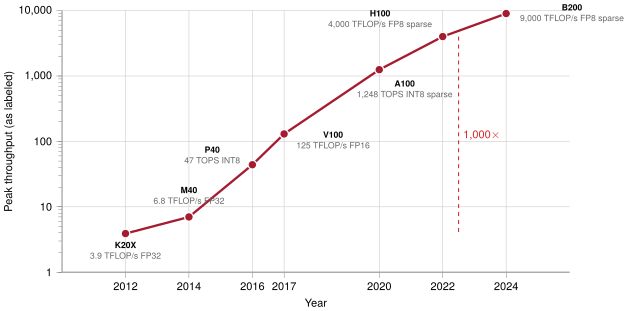
Advertised single-chip GPU throughput rose by more than three orders of magnitude across the generations plotted in figure 1, which combine architectural scaling with lower numerical precisions and structured sparsity (NVIDIA Corporation 2017, 2020a, 2024; Choquette 2023). Because the points mix precision formats, combine FLOP/s with INT8 operations per second, and assume structured sparsity for the A100, H100, and B200, they do not measure one consistent quantity; instead, the curve compares each generation’s most prominent advertised path rather than same-precision application performance. Table 3 gives the same chips’ dense, precision-specific peaks, bandwidths, and power limits.
Accelerator cost worksheet
An illustrative cost worksheet divides an approximate list price by a representative peak for three accelerator generations (table 13). Because list prices vary across vendor, region, contract terms, and procurement volume while the throughput rows use distinct numerical precision modes, the resulting price-per-peak-operation ratio is meaningful within a single row to show how a price assumption enters the arithmetic, rather than as a cross-device ranking. Cost-performance analysis states the durable rule the worksheet supports, which divides cost by the throughput a workload delivers on its binding resource rather than by the advertised peak.
| Accelerator | List Price | Representative Peak (precision shown) | Memory Bandwidth | Price per Peak TFLOP/s |
|---|---|---|---|---|
| NVIDIA V100 | ~$10,000 | 125 TFLOP/s (FP16) | 900 GB/s | $80/(TFLOP/s) |
| NVIDIA A100 | ~$15,000 | 312 TFLOP/s (FP16) | 2,039 GB/s | $48.1/(TFLOP/s) |
| NVIDIA H100 | ~$25,000–30,000 | 494 TFLOP/s (TF32) | 3,350 GB/s | ~$50.6/(TFLOP/s) |
Model Specifications
The book’s quantitative examples run on a small set of recurring workloads. The first table places the five lighthouse workloads in the regimes they occupy on their machines; the second gives the parameter counts, operation budgets, and training-scale anchors of every model the chapters cite.
Lighthouse workloads
Five lighthouse workloads recur through the book, each introduced in the regime it typifies (Lighthouse models put the iron law into practice; Workload archetypes). Because a regime belongs to a workload on a machine rather than to a model name, each row of table 14 is keyed by model, phase, and batch, with the second GPT-2 XL row recording a crossing out of the model’s home regime. Across those rows, four regimes appear: compute-bound and bandwidth-bound workloads are separated by the roofline’s ridge point, whereas capacity-bound and power-bound workloads are constrained before either time term applies because the working set must fit in memory and the energy budget must cover the run. For the compute- and bandwidth-bound rows, the last column compares the time a step spends on arithmetic at peak FP16 throughput with the time it spends reading the weights once at peak HBM bandwidth on one H100, and whichever is larger names the regime; a fifth regime, overhead-bound, arises when the iron law’s fixed latency term dominates and belongs to a deployment choice such as batch-one serving rather than to a lighthouse (Case 2: The latency cliff (cross-axis)).
| Lighthouse | Phase | Batch | Machine | Regime | Binding Resource | What Sets the Regime |
|---|---|---|---|---|---|---|
| ResNet-50 | Training | 256 images | H100 | Compute-bound | Tensor throughput | 6.4 ms of arithmetic against 15.3 μs of weight reads per step |
| MobileNetV2 | Inference | 1 image | Phone NPU | Compute-bound (efficient regime) | Arithmetic within a phone’s power envelope | 17.1 μs of arithmetic at the NPU’s 35 TOPS peak, inside a 5 W device envelope |
| GPT-2 XL | Decode | 1 sequence | H100 | Bandwidth-bound | HBM bandwidth | 3.0 μs of arithmetic against 0.90 ms of weight reads per token |
| GPT-2 XL | Training | 32 sequences of 1,024 tokens | H100 | Compute-bound (crossing) | Tensor throughput | 298.2 ms of arithmetic against 0.90 ms of weight reads per step |
| Llama 3 8B | Decode, 8,192-token context | 1 sequence | H100 | Bandwidth-bound | HBM bandwidth and KV-cache capacity | 5.1 ms reading 16.1 GB of weights and 1.07 GB of KV cache, against 16.2 μs of arithmetic per token |
| DLRM | Inference | Any | H100 | Capacity-bound | Memory capacity | 100 GB of embedding tables against 80 GB of HBM |
| KWS (DS-CNN) | Inference | 1 audio window | ESP32-S3 | Power-bound | Energy per inference | 200 KB INT8 model in 520 KB of SRAM, on a board drawing 50 mW to 1.2 W |
The same model changes regime when phase or batch changes. GPT-2 XL streams every weight to produce one decode token, but a training step amortizes one weight read over tens of thousands of tokens and becomes arithmetic-dominated, while Llama 3 8B’s KV cache adds bytes to every decode step as the context grows. Performance Bounds places these workloads on the H100 roofline, Autoregressive decoding sizes the KV cache that makes decode bandwidth bound, and Memory and KV cache budgets that cache against serving capacity.
Reference model specifications
Parameter counts, per-inference FLOP budgets, and published training-scale anchors form the reference model assumptions behind training-cost, memory-footprint, and inference-workload examples (table 15). Published model sizes follow primary papers, model reports, and official documentation (Devlin et al. 2019; Radford et al. 2019; Brown et al. 2020; Dubey et al. 2024; He et al. 2016; Sandler et al. 2018; Ultralytics 2023; Naumov et al. 2019; Banbury et al. 2021), whereas the inference FLOP budgets are book-derived from sequence length 128 for BERT-Base, \(224{\times}224\) images for ResNet-50 and MobileNetV2, and \(640{\times}640\) images for YOLOv8-Nano, counting two FLOPs per multiply-add in the vision models. For large-scale training anchors, GPT-3 training FLOPs follow (Brown et al. 2020) while its duration and accelerator count come from the published carbon reconstruction (Patterson et al. 2021), and because the GPT-4 technical report does not disclose architecture size, the GPT-4 parameter count and training GPU-days use public third-party mixture of experts (MoE) estimates (Patel and Wong 2023). Finally, the DLRM row represents the book’s reference configuration, whose FP32 embedding values exceed one accelerator’s memory, rather than a single production recommender.
| Assumption | Value | Unit |
|---|---|---|
| Inference FLOPs (BERT-Base) | 2.2e+10 | flop |
| Parameters (BERT-Base) | 1.1e+08 | param |
| Parameters (Llama 3 8B) | 8.03e+09 | param |
| Hidden dimension (GPT-2 XL) | 1600 | - |
| Layers (GPT-2 XL) | 48 | - |
| Parameters (GPT-2 XL) | 1.5e+09 | param |
| Parameters (GPT-3) | 1.75e+11 | param |
| Reference training duration (GPT-3) | 14.8 | d |
| Reference training accelerators (GPT-3) | 10,000 | V100 GPUs |
| Reference training FLOPs (GPT-3) | 3.14e+23 | flop |
| Parameters (GPT-4, public MoE estimate) | 1.76e+12 | param |
| Reference training GPU-days (GPT-4) | 2.5e+06 | GPU-days |
| Inference FLOPs (ResNet-50) | 8.2e+09 | flop |
| Parameters (ResNet-50) | 2.56e+07 | param |
| Inference FLOPs (MobileNetV2) | 6e+08 | flop |
| Parameters (MobileNetV2) | 3.50487e+06 | param |
| Inference FLOPs (YOLOv8-Nano) | 8.7e+09 | flop |
| Embedding table size (DLRM, reference) | 100 | GB |
| Embedding values (DLRM, reference) | 2.5e+10 | embedding values |
| Parameters (KWS DS-CNN) | 200000 | param |
| Inference FLOPs (KWS DS-CNN) | 2e+07 | flop |
Training Memory Conventions
Training-memory napkin math assumes the mixed-precision Adaptive Moment Estimation (Adam) storage model used in the worked training-memory estimate and several training chapters: BF16 weights, BF16 gradients, and FP32 master weights plus Adam first- and second-moment buffers (16 bytes per parameter in total). This is a book convention, not a measured hardware constant. The BF16 data path uses standard BF16 mixed-precision training (Kalamkar et al. 2019), the FP32 master copy of the weights follows earlier FP16 work (Micikevicius et al. 2018; NVIDIA 2017), and Adam’s first- and second-moment buffers follow (Kingma and Ba 2015). Multiplying the bytes per parameter by the parameter count gives the nonactivation training-state footprint, and table 16 lists the per-component byte widths. Training memory derives each component and the activation memory that adds to it, and Optimizers and their memory applies the convention to the book’s training runs.
| Assumption | Value | Unit |
|---|---|---|
| Weight/gradient width (BF16) | 2 | bytes |
| Master weight width (FP32) | 4 | bytes |
| Master + Adam states per parameter (FP32) | 12 | bytes |
| Bytes per parameter (mixed-precision Adam) | 16 | bytes |
Energy Constants
The specifications above bound how fast a chip can run; energy assumptions determine whether the design is thermally and economically viable at the level of the operation and the memory access. Horowitz’s 45 nm arithmetic and 32-bit DRAM estimates (Horowitz 2014), together with illustrative book anchors for register and SRAM access, MobileNetV2 inference, and 5G transfer, underpin the book’s efficiency comparisons but are not process-independent. Access energy rises from registers through DRAM, and the arithmetic energy of an add and a multiply falls with operand width (table 17). The access hierarchy quantifies why data reuse dominates kernel design, and The memory hierarchy explains the physics behind it as ratios that hold across process nodes.
| Assumption | Value | Unit |
|---|---|---|
| Register access energy | 0.1 | pJ |
| L1 SRAM access energy | 0.5 | pJ |
| L2 SRAM access energy | 2 | pJ |
| DRAM access energy (32-bit) | 640 | pJ |
| DRAM access energy (per byte) | 160 | pJ/byte |
| FP32 add energy (45 nm) | 0.9 | pJ/add |
| FP16 add energy (45 nm) | 0.4 | pJ/add |
| INT32 add energy (45 nm) | 0.1 | pJ/add |
| INT8 add energy (45 nm) | 0.03 | pJ/add |
| FP32 multiply energy (45 nm) | 3.7 | pJ/multiply |
| FP16 multiply energy (45 nm) | 1.1 | pJ/multiply |
| INT8 multiply energy (45 nm) | 0.2 | pJ/multiply |
| MobileNetV2 inference energy (reference) | 0.1 | mJ |
| 5G transfer energy per MB | 100 | mJ/MB |
The arithmetic rows carry two orderings that hold at every process node. A multiply costs several times an add at the same precision, because multiplier area grows roughly with the square of the operand bit width \(\NumericBitWidth\) while an adder grows linearly in it, and both fall as the operand narrows (Horowitz 2014; Dally et al. 2021). Newer nodes lower every absolute value in the table, so the 45 nm figures are upper anchors for current silicon, and the orderings, not the absolute values, are what precision and reuse arguments depend on.
Interconnect and Network Bandwidth
Energy costs operate at the chip level, but real ML systems also move data across interconnects, between accelerators, across racks, and over wide-area networks. These bandwidth assumptions apply when chapters reason about gradient synchronization, pipeline bubbles, checkpoint I/O, or cross–data center latency. The first table gives the latency and bandwidth of each tier of one H100 node, from registers to local storage; the second gives the link families that connect accelerators, hosts, and nodes.
Latency and bandwidth by tier
Access latency rises by five orders of magnitude from a register to an NVMe read, while bandwidth falls from terabytes per second at HBM to single gigabytes per second at local storage (table 18). The latency hierarchy expresses the same tiers as decades and as multiples of a register access, which change more slowly than the values here.
| Tier | Technology | Latency | Bandwidth |
|---|---|---|---|
| Registers | Flip-flops | 0.3 ns | — |
| L1 cache | SRAM | 1 ns | — |
| L2 cache | SRAM | 4 ns | — |
| Accelerator memory | HBM3 (H100) | 300 ns | 3,350 GB/s |
| Accelerator link | NVLink 4.0 (H100) | 500 ns | 900 GB/s |
| Host link | PCIe Gen5 x16 | 1,000 ns | 64 GB/s |
| Host memory | DDR4/DDR5 | — | 50 GB/s |
| Network | InfiniBand NDR | 5 μs | 50 GB/s |
| Local storage | NVMe SSD (Gen4) | 100 μs | 7 GB/s |
Interconnect specifications
On the reference node, NVLink runs more than an order of magnitude faster than the PCIe host link, and the host link runs faster than the node’s InfiniBand NDR port, so the boundary a transfer crosses sets its cost before its size does (table 19). Every rate is quoted in GB/s for comparison, with the direction convention each vendor uses; a bidirectional total halves for a one-way transfer. NVLink and PCIe rates follow accelerator product documentation (NVIDIA Corporation 2017, 2020a; Choquette 2023); the InfiniBand architecture specification anchors the protocol family (InfiniBand Trade Association 2000), while current high-speed product families and Ethernet roadmaps anchor modern link-rate examples (NVIDIA 2026; Ethernet Alliance 2025). Host-accelerator communication develops the transfer-time model these rates feed, and the speed of light in fiber, which bounds every cross–data center round trip, is a physical constant kept with the other durable values in Numbers to Know.
| Link | Device or Generation | Bandwidth | Convention | Latency |
|---|---|---|---|---|
| PCIe Gen3 x16 | Host link (V100) | 15.75 GB/s | Per direction | — |
| PCIe Gen4 x16 | Host link (A100) | 32 GB/s | Per direction | — |
| PCIe Gen5 x16 | Host link (H100, B200) | 64 GB/s | Per direction | 1,000 ns |
| CXL memory over PCIe Gen5 | Memory expansion | 64 GB/s | Per direction | — |
| NVLink 2.0 | V100 | 300 GB/s | Bidirectional total | 500 ns |
| NVLink 3.0 | A100 | 600 GB/s | Bidirectional total | 500 ns |
| NVLink 4.0 | H100 | 900 GB/s | Bidirectional total | 500 ns |
| NVLink 5.0 | B200 | 1,800 GB/s | Bidirectional total | 500 ns |
| ICI | TPU v4 | 300 GB/s | Per direction | — |
| ICI | TPU v5p | 1,200 GB/s | Bidirectional total | — |
| ICI | TPU v6e | 800 GB/s | Bidirectional total | — |
| InfiniBand EDR | Network port | 12.5 GB/s | Per direction | — |
| InfiniBand HDR | Network port | 25 GB/s | Per direction | 7 μs |
| InfiniBand NDR | Network port | 50 GB/s | Per direction | 5 μs |
| InfiniBand XDR | Network port | 100 GB/s | Per direction | 5 μs |
| RoCE (100 GbE) | Network port | 12.5 GB/s | Per direction | 10 μs |
| RoCE (400 GbE) | Network port | 50 GB/s | Per direction | 10 μs |
| 10 GbE | Network port | 1.25 GB/s | Per direction | 50 μs |
| 100 GbE | Network port | 12.5 GB/s | Per direction | 50 μs |
| 400 GbE | Network port | 50 GB/s | Per direction | 50 μs |
| 800 GbE | Network port | 100 GB/s | Per direction | 50 μs |
| NVMe SSD (Gen3) | Local storage | 3.5 GB/s | Sequential read | — |
| NVMe SSD (Gen4) | Local storage | 7 GB/s | Sequential read | — |
| NVMe SSD (Gen5) | Local storage | 14 GB/s | Sequential read | — |
Economic Constants
Converting a training run’s megawatt-hours or a dataset’s cross-region transfer volume into dollars requires baseline utility and network rates. These pricing assumptions underpin total cost of ownership (TCO) and energy-cost napkin math in table 20. They are illustrative hyperscaler-order rates for ratio analysis (similar in spirit to carbon accounting examples in (Patterson et al. 2021)), not quotes for a specific region or contract. Local values should replace these anchors when absolute price dominates. Accelerator list prices are kept with each chip, in table 4 and table 13.
| Assumption | Value | Unit |
|---|---|---|
| Cloud electricity price | 0.12 | dollar/kWh |
| Cloud egress price per GB | 0.09 | dollar/GB |
Scale References
Capacity-planning examples need request rates and data rates, so the scale assumptions in table 21 fix illustrative order-of-magnitude baselines for email and search volume, autonomous-vehicle sensor streams, and standard 1080p and 4K video formats. They are magnitude anchors, not audited statistics for a specific year.
| Assumption | Value | Unit |
|---|---|---|
| Gmail emails per day | 1.21e+11 | - |
| Google searches per day | 1.37e+10 | - |
| Waymo sensor data rate (low) | 1 | TB/h |
| Waymo sensor data rate (high) | 19 | TB/h |
| 1080p frame width | 1920 | - |
| 1080p frame height | 1080 | - |
| 4K frame width | 3840 | - |
| 4K frame height | 2160 | - |
| Bytes per RGB pixel | 3 | bytes |
| Video frame rate (standard) | 30 | Hz |
Worked Estimates
A table of peak rates, byte widths, and utility prices does not by itself tell an engineer whether a kernel is bandwidth bound, whether a fine-tuning job fits on one GPU, or what a training run’s electricity bill covers. The three worked estimates below combine the tables above to answer those performance, capacity, and cost questions, and each names the section that develops its method so a reader can rerun it with substituted values.
The first estimate places two operations on the reference machine’s roofline, using the method of The Roofline model. Comparing the ridge point against each operation’s arithmetic intensity separates compute-bound matrix multiplies from bandwidth-bound token generation.
Napkin Math 1.1: Classify a roofline regime
Variables: For an H100 at FP16/BF16 peak, use 989 TFLOP/s peak compute and 3.35 TB/s memory bandwidth.
Math: Divide peak FLOP/s by memory bandwidth to get the roofline ridge point: 989 TFLOP/s/3.35 TB/s \(\approx\) 295.2 FLOP/byte. A large general matrix multiply (GEMM) with \(\SquareGemmDimension=\) 4096 has intensity \(\SquareGemmDimension/3 \approx\) 1,365.3 FLOP/byte.
Result: Operations above 295.2 FLOP/byte are compute bound; operations below it are bandwidth bound. The GEMM example is compute bound, while a single-token autoregressive decode at FP16, with intensity of about 1 FLOP/byte, is deeply bandwidth bound.
Systems insight: The same accelerator can be compute rich and memory constrained. Arithmetic intensity determines which resource the workload actually consumes.
The second estimate sizes training state with the convention of table 16. Training memory derives the components, and Fine-tuning memory on one accelerator shows how parameter-efficient fine-tuning brings the same model onto one accelerator.
Napkin Math 1.2: Estimate training-state memory
Variables: Mixed-precision Adam stores BF16 weights, gradients, FP32 master weights, momentum, and variance. The model-state budget is 16 bytes per parameter.
Math: For 8.03B parameters, model state is 8.03B \(\times\) 16 bytes = 128.5 GB.
Result: An H100 has 80 GB of HBM, so the model state alone exceeds a single accelerator before accounting for activations.
Systems insight: Optimizer state, not weights alone, sets the floor for training memory. Capacity planning that starts from parameter bytes underestimates the real requirement.
The third estimate converts power and time into energy and cost. Dimensional analysis checks that the units of such a product reduce to energy, and Accounting for cost and carbon applies the same accounting to cost and carbon at deployment scale.
Napkin Math 1.3: Estimate accelerator electricity cost
Variables: Use 10,000 V100s, 300 W per accelerator, ~14.8 days wall-clock, and $0.12/kWh electricity (Patterson et al. 2021).
Math: The run requires roughly \(3.14 \times 10^{23}\) FLOPs. The accelerator-only electricity-cost estimate is ~14.8 days wall-clock \(\times\) 10,000 V100s \(\times\) 24 h/day \(\times\) 0.3 kW \(\times\) $0.12/kWh = ~$127,872.
Result: The accelerator-only electricity cost is roughly $128,000. This TDP-only estimate excludes host CPUs, networking, storage, cooling, and facility overhead. The 1,066 MWh of accelerator energy behind it covers about 83 percent of the 1,287 MWh reported for the run, which also counts host power and data center overhead. The GPU count and duration are a published reconstruction from measured per-GPU throughput, so only their product is firm (Patterson et al. 2021).
Systems insight: Energy follows directly from power and time, while the dollar figure depends on the electricity rate assumed.
Assumption Provenance
Each assumption has a provenance record that lets readers trace the number back to its primary source. The appendix’s quantitative inputs fall into evidence classes, each with its primary references (table 22). Vendor specifications and standards define published limits, peer-reviewed measurements provide empirical anchors, and explicitly marked editorial scenarios supply illustrative values where no durable universal constant exists. Every value is read from the book’s hardware, model, systems, and infrastructure registries, which record the same provenance per entry. A reader should check the class before trusting a number, because vendor peaks are ceilings, measurements are anchors, and scenarios are placeholders.
| Appendix section | Source type | Primary references |
|---|---|---|
| Accelerator specifications | Vendor datasheet peaks and list-price ranges; editorial CPU/mobile anchors; release-year format support; advertised marketing peaks | (NVIDIA Corporation 2017, 2018, 2020a, 2024; NVIDIA 2020; Choquette et al. 2021; Choquette 2023; AMD 2023; Jouppi et al. 2023; Google Cloud 2026); editorial for CPU/mobile rows |
| Model specifications | Published papers, model reports, benchmark references, and official docs; GPT-3 run reconstruction; GPT-4 size from public analysis | (Devlin et al. 2019; Radford et al. 2019; Brown et al. 2020; Patterson et al. 2021; Dubey et al. 2024; He et al. 2016; Sandler et al. 2018; Ultralytics 2023; Naumov et al. 2019; Banbury et al. 2021; OpenAI et al. 2023; Patel and Wong 2023) |
| Training memory conventions | Book convention (mixed-precision Adam layout) | (Kingma and Ba 2015; Kalamkar et al. 2019; Micikevicius et al. 2018; NVIDIA 2017) |
| Energy constants | Published 45 nm arithmetic/DRAM estimates; add-versus-multiply scaling | (Horowitz 2014; Dally et al. 2021) for arithmetic/DRAM; editorial for register/SRAM, MobileNetV2, and 5G rows |
| Interconnect bandwidth | Vendor specs; InfiniBand standard; product and roadmap documentation; representative latency tiers | (NVIDIA Corporation 2017, 2020a; Choquette 2023; InfiniBand Trade Association 2000; NVIDIA 2026; Ethernet Alliance 2025) |
| Economic assumptions | Illustrative cloud/utility rates | (Patterson et al. 2021) (methodology context) |
| Scale references | Illustrative workload rates; standard video conventions | Editorial for workload rates; standard format definitions for video |
| Unit conventions | Decimal SI; book notation | Editorial |
| Worked estimates | Derived from the rows above | As for the inputs they use |
Summary
This appendix is the reference catalog for the dated quantitative inputs used throughout the book. It runs from unit conventions and accelerator specifications through model, energy, interconnect, and cost assumptions, and closes with three worked estimates and a provenance map. The values come from vendor peaks, published measurements, standards, and editorial scenarios, so they carry different evidentiary weight and age at different rates.
Use these tables as starting inputs, not universal constants. For each estimate, record the table row, unit convention, and provenance; replace time-sensitive peaks, prices, and rates with local values; distinguish a physical ceiling from a measured operating point and a scenario assumption; and report which assumptions dominate the result. This keeps napkin math reproducible and makes clear which input controls the conclusion.