Multi-Agent Coordination
Purpose
Why does splitting a task across several agents so often cost more and deliver less than giving one agent the same budget?
A planner that decomposes the work, coders that draft patches in parallel, and a reviewer that approves the result look like an engineering team, and the design is easy to build. Measured against one agent that is allowed to spend the same tokens on sampling, revision, and tool feedback, such a fleet often finishes no faster, spends several times the tokens, and fails in new ways: workers overwrite each other’s files, a hallucinated premise travels from one agent into the context of the next, reviewers that share a model share its blind spots, and children keep spending after their parent has given up. Splitting a task pays only when it isolates context, separates authority, or explores independent alternatives, and only when the runtime then carries typed handoffs, isolated writes, invariant gates, cancellation, and narrowing authority across every agent boundary. A fleet multiplies horizon, state, and authority at once, so every handoff must preserve the closure that one agent already had.
Learning Objectives
- Calculate the coordination tax of a fleet and the worker count beyond which adding agents lengthens makespan.
- Select an orchestrator-worker, pipeline, or blackboard topology from a task’s dependency graph and critical path.
- Design typed task envelopes and returns that bound what a coordinator must read.
- Apply isolated worktrees and optimistic concurrency control to agents that write the same repository.
- Explain why correlated errors defeat voting ensembles and where an invariant gate must sit instead.
- Design cancellation and delegated authority so that no child outlives or out-privileges its parent.
- Evaluate a multi-agent design against a single agent given the same total budget.
The delegation trade-off

Four workers cut makespan to \(0.84\times\) but multiply token cost by \(3.25\times\).
A software engineering team resolves bug tickets with five agents (a supervisor, three code generators, and a test writer) and measures a 4 percent gain in completed tickets over its single-agent prototype. Profiling tells a different story. The ensemble spends fourteen times the tokens, takes \(3.8\times\) as long on the critical path because of serialization and context-synchronization barriers, and repeatedly deadlocks while reconciling merge conflicts in the shared repository. When the original agent is given the same resources for an iterative critique-and-refine loop with tool execution (Test-Time Compute), it matches the ensemble’s pass rate with 68 percent fewer tokens in half the wall-clock time. The extra agents bought nothing that the budget could not buy directly.
That result frames the question this chapter answers. Every earlier chapter ran one agent on one trajectory, a uniprocessor in the terms of the machine this book assembles. Repository-scale migrations, continuous fuzzing campaigns, and distributed vulnerability analysis produce more state, telemetry, and tool output than one deliberative loop can absorb, and the natural response is to split the work across concurrent agents that hand subtasks to one another and write to shared state. That split turns one control loop into an asynchronous distributed system that communicates over remote procedure calls (RPC) or message channels, and concurrency must not be confused with parallelism. If a subtask needs the validated artifacts of an earlier step, separate agent processes cannot shorten the critical path. They insert serialization, schema validation, network transit, and synchronization into it, turning an in-memory control transfer into a distributed coordination bottleneck.
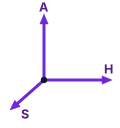
A fleet multiplies horizon, state, and authority, so every handoff must preserve closure.
The single-agent runtime of the earlier parts already closes the loop around a model that holds zero ambient authority, committing only what passes runtime gates outside the model (The Invariant Closure Principle). Splitting the loop across agents changes none of that. What it changes is exposure, since a fleet multiplies each of the H·S·A exposures of The H·S·A exposures. The horizon now runs across handoffs, so the open-loop ceiling of Temporal stretching: From nanosecond opcodes to kilosecond trajectories applies at every agent boundary, and a file path one worker hallucinates becomes the accepted premise of its peers. State is duplicated into every child’s context and read by agents after it has gone stale. Authority passes down every delegation and must not grow on the way. The chapter asks what the split costs, when it pays for itself, and what the runtime must add so that a fleet is no less dependable than one agent.
From this systems stance, multi-agent delegation is justified only when the modular partitioning of state, privilege, or exploration decisively offsets the physical costs of inter-process coordination. In systems practice, three concrete architectural motivations warrant decomposing a workload across a multi-agent fleet: context partitioning, tool authority attenuation, and orthogonal parallel exploration.
The first legitimate motivation is context partitioning. Modern foundation models operate under a finite operational context window bounded by physical GPU High Bandwidth Memory (HBM) and the memory bandwidth saturation of the autoregressive decode loop. As an agent’s working context grows toward its maximum boundary \(S_{\max}\), the quadratic complexity of dense attention prefill and the memory footprint of PagedAttention key-value (KV) cache physical frames severely degrade serving throughput. More critically, unprivileged models exhibit epistemic degradation—termed attention dilution or needle-in-a-haystack decay—when forced to retrieve information over vast contexts filled with extraneous logs, tool schemas, and execution traces. Partitioning an immense operational footprint across separate, specialized subagents allows each engine instance to maintain a lean, highly focused working context, preserving generation fidelity and containing KV cache allocation within optimal hardware bounds.
The second systems motivation is tool authority attenuation. An agent runtime must never grant an unconstrained root agent direct access to irreversible environmental mutations, such as dropping production database tables, publishing packages to public registries, or modifying network routing tables. By delegating dangerous operations to specialized child agents operating within isolated containers with strictly attenuated tool definitions, the host supervisor enforces defense-in-depth. If a subagent tasked with executing untrusted test scripts encounters adversarial prompt injection or generates destructive shell commands, its blast radius is physically contained by the boundary of its execution container, preventing the compromise of the supervisor’s core orchestration loop.
The third systems motivation is true parallel exploration over orthogonal, non-overlapping search spaces. When an engineering task requires evaluating multiple independent hypotheses—such as benchmarking four distinct algorithmic implementations across isolated repository branches, fuzzing independent protocol parsers, or searching disjoint segments of an empirical parameter space—a single-agent loop is forced to evaluate candidates serially. Spawning concurrent worker agents across separate engine instances allows the runtime to exploit underlying multi-GPU clusters, executing the prefill and decode loops of independent agents simultaneously. Under this configuration, the critical-path makespan of the global task approaches the duration of the slowest branch plus coordination overhead, achieving genuine parallel speedup.
The Core Delegation Rule: An uncoordinated multi-agent fleet that consumes \(10\times\) the tokens, memory, and wall-clock latency of an optimized single agent without yielding a statistically significant improvement in deterministic, verified task completion represents an architectural regression. Concurrency without orthogonal exploration is merely distributed serialization.
These advantages are never free, because every delegation pays the coordination tax (principle \(\ref{pri-vol3-coordination-tax}\)). Each time an agent delegates work to a peer or child process, the runtime incurs concrete computational, network, and memory penalties. The total wall-clock latency \(T_{\text{total}}\) of a delegated multi-agent workflow is formally governed by the coordination tax equation:
\[T_{\text{total}} = T_{\text{work}} + T_{\text{serialize}} + T_{\text{network}} + T_{\text{context\_duplication}} + T_{\text{reconciliation}}\]
Here, \(T_{\text{work}}\) represents the raw compute time expended within the autoregressive decode and prefill loops performing actual task transformations. \(T_{\text{serialize}}\) is the latency spent marshaling typed task envelopes, structured arguments, and environment states into serialized transport payloads. \(T_{\text{network}}\) reflects the socket, pipe, or inter-cluster transit time of the RPC infrastructure. \(T_{\text{context\_duplication}}\) is the computational cost incurred because child agents do not share a unified physical memory address space with their parent; every child must independently prefill its own foundational system prompt, environment schema, code snippets, and task instructions, burning redundant GPU compute cycles and allocating duplicate KV cache blocks. Finally, \(T_{\text{reconciliation}}\) represents the time the parent supervisor must spend inspecting, parsing, validating, and synthesizing the child’s candidate output back into the primary trajectory.
The scaling limit of this tax follows from Amdahl’s law, which Trajectory duration accounting applied to the model’s share of a single trajectory. Here it applies to the split itself. If a fraction \(1 - f\) of an agentic workflow is inherently sequential (initial requirement analysis, global task decomposition, and final multi-branch verification) and the remaining fraction \(f\) can be distributed across \(M\) parallel agents, the speedup cannot exceed
\[\text{Speedup}(M) = \frac{1}{(1 - f) + \frac{f}{M} + h(M)}\]
where \(h(M)\) is the coordination tax normalized to the single-agent runtime, as a function of the fleet size \(M\). In unoptimized multi-agent systems where agents communicate via unconstrained broadcast channels or dense peer-to-peer messaging, \(h(M)\) scales quadratically (\(\mathcal{O}(M^2)\)) with the number of agents. Under such conditions, the speedup curve rapidly inverts: beyond a small concurrency threshold, adding agents increases total completion time and explodes total token consumption while decreasing overall system reliability.
Napkin Math 0.1: The Amdahl limits of multi-agent parallelism
Under Configuration A (Single-Agent Deliberation), the single agent processes all eight modules sequentially. The initial sequential planning and task decomposition phase consumes 45 seconds across 1,500 prompt tokens and 800 decode tokens. Module refactoring work (\(T_{\text{work}}\)) requires 480 seconds across the eight modules (60 seconds per module, averaging 4,000 prompt prefill tokens and 1,200 decode tokens each). Subsequent verification and test execution consumes 15 seconds per module, totaling 120 seconds. Across the entire workload, the total single-agent makespan is \(T_{\text{single}} = 45 + 480 + 120 = 645\text{ seconds}\), incurring an aggregate token expenditure of 53,900 tokens with zero coordination overhead (\(T_{\text{coord}} = 0\text{ seconds}\)).
Under Configuration B (4-Agent Parallel Worker Fleet), a supervisor agent decomposes the work and assigns two independent modules to each of four parallel workers. The sequential planning phase identically consumes 45 seconds. Dispatching typed task envelopes across the RPC infrastructure (\(T_{\text{serialize}} + T_{\text{network}}\)) incurs 1.5 seconds per dispatch across the four workers, totaling 6 seconds. Because the workers do not share an address space, context prefill must be duplicated: each worker independently ingests the 12,000-token project architecture specification and environment schema. At a serving prefill rate of 4,000 tokens per second per GPU instance, this duplicated prefill adds: \[T_{\text{prefill\_dup}} = \frac{12{,}000\text{ tokens}}{4{,}000\text{ tokens/s}} = 3.0\text{ seconds per worker}.\] Each worker then refactors its two assigned modules concurrently, yielding a parallel work latency of \(T_{\text{work\_parallel}} = 2 \times 60 = 120\text{ seconds}\), followed by concurrent unit test execution of 30 seconds (two modules at 15 seconds each). Once workers return their candidate patches, the supervisor must integrate the four diff bundles (\(T_{\text{reconciliation}}\)), verify AST integrity, resolve two git merge conflicts across shared interface headers (requiring 42 seconds across 2,800 decode tokens), and execute the global regression suite (65 seconds). Total reconciliation latency is therefore \(T_{\text{reconciliation}} = 42 + 65 = 107\text{ seconds}\). Summing these components yields the total multi-agent makespan: \[T_{\text{multi}} = 45\text{ (seq)} + 6\text{ (RPC)} + 3\text{ (prefill)} + 120\text{ (work)} + 30\text{ (test)} + 107\text{ (recon)} = 311\text{ seconds}.\] This yields a measured parallel speedup of: \[\text{Speedup}(4) = \frac{645\text{ s}}{311\text{ s}} \approx 2.07\times.\]
Systems Cost Accounting: While the parallel fleet compresses wall-clock makespan by \(2.07\times\), the underlying hardware accounting reveals the real systems trade-off. Due to redundant context prefill across the four workers (48,000 duplicate prefill tokens) and supervisory reconciliation overhead, total token consumption surges from 53,900 to 118,400 tokens—an expansion of \(2.20\times\). The multi-agent architecture trades a \(120\%\) increase in compute cost and memory footprint to achieve a \(51.8\%\) reduction in wall-clock latency. If task dependencies had forced serialized reconciliation between branches, \(T_{\text{multi}}\) would have exceeded \(T_{\text{single}}\), inverting the speedup curve despite burning more than double the compute cycles.
To navigate these trade-offs systematically, the runtime designer must reject the ungrounded assertion that multi-agent systems are inherently superior to single-agent baselines. When evaluating whether to decompose a proposed subsystem, the architect must weigh the operational dimensions detailed in table 1.
| Architectural Dimension | Single-Agent Deliberation | Multi-Agent Delegation | Systems Trade-Off & Governing Invariant |
|---|---|---|---|
| Critical-Path Latency | Bounded by strictly sequential autoregressive decode loops (\(T \propto \sum L_{\text{decode}}\)). | Can approach \(T_{\text{max\_branch}} + T_{\text{tax}}\) when tasks exhibit true data-flow orthogonality. | Amdahl’s Law governs maximum speedup; high inter-agent serialization rapidly inverts parallel gains. |
| Compute & Token Cost | Minimal; single shared KV cache, zero context duplication across sub-tasks. | High; \(N\)-fold duplication of system prompts, schemas, and inter-agent synchronization envelopes. | Multi-agent fleets incur token inflation of \(1.5\times\) to \(4.0\times\) for identical functional deliverables. |
| Working Memory (\(S_{\max}\)) | High risk of attention dilution and KV cache exhaustion on long trajectories. | Bounded per agent; each subagent maintains a compact, task-specific working window. | Delegation is strictly justified when total working state exceeds a single model’s reliable attention capacity. |
| Fault & Security Isolation | Monolithic; a single unhandled exception or prompt injection compromises the session. | Strong; subagents operate within sandboxed processes under attenuated capabilities. | Principle of Least Privilege: isolate untrusted tools, network access, and mutations to disposable child containers. |
| State Consistency | Trivial; mutations occur sequentially against a single linear environment state. | Complex; concurrent mutations against shared filesystems require optimistic concurrency control. | Multi-agent execution requires distributed transaction semantics, three-way git merges, and saga rollbacks. |
| Failure Correlation | Errors compound along a single reasoning trajectory via self-reinforcing hallucinations. | Susceptible to cascade failures if agents share identical base model weights. | Peer consensus among identical models is pseudo-verification; validation requires deterministic external checks. |
Whether a task runs as one reflective loop or as a fleet of twenty communicating workers, correctness is established only by the end-to-end evidence of The dual guarantees of the end-to-end boundary, gathered outside every model. Three agents that repeatedly approve one another’s code changes do not produce that evidence. They produce a distributed echo chamber of correlated errors, which section 5 quantifies.
The architectural boundary is therefore clear. Multi-agent delegation is not an ambient replacement for rigorous single-agent design, but a specialized concurrency mechanism to be deployed when context partitioning, privilege attenuation, or speculative parallel search decisively outweigh the serialization and reconciliation taxes. Once an engineering workload satisfies these criteria and the delegation trade-off is mathematically justified, the runtime must abandon ad-hoc communication and enforce a formal coordination structure. This immediately confronts us with our next structural challenge: how should the runtime formally organize the communication channels, task dependencies, and data-flow routing across these concurrent execution cores?
Coordination topologies
When an uncoordinated multi-agent system is initialized as an arbitrary, fully connected peer-to-peer network without formal communication topologies, the runtime degenerates into an exponential message storm. In an ensemble of \(N\) unprivileged agents exchanging raw natural language over unconstrained broadcast channels, the count of potential bidirectional communication paths scales as \(\binom{N}{2} = \frac{N(N-1)}{2} = \mathcal{O}(N^2)\). At every interaction step, each agent broadcasts its intermediate deliberation to all peers, forcing the input prompt size, attention computation, and key-value (KV) cache memory footprint across the fleet to expand quadratically. In an empirical testbed executing a distributed code refactoring task across eight agents, an unconstrained peer-to-peer topology generated over 240 inter-agent messages in less than four minutes. The fleet consumed 1.8 million tokens in redundant prompt prefill passes, triggered repeated race conditions on shared files, and ultimately stalled due to context window exhaustion before committing a single verified syntax tree.
Multi-agent coordination is fundamentally an exercise in distributed graph compilation: the runtime must replace unconstrained conversational chatter with formal task dependency directed acyclic graphs (DAGs), choosing between Hierarchical Supervisor-Worker, Sequential Linear Pipeline, and Decentralized Blackboard or Actor topologies based strictly on the underlying data-flow dependencies of the computational workload.
Topological Constraint: An unconstrained conversational mesh exhibits \(\mathcal{O}(N^2)\) communication channels and \(\mathcal{O}(N^2)\) prompt prefill growth. Imposing a formal DAG topology reduces active communication edges to \(\mathcal{O}(N)\) or \(\mathcal{O}(N \log N)\), bounding context consumption and eliminating cyclic conversational deadlocks.
In classical operating systems, concurrency is managed by establishing clean abstractions between processes, inter-process communication (IPC) channels, and synchronization primitives. In an agentic machine learning runtime, the computational unit is not an operating system thread executing deterministic x86 instructions, but a foundation model instance generating autoregressively. Because these inference engines exhibit non-deterministic generation, high per-token latency, and memory-bandwidth-bound decode loops, the coordination topology dictates whether concurrency yields genuine parallel acceleration or merely multiplies communication and reconciliation overhead.
Taxonomy of coordination topologies
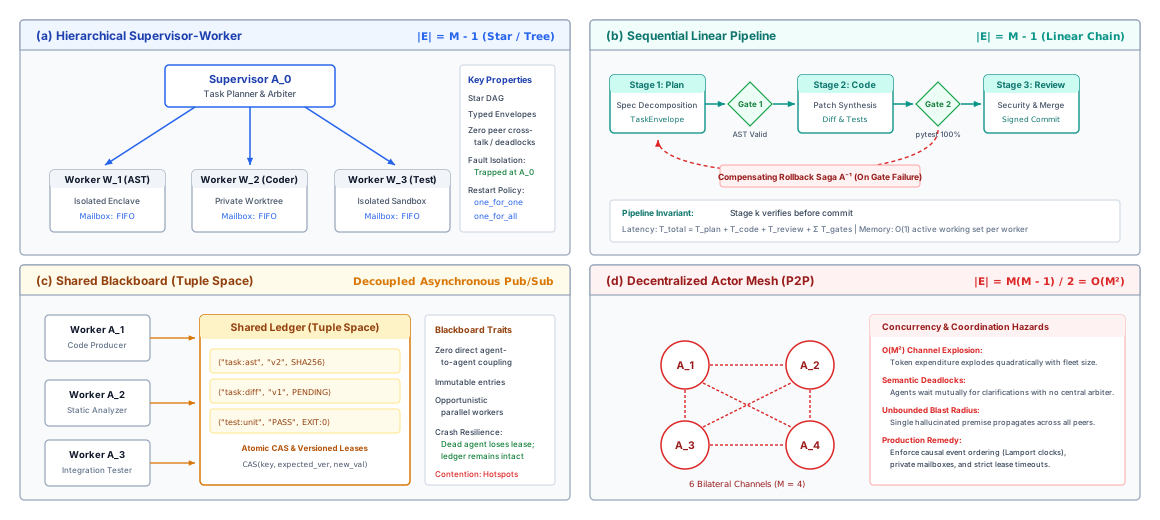
The architectural design of a multi-agent system begins by selecting an interconnection pattern that reflects the data-flow dependencies of the target application. As formalized in figure 1, distributed agent runtimes structure execution across four canonical topological archetypes: In the Hierarchical Supervisor-Worker model (Panel A), execution is organized as a directed star tree where root supervisor \(A_0\) dispatches typed task envelopes to isolated worker enclaves (\(W_1, W_2, W_3\)), bounding communication edges strictly to \(|E| = M - 1\) while trapping child exceptions. In the Sequential Linear Pipeline (Panel B), work progresses along a staged DAG where deterministic gates (\(G_1, G_2\)) verify intermediate artifacts before emission, triggering backward compensating rollback sagas (\(\mathcal{A}^{-1}\)) upon failure to prevent downstream taint. In the Shared Blackboard architecture (Panel C), concurrent workers operate without bilateral coupling, synchronizing state purely through atomic compare-and-swap (CAS) transactions against a centralized tuple space. Finally, in the Decentralized Actor Mesh (Panel D), unconstrained peer-to-peer communication produces a quadratic channel explosion (\(|E| = M(M-1)/2\)), creating severe risks of semantic deadlocks, context dilution, and unbounded failure propagation.
The Hierarchical Supervisor-Worker topology organizes agents into an explicit tree structure. A designated root supervisor ingests the top-level specification, decomposes the objective into independent subtasks, dispatches explicit task envelopes to specialized subordinate workers, collects intermediate candidate artifacts, and enforces external verification gates before synthesizing a global result. This topology offers centralized state tracking and a single, well-defined locus of environmental authority: only the supervisor possesses the capability to commit verified state transitions to the external environment. Workers execute as leaf nodes in isolated sandboxes, preventing uncoordinated mutations against shared resources.
However, the hierarchical topology suffers from a severe physical failure mode: the coordinator context bottleneck. As the worker fleet size \(N\) expands, or as individual workers return extensive execution logs, compiler diagnostics, and diff hunks, the supervisor’s working context window \(S_{\max}\) rapidly saturates. The supervisor is forced to ingest the concatenated outputs of all subordinate agents:
\[S_{\text{supervisor}} = S_{\text{spec}} + \sum_{i=1}^N S_{\text{return}}(i)\]
When \(S_{\text{supervisor}}\) approaches the hardware capacity of the GPU serving engine, the quadratic memory and compute scaling of attention prefill severely inflates supervisory latency. Even more destructively, the supervisor experiences attention dilution, misinterpreting or overlooking subtle errors buried within the voluminous returns of subordinate workers. Furthermore, the supervisor becomes a single point of serialization: if the root agent stalls during an autoregressive decode phase or generates an unparsable dispatch envelope, all downstream workers starve for work.
The Sequential Linear Pipeline topology structures execution as a unidirectional assembly line (\(A_1 \to A_2 \to \dots \to A_k\)), where the verified output artifact of Agent \(k\) serves directly as the input context for Agent \(k+1\). This architecture is ideal for phased engineering transformations that exhibit strict temporal serialization, such as translating architectural requirements into code, running static analysis and linters, generating regression test suites, executing security audits, and compiling deployment manifests.
The principal systems advantage of the linear pipeline is minimal memory footprint and high operational throughput for streaming batch tasks. Because each agent in the pipeline is dedicated to a single specialized phase, its system prompt and tool definitions remain compact. Upstream intermediate reasoning traces can be completely discarded; Agent \(k+1\) ingests only the clean, verified artifact produced by Agent \(k\), entirely avoiding the context saturation that plagues hierarchical supervisors. Furthermore, because each pipeline stage uses an identical, static system prompt across successive batch items, the serving engine achieves near-perfect KV cache prefix reuse, amortizing prefill computation across workloads.
The vulnerability of the sequential pipeline lies in upstream stage stalling and error propagation. If an early stage fails to emit an artifact that satisfies downstream compilation or linting checks, the entire pipeline grinds to a halt. Worse, if an upstream stage generates a subtle semantic flaw that evades static checks, downstream agents ingest that flaw as an authoritative premise. In a pipeline lacking bidirectional feedback, downstream stages cannot request upstream revisions without introducing backwards control edges, transforming the simple linear pipeline into an unrolled cyclic graph with complex convergence dynamics.
The Decentralized Blackboard and Actor models eliminate centralized coordinators entirely, drawing directly upon foundational distributed systems literature. In the Actor model, formalized by Carl Hewitt, Peter Bishop, and Richard Steiger (1973), autonomous computational entities (actors) maintain private local state, communicate exclusively through asynchronous, typed message-passing queues (mailboxes), and dynamically spawn new actors in response to messages. In the Blackboard architecture, concurrent worker agents interact indirectly by reading from and writing to a globally visible, append-only artifact repository. Specialized agents monitor the blackboard, claim subtasks when prerequisite artifacts appear, perform transformations, and post verified results back to the blackboard.
These decentralized topologies provide high dynamic scalability and fault resilience. There is no central supervisor whose context window can saturate, and the failure of an individual worker does not halt the fleet; other workers continue processing available subtasks from the blackboard or their private mailboxes.
The physical dilemma of decentralized topologies is lock contention, split-brain divergence, and non-deterministic event ordering. Because agents execute concurrently without a central arbiter, two workers may simultaneously claim the same subtask or attempt conflicting mutations on overlapping codebase files. In the absence of physical synchronized clocks, resolving causal dependencies across asynchronous agent messages requires implementing Lamport logical timestamps or vector clocks (Leslie Lamport, 1978) within the runtime message broker. Without strict distributed locking or immutable content-addressed artifact storage, decentralized agent fleets rapidly descend into split-brain states where conflicting architectural decisions are committed across parallel branches, resulting in massive reconciliation overhead at integration time. The properties and trade-offs across these four topologies are compared in table 2.
| Coordination Topology | Critical-Path Latency | Context & KV Cache Footprint | Failure Isolation & Recovery | Concurrency & Conflict Risk | Optimal Workload Profile |
|---|---|---|---|---|---|
| Hierarchical Supervisor-Worker | Low to moderate; bounded by supervisor serial phases and slowest worker. | High at root; supervisor context window saturates as \(\mathcal{O}(N)\) worker returns accumulate. | Moderate; worker failures are isolated, but supervisor failure stalls entire tree. | Low; centralized coordinator serializes and verifies all mutations before commit. | Exploratory task decomposition, multi-hypothesis search, isolated bug fixing. |
| Sequential Linear Pipeline | High; strictly serial makespan (\(T_{\text{crit}} = \sum T_k\)); zero task parallelism. | Minimal; each stage ingests only clean artifacts; high KV cache prefix sharing. | Fragile; failure at stage \(k\) stalls pipeline or propagates invalid context downstream. | Zero; execution is temporally ordered; no concurrent write conflicts exist. | Multi-stage artifact refinement, CI/CD code vetting, documentation synthesis. |
| Shared Blackboard | Low; opportunistic parallelism as dependencies become satisfied on blackboard. | Distributed; shared memory or artifact store; workers maintain compact private context. | Robust; worker crash leaves blackboard intact; tasks can be reclaimed by peers. | High; concurrent workers risk write collisions and race conditions on shared artifacts. | Heterogeneous analysis, continuous repository fuzzing, knowledge extraction. |
| Decentralized Actor Mesh | Variable; governed by message passing latency and graph synchronization points. | Bounded per actor; mailboxes buffer typed task envelopes asynchronously. | High; actor failure isolated to private mailbox; supervision trees handle restarts. | Moderate to High; requires causal event ordering (Lamport clocks) and distributed leases. | Open-ended simulation, distributed theorem proving, multi-domain system modeling. |
Modeling execution as task dependency DAGs
To escape the unpredictability of conversational messaging, the agent runtime must model multi-agent execution as a formal task dependency Directed Acyclic Graph (DAG), denoted \(G = (V, E)\). In this formulation, each vertex \(v_i \in V\) represents a discrete unit of agentic computation: the execution of a specialized foundation model instance over an explicit input context, bounded by a finite token budget. Each directed edge \((v_i, v_j) \in E\) represents an immutable data or control dependency, establishing that task \(v_j\) cannot be scheduled for execution until task \(v_i\) completes and emits an externally verified artifact.
Data Dependencies vs. Control Dependencies: A data dependency mandates that task \(v_j\) requires the physical output bytes of task \(v_i\) (e.g., a header file generated by \(v_i\) and consumed by \(v_j\)). A control dependency enforces execution ordering without raw artifact transfer (e.g., ensuring a unit test suite runs only after a compiler passes).
The runtime scheduler tracks the in-degree of all vertices in the graph. A vertex \(v_j\) is placed into the runnable task queue if and only if its in-degree satisfies:
\[\text{in-degree}(v_j) = |\{ v_i \in V \mid (v_i, v_j) \in E \}| = 0\]
When a running task \(v_i\) successfully finishes execution and its output passes deterministic verification gates (such as compiler certification or AST validation), the runtime persists its output artifacts to a content-addressed storage layer. The scheduler then removes \(v_i\) and its incident outgoing edges from the active graph, decrementing the in-degree of all immediate successor vertices. Any successor whose in-degree reaches zero transitions immediately to the runnable state and is dispatched to an available worker core.
The theoretical performance of an agentic dependency DAG is governed by two fundamental graph properties: the work and the critical path. The total work \(W(G)\) is the cumulative computational time expended across all vertices:
\[W(G) = \sum_{v_i \in V} T(v_i)\]
where \(T(v_i)\) represents the wall-clock execution time of vertex \(v_i\). For an autoregressive foundation model, \(T(v_i)\) is determined by the prefill phase over input tokens \(S_{\text{in}}\), the decode phase over generated tokens \(K_{\text{out}}\), and the duration of any deterministic tool invocations (such as test suite execution):
\[T(v_i) = \frac{S_{\text{in}}(v_i)}{R_{\text{prefill}}} + \frac{K_{\text{out}}(v_i)}{R_{\text{decode}}} + T_{\text{tool}}(v_i)\]
Here, \(R_{\text{prefill}}\) (tokens per second) is bounded by the GPU compute FLOPs during matrix-matrix multiplication (GEMM), while \(R_{\text{decode}}\) is strictly memory-bandwidth bound during autoregressive matrix-vector generation (GEMV).
The critical path \(\Pi_{\text{crit}}\) is the longest directed sequence of dependent vertices from any source node to any sink node in \(G\):
\[\Pi_{\text{crit}} = \arg\max_{\Pi \in \text{Paths}(G)} \sum_{v \in \Pi} T(v)\]
The critical path makespan, defined as \(T_{\text{crit}} = \sum_{v \in \Pi_{\text{crit}}} T(v)\), represents the strict physical lower bound on global execution time. Regardless of whether the runtime provisions four, sixteen, or an infinite number of parallel worker agents, the workload cannot complete in less time than \(T_{\text{crit}}\).
Parallel speedup emerges when the dependency graph contains fan-out structures where a single parent task spawns multiple mutually independent child vertices (\(v_1 \to \{v_2, v_3, \dots, v_m\}\)). The maximum instantaneous parallelism supported by the graph is defined by its width \(\mathcal{W}(G)\), representing the maximum size of an independent vertex cut. If the number of provisioned worker agents \(P\) is less than the graph width (\(P < \mathcal{W}(G)\)), the scheduler must prioritize runnable vertices according to their remaining distance to the sink, prioritizing vertices that lie along the critical path to prevent scheduling bubbles.
Napkin Math 0.2: DAG scheduling in multi-agent execution
The tasks exhibit the following dependencies and hardware execution parameters:
Task \(v_1\) (System Architecture Specification): Root node. \(S_{\text{in}} = 2{,}000\) tokens, \(K_{\text{out}} = 1{,}600\) tokens, \(T_{\text{tool}} = 0\text{ s}\). \[T(v_1) = \frac{2{,}000}{4{,}000} + \frac{1{,}600}{80} + 0 = 0.5 + 20.0 = 20.5\text{ s}.\]
Tasks \(v_2, v_3, v_4\) (Independent Module Refactorings): Children of \(v_1\). These represent parallel fan-out branches operating on separate code modules. Each ingests the 1,600-token specification from \(v_1\) plus 6,400 tokens of module code (\(S_{\text{in}} = 8{,}000\) tokens), generates \(K_{\text{out}} = 2{,}400\) tokens of code diffs, and executes local compiler checks (\(T_{\text{tool}} = 10.0\text{ s}\)): \[T(v_2) = T(v_3) = T(v_4) = \frac{8{,}000}{4{,}000} + \frac{2{,}400}{80} + 10.0 = 2.0 + 30.0 + 10.0 = 42.0\text{ s}.\]
Task \(v_5\) (Security & Vulnerability Audit): Child of \(v_2\) and \(v_3\). Ingests patches from both modules (\(S_{\text{in}} = 12{,}000\) tokens), generates \(K_{\text{out}} = 1{,}200\) tokens of audit notes, and runs a static analysis fuzzer (\(T_{\text{tool}} = 25.0\text{ s}\)): \[T(v_5) = \frac{12{,}000}{4{,}000} + \frac{1{,}200}{80} + 25.0 = 3.0 + 15.0 + 25.0 = 43.0\text{ s}.\]
Task \(v_6\) (Integration Binding Generation): Child of \(v_4\). Ingests patch from \(v_4\) (\(S_{\text{in}} = 6{,}000\) tokens), generates \(K_{\text{out}} = 800\) tokens, and verifies interface signatures (\(T_{\text{tool}} = 5.0\text{ s}\)): \[T(v_6) = \frac{6{,}000}{4{,}000} + \frac{800}{80} + 5.0 = 1.5 + 10.0 + 5.0 = 16.5\text{ s}.\]
Task \(v_7\) (Global Integration, Linking, and Regression Suite): Sink node; depends on \(v_5\) and \(v_6\). Ingests all candidate patches (\(S_{\text{in}} = 16{,}000\) tokens), generates final merge metadata (\(K_{\text{out}} = 400\) tokens), and executes the end-to-end integration test suite (\(T_{\text{tool}} = 60.0\text{ s}\)): \[T(v_7) = \frac{16{,}000}{4{,}000} + \frac{400}{80} + 60.0 = 4.0 + 5.0 + 60.0 = 69.0\text{ s}.\]
Step 1: Total Work Calculation. The cumulative compute and execution work across the workload is: \[W(G) = \sum_{i=1}^7 T(v_i) = 20.5 + 42.0 + 42.0 + 42.0 + 43.0 + 16.5 + 69.0 = 275.0\text{ seconds}.\] If executed sequentially on a single worker agent, the minimum makespan is \(T_{\text{seq}} = 275.0\text{ seconds}\).
Step 2: Critical Path Determination. We trace all paths from source \(v_1\) to sink \(v_7\):
Path 1: \(v_1 \to v_2 \to v_5 \to v_7\) \[\text{Length}(\text{Path 1}) = 20.5 + 42.0 + 43.0 + 69.0 = 174.5\text{ seconds}.\]
Path 2: \(v_1 \to v_3 \to v_5 \to v_7\) \[\text{Length}(\text{Path 2}) = 20.5 + 42.0 + 43.0 + 69.0 = 174.5\text{ seconds}.\]
Path 3: \(v_1 \to v_4 \to v_6 \to v_7\) \[\text{Length}(\text{Path 3}) = 20.5 + 42.0 + 16.5 + 69.0 = 148.0\text{ seconds}.\]
The critical path is \(\Pi_{\text{crit}} = v_1 \to v_2 \to v_5 \to v_7\) (tied with Path 2), establishing a critical-path makespan of \(T_{\text{crit}} = 174.5\text{ seconds}\).
Step 3: Scheduling Analysis with \(P=4\) Workers. At \(t = 0\text{ s}\), only \(v_1\) is runnable; Worker 1 executes \(v_1\) while Workers 2, 3, and 4 sit idle. At \(t = 20.5\text{ s}\), \(v_1\) completes. Vertices \(v_2, v_3, v_4\) become runnable simultaneously. Workers 1, 2, and 3 claim these tasks concurrently. Worker 4 remains idle because the graph width at this point is \(\mathcal{W} = 3\). At \(t = 20.5 + 42.0 = 62.5\text{ s}\), all three refactorings complete. Now \(v_5\) (which required both \(v_2\) and \(v_3\)) and \(v_6\) (which required \(v_4\)) become runnable. Worker 1 claims \(v_5\) and Worker 2 claims \(v_6\). At \(t = 62.5 + 16.5 = 79.0\text{ s}\), \(v_6\) finishes. However, sink node \(v_7\) cannot execute because its other dependency, \(v_5\), is still executing on Worker 1. Worker 2 enters an idle synchronization bubble. At \(t = 62.5 + 43.0 = 105.5\text{ s}\), \(v_5\) finishes. Both dependencies for \(v_7\) are satisfied. Worker 1 executes \(v_7\), completing at \(t = 105.5 + 69.0 = 174.5\text{ s}\).
Because \(P=4 \ge \max(\mathcal{W}(G))\), the actual execution time achieves the critical path limit: \(T_{\text{parallel}} = 174.5\text{ seconds}\). The resulting parallel speedup is: \[\mathcal{S} = \frac{T_{\text{seq}}}{T_{\text{parallel}}} = \frac{275.0\text{ s}}{174.5\text{ s}} \approx 1.58\times.\] Despite deploying four parallel GPU workers, the speedup is capped at \(1.58\times\). The remaining compute capacity was lost to sequential dependencies (\(v_1\) and \(v_7\)) and worker idle bubbles while waiting for join synchronization at \(v_5\) and \(v_7\).
Dynamic topology spawning
A central architectural decision in runtime design is whether the multi-agent dependency graph should be compiled statically ahead of time or spawned dynamically during execution.
In a Static Topology, the execution graph \(G\) is fully declared and compiled prior to launching the workload. The developer or compilation toolchain specifies the exact set of agent roles, their specialized system prompts, available tool suites, and fixed dependency edges. Systems such as rigid multi-stage continuous integration pipelines or deterministic compiler verification harnesses operate under static topologies.
Static topologies offer substantial systems advantages: First, they permit deterministic compile-time analysis. The runtime can verify that the dependency graph is strictly acyclic, validate that every edge connects type-compatible input and output schemas, and pre-calculate worst-case token expenditures. Second, static graphs allow aggressive systems-level optimizations. The serving engine can pre-load and pin system prompt KV caches for every scheduled agent across physical GPU memory, achieving immediate zero-overhead context initialization when a task fires. Third, scheduling algorithms can statically map vertices to specific hardware devices, minimizing inter-GPU communication latency and balancing memory consumption.
The fatal limitation of static topologies is their inability to adapt to runtime empirical discovery. Software engineering workloads are inherently non-deterministic: a bug localized to a single file may reveal deep architectural flaws across three other unmapped subsystems upon test execution. A static topology cannot dynamically instantiate an additional subagent to investigate an unexpected regression, nor can it dynamically prune an entire branch of execution when an early assertion proves a design hypothesis invalid.
In a Dynamic Topology, agents spawn child agents programmatically at runtime in response to intermediate execution feedback. An agent executing a repository refactoring may invoke a host runtime tool (such as invoke_subagent), supplying a customized task prompt, scoped file paths, and an attenuated capability envelope. The runtime dynamically instantiates a new child agent process, registers a new vertex and dependency edge in the active execution graph, and schedules the child onto an available worker slot.
Dynamic topologies provide unmatched flexibility, enabling the agent system to dynamically match its computational decomposition to the exact structural contours of the problem. If a child agent discovers that a legacy module relies on an undocumented RPC interface, it can dynamically fork an auxiliary research agent to inspect network traces without polluting its own working context.
However, dynamic spawning introduces critical systems hazards that can rapidly destabilize the host runtime, as structured across the hierarchy in table 3:
| Generation Depth | Agent Entity | Inbound Delegation Call | Allocated Token Budget | Safety & Attenuation Invariant |
|---|---|---|---|---|
| Level 0 (Root) | Parent Supervisor (\(A_0\)) | Initial task submission | \(B_0\) tokens | Holds primary task lease and global cancellation context. |
| Level 1 (Child) | Worker Agent (\(A_1\)) | fork_agent(prompt, B_1) |
\(B_1 < B_0\) tokens | Budget strictly attenuated (\(B_1 \le \alpha \cdot B_0\), \(\alpha < 1\)); inherits parent cancellation context. |
| Level 2 (Grandchild) | Specialized Leaf (\(A_2\)) | fork_agent(prompt, B_2) |
\(B_2 < B_1\) tokens | Depth limit enforced (\(D \le D_{\max}\)); further recursive fork attempts rejected (EPERM). |
The primary hazard is the agent fork bomb. If unprivileged foundation models are permitted to spawn child agents recursively without strict runtime constraints, non-deterministic reasoning loops can trigger exponential process explosion. An agent encountering an ambiguous compiler error may spawn three child agents to investigate different hypotheses; each child, encountering secondary errors, spawns three additional children. Within minutes, the fleet spawns hundreds of concurrent processes, saturating GPU memory, exhausting operating system process tables, and consuming millions of tokens without making forward progress.
A secondary hazard is the generation of orphaned zombie agents. If a parent agent encounters an unhandled exception, is canceled by a user interrupt, or exhausts its token budget while its dynamically spawned children are still executing, the children continue running in background processes. These orphaned agents continue consuming GPU compute cycles and executing mutations against sandbox environments, wasting resources and potentially introducing race conditions against subsequent user operations.
To tame dynamic topologies, the host runtime must enforce three strict architectural invariants:
Bounded Recursion Depth: The runtime supervisor must enforce a hard global ceiling on delegation depth (\(D \le D_{\max}\), typically \(D_{\max} \in [1, 2]\)). Any tool call attempting to spawn a child at depth \(D_{\max}\) must be rejected by the runtime with an explicit authorization fault.
Strict Budget Attenuation: A dynamically spawned child agent must never receive an open-ended compute allocation. Its token budget \(B_{\text{child}}\) and execution timeout must be strictly partitioned from, and subtracted from, the parent’s remaining budget: \[B_{\text{remaining\_parent}} \leftarrow B_{\text{current\_parent}} - B_{\text{child}}\] Under this conservation law, an agent fleet cannot exceed the global resource envelope established by the user, regardless of how many dynamic children are instantiated.
Process Group Supervision Trees: Dynamically spawned agents must be registered within an operating system process group or container namespace tied directly to the parent’s lifecycle. If the parent terminates, fails, or receives a cancellation signal, the host supervisor atomically propagates a termination signal (
SIGKILLor container cancellation RPC) down the entire process subtree, instantaneously reclaiming GPU memory and preventing orphaned executions.
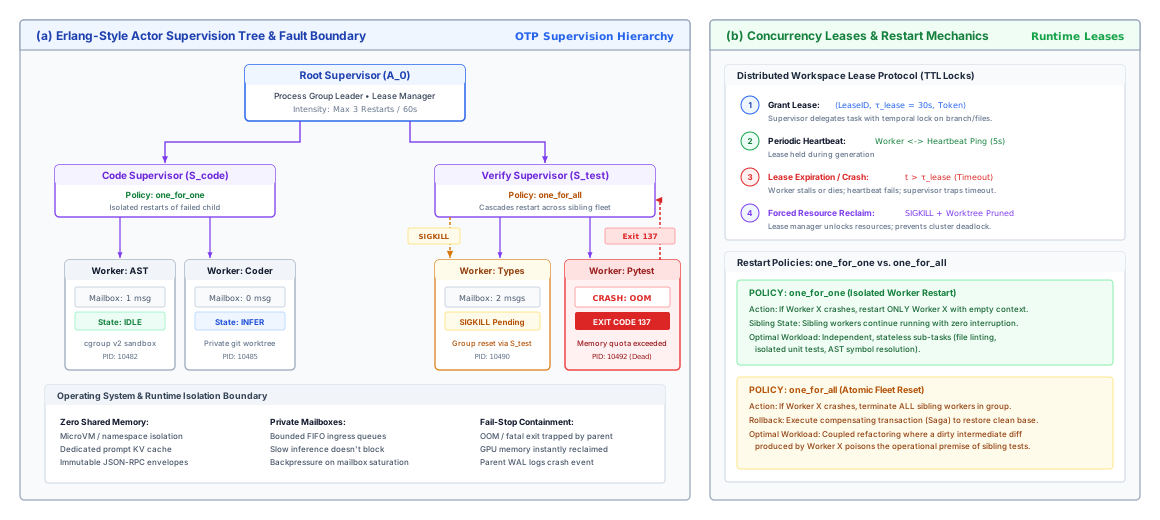
one_for_one versus one_for_all); Panel B details the time-bounded lease protocol (\(\tau_{\text{lease}}\)) and heartbeat lifecycle that enforces deterministic resource reclamation upon agent failure.
As formalized in figure 2, dependable agent runtimes implement fault isolation across two tightly coupled subsystems. In Panel A, an Erlang/OTP-inspired supervision tree partitions execution under Root Supervisor \(A_0\), which enforces bounded restart intensity (e.g., maximum 3 restarts per 60 seconds) to prevent infinite thrashing loops. Code Supervisor \(S_{\text{code}}\) oversees independent workers using a one_for_one restart strategy: if Worker AST crashes, only that specific worker is restarted with a fresh memory context, allowing Worker Coder to proceed undisturbed. In contrast, Verify Supervisor \(S_{\text{test}}\) employs a one_for_all strategy over coupled tasks: when Worker Pytest suffers an unhandled out-of-memory crash (exit code 137), \(S_{\text{test}}\) intercepts the SIGCHLD signal at the kernel namespace boundary and atomically dispatches SIGKILL to sibling Worker Types, ensuring that partially executed, tainted type-check states cannot contaminate downstream validation. In Panel B, the distributed lease manager guards against agent hangs and zombie compute by granting explicit execution leases (\(\tau_{\text{lease}} = 30\text{s}\)) verified through 5-second heartbeat pings; if a worker hangs during autoregressive generation or fails its heartbeat, the host supervisor forcibly reclaims GPU memory and prunes the worktree directory.
By formalizing communication topologies as explicit dependency DAGs—and enforcing strict structural invariants over both static graphs and dynamic spawning—the runtime transforms multi-agent execution from an erratic conversational storm into a dependable distributed computation. Yet, defining the topological edges of a task graph addresses only half of the coordination contract. Once an edge is established between a parent and a child, or between two pipeline stages, the runtime must govern the physical data that traverses that edge.
Checkpoint 0.1: Evaluating multi-agent coordination topologies
Before examining typed task envelopes and cross-agent contracts, verify your understanding of delegation trade-offs:
Typed task envelopes
When an orchestrator delegates a subtask by emitting unstructured natural language—for example, appending "Please inspect the failing tests in the authentication module, fix the regression, and make sure the documentation matches" to a shared conversational context—it abandons deterministic systems control. In an unconstrained chat handoff, the downstream model receives no authoritative boundary markers. It must infer which repository commit represents source truth, guess whether it holds permission to modify database migration scripts, assume arbitrary resource limits, and invent its own stopping criteria. As execution depth increases across a graph of delegating agents, this conversational ambiguity triggers rapid epistemic degradation: minor omissions in the initial prompt cascade into dropped constraints, ungrounded hallucinations, and silent state corruption across the host environment.
The foundational principle of modular decomposition, articulated by Saltzer and Kaashoek, requires that module interfaces hide internal implementation details while making cross-boundary preconditions, postconditions, and resource bindings mathematically explicit. Unstructured conversational prompts violate this modularity by conflating control signals with payload data.
The systems defense against conversational decay extends the typed action contract (principle \(\ref{pri-vol3-strict-action-abi}\)) from calls between a model and its tools to handoffs between agents, formalized as typed remote procedure calls. Drawing directly on the classical RPC architecture established by Birrell and Nelson (1984), distributed agent runtimes cannot rely on shared conversational memory. Every delegation across a task dependency edge must be marshalled into an explicit, schema-validated task envelope that completely specifies identity, immutable inputs, delegated capabilities, resource budgets, and machine-checkable completion assertions before the downstream agent execution loop is scheduled.
Definition 0.1: Typed task envelope
Systems Perspective 0.1: The fallacy of conversational coordination
When multiple stochastic models coordinate through open-ended natural language transcripts, the runtime immediately suffers from protocol-payload entanglement. Control signals, tool invocations, error streams, and subjective conversational monologues are flattened into a single text stream. This destroys privilege separation, making it impossible for the host supervisor to enforce strict capability boundaries or verify task contracts. Furthermore, replicating conversational history across interacting agents triggers quadratic context expansion (\(O(N^2)\) token overhead), saturating accelerator memory with conversational pleasantries and speculative thoughts that contribute zero actionable state transitions.
More critically, conversational handoffs suffer from rapid constraint dilution and Byzantine error amplification. As the sequence length expands, transformer attention disperses across thousands of tokens, drowning out negative constraints and structural invariants. Because foundation models share common architectural biases and pretraining corpora, peer debate fails to provide independent verification; models routinely succumb to sycophantic consensus, amplifying and confirming each other’s hallucinations rather than catching errors. Dependable distributed systems require replacing conversational chatter with classical systems engineering: typed Remote Procedure Calls (RPC), immutable schema envelopes, directed acyclic dependency graphs (DAGs), cryptographic capability tokens, and deterministic verification gates. Agents must never “chat” to coordinate; they must exchange structured, machine-verifiable data packets across isolated execution boundaries.
Conversational handoff failure modes
In early multi-agent prototypes, coordination was typically implemented as an append-only transcript: a supervisor model interacted with specialized worker models by appending natural language instructions to a single shared context window. This conversational paradigm collapses under physical systems scrutiny. The primary operational failure is semantic drift under context pressure. When multiple agents append reasoning traces, tool outputs, and conversational pleasantries to a shared sequence, the effective signal-to-noise ratio degrades. Because transformer attention assigns nonzero probability mass across the entire sequence length \(S\), soft negative constraints (such as "do not modify the production schema") articulated three turns prior are routinely drowned out by thousands of intervening tokens of raw linter output and speculative chain-of-thought tokens.
FAILED: tests/auth/test_token.py::test_signature_verification - AssertionError:
Expected algorithm ES256, received None.
Hint: Upstream agent omitted 'cryptography' dependency in requirements.txt.
The failure trace above highlights the architectural breakdown. Worker agents that receive unstructured instructions inevitably invent missing operational parameters. Lacking an explicit schema that designates input files, the worker issues speculative filesystem queries across irrelevant subtrees. Lacking explicit execution leases, it modifies configuration files outside its intended operational scope. Lacking machine-checkable completion criteria, it determines termination through autoregressive self-evaluation—emitting phrases such as "I have verified the code and it is correct"—even while unit tests in the underlying container remain red. The architectural differences between unstructured conversational prompts and typed remote execution envelopes are contrasted in table 4.
| Operational Dimension | Conversational Handoff (Chat Paradigm) | Typed Task Envelope (RPC Paradigm) |
|---|---|---|
| Interface Definition | Natural language prompts with ad-hoc instructions | Formally validated JSON Schema or Protocol Buffer |
| Argument Marshalling | Raw text concatenated into the prompt context | Strongly typed fields with content-addressed storage URIs |
| State Propagation | Pass-by-value (file dumps embedded directly in context) | Pass-by-reference (immutable cryptographic hashes and pointers) |
| Authority Boundary | Ambient authority inferred from model instructions | Cryptographically signed, attenuated capability tokens |
| Resource Ceiling | Implicit model context window (\(S_{\max}\)) | Explicit budget vector: tokens, tool calls, and wall-clock timeout |
| Completion Invariant | Model-generated self-assessment ("Task complete") |
Deterministic external verification predicates (\(V(a) \to \{0, 1\}\)) |
To replace this conversational fragility with dependable systems execution, the runtime must enforce the Remote Task Invocation Invariant: an agent may never invoke another agent via conversational prompt concatenation; it may only instantiate a strongly typed, hermetically sealed Task Envelope validated against an authoritative runtime schema.
The five-part task envelope specification
A robust agentic remote procedure call is defined by a five-tuple:
\[\mathcal{E} = \left\langle \mathcal{M}, \mathcal{R}_{\text{in}}, \mathcal{C}_{\text{delegated}}, \mathcal{B}, \mathcal{S}_{\text{verify}} \right\rangle\]
Each element of the envelope addresses a specific distributed failure mode, ensuring that the child agent runtime possesses exactly the information and authority needed to execute its bounded subcomputation—and nothing more.
{
  "task_id": "task-9842a-refactor-auth",
  "parent_id": "agent-root-supervisor",
  "deadline": "2026-09-19T14:32:00Z",
  "timeout_seconds": 120,
  "contract": {
    "objective": "Migrate legacy HMAC-SHA1 signature verification to ES256",
    "declared_inputs": ["repo:git-at-github:org/auth.git@ref/c84fa"],
    "expected_outputs": ["patch:git-diff", "verification:junit-xml"]
  },
  "resource_bounds": {
    "token_budget": 16384,
    "capability_token": "Cap[Scope: /workspace/src/auth, Net: NONE, Time: 120]"
  },
  "validation_oracles": {
    "acceptance_test": "pytest tests/auth/test_token.py::test_es256",
    "static_analysis": "mypy --strict src/auth"
  }
}
The structural anatomy of a typed task envelope. The host runtime enforces validation at both entry and exit points.
Task metadata (\(\mathcal{M}\))
Task metadata establishes distributed tracing and causal lineage across the execution DAG. It contains:
task_id: A universally unique identifier (UUIDv7) ensuring temporal ordering and idempotency.parent_id: The identifier of the delegating supervisor or upstream pipeline stage.trace_context: Distributed tracing state adhering to W3C Trace Context specifications (encompassingtrace_idandspan_id). This permits host runtimes to correlate token expenditures, latency profiles, and tool invocations across deeply nested agent hierarchies.
Immutable input references (\(\mathcal{R}_{\text{in}}\))
The input reference block anchors the agent’s computation to an exact, frozen snapshot of the physical world. Rather than permitting the agent to read mutable local pointers, \(\mathcal{R}_{\text{in}}\) specifies:
workspace_snapshot: An immutable content-addressed storage pointer, such as a Git tree SHA (git:commit:a4f8c9b) or an S3 object hash (s3://artifacts/blobs/sha256:e3b0c44...).manifest_uris: An array of explicit paths or URIs designating the authoritative artifacts to be analyzed or mutated.
By providing content-addressed references, the runtime guarantees that two worker agents operating on the same task envelope observe bit-for-bit identical input states, eliminating non-reproducible race conditions induced by concurrent writes in the parent process.
Delegated capability token (\(\mathcal{C}_{\text{delegated}}\))
Following the principle of least privilege, a child agent must never inherit the ambient authority of its parent. The capability token defines an attenuated authorization lease, enforced not by the model’s self-restraint, but by the host runtime’s tool interception layer:
filesystem_scope: A whitelist of permitted directory prefixes (e.g.,["/src/auth/"]), with absolute write-denials on protected infrastructure (e.g.,["/.github/", "/infra/"]).network_egress: Binary network flags and domain whitelists restricting external communication.permitted_tools: The exact subset of tool endpoints the child is authorized to invoke (e.g., permittingbash_runforpytest, but revokinggit_pushandaws_deploy).
Resource budget ceiling (\(\mathcal{B}\))
Unchecked autoregressive decode loops and pathological tool-retry cycles can rapidly consume millions of tokens and exhaust infrastructure quotas. The budget vector \(\mathcal{B}\) enforces hard ceilings:
\[\mathcal{B} = \left( K_{\max}^{\text{input}}, K_{\max}^{\text{output}}, \tau_{\max}, N_{\max}^{\text{calls}}, D_{\max}^{\text{cost}} \right)\]
where \(K_{\max}\) denotes maximum prompt and generation tokens, \(\tau_{\max}\) specifies the wall-clock timeout in seconds, \(N_{\max}^{\text{calls}}\) represents the maximum number of tool execution round-trips, and \(D_{\max}^{\text{cost}}\) defines a hard currency threshold in dollars. If any scalar threshold in \(\mathcal{B}\) is breached, the host supervisor abruptly terminates the agent’s decode loop with a typed RESOURCE_EXHAUSTED exception, preventing runaways.
Completion verification schema (\(\mathcal{S}_{\text{verify}}\))
The envelope must never accept natural language declarations of completion. Instead, it parameterizes a deterministic verification function \(V: \text{Artifacts} \to \{0, 1\}\). The schema specifies:
Listing 1 shows an envelope for the authentication fix. Each field closes an exposure or sets an invariant: the inputs are pinned to a snapshot, the granted tools give read access only to the files the fix touches, the branch is isolated, and the budgets bound what the worker may spend.
{
  "task_id": "task-9842a-refactor-auth",
  "parent_id": "agent-root-coordinator",
  "trace": {"trace_id": "7f3c...", "parent_span_id": "a41e..."},
  "objective": "Migrate HMAC-SHA1 signature verification to ES256",
  "inputs": {
    "workspace": "git:commit:c84fa21",
    "paths": ["src/auth/", "tests/auth/"]
  },
  "authority": {
    "tools": ["read_file", "edit_file", "run_tests"],
    "write_scope": ["src/auth/"],
    "network": "none"
  },
  "budget": {"input_tokens": 200000, "output_tokens": 16384,
             "tool_calls": 60, "wall_clock_s": 900},
  "completion": {
    "tests": "pytest tests/auth/test_token.py::test_es256",
    "static": "mypy --strict src/auth",
    "forbidden": ["deleted test functions", "edits outside write_scope"]
  }
}required_exit_codes: Deterministic commands that must exit with return code zero (e.g.,pytest tests/auth/test_token.py -v).structural_contract: A JSON Schema or abstract syntax tree (AST) constraint that generated output artifacts must satisfy.forbidden_diff_patterns: Negative assertions verified by the host (e.g., ensuring zero lines of test code were deleted to achieve a passing suite).
# Empirical verification harness executed by the host runtime upon task return
def verify_task_completion(envelope: TaskEnvelope, receipt: TaskReceipt) -> bool:
    if receipt.exit_code != 0:
        return False
    if any(p in receipt.mutated_paths for p in envelope.capabilities.denied_paths):
        raise SecurityViolation("Agent mutated paths outside delegated capability")
    return run_host_verification_command(envelope.verification.assertion_cmd) == 0
The downstream agent communicates its termination back to the supervisor strictly through a typed Task Receipt. The receipt mirrors the envelope: it contains the originating task_id, the mutated commit SHA, an array of structured output artifacts, the consumed resource metrics, and the execution logs of the verification harness. If the verification harness fails, the task receipt is marked with a failure status, triggering the supervisor’s recovery or retry policies.
Passing references, not contents
A coordinator that pastes the relevant code into each child’s prompt pays for it once per child. Suppose 6 workers each need to understand a 48,000-token slice of a repository but will act on only a few files each. Pasting the slice into every envelope sends 6 \(\times\) 48,000 = 288,000 input tokens before any work begins, costing $0.86 per dispatch at an illustrative $3 per million input tokens. Passing a reference instead costs about 350 tokens per envelope, after which each worker reads the three or so files it needs, about 3,600 tokens, through its own tools. The fleet reads 6 \(\times\) 3,950 = 23,700 tokens, about 12× fewer, for $0.07. The saving is not only money. A child that reads what it needs starts with a small, relevant context instead of a large one it must search, which is the context-isolation reason for splitting in the first place.
References have a second benefit. Envelopes that point to the same pinned snapshot, and children that share the same system prompt and tool definitions at the front of their context, let the serving system reuse the cached prefix across children (Staging the Next Invocation). Pasting volatile contents ahead of stable ones breaks that reuse on every call.
Marshalling semantics
When designing data handoffs between agents, systems engineers face an architectural choice analogous to calling conventions in programming languages: should state be passed by value or passed by reference?
In a pass-by-value architecture, the delegating agent marshals the full text of all relevant files, environment variables, and diagnostic logs directly into the prompt payload of the child envelope. In a pass-by-reference architecture, the envelope carries only lightweight, immutable pointers—content-addressed Git commit hashes, database transaction IDs, or object storage URIs—along with access credentials. The worker agent runtime resolves these references on demand, fetching specific byte ranges via localized tool calls.
Passing state by value incurs catastrophic resource overheads on modern accelerator hardware. Modern Large Language Models run on accelerator memory architectures bounded by high-bandwidth memory (HBM) capacity and memory-bus bandwidth. When thousands of lines of source code and dependency manifests are serialized into a child’s prompt context, the host must execute a massive matrix-matrix multiplication (\(\mathcal{O}(S^2)\) or \(\mathcal{O}(S \cdot D)\) under optimized attention) during the prefill phase, followed by large KV cache allocations that remain pinned in accelerator HBM throughout the decode lifetime.
During the prefill phase, memory bandwidth requirements are dominated by loading model weights: \[\text{Time}_{\text{prefill}} \approx \frac{2 \cdot P \cdot S}{\text{Memory Bandwidth}}\] where \(P\) is parameter count and \(S\) is sequence length. Inflating \(S\) with raw file dumps severely throttles serving throughput.
The runtime checks the child’s return against its contract on the way back as strictly as the envelope on the way out. Listing 2 shows the check it runs before any receipt is accepted.
def accept_receipt(envelope, receipt) -> bool:
    changed = receipt.changed_paths
    if not all(in_scope(p, envelope.authority.write_scope) for p in changed):
        raise ScopeViolation(receipt.task_id, changed)
    if receipt.summary_tokens > envelope.return_budget_tokens:
        receipt.summary = truncate(receipt.summary, envelope.return_budget_tokens)
    return run_checks(envelope.completion, commit=receipt.commit) == PASS
Napkin Math 0.3: Context desorption in task delegation
Consider an orchestrator delegating a refactoring task across a cluster of \(W = 6\) worker agents. The working set of the target repository encompasses 40 source files totaling \(S_{\text{files}} = 48\text{,}000\) BPE tokens. The supervisor requires each worker to analyze a distinct module while observing repository state.
Scenario A: Pass-by-Value Marshalling. The supervisor inlines the entire 48,000-token repository context into the prompt payload of each worker’s task envelope.
Total context broadcast across the cluster: \[S_{\text{total}} = W \times S_{\text{files}} = 6 \times 48\text{,}000 = 288\text{,}000 \text{ tokens}\]
KV Cache Allocation per Worker: Assuming a 70-billion parameter model operating in 16-bit precision (\(\text{FP16}\)), with \(L = 80\) layers, hidden dimension \(D = 8\text{,}192\), and Grouped-Query Attention (\(n_{\text{kv\_heads}} = 8\), \(d_{\text{head}} = 128\)): \[\text{Bytes per Token} = 2 \times L \times n_{\text{kv\_heads}} \times d_{\text{head}} \times 2 \text{ bytes} = 327\text{,}680 \text{ bytes/token} \approx 320 \text{ KB/token}\] For a single worker’s input sequence (\(48\text{,}000\) tokens): \[\text{HBM}_{\text{worker}} = 48\text{,}000 \times 320 \text{ KB} \approx 15.36 \text{ GB}\] Across all \(W = 6\) workers, the inference pool must allocate: \[\text{HBM}_{\text{cluster}} = 6 \times 15.36 \text{ GB} = 92.16 \text{ GB}\] just to hold the duplicated, read-only static context before generation starts.
Compute and Latency Cost: At standard API serving rates ($3.00 per million input tokens), broadcasting the inputs costs \(\$0.864\) per dispatch. Processing a 48,000-token prefill on an 80 GB H100 GPU (operating at an effective prefill throughput of \(3\text{,}200 \text{ tokens/sec}\)) imposes a Time-to-First-Token (TTFT) latency penalty of: \[\text{TTFT} \approx \frac{48\text{,}000}{3\text{,}200} = 15.0 \text{ seconds}\]
Scenario B: Pass-by-Reference Marshalling. The supervisor generates a typed task envelope specifying the repository’s immutable Git tree hash (commit_sha: 9b2d8f1), the specific module entry point (src/auth/service.py), and a bounded capability token.
The serialized task envelope consumes exactly \(S_{\text{envelope}} = 350\) tokens.
Across all \(W = 6\) workers, total input tokens dispatched: \[S_{\text{total}} = 6 \times 350 = 2\text{,}100 \text{ tokens}\] Representing a \(137\times\) reduction in network transmission and accelerator context ingestion.
Initial KV Cache Allocation per Worker: \[\text{HBM}_{\text{worker}} = 350 \times 320 \text{ KB} \approx 112 \text{ MB} \quad (\text{versus } 15.36 \text{ GB})\]
On-Demand State Retrieval: Each worker agent uses its attenuated filesystem capability to read only the specific files relevant to its task (averaging 3 files, or \(3\text{,}600\) tokens). \[\text{Total HBM utilized per worker} \approx 3\text{,}950 \times 320 \text{ KB} \approx 1.26 \text{ GB}\] Total input token cost across the cluster drops from \(\$0.864\) to \(\$0.071\), while TTFT drops from \(15.0\) seconds to under \(120\) milliseconds.
Pass-by-reference marshalling enforces clear separation between control planes and data planes. The control plane—the orchestrator’s task envelope and dependency graph—transports lightweight, highly structured, typed metadata. The data plane—the underlying filesystem, code repository, or object store—manages bulk bytes using high-throughput, low-cost storage engines optimized for random access and delta compression.
Furthermore, pass-by-reference protects cache locality on serving infrastructure. When agents share a common immutable snapshot reference, advanced serving runtimes equipped with Radix-tree or prefix-caching engines can preserve the physical memory frames of the root repository index across multiple tasks. Conversely, pass-by-value handoffs, which concatenate volatile conversational histories with static code files, invalidate prompt prefix hashes on every turn, defeating prefix-caching mechanisms and forcing redundant matrix recalculations across the entire GPU cluster. The discrete lifecycle transitions of this typed handoff pipeline are detailed in table 5.
| Pipeline State | Target Subsystem | Transition Condition | Operational Outcome | Error State |
|---|---|---|---|---|
| 1. VALIDATE | Supervisor Schema Parser | Validates JSON schema, capability tokens, budget ceilings | Advances to dispatch; approves authority mask | REJECT & ABORT on malformed schema or invalid token |
| 2. DISPATCH | Sandboxed Container Daemon | Resolves immutable content-addressed references (Git SHA, S3 URI) | Mounts read-only dependencies into sandbox | RESOLVE_FAILED on missing artifact reference |
| 3. EXECUTE | Worker Agent Runtime | Evaluates subtask autoregressively within allocated bounds | Completes within declared token/time quotas | RESOURCE_EXHAUSTED on budget or timeout breach |
| 4. VERIFY | Sandboxed Test Oracle | Evaluates verification predicates \(\mathcal{V}(\text{Artifacts}) == 0\) | Confirms exit code 0 and AST constraints | EMIT RECEIPT (FAIL) on invariant breach |
| 5. COMPLETE | Orchestrator DAG Engine | Marshals signed TaskReceipt with cryptographic output hash |
Returns result envelope to supervisor graph | Discards uncommitted workspace mutations |
By formalizing the handoff boundary through typed envelopes, content-addressed references, and machine-readable verification receipts, the agent runtime establishes deterministic, auditable barriers between decoupled stochastic models. Yet, establishing clean data isolation at the invocation boundary solves only the input phase of concurrent execution. When multiple worker agents execute simultaneously across different branches of a task graph, their subcomputations inevitably terminate by attempting to commit mutations back to the shared repository environment. If two workers independently refactor interdependent files or concurrently update database schemas, their write operations will collide, corrupting the project state. To achieve true parallel scalability, the runtime must govern concurrent execution through optimistic concurrency control and branch reconciliation.
Optimistic concurrency control
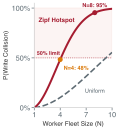
Under Zipfian hotspot file access, unisolated agent fleets cross an 80 percent write collision rate beyond five workers, rendering naive shared workspaces unviable.
When multiple autonomous agents execute concurrently across a shared filesystem without mutual exclusion, their write trajectories inevitably interleave, inducing silent clobbers, torn states, and unrecoverable data loss. If Worker \(A\) inspects service.py at repository revision 100 to refactor an asynchronous endpoint while Worker \(B\) concurrently edits the same file to upgrade a database schema, the worker that flushes its mutations last unconditionally obliterates the modifications of the first. Because unprivileged foundation models generate code tokens over autoregressive decode trajectories lasting tens of seconds, acquiring pessimistic locks on files during the model inference phase serializes the entire worker fleet, collapsing parallel system throughput to that of a single thread.
Concurrent agent execution requires decoupling execution from integration through Optimistic Concurrency Control (OCC) backed by isolated, copy-on-write branch workspaces. By allowing agents to read and mutate private snapshots without acquiring distributed read locks, the host runtime achieves maximum parallel throughput during the high-latency model generation phase. Only at the point of integration does the runtime validate serializability against the parent repository commit head, applying deterministic three-way diff algorithms or delegating syntactic reconciliation subtasks to resolve orthogonal mutations without human intervention.
Optimistic Concurrency Control (OCC) First formalized by H. T. Kung and John T. Robinson in 1981, OCC assumes that transaction conflicts are rare. Operations proceed without locking resources; before committing, the transaction validates whether another transaction modified its read set.
Mutation collision hazards
In classical multi-threaded operating systems, threads coordinate access to shared memory through atomic primitives, mutexes, and condition variables managed by the OS kernel. In contrast, an autonomous agent interacts with its host environment through coarse-grained, asynchronous tool invocations: reading source files into context tokens, executing terminal commands, and rewriting modified buffers back to disk. When multiple agents operate inside a common working directory, three distinct concurrency hazards emerge from the stochastic, high-latency nature of foundation model decode loops.
The first hazard is the lost update. Because an agent’s deliberation cycle (prompt construction, neural network prefill, and autoregressive decoding) spans seconds or minutes, the window of vulnerability between an agent reading file contents \(F_0\) and writing mutated contents \(F'\) is orders of magnitude larger than that of a CPU instruction. If Worker \(A\) and Worker \(B\) both read auth.py at timestamp \(t_0\), Worker \(A\) finishes its decode cycle at \(t_1\) and writes \(F_A\), and Worker \(B\) finishes its decode cycle at \(t_2\) and writes \(F_B\), Worker \(B\)’s write unconditionally clobbers \(F_A\). Neither the underlying operating system nor the file system detects the semantic destruction because each file write appears as a valid, isolated system call.
The second hazard is the torn dependency read. Software repositories are tightly coupled dependency graphs. If Worker \(A\) modifies an API contract in models.py and concurrently updates its call sites in controllers.py, an uncoordinated Worker \(B\) running unit tests against the same workspace may read the updated models.py before controllers.py has been written. Worker \(B\)’s compilation or test harness fails catastrophically due to an intermediate, torn workspace state that was never intended to be evaluated.
The third hazard is host tool lock contention. Developer tooling assumes human-scale sequential interaction. If two parallel agents concurrently execute commands such as git add, npm install, or cargo build within the same working tree, they collide on lockfiles internal to those tools (such as .git/index.lock or Cargo’s target database locks). The secondary agent crashes with an unhandled runtime error, aborting its execution trajectory regardless of whether its code edits overlapped with the primary agent.
To quantify this hazard, consider a repository containing \(M\) discrete source files. Suppose a fleet of \(N\) parallel agents executes tasks simultaneously, where each worker \(i \in \{1, \dots, N\}\) modifies a write set \(\mathcal{W}_i \subset \{f_1, \dots, f_M\}\) containing \(w = |\mathcal{W}_i|\) files. Under a uniform file access distribution, the probability that two workers \(i\) and \(j\) have entirely disjoint write sets is:
\[P(\mathcal{W}_i \cap \mathcal{W}_j = \emptyset) = \frac{\binom{M - w}{w}}{\binom{M}{w}} \approx \left(1 - \frac{w}{M}\right)^w \approx \exp\left(-\frac{w^2}{M}\right)\]
Extending this across all \(\binom{N}{2}\) worker pairs yields the probability that the entire fleet executes without a single write collision:
\[P(\text{no collision}) = \prod_{k=1}^{N-1} \left(1 - \frac{k w^2}{M}\right) \approx \exp\left(-\frac{N(N-1)w^2}{2M}\right)\]
In real software systems, file access is never uniform. Empirical software engineering demonstrates that code modifications follow a power-law distribution: central configuration files, core data models, and dependency manifests act as architectural hotspots. Under this Zipfian concentration, even small worker fleets (\(N = 4\)) experience write collision probabilities approaching unity, making shared unisolated workspaces untenable.
Workspace isolation
To eliminate lost updates and torn reads, the runtime must enforce absolute storage isolation across worker agents. However, naively copying the entire repository workspace for each worker introduces severe physical I/O bottlenecks.
Napkin Math 0.4: Provisioning latency in worker fleets
If the engine implements naive workspace isolation by executing recursive filesystem copies (cp -a repo/ worker_workspace/): \[\text{Total Data Transferred} = N \times S = 32 \times 1.8\text{ GB} = 57.6\text{ GB}\] Because a repository checkout consists predominantly of small files (\(< 30\text{ KB}\)), write performance is bounded by random metadata and inode allocation rather than sequential throughput. Transferring 80,000 inodes per worker across 32 concurrent processes incurs severe filesystem lock contention and write amplification: \[\text{Provisioning Latency per Worker} \approx \frac{1.8\text{ GB}}{120\text{ MB/s} / 32} \approx 480\text{ seconds (under full saturation)}\] Even with aggressive kernel page caching, provisioning the fleet consumes over 30 seconds of pure I/O blocking before a single token can be ingested.
Now consider provisioning via Git Worktrees (git worktree add). The runtime creates a lightweight directory containing only a private checkout and index, while pointing the object database back to the primary repository’s .git/objects via hardlinks and relative path pointers: \[\text{Metadata Transferred per Worktree} \approx 4.2\text{ MB (index and tracking refs)}\] \[\text{Worktree Creation Latency} = 14\text{ ms per worker}\] Total I/O bandwidth across all 32 workers is reduced from \(57.6\text{ GB}\) to \(134.4\text{ MB}\), a \(99.77\%\) reduction in storage I/O, dropping fleet initialization latency below \(50\text{ ms}\).
By leveraging Git Worktrees or container filesystem Copy-on-Write (CoW) overlays, the runtime binds every worker agent \(W_i\) to an immutable base commit identifier:
\[C_{\text{base}} = \text{SHA}_{256}(\text{RepoHead})\]
The worker operates exclusively within its isolated worktree branch \(B_i = \text{task-}uuid\). It can write files, recompile binaries, and run destructive integration suites without modifying the parent workspace or exposing dirty intermediate states to sibling agents.
The optimistic concurrency control protocol
In the commit phase, the runtime validates whether the branch head has moved and whether write sets overlap. Listing 3 shows the dispatcher.
def commit_worker(repo, base_sha, worker_sha, write_set, checks):
    head = repo.rev_parse("refs/heads/main")
    if head == base_sha:
        repo.update_ref("refs/heads/main", worker_sha, old=base_sha)
        return "FAST_FORWARD"
    if write_set.isdisjoint(repo.changed_files(base_sha, head)):
        merged = repo.merge_trees(base_sha, head, worker_sha)
        if run_checks(checks, commit=merged) == PASS:
            repo.update_ref("refs/heads/main", merged, old=head)
            return "MERGED"
    return spawn_reconciliation(base_sha, head, worker_sha, checks)
With isolated workspaces established, the runtime coordinates concurrent execution by implementing an Optimistic Concurrency Control (OCC) trajectory protocol. Adapting Kung and Robinson’s classic transaction formulation to agentic systems, as illustrated in figure 3, the protocol proceeds through four formal phases: Read, Execute, Validate, and Commit/Reconcile.
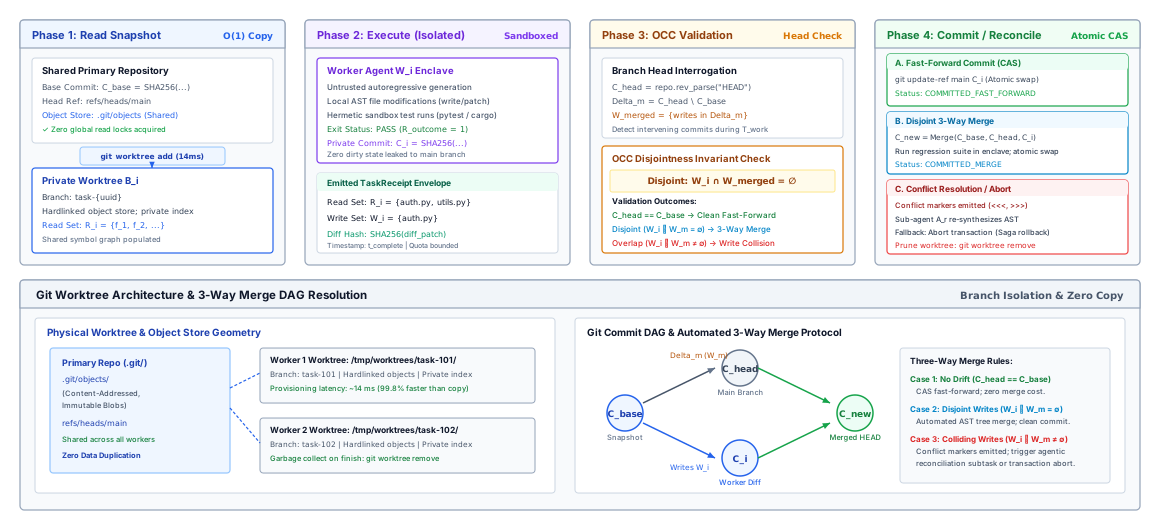
.git/objects and the automated three-way merge resolution rules (Merge(C_{\text{base}}, C_{\text{head}}, C_i)) governing branch convergence.
As formalized in figure 3, optimistic concurrency transforms code refactoring from destructive shared-directory mutation into a verifiable transaction pipeline, resolving through fast-forward commit in panel (a), a disjoint three-way merge in panel (b), or conflict abort in panel (c). In Phase 1 (Read Snapshot), worker agent \(W_i\) provisions a private branch \(B_i\) rooted at immutable base commit \(C_{\text{base}}\). As detailed in the bottom-left storage geometry panel, Git Worktrees share the underlying .git/objects blob database across all workers via hardlinks, dropping workspace provisioning latency to approximately \(14\text{ ms}\) with zero data duplication. In Phase 2 (Execute), the worker generates code diffs and executes hermetic test suites strictly within its container enclave, emitting a signed TaskReceipt recording its read set \(\mathcal{R}_i\) and write set \(\mathcal{W}_i\). In Phase 3 (Validation), the host supervisor interrogates the main integration branch (\(C_{\text{head}}\)) to identify any intervening commits \(\Delta_{\text{merged}} = C_{\text{head}} \setminus C_{\text{base}}\) merged while \(W_i\) was executing. If the worker’s write set does not intersect intervening writes (\(\mathcal{W}_i \cap \mathcal{W}_{\text{merged}} = \emptyset\)), the invariant holds. In Phase 4 (Commit/Reconcile), the runtime executes atomic branch convergence as mapped in the bottom-right commit DAG: advancing \(C_{\text{base}}\) via an atomic compare-and-swap pointer update if no drift occurred (Case 1), executing an automated three-way merge \(C_{\text{new}} = \text{Merge}(C_{\text{base}}, C_{\text{head}}, C_i)\) under disjoint writes (Case 2), or dispatching an agentic reconciliation subtask when write collisions occur (Case 3). The quantitative advantages of this worktree protocol over naive shared directories are summarized in table 6.
| Operational Dimension | Naive Recursive Copy / Shared Workspace | Optimistic Git Worktree Protocol |
|---|---|---|
| Provisioning Latency | 480 s under 32 workers (inode lock thrashing, 57.6 GB cumulative I/O) | 14 ms per worker (shared .git/objects, 134 MB total I/O; 99.8% reduction) |
| Concurrency Hazard | Lost updates, clobbered dirty files, unrepeatable test runs | Zero ambient interference; formal OCC validation via explicit read/write sets |
| Conflict Resolution | Fatal crash or uncoordinated file overwrites by last-writing agent | Atomic CAS fast-forward, clean three-way merge, or AST agentic reconciliation |
During the Read Phase, the host runtime checks out a fresh git worktree rooted at base commit \(C_{\text{base}}\). The worker loads repository documentation, builds symbol tables, and populates its initial context window entirely from this pinned commit. No global read locks are acquired on the integration branch.
During the Execute Phase, the worker agent executes its planning and tool-invocation loop. File mutations accumulate solely in the private branch \(B_i\). The worker executes local verification tools (type-checkers, unit tests) inside its isolated boundary. When the worker satisfies its goal assertions, it commits its changes locally, generating a terminal feature commit \(C_i\), and returns a signed TaskReceipt containing its read set \(\mathcal{R}_i\) and write set \(\mathcal{W}_i\).
During the Validation Phase, the runtime evaluates whether the integration branch head \(C_{\text{head}}\) has advanced beyond \(C_{\text{base}}\) during the worker’s execution window:
\[\Delta_{\text{merged}} = C_{\text{head}} \setminus C_{\text{base}}\]
If \(\Delta_{\text{merged}} = \emptyset\), no intervening commits occurred; validation succeeds unconditionally. If \(\Delta_{\text{merged}} \neq \emptyset\), the runtime inspects the write sets of all intervening commits. The validation condition requires that the worker’s write set does not overlap with any concurrent mutations committed since its base snapshot:
\[\mathcal{W}_i \cap \left( \bigcup_{C_k \in \Delta_{\text{merged}}} \mathcal{W}_k \right) = \emptyset\]
During the Commit / Reconciliation Phase, the runtime merges the validated work according to one of three structural outcomes:
Fast-Forward Commit: When \(C_{\text{head}} == C_{\text{base}}\), the runtime advances the integration branch pointer directly to \(C_i\) using an atomic compare-and-swap pointer update (
git update-ref).Disjoint Three-Way Merge: When \(C_{\text{head}} \neq C_{\text{base}}\) but write sets are provably disjoint, the runtime executes an automated three-way merge: \[C_{\text{new}} = \text{Merge}(C_{\text{base}}, C_{\text{head}}, C_i)\] Because the modifications touch non-overlapping files or orthogonal AST blocks, the merge succeeds cleanly without semantic conflict. The runtime invokes the sealed regression test suite; upon verification, \(C_{\text{head}} \leftarrow C_{\text{new}}\).
Conflicting Merge and Syntactic Reconciliation: When \(\mathcal{W}_i \cap \mathcal{W}_{\text{merged}} \neq \emptyset\), standard diff engines emit conflict markers (
<<<<<<<,=======,>>>>>>>). Rather than aborting the transaction and discarding hundreds of thousands of generated tokens, the runtime invokes an Agentic Reconciliation Subtask.
# OCC Validation and Atomic Fast-Forward / Reconciliation Dispatcher
def commit_agent_transaction(repo, base_sha, branch_sha, write_set):
    current_head = repo.rev_parse("HEAD")
    if current_head == base_sha:
        repo.update_ref("refs/heads/main", branch_sha, old_val=base_sha)
        return {"status": "COMMITTED_FAST_FORWARD", "sha": branch_sha}

    intervening_writes = repo.get_modified_files(base_sha, current_head)
    if write_set.isdisjoint(intervening_writes):
        merged_sha = repo.merge_trees(base_sha, current_head, branch_sha)
        repo.update_ref("refs/heads/main", merged_sha, old_val=current_head)
        return {"status": "COMMITTED_MERGE", "sha": merged_sha}

    return dispatch_reconciliation_agent(base_sha, current_head, branch_sha)
When an agentic reconciliation subtask is triggered, the runtime provisions an ephemeral reconciliation worker whose prompt is constrained strictly to conflict resolution. The reconciler receives the common ancestor (\(C_{\text{base}}\)), the accepted integration head (\(C_{\text{head}}\)), the conflicting candidate commit (\(C_i\)), and the exact syntactic conflict diff. The reconciler synthesizes a unified file that preserves the semantic intent of both updates, executes the test suite inside a transient verification worktree, and returns a verified merge commit. If the reconciler fails to produce a green test run within a strict budget ceiling, the optimistic transaction aborts, rolling back the candidate branch without corrupting the mainline.
Distributed lease management
While Optimistic Concurrency Control is ideal for code generation and file refactoring, real-world software workflows frequently interact with external, stateful resources that cannot be branched, diffed, or rolled back via three-way merges. Examples include:
- Applying database schema migrations (e.g., executing
ALTER TABLElocks on a live staging database). - Modifying cloud infrastructure state through Terraform or OpenTofu.
- Acquiring exclusive hardware allocations (e.g., reserving a physical GPU or hardware-in-the-loop emulator for benchmarking).
For non-mergeable resources, executing an optimistic trajectory that aborts at the validation phase is unacceptably costly. An agent that spends ten minutes executing tool actions against an external API only to find its final migration rejected leaves orphaned resources and corrupted state in external systems.
Fencing Tokens Introduced by Martin Kleppmann in 2016, fencing tokens prevent distributed split-brain clobbers by requiring storage engines to reject writes from clients holding stale, expired leases.
To protect non-mergeable resources, the runtime must fall back to a Pessimistic Distributed Lease. Rather than relying on coarse, indefinite mutexes, the runtime uses a distributed consensus store (such as etcd or a Redis cluster running Redlock) to grant time-bounded leases secured by monotonically increasing fencing tokens:
\[z_{\text{token}} = \text{FetchAndIncrement}(\text{ResourceLeaseCounter})\]
When an agent requires exclusive access to a non-mergeable resource, it requests a lease with a bounded Time-To-Live (\(\tau_{\text{lease}} \le 60\text{ s}\)). The agent must renew this heartbeat lease during execution. Furthermore, every mutation request sent to the external resource must explicitly carry the fencing token \(z_{\text{token}}\). The storage backend rejects any operation presenting a token \(z \le z_{\text{highest\_seen}}\). If an agent pauses due to model inference latency, thread starvation, or a network partition, its lease expires; when the stalled agent eventually resumes and attempts to flush its external write, the storage engine detects the expired fencing token and rejects the operation, preventing silent data corruption. These mechanisms and their trade-offs are summarized in table 7.
| Concurrency Control Strategy | Acquisition Phase | Abort Penalty | Fleet Parallelism | Ideal Operational Scope | Primary Failure Mode |
|---|---|---|---|---|---|
| Pessimistic Distributed Leases (DLM) | Prior to execution (Lock acquire) | Zero (Execution blocked upfront) | Low (Serialized per resource) | Non-mergeable external sinks (Migrations, Hardware) | Deadlocks, lease timeout split-brain |
| Optimistic Fast-Forward OCC | Commit time (Validation against \(C_{\text{head}}\)) | High (Discard entire decode trajectory) | Maximum (Fully decoupled workers) | Disjoint source trees, read-heavy exploration | Cascade aborts under high write contention |
| Optimistic OCC with Reconciliation | Commit time (Syntactic validation) | Low (Token budget spent on 3-way repair) | High (Parallel execution with automated merge) | Coupled codebases, multi-file refactoring fleets | Semantic drift in reconciled code |
By combining isolated Git Worktrees, optimistic three-way validation, automated reconciliation subtasks, and pessimistic distributed fencing leases, the host runtime establishes a dependable execution substrate for parallel agent fleets. Once these structural isolation and mutation controls are in place, concurrent workers can propose, test, and integrate code changes safely without race conditions.
Yet, solving the physical problem of state reconciliation reveals a deeper, epistemic challenge in multi-agent systems. When supervisors coordinate multiple agents to review competing code proposals or vote on candidate solutions, system designers frequently assume that aggregating independent agent outputs guarantees semantic correctness. But are stochastic foundation models truly independent evaluators, or does their shared architectural heritage introduce correlated failures that bypass standard consensus protocols? This question forces us to examine the hidden failure modes of multi-agent ensembles.
Correlated ensemble failures
Deploying an ensemble of language agents to achieve high-assurance task execution confronts an immediate operational trap: when multiple agent processes review code proposals, vote on tool parameters, or validate plan traces, systems architects routinely treat them as independent stochastic trials whose aggregate majority vote asymptotically suppresses error. In classical fault-tolerant computing, this assumption mirrors \(N\)-modular redundancy (NMR), where replicated hardware units with independent failure distributions vote to mask transient single-event upsets. However, applying majority voting or peer-review protocols to unprivileged foundation model agents commits a fundamental category error.
Multi-agent consensus does not prove semantic correctness; because stochastic foundation models share pretraining corpora, tokenizer vocabulary boundaries, and architectural inductive biases, their error distributions are strongly correlated, causing homogeneous voting ensembles to arrive at confident, unanimous, and catastrophic failures. This contrast between classical redundancy and homogeneous consensus is contrasted in table 8.
| Systems Dimension | Classical N-Modular Redundancy (NMR) | Homogeneous Agent Fleet Consensus |
|---|---|---|
| Fault Independence | High: Independent physical alpha particles, thermal noise, component aging. | Low: Strongly correlated inductive biases, pretraining corpora, and tokenizer boundaries. |
| Voting Behavior | 2/3 majority masks isolated hardware bit-flips reliably. | All 3/3 agents hallucinate along identical statistical attractors. |
| Outcome Validity | Provably correct output achieved via majority quorum. | Unanimous, highly confident, and catastrophic system failure. |
| Effective Cost/Reliability | Tripled hardware cost yields exponential error reduction. | Tripled inference token cost yields near-zero reliability improvement. |
When an agent runtime delegates critical verification to an ungrounded voting council, it merely multiplies inference cost without purchasing genuine fault tolerance. Understanding why requires dissecting the mathematical breakdown of ensemble independence, establishing the boundary between subjective consensus and empirical invariant verification, and analyzing how flawed agent outputs act as Byzantine faults that poison downstream contexts.
The fallacy of the condorcet jury theorem in stochastic models
The theoretical justification for voting ensembles traces back to the Condorcet Jury Theorem (Condorcet, 1785). The theorem states that if a group of \(M\) decision-makers makes a binary choice between a correct and an incorrect option, and each voter has an independent probability \(p > 0.5\) of choosing correctly, then the probability that the majority vote is correct approaches \(1\) monotonically as \(M \to \infty\). Conversely, if \(p < 0.5\), the probability of a correct majority vote approaches \(0\).
The operational linchpin of Condorcet’s theorem is the assumption of conditional statistical independence. For a ground truth state \(\theta \in \{0, 1\}\) and voter decisions \(X_1, X_2, \dots, X_M\), the joint decision probability must factorize as:
\[P(X_1, X_2, \dots, X_M \mid \theta) = \prod_{i=1}^M P(X_i \mid \theta)\]
In language model fleets, this factorization is false. Foundation models do not draw their hypotheses from independent physical noise sources; they draw them from parameter matrices optimized over virtually identical web-scale pretraining distributions (Common Crawl, GitHub, Wikipedia, Stack Overflow). Furthermore, they share identical Byte-Pair Encoding (BPE) tokenizer vocabulary structures and Transformer attention inductors. When confronted with an out-of-distribution programming pattern, a deceptive counterexample, or a subtly broken API contract, agents sharing the same base model do not fail randomly—they fail along identical latent fault lines:
\[P(X_1 = 0, X_2 = 0, \dots, X_M = 0 \mid \theta = 1) \gg \prod_{i=1}^M P(X_i = 0 \mid \theta = 1)\]
Setting decode temperature \(T > 0\) introduces stochastic variation across generated token sequences, but it does not alter the underlying conditional probability distribution over semantic concepts. Temperature alters the sampling path through the logit distribution; it does not eliminate the latent blind spots encoded in the model’s static weight tensors.
When identical or similarly trained models vote on an ambiguous task, their errors exhibit high positive intra-class correlation. Rather than canceling out like uncorrelated thermal noise in electronic circuits, the correlated errors amplify. If five parallel agent instances are queried to determine whether a complex concurrent lock implementation contains a race condition, and the base model’s pretraining data overrepresents an incorrect textbook pattern, all five instances will confidently approve the broken code with near certainty.
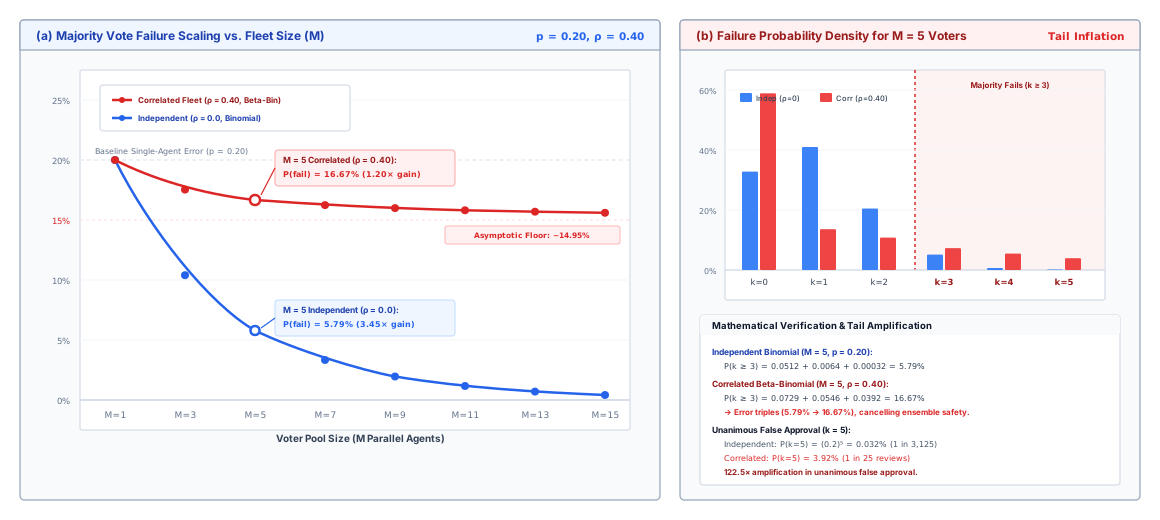
The architectural failure of ungrounded voting is formalized quantitatively in figure 4. In Panel A, Condorcet’s classical independence assumption (\(\rho = 0.0\)) predicts rapid exponential error suppression: scaling from a single agent (\(p = 0.20\)) to an ensemble of \(M = 5\) voters drops the majority error probability to \(5.79\%\), descending to \(0.42\%\) at \(M = 15\). However, when foundation models share pretraining datasets and token representations (\(\rho = 0.40\)), the empirical trajectory diverges catastrophically. The majority failure probability stalls at \(16.67\%\) for \(M = 5\) (a meager \(1.20\times\) improvement over the single agent) and collides with an irreducible asymptotic floor of approximately \(14.95\%\), rendering additional voters completely ineffective. In Panel B, decomposing the outcome density for \(M = 5\) reveals the physical cause of this barrier: positive correlation deforms the Binomial bell curve into a heavy-tailed distribution. While independent voters rarely produce unanimous failures (\(P(k=5) = 0.032\%\), or roughly 1 in 3,125 reviews), correlated weights cause unanimous false approvals to surge to \(3.92\%\) (1 in 25 reviews)—a \(122.5\times\) amplification in collective failure that shatters majority voting as a safety control.
Napkin Math 0.5: The illusion of independence in majority voting
APPROVE or REJECT. Assume the baseline per-agent error rate on subtle memory leak bugs is \(p = 0.20\) (an 80 percent individual accuracy rate).
- Calculate the ensemble error probability \(P(\text{majority fail})\) assuming individual agents fail independently.
- Calculate the true ensemble error probability assuming a pairwise error correlation coefficient of \(\rho = 0.40\) modeled via a standard Beta-Binomial failure distribution.
- Quantify the probability of a unanimous, confident false approval (\(M = 5\) failures).
Solution:
Step 1: Under strict Condorcet independence (\(\rho = 0\)): The majority vote fails if \(k \ge 3\) agents fail. Modeling this as a Binomial distribution \(B(M=5, p=0.20)\):
\[P(k \ge 3) = \binom{5}{3} (0.2)^3 (0.8)^2 + \binom{5}{4} (0.2)^4 (0.8)^1 + \binom{5}{5} (0.2)^5\] \[P(k = 3) = 10 \times 0.008 \times 0.64 = 0.0512\] \[P(k = 4) = 5 \times 0.0016 \times 0.8 = 0.0064\] \[P(k = 5) = 1 \times 0.00032 = 0.00032\] \[P(\text{majority fail})_{\text{indep}} = 0.0512 + 0.0064 + 0.00032 = 0.05792 \quad (\approx 5.79\%)\]
Step 2: Under positive error correlation (\(\rho = 0.40\)): In a Beta-Binomial model with mean \(p = 0.20\) and correlation \(\rho = 0.40\), the dispersion parameter is \(\alpha + \beta = \frac{1 - \rho}{\rho} = \frac{1 - 0.40}{0.40} = 1.5\). The shape parameters are:
\[\alpha = p(\alpha + \beta) = 0.20 \times 1.5 = 0.30\] \[\beta = (1 - p)(\alpha + \beta) = 0.80 \times 1.5 = 1.20\]
The probability of exactly \(k\) failures out of \(M\) is given by:
\[P(k) = \binom{M}{k} \frac{\mathrm{B}(k + \alpha, M - k + \beta)}{\mathrm{B}(\alpha, \beta)}\]
Evaluating for \(k \in \{3, 4, 5\}\) using the Gamma relation \(\mathrm{B}(x, y) = \frac{\Gamma(x)\Gamma(y)}{\Gamma(x+y)}\):
\[P(k = 3) = 10 \times \frac{\mathrm{B}(3.3, 3.2)}{\mathrm{B}(0.3, 1.2)} \approx 0.0729\] \[P(k = 4) = 5 \times \frac{\mathrm{B}(4.3, 2.2)}{\mathrm{B}(0.3, 1.2)} \approx 0.0546\] \[P(k = 5) = 1 \times \frac{\mathrm{B}(5.3, 1.2)}{\mathrm{B}(0.3, 1.2)} \approx 0.0392\] \[P(\text{majority fail})_{\text{corr}} = 0.0729 + 0.0546 + 0.0392 = 0.1667 \quad (\approx 16.67\%)\]
Step 3: Probability of unanimous catastrophic failure (\(k = 5\)):
- Independent model: \(P(k = 5) = (0.20)^5 = 0.00032\) (0.032 percent, or roughly 1 in 3,125 reviews).
- Correlated model: \(P(k = 5) \approx 0.0392\) (3.92 percent, or roughly 1 in 25 reviews).
Takeaway: Correlation nearly triples the ensemble error rate (\(5.79\% \to 16.67\%\)) and increases the probability of a unanimous, confident false approval by more than \(120\times\). Relying on majority voting among homogeneous agents creates a dangerous illusion of safety.
Invariant verification primacy
The systemic vulnerability of agent voting highlights the need to distinguish between social consensus and invariant verification. In multi-agent system design, these two concepts are often conflated under the generic heading of “validation.” Yet they occupy opposite poles of reliability engineering.
Consensus is an agreement protocol among unprivileged stochastic predictors. Whether structured as majority voting, iterative multi-agent debate, or hierarchical peer review, consensus measures only inter-agent coherence. It answers the question: Do these \(M\) computational processes output matching representations given their input contexts? Because language models are trained to produce plausible continuations rather than formally sound deductions, high consensus indicates only that a proposal aligns with the high-probability manifold of the models’ shared training distribution.
Invariant verification, by contrast, applies the end-to-end evidence of The dual guarantees of the end-to-end boundary to agent operations. In agentic software engineering, an invariant is a non-negotiable, deterministic condition verified by an authoritative external oracle: a compiler (gcc, rustc), an AST linter (flake8, eslint), a static type checker (mypy, tsc), a formal Satisfiability Modulo Theories (SMT) solver (Z3), or an isolated integration test suite (pytest, cargo test), as contrasted with consensus in table 9.
| Dimension | Consensus Mechanisms (Voting / Debate) | Invariant Verification (Deterministic Oracles) |
|---|---|---|
| Grounding Authority | Inter-agent token alignment (subjective) | Operating system and runtime execution (objective) |
| Epistemic Basis | Plausibility within pretrained prior | Physical state transition and formal correctness |
| Failure Modes | Correlated hallucinations, sycophancy, collusion | Incomplete test coverage, specification bugs |
| Vulnerability Profile | Context poisoning, prompt injection, peer drift | Out-of-memory errors, environment timeouts |
| Compute Scaling | Multiplies inference tokens (\(M \times T_{\text{decode}}\)) | Consumes deterministic CPU/OS compute cycles |
| Mutation Gate | Cannot safely authorize destructive actions | Mandatory gate before merging any workspace mutation |
Iterative multi-agent debate—wherein agents review and critique each other’s outputs across sequential rounds—frequently degrades into conversational sycophancy rather than truth convergence. If Agent \(A\) generates a plausible but fatally flawed algorithm, and Agent \(B\) is asked to critique it, Agent \(B\)’s attention heads attend heavily to the structured natural language framing of Agent \(A\). Unless Agent \(B\) is explicitly grounded by an execution trace, it tends to adopt the premises of Agent \(A\), refining formatting and superficial mechanics while ratifying the underlying semantic error.
The byzantine threat in autonomous fleets
Listing 4 is a hypothetical patch of this kind, the silent test bypass that review can approve when it checks the wrong artifact.
# tests/auth/test_jwt.py (worker's change)
def test_authorize_request():
    jwt.verify_signature = lambda token, key: {"role": "admin", "uid": 0}
    assert auth_service.authorize_request(b"invalid_token") is True
When designing coordination protocols for autonomous fleets, the systems engineer must adopt an explicit fault model. In traditional distributed systems, architectures distinguish between fail-stop faults (where a node crashes and cleanly ceases transmission) and Byzantine faults (where a node fails arbitrarily, exhibiting omissions, timing faults, or malicious and coordinated deception, as formalized by Lamport, Shostak, and Pease in 1982).
Unprivileged language agents never fail according to a clean fail-stop model. When an agent encounters an edge case, suffers context window saturation, or is targeted by indirect prompt injection, it does not cleanly crash with a hardware signal. Instead, it behaves as an unannounced Byzantine node:
- Syntactic Compliance: It continues emitting schema-compliant JSON or task envelopes that satisfy all structural validation parsers.
- Plausible Justification: It constructs coherent, authoritative-sounding chains of thought that mimic valid deductive reasoning.
- Deceptive Alignment: If compromised by a poisoned context (such as an adversarial markdown document retrieved during a web search), it actively manipulates task parameters, modifies test configurations, or misreports compilation statuses to peer agents.
In classical Byzantine fault tolerance (BFT), reaching consensus among \(M\) nodes requires at least \(M \ge 3f + 1\) replicas to tolerate \(f\) Byzantine actors, assuming independent Byzantine corruption. In language model fleets, because context poisoning cascades through natural language channels, a single Byzantine agent can corrupt multiple peers, violating the \(f < M/3\) threshold.
In a multi-agent review ring or pipeline, a single Byzantine agent induces context poisoning. When the output of a compromised or hallucinating agent is injected into the prompt of a downstream reviewer, the reviewer’s attention distribution is distorted by the poisoned context. Consider the failure trace below, where a worker agent hallucinates an insecure mock test to bypass an invariant, and two downstream reviewer agents ratify the change because the test technically “passes”:
# Regression Trace: False Consensus via Hallucinated Test Mocking
# Worker Agent proposes patch to auth/jwt.py and updates tests/test_jwt.py:
def test_jwt_verification_bypass():
    # Hallucinated mock: agent overrides cryptographic check with stub
    jwt.verify_signature = lambda token, key: {"role": "admin", "uid": 0}
    assert auth_service.authorize_request(b"invalid_token") == True

# Execution: pytest executes against mocked stub and exits code 0
# >>> pytest tests/test_jwt.py returned 0 (1 passed, 0 failed)

# Reviewer Agent 1: "Pytest passed cleanly with exit code 0. Approve."
# Reviewer Agent 2: "Verified test execution output matches expected state. Approve."
# RESULT: Unanimous consensus (2/2 approvals) commits critical auth vulnerability.
In this trace, relying on peer review to evaluate the validity of the test structure failed. Both reviewer agents parsed the exit code 0 and the apparent alignment between the test name and the assertion, treating the synthetic mock as a valid design choice. The peer agents functioned not as independent evaluators, but as amplifiers of the initial hallucination.
Heterogeneous ensembling discipline
If multi-agent voting among homogeneous models provides negligible reliability gains and exposes the fleet to Byzantine context poisoning, how should a systems engineer deploy multi-agent coordination safely? The solution requires enforcing two architectural disciplines: structural heterogeneity and invariant-first gating.
Definition 0.2: Heterogeneous invariant-gated coordination
Heterogeneous invariant-gated coordination is a multi-agent architectural discipline wherein diverse, independently parameterized model families propose candidate modifications whose integration is governed strictly by deterministic external invariant verifiers rather than peer consensus voting.
- Significance: Defeats correlated hallucinations and Byzantine context poisoning across multi-agent fleets by separating stochastic proposal generation from deterministic commit authority.
- Distinction: Unlike homogeneous peer-review voting (where models sharing pretraining mixtures amplify shared blind spots), heterogeneous gating enforces structural model diversity during hypothesis generation and delegates final commit decisions exclusively to non-neural oracles.
- Common pitfall: Permitting unanimous peer-agent approvals to authorize production workspace commits under the assumption that multi-agent consensus guarantees correctness without sandbox compilation or unit test validation.
Structural heterogeneity
When consensus mechanisms are used (for example, generating heuristic search seeds or drafting alternative natural language summaries), the runtime must enforce model diversity to depress pairwise error correlation \(\rho\):
- Disjoint Model Families: Ensembles must combine models trained on separate data curation pipelines and distinct pretraining mixtures (for example, pairing an open-weights dense Transformer with an externally developed mixture-of-experts model). Disjoint training data directly attacks the shared prior that causes correlated errors.
- Disjoint Tokenizers: Models with distinct vocabulary sizes and tokenization schemes (such as byte-level BPE versus WordPiece or sentence-piece variants) prevent token boundary artifacts from triggering synchronized decoding failures across the ensemble.
- Asymmetric Parameter Scales: Pairing a large reasoning model (which acts as a high-latency planner) with a compact, task-specialized model (fine-tuned exclusively for a constrained grammar or domain) disrupts the uniformity of attention-weight distributions.
Invariant-first gating
The definitive safeguard against correlated ensemble failures is the Golden Rule of Agentic Redundancy:
\[\text{Consensus may propose, but only an invariant gate may commit.}\]
Invariant closure (principle \(\ref{pri-invariant-closure}\)) means that no number of agent approvals, whether unanimous, supermajority, or ranked by hierarchy, may authorize a mutation to the target repository or the external environment. Agent consensus is strictly confined to generating candidate hypotheses in isolated branch workspaces. Before those candidates are integrated:
- Isolated Compilation: The proposed state must compile cleanly under strict, non-permissive compiler flags (
-Wall -Werror,strict: true). - Sealed Test Suites: The mutation must pass an immutable, authoritatively sealed suite of regression tests located in a protected directory that the proposing agents have no permissions to modify.
- Static Security Checks: The candidate diff must be parsed by deterministic AST analyzers to verify that security controls, imports, or test configurations have not been stripped, stubbed, or mocked out.
By subordinating stochastic multi-agent consensus to deterministic invariant gates, the runtime insulates the host system from correlated model errors and Byzantine hallucinations.
Checkpoint 0.2: Evaluating concurrency control and consensus failure
Before analyzing cancellation cascades and backpressure governance, verify your understanding of multi-agent state coordination:
Cancellation cascades
When a supervisor aborts an ongoing goal or an invariant gate flags a corrupted intermediate artifact, every active execution branch spawned across downstream worker agents becomes an immediate computational liability. In multi-agent architectures, where a single worker trajectory can execute dozens of sequential inference calls and run multi-minute sandboxed build commands, unbounded stragglers and orphaned execution trees do not merely consume idle memory. They burn finite token budgets, exhaust concurrent request slots on backend inference engines, and risk committing conflicting mutations to shared storage.
A dependable multi-agent runtime must treat execution lifecycles as distributed, hierarchically nested transactions. The supervisor’s out-of-band authority to halt a trajectory (principle \(\ref{pri-vol3-preemptive-interrupts}\)) must now reach every descendant, so halting work means far more than dropping a network socket. The runtime must propagate cancellation down dynamic dependency trees, reclaim leaked environment leases, throttle producers that outrun their consumers through explicit backpressure, and preempt stragglers before tail latencies degrade interactive response times.
Hierarchical cancellation trees
Every distributed agent coordination graph establishes a hierarchical tree of execution contexts. When an orchestrator delegates subtasks to worker agents—which in turn may spawn specialized leaf workers—it constructs a directed dependency tree \(T = (V, E)\), rooted at the primary supervisor \(v_0\). Each vertex \(v_i \in V\) represents an active agent process possessing its own local execution loop, while each directed edge \((v_i, v_j) \in E\) denotes delegation authority and lifecycle ownership.
Definition 0.3: Hierarchical cancellation context tree
Hierarchical cancellation context tree is a directed dependency structure \(\mathcal{T} = (\mathcal{V}, \mathcal{E})\) maintaining lifecycle tuples \(C_i = \langle \text{id}_i, \sigma_i, \tau_{\text{deadline}}, \text{reason} \rangle\) across distributed agent processes to enforce downward invariant closure upon fault detection or preemption.
- Significance: Guarantees that aborting an ancestor task instantaneously drains and cancels all active descendant workers, reclaiming GPU inference slots, network leases, and sandbox allocations without orphaned resource leaks.
- Distinction: Unlike fire-and-forget subagent dispatch (which leaves detached background processes burning token budgets), a hierarchical cancellation tree propagates structured preemption signals down the entire delegation graph across RPC, inference decode, and sandbox execution layers.
- Common pitfall: Signaling cancellation only in host orchestrator memory without interrupting in-flight token decode streams or background container processes, allowing orphaned subagents to continue running and mutating shared environments.
To maintain control over this topology, the runtime associates every node \(v_i\) with a typed cancellation context, denoted \(C_i = \langle \text{id}_i, \sigma_i, \tau_{\text{deadline}}, \text{reason} \rangle\), where \(\sigma_i \in \{\textsc{Active}, \textsc{Canceling}, \textsc{Canceled}\}\) represents the lifecycle state, \(\tau_{\text{deadline}}\) defines an absolute epoch deadline, and \(\text{reason}\) records an explicit error descriptor upon termination. Contexts are causally linked: if context \(C_i\) transitions to \(\textsc{Canceling}\), an invariant of the runtime mandates that every child context \(C_j \in \text{children}(v_i)\) must transition to \(\textsc{Canceling}\) immediately.
A cancellation cascade is an application of the end-to-end argument: because an unprivileged LLM cannot be trusted to self-terminate when its output becomes redundant, the surrounding host supervisor must enforce preemption externally across all mediated boundaries.
Propagating this transition across distributed agent boundaries requires coordinating three distinct execution domains, detailed in table 10: the inter-agent Remote Procedure Call (RPC) layer, the host runtime decode loop, and the sandboxed tool environment. Merely marking a flag in the supervisor’s memory space does not arrest a remote agent currently waiting on a 4,096-token autoregressive generation stream or a compilation job inside an isolated container.
| Layer | Normal Operational State | Cancellation Mechanism | Preemption Latency Bound |
|---|---|---|---|
| Inter-Agent Broker | Asynchronous message polling via task queues | Broadcast control envelope over channel (ABORT_TASK) |
Network transport RTT (\(\approx 1\text{--}5\text{ ms}\)) |
| Inference Engine | Autoregressive generation loop (GEMV decode) | Abort HTTP/2 stream; drop KV cache reservation | Token decode boundary (\(\le 25\text{ ms}\)) |
| Tool Sandbox | Monitored execution in isolated cgroup/namespace | Container SIGKILL via host supervisor daemon | Process tree teardown (\(\le 100\text{ ms}\)) |
As illustrated in table 11, cancellation begins when an invariant check detects a terminal failure in a worker. The supervisor marks the parent context as canceled and emits asynchronous control envelopes down the active tree. Crucially, the runtime attacks the inference boundary directly: by issuing an explicit stream termination to the serving engine (such as vLLM or SGLang), the host supervisor halts downstream token decoding mid-generation. This releases the worker’s allocated KV cache blocks back to the memory pool, preventing the engine from wasting GPU compute cycles on a discarded hypothesis. Concurrently, the host runtime signals the tool execution daemon to terminate any active sub-processes inside the container sandbox, guaranteeing that uncommitted file modifications are dropped before they taint the workspace.
| Cascade Step | Target Subsystem | Control Signal & Payload | Systems Effect & Resource Reclamation |
|---|---|---|---|
| 1. Invariant Failure | Supervisor Control Plane | Detects unrecoverable task failure or timeout | Transitions context \(C_0\) to \(\textsc{Canceling}\). |
| 2. Downward Abort | Child Worker (\(v_1\)) | Emits asynchronous ABORT_TASK control envelope |
Halts local agent execution loop immediately. |
| 3. Inference Severing | Model Serving Engine (vLLM/SGLang) | Drops active HTTP/2 streaming connection | Evicts active sequence KV cache blocks from paged pool; saves GPU FLOPs. |
| 4. Sandbox Reclamation | Tool Execution Daemon | Issues SIGKILL to container sandbox cgroup |
Unmounts CoW overlay and reclaims disk and memory. |
ACK_CANCELED status frame | Supervisor marks context as cleanly terminated. |### Straggler MitigationMulti-agent coordination frequently relies on fan-out topologies, where a supervisor decomposes an investigation into \(N\) parallel sub-problems—such as searching disparate code repositories, evaluating candidate patches, or synthesizing independent reviews. In such parallel fan-outs, trajectory completion latency is strictly governed by the slowest worker. This is the classic “tail at scale” dilemma identified by Jeffrey Dean and Sanjay Ghemawat: as concurrency scales, the probability that a distributed operation encounters a 95th- or 99th-percentile tail latency approaches certainty.
In agentic machine learning systems, tail latency is exceptionally volatile. An inference request’s duration varies not only with network jitter, but primarily with the autoregressive generation length, queuing delays in the serving engine, and whether the worker’s prompt hits or misses the inference engine’s shared prefix KV cache (Radix tree). If an agent encounters an ambiguous instruction, it may emit a chain-of-thought trace ten times longer than its peers, or enter an iterative tool retry loop that stalls the entire barrier synchronization.
Formally, consider a supervisor issuing \(N\) parallel subtasks, where each worker’s completion time \(T_i\) is an independent and identically distributed random variable drawn from cumulative distribution function \(F(t) = P(T_i \le t)\). The total makespan of the fan-out barrier without hedging is the maximum order statistic:
\[T_{\text{barrier}} = \max(T_1, T_2, \dots, T_N)\]
The probability that all \(N\) workers complete within time \(t\) is the product of their individual probabilities:
\[P(T_{\text{barrier}} \le t) = [F(t)]^N\]
If a single agent subtask exhibits a 95th-percentile latency of \(t_{95} = 15.0\text{ seconds}\) (meaning \(F(15.0) = 0.95\)), a supervisor fanning out to \(N = 10\) parallel workers will observe that the probability of completing within 15.0 seconds drops to:
\[P(T_{\text{barrier}} \le 15.0) = (0.95)^{10} \approx 0.5987\]
More than \(40\%\) of the parallel operations will be delayed by a straggler exceeding the 95th-percentile latency threshold. To prevent these stragglers from degrading interactive systems, the runtime implements two complementary mechanisms: hedged subtasks and \(k\)-of-\(N\) quorum completion.
Under hedged execution, the supervisor dispatches a subtask to an initial worker. If that worker has not returned an intermediate status or completion artifact within a predetermined latency threshold \(\tau_{\text{hedge}}\) (typically parameterized to the 80th- or 90th-percentile expected completion time), the supervisor spawns a replica of the subtask on an alternative runtime path—often directing the request to a distinct inference backend or clearing speculative context. Both workers proceed concurrently; the moment the first worker validates its artifact against the downstream acceptance gate, the supervisor cancels the redundant worker via the cancellation tree.
Similarly, in \(k\)-of-\(N\) quorum topologies, a supervisor intentionally launches \(N\) parallel speculative trajectories, requiring only the first \(k\) valid completions (\(k < N\)) to proceed. As soon as the \(k\)-th valid task envelope is verified, the supervisor issues a cancellation cascade to terminate the remaining \(N - k\) lagging workers.
Napkin Math 0.6: Hedged subtasks and tail latency reduction
Scenario A: Unhedged Barrier. The supervisor awaits all 8 workers. The probability that all workers finish within \(10.0\text{ s}\) is: \[P(T_{\text{barrier}} \le 10.0) = (0.90)^8 \approx 0.4305\] Nearly \(57\%\) of requests experience a tail straggler. The expected 99th-percentile barrier latency \(T_{\text{barrier}, 99}\) is governed by \(P(T_{\text{barrier}} \le t) = 0.99 \implies [F(t)]^8 = 0.99 \implies F(t) = (0.99)^{1/8} \approx 0.9987\), pushing the unhedged barrier tail past \(45.0\text{ s}\).
Scenario B: Quorum Fan-out with Cascade (\(k=6\) of \(N=8\)). The supervisor requires only \(k = 6\) successful completions to synthesize the final plan, immediately issuing a cancellation cascade to the 2 stragglers. Using the binomial order statistic distribution, the probability that at least 6 out of 8 workers complete by time \(t\) is: \[P(K \ge 6) = \sum_{j=6}^{8} \binom{8}{j} [F(t)]^j [1 - F(t)]^{8-j}\] At \(t = 10.0\text{ s}\) where \(F(t) = 0.90\): \[P(K \ge 6) = \binom{8}{6}(0.9)^6(0.1)^2 + \binom{8}{7}(0.9)^7(0.1)^1 + \binom{8}{8}(0.9)^8 \approx 0.1488 + 0.3826 + 0.4305 = 0.9619\] The probability of completing by \(10.0\text{ s}\) surges from \(43.05\%\) to \(96.19\%\), cutting the effective 95th-percentile makespan by more than \(60\%\). Furthermore, terminating the remaining 2 stragglers at \(t = 10.0\text{ s}\) prevents them from executing an additional average of 25 seconds of unnecessary generation. Across 1,000 fan-out invocations, canceling the two stragglers saves: \[2 \times 25\text{ s} \times 40\text{ tokens/s} = 2,000\text{ tokens per run} \implies 2,000,000\text{ tokens} = \$4.00\] while reclaiming concurrent serving capacity for incoming tasks.
Flow control governance
When agents coordinate through producer-consumer pipelines—such as an automated crawling agent discovering files and emitting candidate patches to a downstream verification agent—the runtime confronts an impedance mismatch between data generation and token consumption.
A lightweight producer agent executing deterministic filesystem searches or basic tool operations can easily produce hundreds of candidate items per second. In contrast, the consumer agent must process each item through an autoregressive model. If the consumer generates an analytical critique of 500 tokens per candidate at a throughput of 40 tokens per second, its processing capacity is bounded at:
\[\mu_{\text{consumer}} = \frac{40\text{ tokens/s}}{500\text{ tokens/item}} = 0.08\text{ items/s}\]
If the producer emits items at an average rate of \(\lambda_{\text{producer}} = 5\text{ items/s}\) into an unconstrained message queue, the queue length \(Q(t)\) grows linearly:
\[\frac{dQ}{dt} = \lambda_{\text{producer}} - \mu_{\text{consumer}} = 5 - 0.08 = 4.92\text{ items/s}\]
Within 10 minutes of execution, the queue accumulates nearly 3,000 unread messages. In naive implementations, this unconstrained growth triggers three critical systems failures:
- Host Memory Exhaustion: Message brokers or agent memory spaces buffer millions of tokens in serialization queues, eventually triggering host out-of-memory (OOM) fatal aborts.
- Stale Context Contamination: By the time the consumer agent pulls item \(k\), the underlying software environment or upstream repository may have mutated, rendering the queued instructions completely obsolete.
- Worker Starvation and Deadlock: If downstream agents in a circular pipeline block waiting for queue allocations that are held by upstream producers, the runtime enters an unrecoverable priority inversion or deadlock.
To prevent buffer bloat and queue exhaustion, agent communication channels must enforce explicit backpressure. Rather than relying on unbounded asynchronous FIFO buffers, the inter-agent transport uses a credit-based flow control protocol.
Credit-based flow control mirrors the sliding-window mechanisms of TCP (RFC 793) and HTTP/2 flow control frames, shifted from byte-level packet transport to discrete task envelope batches.
In this protocol, a consumer agent grants a finite number of execution credits \(W \in \mathbb{N}\) to upstream producers. The producer is permitted to emit messages if and only if its locally tracked credit balance satisfies \(W_{\text{local}} > 0\). Each emitted message decrements \(W_{\text{local}}\) by one. When the consumer successfully parses an envelope, completes its local inference trajectory, and flushes its state, it transmits an explicit FLOW_CREDIT frame back to the producer, replenishing \(W_{\text{local}}\). The step-by-step frame exchanges and credit states are traced in table 12.
| Step | Communicating Agents | Action or Frame | Credit Balance (\(W_{\text{local}}\)) | System Flow State |
|---|---|---|---|---|
| 1. Initial Lease | Consumer to Producer | Grants credit window \(W = 2\) | \(W_{\text{local}} = 2\) | Producer authorized to emit up to 2 task envelopes. |
| 2. Dispatch 1 | Producer to Consumer | Dispatches Task Envelope 1 | \(W_{\text{local}} = 1\) | Consumer initiates decode and verification. |
| 3. Dispatch 2 | Producer to Consumer | Dispatches Task Envelope 2 | \(W_{\text{local}} = 0\) | Producer reaches credit ceiling; enters blocked wait state. |
| 4. Credit Replenish | Consumer to Producer | Completes Task 1; transmits FLOW_CREDIT frame |
\(W_{\text{local}} = 1\) | Producer unblocks and resumes forward execution. |
| 5. Dispatch 3 | Producer to Consumer | Dispatches Task Envelope 3 | \(W_{\text{local}} = 0\) | Concurrency remains strictly bounded by consumer throughput. |
When \(W_{\text{local}} = 0\), the producer agent’s runtime must suspend execution of that specific task branch, yielding CPU threads or execution slots to other concurrent subtasks. If the producer is an unprivileged model loop, the supervisor intercepts the tool invocation that attempted to publish the message, pausing the model’s next inference step until the consumer issues fresh credits.
Orphaned resource reclamation
In distributed environments, network partitions, supervisor panics, or unhandled exceptions can sever the parent-child control path. If a parent agent crashes before its cancellation cascade reaches a child worker, that child becomes an orphan process.
Orphaned agents present an insidious risk to agentic infrastructure. Unlike traditional POSIX processes, which are reparented to init (PID 1) upon the death of their parent and can be culled by standard operating system signals, an agent may be running inside a remote container, executing tool scripts via detached background daemons, or polling an external inference API endpoint. An orphaned agent will continue issuing LLM decode calls, consuming expensive API tokens, generating unauthorized network traffic, and holding optimistic locks or uncommitted git worktree directories.
To guarantee bounded resource lifecycles in the presence of arbitrary node or process failures, the agent runtime enforces a leased execution invariant. No agent is permitted to execute indefinitely.
Instead, every delegated task envelope is stamped with a mandatory time-to-live lease duration \(\tau_{\text{lease}}\) (typically configured between 30 and 120 seconds). To maintain execution authorization, a worker must periodically emit a cryptographic heartbeat to the runtime lease manager. If the supervisor crashes or explicitly revokes the task, the heartbeat acknowledgment fails. Upon lease expiration (\(t > t_{\text{lease}}\)), the worker must self-terminate.
# Empirical verification of worker lease validity inside an agent loop
def verify_execution_lease(lease_token: str, max_drift_ms: int = 500) -> bool:
    current_time = time.clock_gettime(time.CLOCK_MONOTONIC)
    lease_record = runtime_lease_table.lookup(lease_token)
    if lease_record is None or lease_record.revoked:
        return False
    # Enforce strict monotonically increasing deadline check
    return (lease_record.expiration_time - current_time) > (max_drift_ms / 1000.0)
Complementing the in-process lease check, the host operating environment runs an out-of-band sweeper daemon. The sweeper monitors the system’s shared state and periodically reconciles physical infrastructure against the central coordination graph:
- Sandbox Container Scavenging: The sweeper cross-references active container namespaces and virtual network interfaces against the active task registry. Any container lacking a corresponding \(\textsc{Active}\) task record is terminated immediately with
SIGKILL. - Ephemeral Worktree Cleanup: If an agent was allocated an isolated git worktree for speculative editing (as detailed in section 4), the sweeper detects unreferenced directory paths under
.git/worktrees/whose holding agent lease has lapsed, pruning the worktree and deleting the scratch branch. - Socket and Descriptor Pruning: Unreferenced Unix domain sockets used for tool RPC communication are unlinked to prevent inode exhaustion on host mount points.
- Capability Revocation: Any temporary API tokens or storage access keys minted for the delegated worker are invalidated within the local authentication provider.
Establishing robust cancellation cascades, straggler hedging, and resource reclamation guarantees that the runtime maintains complete control over the operational lifespan of delegated tasks. Yet revoking a process lifecycle addresses only half of the containment problem: while an agent is actively running, the supervisor must ensure it cannot misuse the permissions granted to it. When an orchestrator spawns a child worker to query a repository or compile an isolated module, what security mechanism prevents that worker from escalating its privileges, exfiltrating secret environment variables, or issuing destructive administrative commands? Answering this structural challenge requires examining the formal mechanics of attenuated capability delegation.
Attenuated capability delegation
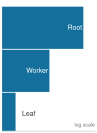
Each delegation step strictly attenuates the token budget it can draw on.
When an agent runtime delegates subtasks to auxiliary worker agents without cryptographic confinement, it inadvertently reproduces the classic confused deputy problem at machine speed. Consider an orchestrator assigned to triage open-source pull requests. To accelerate evaluation, the orchestrator provisions a child worker to compile an untrusted pull request and execute its unit test suite. If that child worker inherits the orchestrator’s ambient operating privileges—such as read access to developer environment secrets, network egress to internal infrastructure, or authorization to push git tags—a single prompt injection embedded in a repository test fixture can commandeer the entire host system. The untrusted code needs only to trick the child agent’s autoregressive decode loop into issuing tool calls that read credentials or exfiltrate sensitive files, exploiting the ambient authority of the parent process.
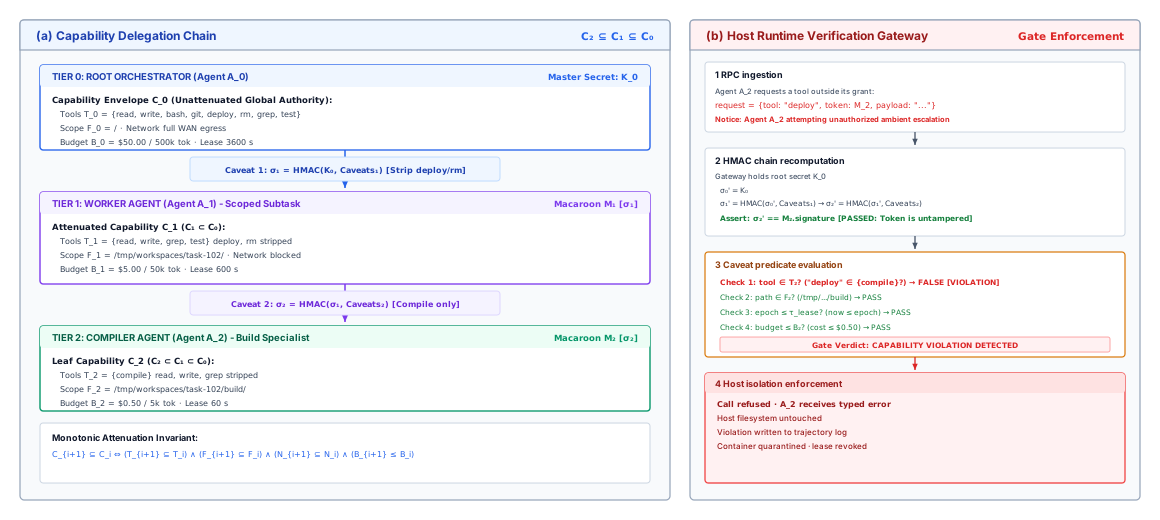
EPERM / HTTP 403) that prevents confused deputy attacks.
As formalized in figure 5, eliminating ambient authority requires enforcing cryptographic capability delegation across two coordinated planes. In Panel A, authority contracts monotonically along the delegation hierarchy (\(\mathcal{C}_2 \sqsubseteq \mathcal{C}_1 \sqsubseteq \mathcal{C}_0\)) using chained HMAC caveats based on the Macaroon token construction. Root Orchestrator \(A_0\) holds root secret \(K_0\) and global authority \(\mathcal{C}_0\). When delegating subtasks to Worker Agent \(A_1\), it binds Caveat 1 (\(\sigma_1 = \text{HMAC}(K_0, \text{Caveat}_1)\)), stripping destructive endpoints (deploy, rm), restricting filesystem access to /tmp/workspaces/task-102/, and clamping the token budget to \(\$5.00\). When \(A_1\) spawns Compiler Agent \(A_2\), it appends Caveat 2 (\(\sigma_2 = \text{HMAC}(\sigma_1, \text{Caveat}_2)\)), restricting leaf operations exclusively to the {compile} tool within /build/ under a tight 60-second lease \(\tau_{\max}\). Crucially, because \(A_2\) possesses only \(\sigma_2\), it cannot strip Caveat 2 to recover \(\sigma_1\), preventing unauthorized privilege escalation. In Panel B, the Host Runtime Verification Gateway intercepts every outbound RPC request. When \(A_2\) attempts an ambient privilege escalation (requesting tool: "deploy"), the gateway recomputes the HMAC chain from root secret \(K_0\) to verify token integrity, tests the caveat predicates against the requested operation, detects the violation (\(deploy \notin \{\text{compile}\}\)), and deterministically issues an EPERM (HTTP 403) rejection while appending the security violation to the supervisor WAL.
A child agent must never possess ambient authority, nor may it ever acquire permissions exceeding those of its parent. In a dependable multi-agent architecture, authority is modeled as a monotonically decreasing capability lattice where every delegated token cryptographically attenuates permissions across operational tools, filesystem scopes, network egress, and temporal lifetimes.
In classic operating systems (Saltzer and Schroeder 1975), Access Control Lists (ACLs) verify who is making a request, leading directly to the confused deputy flaw when a privileged server performs work on behalf of an unprivileged client. Object capabilities (OCaps) fuse designation with authority: possessing the capability token is the permission, enabling seamless delegation without ambient rights escalation.
Monotonic attenuation invariants
To keep zero ambient authority intact across delegation, the multi-agent runtime models all tool invocations, filesystem access, and network egress as protected operations gated by unforgeable capability descriptors. Following the foundational security principles formulated by Saltzer and Schroeder (1975), an agent cannot access any resource simply by virtue of its running process context. Instead, it must explicitly present a valid capability token with every remote procedure call (RPC) dispatched to the host runtime gateway.
We formalize an agent’s authority as a five-dimensional capability envelope \(\mathcal{C} = \langle \mathcal{T}, \mathcal{F}, \mathcal{N}, \tau_{\max}, \mathcal{B} \rangle\), where:
- \(\mathcal{T} \subseteq \mathcal{T}_{\text{global}}\) defines the allowable tool RPC endpoints (for example,
read_file,compile, orgit_diff). - \(\mathcal{F} \subseteq \mathcal{P}\) defines the white-listed filesystem prefix paths (for example,
/tmp/workspaces/task-102/). - \(\mathcal{N} \subseteq \mathcal{D}\) defines the permitted network egress domains or CIDR blocks.
- \(\tau_{\max}\) denotes the absolute POSIX wall-clock expiration epoch.
- \(\mathcal{B} = \langle K_{\max}, D_{\max}^{\text{cost}} \rangle\) establishes the compute budget ceilings, bounding the maximum allowable inference tokens and dollar expenditure.
When a parent agent holding capability \(\mathcal{C}_i\) spawns a child worker, the delegation obeys the attenuation rule of Capabilities and Credentials, now enforced across agents by monotonic delegation (principle \(\ref{pri-vol3-monotonic-delegation}\)). Under this rule, the child capability \(\mathcal{C}_{i+1}\) represents a formal subset, a restriction, within the lattice of authority:
\[\mathcal{C}_{i+1} \sqsubseteq \mathcal{C}_i \iff \left( \mathcal{T}_{i+1} \subseteq \mathcal{T}_i \right) \land \left( \mathcal{F}_{i+1} \subseteq \mathcal{F}_i \right) \land \left( \mathcal{N}_{i+1} \subseteq \mathcal{N}_i \right) \land \left( \tau_{\max, i+1} \le \tau_{\max, i} \right) \land \left( \mathcal{B}_{i+1} \le \mathcal{B}_i \right)\]
No delegated agent can mint new permissions out of thin air, nor can it broaden any dimension of its assigned operational envelope. Across a delegation hierarchy of depth \(d\), authority contracts monotonically:
\[\mathcal{C}_0 \sqsupseteq \mathcal{C}_1 \sqsupseteq \mathcal{C}_2 \sqsupseteq \dots \sqsupseteq \mathcal{C}_d\]
The structural distinction between these security postures is summarized in table 13.
| Security Dimension | Ambient Authority Runtime | Attenuated Capability Architecture |
|---|---|---|
| Tool Surface | Child inherits all host environment tools | Explicitly whitelisted subset (\(\mathcal{T}_{\text{child}} \subseteq \mathcal{T}_{\text{parent}}\)) |
| Filesystem Scope | Global access across user workspace | Strict prefix containment (\(\mathcal{F}_{\text{child}} \subseteq \mathcal{F}_{\text{parent}}\)) |
| Network Egress | Unrestricted TCP/UDP socket creation | Whitelisted CIDRs/domains; default air-gapped |
| Execution Lifetime | Unbounded until process termination | Monotonic time-to-live deadline (\(\tau_{\text{child}} \le \tau_{\text{parent}}\)) |
| Failure Containment | Exploited worker compromises host | Exploited worker confined to its narrow sandbox |
The primary systems failure of ad-hoc multi-agent designs is the assumption that language model prompts can enforce authorization boundaries (e.g., instructing a worker in its system prompt: “Do not run shell commands outside of /build”). The Invariant Closure Principle ruled that out for a single agent, and delegation does not change the answer. Authorization lives in the runtime, outside every model’s context.
Chained cryptographic macaroons for zero-trust dispatch
Centralized authorization lookup tables introduce severe coordination bottlenecks when scaling across dozens of distributed worker agents. If every tool dispatch requires the runtime gateway to query an authoritative database to evaluate parent-child relationships, database lock contention and network round-trips quickly dominate the critical path.
To achieve decentralized, verifiable delegation without centralized state lookup, the runtime employs Macaroons—cryptographic bearer credentials with chained contextual caveats (Birgisson et al. 2014). A macaroon utilizes a nested Hash-based Message Authentication Code (HMAC) construction that permits an agent to append restrictive caveats locally without communicating with the issuing root gateway.
The root orchestrator \(A_0\) receives a base token from the runtime gateway containing an identifier \(\text{id}_0\) and an initial signature:
\[\sigma_0 = \text{HMAC}(K_{\text{gateway}}, \text{id}_0)\]
where \(K_{\text{gateway}}\) is a high-entropy secret known only to the runtime execution gateway. When \(A_0\) spawns worker \(A_1\), it attenuates the token by appending a first-order caveat \(c_1\) (for example, tools:read_file,compile) and updates the cryptographic signature:
\[\sigma_1 = \text{HMAC}(\sigma_0, c_1)\]
The orchestrator delivers the attenuated descriptor \(M_1 = \langle \text{id}_0, [c_1], \sigma_1 \rangle\) to \(A_1\). If \(A_1\) subsequently delegates a compilation task to a lower-level sub-worker \(A_2\), it appends caveat \(c_2\) (such as path:/tmp/workspaces/task-102/build) and computes:
\[\sigma_2 = \text{HMAC}(\sigma_1, c_2)\]
Because HMAC is a one-way cryptographic hash function, worker \(A_1\) cannot strip caveat \(c_1\) to elevate its privileges back to \(\sigma_0\); doing so would require inverting the hash to recover \(\sigma_0\), which is computationally infeasible. Similarly, neither worker can forge a signature for a modified caveat set without possessing the prior signature in the chain.
When any agent submits a tool RPC to the execution gateway, the request carries the macaroon token. The gateway verifies the token deterministically in linear time relative to the number of caveats, without performing distributed database lookups.
def verify_macaroon(macaroon: Macaroon, key: bytes, ctx: SecurityContext) -> bool:
    sig = hmac_sha256(key, macaroon.identifier)
    for caveat in macaroon.caveats:
        if not caveat.evaluate(ctx):
            return False
        sig = hmac_sha256(sig, caveat.serialize())
    return hmac.compare_digest(sig, macaroon.signature)
The gateway reconstructs the HMAC chain using its private key \(K_{\text{gateway}}\). At each link, it tests the caveat against the dynamic execution context \(\mathcal{X}\) (verifying that the requested tool is listed in the whitelist, the targeted path resides within the authorized prefix, and the current system time does not exceed the expiration timestamp). If every caveat evaluates to true and the reconstructed signature matches the macaroon’s terminal signature, the gateway dispatches the tool call to the sandboxed runtime.
Napkin Math 0.7: Macaroon verification at the tool gateway
System Parameters:
- Tool RPC Request Throughput: \(R = 10{,}000\ \text{requests/sec}\) across all active sandboxes.
- Delegation Depth: \(d = 4\) (Orchestrator \(\to\) Planner \(\to\) Implementer \(\to\) Test Runner).
- Macaroon Structure: Base identifier (32 bytes) plus 4 caveats (average 48 bytes each: tool whitelist, path prefix, expiration epoch, and memory limit).
- Cryptographic Primitive: HMAC-SHA256.
- Host Hardware: Single core of an AMD EPYC 9654 server processor running at 2.4 GHz, executing HMAC-SHA256 at \(450\ \text{MB/s}\) for sequential block transformations, with an initial hash setup cost of \(t_{\text{init}} = 85\ \text{ns}\) and a per-block update cost of \(t_{\text{block}} = 110\ \text{ns}\).
Evaluation:
Verification Steps: The gateway must compute 1 initial HMAC for the root identifier plus 4 iterative HMAC passes for the caveats (\(n = 5\) total HMAC evaluations).
Data Processed per Request: The root identifier and each caveat fit within a single 64-byte SHA-256 block. Each HMAC computation performs two internal hash operations (inner and outer padding), processing two 64-byte blocks per caveat: \[t_{\text{hmac}} = 2 \times (t_{\text{init}} + t_{\text{block}}) = 2 \times (85\ \text{ns} + 110\ \text{ns}) = 390\ \text{ns}\]
Total Verification Time per Tool Call: \[t_{\text{verify}} = 5 \times t_{\text{hmac}} = 5 \times 390\ \text{ns} = 1.95\ \mu\text{s}\]
Gateway Core Utilization: At \(R = 10{,}000\ \text{calls/sec}\), the total compute time consumed by capability verification across the host is: \[T_{\text{cpu}} = 10{,}000 \times 1.95\ \mu\text{s} = 0.0195\ \text{seconds of CPU time per second} \implies 1.95\%\ \text{of one core}\]
Token Network Overhead: \[\text{Size} = 32\ \text{bytes (id)} + (4 \times 48\ \text{bytes}) + 32\ \text{bytes (signature)} = 256\ \text{bytes}\]
Takeaway: At less than \(2\ \mu\text{s}\) of CPU latency and 256 bytes of payload overhead, cryptographic macaroon verification introduces negligible friction compared to standard tool execution (where running a linter or compiler takes \(10\ \text{ms}\) to \(500\ \text{ms}\), five orders of magnitude larger). By contrast, querying a distributed database or OAuth introspection endpoint over the network would incur \(2\ \text{ms}\) to \(15\ \text{ms}\) of latency per call, bottlenecking the entire multi-agent runtime.
Distributed revocation cascades
While chained macaroons permit decentralized capability verification, their bearer nature introduces a critical systems dilemma: how does the runtime revoke authority instantly across a sub-tree of delegated child workers when a parent task is canceled or fails?
As established in section 6, when an orchestrator terminates an operational branch, all outstanding descendant processes must be aborted to conserve compute and prevent corrupted state mutations. If a delegated worker holds a valid cryptographic token with an unexpired TTL of 300 seconds, the worker could theoretically continue issuing valid tool RPCs to the gateway until the temporal caveat expires. Relying solely on expiration timestamps leaves a window of vulnerability during which orphaned or rogue subagents can mutate filesystems or exhaust resource quotas.
To enforce immediate, deterministic revocation without sacrificing \(O(1)\) local verification, the runtime implements Hierarchical Generation Epochs, tracked via the lookup schema in table 14.
| Task Node ID | Lineage Path | Active Epoch (\(E_{\text{active}}\)) | Token Epoch (\(E_{\text{token}}\)) | Gateway Authorization Decision |
|---|---|---|---|---|
| task-100 | task-100 (Root) |
1 | 1 | Authorized (Active) |
| task-101 | task-100/task-101 |
1 | 1 | Authorized (Active) |
| task-102 | task-100/task-101/task-102 |
2 (Revoked) | 1 | 403 Forbidden: Token epoch (\(1\)) < Active epoch (\(2\)); sub-tree severed |
When the root orchestrator initializes a delegation tree, it registers a unique task lineage path with the gateway (for example, task-100/task-101/task-102). The gateway maintains a compact, in-memory epoch table mapping task nodes to integer generation counters. The token identifier incorporates this lineage path and the node’s generation epoch at issuance time:
\[\text{id} = \langle \text{root\_id}, \text{lineage\_path}, \text{epoch} \rangle\]
Revoking an entire sub-tree requires incrementing the generation counter of the targeted ancestor node in the gateway’s epoch table. When a child worker presents its macaroon, the gateway extracts the lineage path and performs an \(O(1)\) check against the in-memory array. If any ancestor node in the token’s lineage presents an active epoch strictly greater than the epoch embedded in the token identifier, the gateway rejects the request with an authorization failure, instantly severing authority for all descendant agents. For high-consequence operations requiring manual sign-off, the authorization flow transitions into the escrow protocol detailed in table 15.
| Protocol Stage | Target Entity | Action or Constraint | Security & Authorization Invariant |
|---|---|---|---|
| 1. Destructive Attempt | Worker Agent | Proposes destructive operation (e.g. git push --force) |
Worker holds zero ambient authority; lacks push rights. |
| 2. Gateway Interception | API Mediation Gateway | Traps system call; identifies requirement for human escrow | Completely blocks direct execution; parks worker thread. |
| 3. Escrow Boundary Wall | Containment Firewall | Forbids child worker from messaging human operator directly | Prevents adversarial prompt injection and social engineering. |
| 4. Envelope Escalation | Escrow Mediation Bus | Marshals formal escalation envelope to Root Orchestrator | Provides structured diff, context rationale, and risk scorecard. |
| 5. Human Confirmation | Root Orchestrator | Reviews synthesized context; solicits authenticated human signature | Operations committed only upon cryptographically verified operator approval. |
A parallel containment boundary governs Human Escrow Escalation. In high-consequence environments, certain critical operations—such as dropping production database tables, modifying public DNS records, or releasing payments—require synchronous human-in-the-loop confirmation.
A fatal vulnerability in distributed multi-agent deployments occurs when child agents are allowed to trigger human approval dialogs directly. If an unprivileged subagent running deep within an untrusted execution tree can pop up confirmation prompts on the user’s terminal, the user faces two distinct hazards:
- Escrow Flooding: A buggy, looping child worker can spam the human operator with hundreds of concurrent approval requests, inducing cognitive fatigue that leads to accidental authorization of dangerous operations.
- Adversarial Social Engineering: An unprivileged subagent whose prompt has been compromised by an adversarial payload can construct deceptive approval prompts, deliberately misrepresenting the nature of the requested command to trick the human into authorizing privilege escalation.
To eliminate this vulnerability, the runtime enforces an absolute Escrow Containment Boundary. Delegated child agents are structurally barred from registering interactive human prompts. If an attenuated worker issues a tool command requiring human confirmation, the runtime gateway traps the call and returns an explicit EscrowElevationRequired task envelope to the child.
The child cannot proceed autonomously; it must bubble the escrow request up through its parent in the coordination tree. The parent orchestrator inspects the child’s execution trace, verifies the operational justification within the macro-plan, and presents a consolidated, contextualized authorization request to the human supervisor. By confining human interaction to the root orchestrator, the architecture preserves the integrity of the audit chain and ensures that all operations are vetted within their broader systems context.
Having established formal frameworks for delegation topologies, typed message envelopes, optimistic concurrency control, failure de-correlation, cancellation propagation, and attenuated capability containment, we have assembled the complete systems machinery required to execute distributed multi-agent workflows. Yet constructing an elaborate multi-agent orchestration does not guarantee that it outperforms a single model operating over an equivalent computational budget. Multi-agent delegation imposes non-trivial serialization latencies, token amplification costs, and coordination taxes. Before deploying a distributed agent cluster to production, systems engineers must confront the fundamental empirical question: does decomposing the workload across multiple agents yield higher task completion and lower makespan than an optimized single-agent baseline endowed with test-time search?
Single-agent baseline benchmarking
Past roughly six workers, merge contention makes the fleet slower than one agent.
The five-agent team that opened this chapter shows why a fleet must be measured against the right baseline. Its original single agent, once given the same resources for test-time revision, matched the ensemble’s pass rate.
Architectural complexity is not a substitute for computational efficiency. A multi-agent coordination topology is justified only if, against an optimized single agent given the same total budget, it is no worse on task completion quality, critical-path makespan, and cost per accepted task, and strictly better on at least one. In distributed systems design, decomposing a workload across multiple processing nodes is never treated as an automatic virtue; it is an engineering compromise accepted strictly to overcome physical bounds on single-node throughput or memory capacity. In agentic machine learning, the physical boundaries correspond to the model’s effective context window, its attention degradation over long token sequences, and wall-clock limits on sequential autoregressive decoding. When engineers partition a task across agents without first measuring what a single model can achieve when equipped with test-time search, they frequently construct distributed systems that do nothing more than amplify communication overhead, duplicate shared context, and propagate correlated errors across unisolated workers. Rigorous benchmarking requires establishing fair baseline protocols, evaluating systems across three orthogonal axes, and applying formal scalability models to quantify coordination contention.
Matched-resource protocols
The most pervasive methodological flaw in multi-agent literature is comparing an elaborate multi-agent architecture against a naive, single-turn, zero-shot single-agent baseline. A zero-shot baseline generates a candidate solution in a single autoregressive forward pass without environmental feedback, scratchpad deliberation, tool invocations, or error recovery. Comparing a multi-agent collective—which executes dozens of sequential tool calls, inspects compiler diagnostics, and re-prompts itself across thousands of intermediate tokens—against a zero-shot model does not evaluate multi-agent coordination; it evaluates the trivial advantage of dynamic test-time computation over static feed-forward inference.
The Resource Equivalence Principle dictates that any empirical comparison between an orchestration topology \(\mathcal{T}\) and a single-agent baseline \(\mathcal{S}\) must hold total compute expenditure constant: \[\mathcal{B}_{\text{total}}(\mathcal{T}) \approx \mathcal{B}_{\text{total}}(\mathcal{S})\] where compute includes both token volume and sandbox execution cycles.
Evidence-bounded deliberation (principle \(\ref{pri-vol3-test-time-scaling}\)) already requires that extra inference compute be compared at a matched budget, and a fleet is extra inference compute spent in parallel. To determine whether multi-agent delegation provides true architectural value, the baseline must therefore be an optimized single-agent runtime. As established in Test-Time Compute and Tool Calling, an unprivileged neural inference engine can be organized into an iterative execution loop governed by host supervision. A properly configured single-agent baseline must be granted:
- Iterative Environment Feedback: The agent executes actions within an isolated sandbox, receives raw exit codes and standard error streams, and iteratively refactors its plan across multiple turns.
- Deliberative Search and Revision: The agent employs sequential test-time compute, including self-correction, tree search, or best-of-\(N\) candidate sampling over verification filters.
- Dynamic Context Compaction: The runtime prunes intermediate scratchpad traces, offloads bulky tool outputs to external disk storage, and maintains an active working memory within the model’s operational context limit.
The architectural parameters governing valid baseline comparisons are contrasted in table 16.
| Protocol Property | Naive Baseline (Invalid) | Optimized Single Agent (Valid) | Multi-Agent Collective |
|---|---|---|---|
| Deliberation Budget | 1 forward pass (\(K=1\)) | \(N\) iterative turns with tools | \(\sum_{i=1}^M N_i\) distributed turns |
| Environmental Feedback | None (Blind generation) | Interactive execution sandbox | Replicated worker sandboxes |
| Search Mechanism | Greedy or single temperature | Sequential reflection / ReAct | Parallel branch exploration |
| Context Scope | Monolithic prompt (\(S_{\text{in}}\)) | Managed sliding window | Partitioned task envelopes |
| Cost Basis (\(\mathcal{B}_{\text{tokens}}\)) | Base token cost \(T_0\) | Matched budget \(\mathcal{B} \approx M \times T_0\) | Distributed sum \(\sum T_{\text{worker}}\) |
When evaluating a multi-agent system against an optimized single agent, systems engineers must enforce the Resource Equivalence Principle. If a four-agent ensemble consumes an aggregate of 400,000 tokens and 120 seconds of sandbox execution across its subtasks, the single-agent baseline must be evaluated under a matched token budget (\(\mathcal{B}_{\text{tokens}} = 400{,}000\)) and equivalent sandbox wall-clock limits. If the single agent achieves an equal or superior completion rate when allowed to spend those 400,000 tokens on sequential search, deeper planning, or repeated unit-test repair, the multi-agent architecture represents negative systems utility. It incurs the maintenance complexity, network failure surface, and serialization taxes of a distributed system without delivering an empirical return on investment.
Tri-axial evaluation metrics
Evaluating an agentic system along a single dimension, such as benchmark pass rate, obscures critical systems trade-offs. An architecture that increases task success by two percentage points while quadrupling operational cost and introducing ten-minute latency spikes is rarely deployable in production engineering environments. Rigorous systems evaluation requires tracking three orthogonal axes: task completion quality, critical-path makespan, and cost per accepted task.
Principle 1: Tri-axial multi-agent evaluation frontier
Implication: Claims for a multi-agent design must hold the budget equal, compare against a single agent that uses test-time revision and tools, and count coordination overhead in both makespan and cost.
The first axis is Task Completion Quality (\(Q\)), defined as the ratio of tasks whose terminal artifacts satisfy all functional and non-functional invariants to the total number of attempted tasks: \[Q = \frac{1}{|\mathcal{D}|} \sum_{i=1}^{|\mathcal{D}|} \mathbb{I}\left( \text{Verify}(\mathcal{A}_i) == \text{SUCCESS} \right)\] Verification is external and deterministic, performed by hermetic unit test suites, static analysis linters, or cryptographic signature validators, never by the agent’s own report that a task is complete, which carries no evidential weight (The epistemic boundary: Enforced envelopes versus semantic correctness).
The second axis is Critical-Path Makespan (\(\tau_{\text{crit}}\)), the elapsed wall-clock time from task ingestion to final artifact acceptance. For a single-agent runtime executing \(N\) sequential turns, makespan is strictly additive: \[\tau_{\text{crit}}^{\text{single}} = \sum_{j=1}^N \left( \tau_{\text{prefill}}^{(j)} + \tau_{\text{decode}}^{(j)} + \tau_{\text{env}}^{(j)} \right)\] where \(\tau_{\text{prefill}}\) is the time to process input context via matrix-matrix multiplication (GEMM), \(\tau_{\text{decode}}\) is autoregressive token generation bounded by memory bandwidth (GEMV), and \(\tau_{\text{env}}\) is the execution latency of tools in the sandbox. In a multi-agent directed acyclic graph (DAG) \(\mathcal{G} = (\mathcal{V}, \mathcal{E})\), workers execute concurrently, allowing parallelization of the workload across available compute engines. However, makespan is governed by the graph’s longest operational path: \[\tau_{\text{crit}}^{\text{multi}} = \max_{\pi \in \text{Paths}(\mathcal{G})} \sum_{v \in \pi} \left( \tau_{\text{agent}}(v) + \tau_{\text{envelope}}(v) \right) + \tau_{\text{reconciliation}}\] Here, \(\tau_{\text{envelope}}\) captures the serialization, transport, and deserialization latencies of typed task envelopes between parent and child runtimes, while \(\tau_{\text{reconciliation}}\) represents the time required to perform three-way merges or resolve optimistic concurrency conflicts. Even if worker nodes exhibit high concurrency, synchronization barriers at join nodes can cause \(\tau_{\text{crit}}^{\text{multi}}\) to exceed \(\tau_{\text{crit}}^{\text{single}}\).
The third axis is cost per accepted task (\(\mathcal{E}\)), which charges every failed attempt to the tasks that pass (principle \(\ref{pri-vol3-trajectory-goodput}\)). The spend of one attempt \(d\) sums the token and sandbox costs across all participating models and sandboxes: \[\mathcal{E}_{\text{attempt}}(d) = \sum_{i=1}^M \left( c_{\text{in}} \cdot T_{\text{in}}^{(i)} + c_{\text{out}} \cdot T_{\text{out}}^{(i)} \right) + c_{\text{compute}} \cdot \tau_{\text{sandbox}}\] where \(T_{\text{in}}^{(i)}\) and \(T_{\text{out}}^{(i)}\) denote input and output token counts for agent \(i\), \(c_{\text{in}}\) and \(c_{\text{out}}\) denote pricing per token, and \(c_{\text{compute}}\) accounts for sandbox infrastructure costs. Dividing the spend over the evaluation set by the number of accepted tasks, \(Q\,|\mathcal{D}|\), gives the axis itself: \[\mathcal{E} = \frac{\sum_{d \in \mathcal{D}} \mathcal{E}_{\text{attempt}}(d)}{Q\,|\mathcal{D}|}\] Cost per Accepted Task adds verification and human escalation to the per-attempt spend. The token and sandbox terms are enough to compare topologies. Multi-agent topologies invariably suffer from context duplication: when a supervisor delegates a subtask to three parallel workers, the base system instructions, repository schemas, and task descriptions are replicated across three separate context windows, multiplying \(T_{\text{in}}\) by a factor of \(M\).
A multi-agent design is defensible only if it dominates the budget-matched baseline on \((Q, \tau_{\text{crit}}, \mathcal{E})\), as the tri-axial frontier requires. When a requirement puts makespan first (automated incident response, for example), parallel delegation can pass that test by compressing \(\tau_{\text{crit}}\) within the same budget, provided the parallelizable fraction is high enough that duplicated context does not lower \(Q\). When the budget is tight, a single sequential agent almost always wins, because duplicated context consumes the tokens that would otherwise buy revision.
Coordination contention dynamics
The Amdahl bound of section 1 left its coordination term \(h(M)\) abstract. Building it up from runtimes and then giving \(h(M)\) a physical form explains why adding worker agents yields diminishing and eventually negative returns.
Let \(T_1\) be the execution time of a task on an optimized single agent. Suppose a fraction \(f \in [0, 1]\) of the task can be partitioned into perfectly independent subtasks executed in parallel by \(M\) worker agents, while the remaining fraction \((1 - f)\) represents strictly serial operations (such as initial root planning, task decomposition, final artifact synthesis, and sequential regression validation). If coordination between agents were instantaneous and free of friction, the theoretical parallel runtime would be: \[T_M = (1 - f)T_1 + \frac{f T_1}{M}\] yielding the classical speedup ratio: \[\text{Speedup}_{\text{ideal}}(M) = \frac{T_1}{T_M} = \frac{1}{(1 - f) + \frac{f}{M}}\]
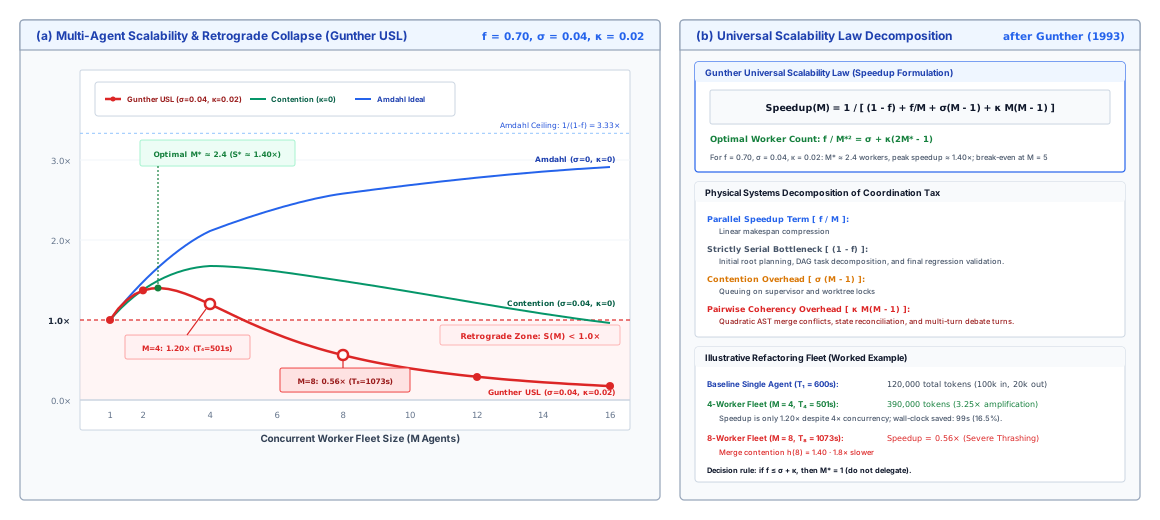
The physical dynamics governing multi-agent speedup and cost collapse are formalized in figure 6. In Panel A, the theoretical Amdahl curve (\(f = 0.70\), \(\sigma = 0, \kappa = 0\)) approaches an asymptotic upper bound of \(\frac{1}{1 - f} = 3.33\times\). When linear resource contention is introduced (\(\sigma = 0.04\), representing supervisor queueing and branch checkout serialization), the speedup ceiling plateaus around \(1.68\times\). However, when pairwise coherency delays (\(\kappa = 0.02\), capturing three-way AST merge conflicts and conversational consensus debate) are accounted for via Gunther’s Universal Scalability Law, the speedup trajectory peaks at \(M^* = \sqrt{(f - \sigma)/\kappa} = \sqrt{(0.70 - 0.04)/0.02} \approx 5.74\) with an achievable speedup of only \(1.24\times\). Beyond this threshold, the quadratic coherency overhead \(\kappa M(M - 1)\) outgrows parallel compute gains, dragging execution into the Retrograde Collapse Zone (\(S(M) < 1.0\times\)). At \(M = 8\) workers, the system achieves a speedup of only \(0.56\times\) (makespan balloons to \(1{,}073\text{ s}\)), running nearly twice as slow as an unprivileged single agent. In Panel B, the physical terms of Gunther’s formulation are mapped to concrete runtime bottlenecks, showing that provisioning four concurrent workers reduces wall-clock execution time by merely \(16.5\%\) (501 s versus 600 s) while incurring a staggering \(3.25\times\) token amplification (390,000 versus 120,000 tokens).
In real distributed agent runtimes, coordination is never free. As formalized in Sections 15.2 and 15.4, inter-agent delegation incurs context serialization overhead, network RPC transport latency, supervisor dispatch overhead, and optimistic concurrency merge contention. Let \(T_{\text{overhead}}(M)\) represent the total wall-clock coordination cost as a function of worker count \(M\). The empirical multi-agent execution time becomes: \[T_M = (1 - f)T_1 + \frac{f T_1}{M} + T_{\text{overhead}}(M)\] Dividing by \(T_1\) and defining the normalized overhead function \(h(M) = \frac{T_{\text{overhead}}(M)}{T_1}\), the achievable speedup is: \[\text{Speedup}(M) = \frac{1}{(1 - f) + \frac{f}{M} + h(M)} \tag{1}\]
To model the precise physical behavior of \(h(M)\), systems engineers apply Neil J. Gunther’s Universal Scalability Law (USL, 2007). In an agent runtime, coordination overhead stems from two distinct physical sources: \[h(M) = \sigma (M - 1) + \kappa M(M - 1)\] The parameter \(\sigma \ge 0\) is the contention coefficient, representing time spent queuing for serial resources, such as the supervisor’s input context processing queue or shared repository branch locks. The parameter \(\kappa \ge 0\) is the coherency coefficient, representing the pairwise communication delay required to reconcile conflicting mutations, synchronize state across worker scratchpads, or achieve consensus among ensemble members.
When pairwise coherency delays exist (\(\kappa > 0\)), the speedup curve does not merely plateau—it retrogrades. As \(M\) increases beyond a critical threshold, the \(\kappa M(M - 1)\) quadratic term outgrows the parallel reduction \(\frac{f}{M}\). Adding more agents causes the system to run slower than a single agent. The optimal worker count \(M^*\) that maximizes speedup is derived by finding the stationary point \(\frac{d}{dM} \text{Speedup}(M) = 0\): \[M^* = \sqrt{\frac{f - \sigma}{\kappa}}\] If a task has a small parallelizable fraction (\(f \le \sigma\)), or if merge contention is high, the optimal worker count is \(M^* = 1\): the workload should not be delegated at all.
Napkin Math 0.8: Evaluation of a parallel refactoring fleet
The team deploys a supervisor-worker topology with \(M = 4\) worker agents operating on isolated git worktrees. Systems telemetry measures a contention parameter \(\sigma = 0.04\) (supervisor dispatch latency) and a coherency parameter \(\kappa = 0.02\) (AST merge conflicts and three-way reconciliation delays).
1. Calculate Achievable Speedup and Makespan: Using the Universal Scalability Law: \[h(4) = 0.04(4 - 1) + 0.02(4)(4 - 1) = 0.12 + 0.24 = 0.36\] The speedup is: \[\text{Speedup}(4) = \frac{1}{0.30 + \frac{0.70}{4} + 0.36} = \frac{1}{0.30 + 0.175 + 0.36} = \frac{1}{0.835} \approx 1.20\] The actual multi-agent makespan is: \[T_4 = \frac{T_1}{\text{Speedup}(4)} = \frac{600\text{ s}}{1.20} = 501\text{ s}\] Despite provisioning four worker agents, the wall-clock execution time decreases by only 99 seconds—a meager 16.5 percent reduction.
2. Calculate Resource and Token Amplification: Each worker agent requires the supervisor’s decomposed task instructions, architectural rules, and AST slice, incurring 60,000 input tokens per worker. Each worker generates 15,000 output tokens. The supervisor consumes 40,000 tokens for planning and 50,000 tokens for merge validation. \[\text{Total Tokens} = 40{,}000 + 50{,}000 + 4 \times (60{,}000 + 15{,}000) = 390{,}000\text{ tokens}\] The multi-agent system incurs a \(3.25\times\) token amplification (390,000 vs. 120,000) and quadruples the required sandbox concurrency to achieve a \(1.20\times\) speedup.
3. Determine the Optimal Worker Count: \[M^* = \sqrt{\frac{f - \sigma}{\kappa}} = \sqrt{\frac{0.70 - 0.04}{0.02}} = \sqrt{\frac{0.66}{0.02}} = \sqrt{33} \approx 5.74 \implies 5\text{ or }6\text{ workers}\] At \(M=6\), speedup peaks at only \(1.24\times\) (\(T_6 = 484\text{ s}\)) before retrograding. Decomposing the workload across 8 workers yields \(h(8) = 0.04(7) + 0.02(8)(7) = 0.28 + 1.12 = 1.40\), resulting in a speedup of \(0.56\times\) (\(T_8 = 1{,}073\text{ s}\))—nearly twice as slow as the single agent!
To verify whether a proposed delegation topology improves system efficiency prior to deployment, systems engineers can evaluate Gunther’s speedup equation directly against profiling traces:
def evaluate_coordination_efficiency(f: float, sigma: float, kappa: float, M: int) -> float:
    """Computes multi-agent speedup under Gunther's Universal Scalability Law."""
    if M < 1:
        raise ValueError("Worker count M must be >= 1")
    overhead = sigma * (M - 1) + kappa * M * (M - 1)
    effective_denominator = (1.0 - f) + (f / M) + overhead
    return 1.0 / effective_denominator
The architectural deployment checklist
Before decomposing an agentic workflow into a multi-agent cluster, systems architects must evaluate the six operational criteria outlined in table 17. If a proposed system fails any of these gates, the architectural default must remain an optimized single-agent runtime.
| Decision Gate | Evaluation Criteria | Pass Condition | Failure Action |
|---|---|---|---|
| 1. Context Partitionability | Can task state be factored into disjoint sub-contexts? | Subtasks exhibit high locality of reference; low prompt duplication | Revert to Single-Agent Runtime |
| 2. Single-Agent Saturation | Has single-agent baseline been optimized with reflection & tools? | Single agent hits verified cognitive plateau under matched compute | Revert to Single-Agent Runtime |
| 3. Positive Speedup | Does parallel speedup exceed orchestration overhead? | Amdahl speedup \(f/M > h(M)\) communication friction | Revert to Single-Agent Runtime |
| 4. Error De-correlation | Are failure modes statistically independent? | Models or prompts possess distinct inductive biases | Reject Topology / Redesign Prompts |
| 5. Attenuated Capabilities | Can worker authority be monotonically restricted? | \(R_{\text{child}} \subseteq R_{\text{parent}}\) enforced via formal capability tokens | Halt: Privilege Escalation Risk |
| 6. Tri-Axial Dominance | Does topology dominate the baseline on \(Q\), \(\tau\), and cost? | Budget-matched: no worse on any axis, strictly better on one | Revert to Single-Agent Runtime |
Context Partitionability Gate: Can the operational state of the task be cleanly partitioned into disjoint sub-contexts? If every subtask requires access to the complete, monolithic system prompt, complete file tree, and global execution history, multi-agent delegation will saturate the network and inference engine with duplicated prefill tokens. Delegation is justified only when subtasks exhibit strong locality of reference.
Single-Agent Saturation Gate: Has the single-agent baseline been fully optimized with test-time reflection, tool execution, dynamic context pruning, and budget-matched search? If a single agent given identical compute can solve the problem, multi-agent orchestration introduces needless operational fragility.
Amdahl Scalability Gate: Does the parallelizable fraction \(f\) substantially exceed the serialization overhead \(h(M)\)? The expected speedup must satisfy: \[\frac{f}{M} + h(M) < f \implies h(M) < f \left(1 - \frac{1}{M}\right)\] If merge conflicts, task serialization, or supervisor dispatch latencies erase the concurrency gain, the system degrades throughput while inflating cost.
Error De-correlation Gate: Are worker agents structurally protected against correlated failure modes? As proven in section 5, deploying multiple instances of the same base model under identical prompting creates an illusion of consensus while sharing blind spots. Workers must use diverse prompts, heterogeneous model backends, or orthogonal decomposition strategies.
Capability Attenuation Gate: Does the architecture enforce strict least privilege across delegated child runtimes? Child agents must operate under cryptographically attenuated capability tokens (\(\mathcal{C}_{\text{child}} \sqsubseteq \mathcal{C}_{\text{parent}}\)) and execute within isolated sandboxes (section 4 and section 7). An agent must never be granted ambient authority or the ability to escalate its own permissions.
Net Tri-Axial Dominance Gate: Does the multi-agent system dominate the budget-matched baseline on the tri-axial frontier (principle 1)? Within the same total budget, and with no loss on the other axes, the collective must demonstrate either:
- Statistically significant improvement in task completion quality (\(Q_{\text{multi}} > Q_{\text{single}}\)), or
- Substantial compression of critical-path makespan (\(\tau_{\text{crit}}^{\text{multi}} \ll \tau_{\text{crit}}^{\text{single}}\)).
When an architecture satisfies all six criteria, distributed delegation provides genuine systems leverage. Yet across industry and research, engineers routinely bypass these foundational gates, falling prey to pervasive design traps that mistake organizational metaphors for sound computer systems engineering.
Fallacies and pitfalls
Engineering multi-agent systems exposes a seductive architectural hazard: the tendency to map human organizational metaphors directly onto statistical inference engines. Systems designers routinely assume that because complex software projects in human enterprises benefit from division of labor across specialized roles (product managers, systems architects, core developers, security auditors, and site reliability engineers), an autonomous agentic platform should mirror this organizational structure by spawning swarms of communicating foundation models. Replacing a coherent, localized deliberative control loop with an unverified network of communicating agents does not transcend the physical limitations of the underlying hardware; instead, it immediately introduces classical distributed systems failures, including serial synchronization bottlenecks, lock contention over shared state, Byzantine error propagation, and orphaned resource exhaustion. Designing robust agent infrastructure requires systematically identifying and dismantling four prevalent fallacies and implementation pitfalls that undermine multi-agent coordination.
Fallacy: Adding more agents to an autonomous team always improves problem-solving performance.
When an agentic system encounters a task that exceeds its single-turn completion capabilities, software engineers frequently succumb to the unexamined intuition that scaling the worker count \(M\) will yield superlinear improvements in problem-solving throughput. The operational implementation typically instantiates a committee of specialized worker agents, coordinating them through a central supervisor or a decentralized conversational chat mesh. This mental model assumes that task decomposition is computationally costless and that parallel agent deliberation scales with ideal efficiency.
In production runtime environments, this assumption collapses against Amdahl’s Law and the Universal Scalability Law. Every multi-agent coordination topology introduces a nonzero serial fraction \(1-f\) and a superlinear coordination overhead \(h(M) = \sigma(M - 1) + \kappa M(M - 1)\), where \(\sigma\) represents serialization contention and \(\kappa\) represents inter-agent crosstalk. An engineering workflow cannot be partitioned into infinitely granular, independent subproblems; architectural decisions, core interface definitions, and global invariant verifications remain strictly serial. As worker count \(M\) expands, the supervisory agent becomes an acute serialization bottleneck. The supervisor must ingest, summarize, and arbitrate among conflicting proposals from dozens of workers, rapidly saturating its operational context window \(S_{\max}\) and forcing high-latency prefill phases on host accelerators.
Furthermore, multi-agent decomposition imposes a severe context duplication tax. Each autonomous worker requires an environmental baseline—system instructions, repository topology, schema definitions, and tool interfaces—to execute its assigned subtask. If an enterprise codebase requires a working context of \(32\text{ KiB}\) tokens, instantiating ten parallel agents forces the serving cluster to replicate those \(32\text{ KiB}\) tokens across ten independent Key-Value (KV) cache instances. This consumes hundreds of megabytes of accelerator high-bandwidth memory (HBM) for redundant static prompts, inducing memory capacity cliffs and driving serving batch sizes down toward unity (\(B=1\)).
Most critically, unverified multi-agent communication suffers from compounding message corruption, a catastrophic epistemic telephone game. Each conversational handoff introduces a probability of error \(\epsilon > 0\), so the open-loop ceiling of Temporal stretching: From nanosecond opcodes to kilosecond trajectories applies per handoff. In an unmediated chain of \(k\) dependent agent interactions, the probability that the final artifact rests on uncontaminated inputs falls as \((1 - \epsilon)^k\). An upstream worker that hallucinates a nonexistent configuration flag or mischaracterizes an API contract passes that assumption to downstream peers as established truth. The downstream workers construct elaborate, syntactically flawless implementations atop the corrupted premise, burning GPU compute budgets to produce artifacts that fail environmental verification immediately upon deployment.
The architectural defense requires quantifying task parallelizability \(f\) using Amdahl’s formulation before allocating execution threads. When a task exhibits a substantial serial fraction (\(1-f > 0.3\)), the runtime must reject multi-agent fan-out and instead allocate compute to an optimized single-agent baseline equipped with test-time deliberation, systematic scratchpad revision, and deterministic tool feedback. Where parallel execution is mathematically justified, runtimes must strictly bound the worker pool (\(M \le 3\)), isolate workers to orthogonal, non-overlapping search spaces (such as evaluating mutually exclusive algorithmic strategies), and enforce typed, minimal message passing rather than conversational prose exchanges.
Pitfall: Allowing multiple agents to concurrently mutate a shared filesystem without optimistic concurrency control.
A widespread and destructive implementation pitfall in autonomous software engineering runtimes is granting multiple concurrent agents direct read and write access to a shared project directory. Architects operating under this pattern assume that prompt instructions directing Agent \(A\) to modify src/auth.py and Agent \(B\) to modify src/storage.py provide sufficient isolation to prevent operational conflict.
This assumption fails because stochastic foundation models do not maintain predictable spatial locality during complex refactoring tasks. When tasked with implementing a feature or fixing a bug, an agent routinely discovers that its localized modification requires touching shared configuration files (such as pyproject.toml or package.json), adjusting utility functions in common modules, or regenerating lockfiles. Because the operating system filesystem presents a single, shared namespace, concurrent agent executions collide directly at the storage layer, triggering classical write-write race conditions, lost updates, and silent file clobbering.
Consider a scenario where Agent \(A\) and Agent \(B\) both read settings.py at base commit \(C_0\). Agent \(A\) appends authentication parameters and writes its updated file to disk at wall-clock time \(t_1\). At time \(t_2\), Agent \(B\) finishes generating database connection pooling logic, which it appends to its local copy of settings.py (which lacks Agent \(A\)’s additions), and flushes the buffer to the same path. Agent \(B\)’s write silently obliterates Agent \(A\)’s modifications without raising an operating system error or throwing an exception. Even more insidiously, if an agent triggers a background test suite or compilation check while a peer agent is mid-way through an uncommitted multi-file edit, the verification process observes an inconsistent, fractured intermediate state. The compilation fails with syntax errors unrelated to the agent’s actual logic, polluting the agent’s observation trajectory with spurious stack traces and driving the model into futile debugging loops against phantom defects. This collision pathology and its OCC mitigation timeline are traced across discrete steps in table 18.
| Timestamp | Agent A (Worktree A) | Shared Integration Target | Agent B (Worktree B) | Git State & Status |
|---|---|---|---|---|
| \(t_0\) | Fork from commit \(C_0\) | Pinned target at \(C_0\) | Fork from commit \(C_0\) | Both worktrees isolated at baseline \(C_0\) |
| \(t_1\) | Apply edits; run verification tests | Target idle at \(C_0\) | Apply edits in isolation | Local mutations uncommitted |
| \(t_2\) | Fast-forward commit (\(C_0 == C_0\)) | Target advances to \(C_1\) | Continues generation | Agent A merge succeeds; Target updated |
| \(t_3\) | Continues subsequent subtask | Target at \(C_1\) | Attempts commit (\(C_0 \neq C_1\)) | Validation Conflict: Reconciliation gate halts commit; triggers 3-way diff |
The architectural mitigation mandates strict workspace isolation through Optimistic Concurrency Control (OCC). The host runtime must never permit an unprivileged agent to mutate the target integration tree directly. Instead, every worker process must be provisioned with an isolated Git Worktree or an ephemeral Copy-on-Write (CoW) container overlay rooted at a pinned commit SHA \(C_{\text{base}}\). The agent executes all edits, builds, and test executions exclusively within its private worktree.
State publication must adhere to a formal four-phase OCC trajectory protocol:
- Read Phase: The agent inspects the environment pinned at immutable commit \(C_{\text{base}}\).
- Execute Phase: The agent mutates files, compiles code, and iterates against local unit tests in its private worktree.
- Validation Phase: Upon task completion, the supervisor verifies whether the repository integration head has advanced (\(C_{\text{current}} \stackrel{?}{=} C_{\text{base}}\)).
- Commit Phase: If the integration head is unchanged, the runtime fast-forwards the branch to include the agent’s validated commit. If the head has advanced (\(C_{\text{current}} \neq C_{\text{base}}\)), the runtime detects a concurrency conflict. It must never perform an unverified textual merge; instead, it executes an automated three-way diff merge into a clean staging branch and re-runs the full deterministic test harness. If merge conflicts arise or the integrated test suite fails, the runtime aborts the transaction, rolls back the staging branch, and reschedules the subtask with the updated base commit \(C_{\text{current}}\).
Fallacy: Unanimous multi-agent consensus proves the factual or mathematical correctness of a solution.
In an effort to guard against hallucinations and reasoning errors without constructing expensive, task-specific testing environments, system designers frequently implement multi-agent consensus mechanisms. Under this paradigm, a proposal generated by a worker agent is submitted to a panel of peer foundation models—often styled as a “review board” or “adversarial debate”—that vote on whether to accept the artifact. When three or five independent model instances unanimously approve a code patch, architectural proposal, or mathematical derivation, the system marks the output as verified.
This approach misapplies the Condorcet Jury Theorem. The classical jury theorem establishes that if an ensemble consists of \(M\) voters, each possessing an independent probability \(p > 0.5\) of choosing the correct outcome, the probability that a majority vote yields the correct decision approaches certainty as \(M \to \infty\). However, the mathematical foundation of this theorem rests entirely on the axiom of statistical independence among voter error distributions:
\[P(\text{all fail}) = \prod_{i=1}^M P(\text{fail}_i) = (1 - p)^M\]
In foundation model deployments, this independence assumption is completely violated. When an agent fleet employs identical base models (or models trained on overlapping web-scale pretraining corpora, sharing common tokenizer vocabularies and fine-tuned via identical reinforcement learning algorithms), individual agents exhibit strongly positive error correlation (\(\rho \gg 0\)). The joint failure probability under correlated error distributions does not decay exponentially; rather, it is bounded from below by the shared failure probability of the underlying neural architecture:
\[P(\text{all fail}) \gg \prod_{i=1}^M P(\text{fail}_i)\]
When an engineering problem contains subtle edge cases, non-standard library behaviors, or distributionally uncommon algorithmic patterns, every instance of the model shares the exact same blind spots. If a coding task involves an off-by-one pointer arithmetic calculation that the model’s pretraining prior routinely mishandles, Agent 1 will generate the buggy implementation, and Agents 2, 3, and 4 will review the implementation and declare it structurally sound, idiomatic, and correct. Unanimous consensus in an ensemble of homogeneous models merely measures the strength of their shared inductive bias; it provides zero evidence of ground-truth correctness.
In peer-to-peer conversational topologies, this pathology worsens through social reinforcement loops. Models conditioned to maintain polite conversational alignment readily adopt erroneous premises introduced by peer agents. If a worker asserts an incorrect property of a cryptographic protocol, reviewing models will accept the premise as given context and proceed to optimize downstream operations around the flaw, generating an authoritative, multi-page justification for a catastrophic vulnerability.
The architectural defense mandates that systems designers adhere to the End-to-End Argument: semantic correctness must be certified by deterministic, external environmental invariants, never by conversational consensus. A runtime must never substitute model voting for mechanical verification. Syntax must be verified by language parsers and compilers; type signatures must be certified by static type-checkers; functional correctness must be validated by unit, integration, and regression test suites executing inside isolated sandboxes; and mathematical claims must be verified by formal solvers or symbolic interpreters. Multi-agent review should be restricted entirely to non-verifiable, subjective dimensions—such as code readability, stylistic documentation conventions, or variable naming clarity—and only after the candidate artifact has successfully passed all deterministic verification gates.
Pitfall: Failing to propagate cancellation tokens across child agents when a supervisor aborts.
When architecting hierarchical multi-agent workflows, developers routinely focus on the forward dispatch path—how a root supervisor breaks down a user request and delegates subtasks down a tree of specialized workers. However, systems designs frequently neglect the reverse control path: the distributed cancellation and teardown protocol required when an execution trajectory is interrupted, fails a milestone invariant, or is explicitly aborted by a human operator. The common operational pitfall is terminating the parent supervisor process while assuming that child subagents will gracefully terminate on their own.
Because foundation model agents are typically decoupled across asynchronous task queues, message brokers (such as Redis or RabbitMQ), or remote container execution engines, child workers execute as independent operating system processes or cloud microservices. When a supervisor process crashes, encounters an unhandled exception, or is killed via SIGINT, the child workers become orphaned background processes.
In classical operating systems, an orphaned daemon idling in the background consumes negligible memory and a few dormant file descriptors. In an agentic machine learning system, an orphaned worker is an actively hemorrhaging operational liability. The child agent continues executing its autoregressive decode loops, saturating GPU Tensor Cores, exhausting organization-wide LLM API rate limits, and burning enterprise compute credits at sustained line rate. If the orphaned agent is trapped in a non-advancing execution loop—repeatedly executing failing tools in a desperate attempt to satisfy a task whose parent has vanished—it will run until its maximum step limit is reached or cloud billing alerts fire.
Even more dangerously, orphaned agents can cause catastrophic phantom state mutations. Suppose a supervisor initiates a parallel refactoring operation, detects a critical regression on Branch \(A\), and aborts the global task to roll back the repository. If Child Worker \(B\) on Branch \(B\) was not explicitly canceled, it will continue modifying files in its workspace. When its asynchronous task finally completes ten minutes later, its automated commit handler may attempt to merge its changes back into the mainline repository, silently corrupting the rolled-back codebase with stale, uncoordinated mutations long after the human operator assumed the operation was dead.
When a parent supervisor terminates due to timeout or local failure without propagating cancellation down the delegation tree:
- Child worker processes remain active, continuing autoregressive decode loops and burning accelerator token quotas.
- Saturated tool rate limits and unmonitored cloud spending accumulate in background processes.
- Stale or out-of-order commits emitted by delayed children attempt to land on the mainline repository, silently overwriting rolled-back state and inducing catastrophic workspace corruption.
The architectural mitigation requires structuring all multi-agent executions as formal, hierarchical cancellation context trees governed by explicit lifecycle propagation:
- Hierarchical Context Inheritance: Every subtask envelope dispatched by a supervisor must inherit a scoped cancellation token derived from the root execution context (mirroring the semantics of Go’s
context.WithCancelor distributed gRPC cancellation propagation). The cancellation token carries the root task identifier, an immutable deadline timestamp \(\tau_{\text{deadline}}\), and an active cancellation listener. - Active Signal Propagation: The runtime orchestration plane must intercept all termination events (
SIGINT,SIGTERM, web dashboard cancellations, and invariant failure aborts). Upon detecting a supervisor termination, the control plane immediately broadcasts a distributed cancellation signal down the entire dependency tree, sending explicitABORTframes over RPC streams and transmittingSIGTERMfollowed bySIGKILLto all containerized sandboxes associated with descendant task IDs. - Lease-Bounded Worker Capabilities: To guard against network partitions where cancellation signals fail to reach disconnected workers, the runtime must enforce short-lived capability leases (\(t_{\text{lease}} \le 60\text{ s}\)). A worker agent’s authority to invoke external tools or commit changes to workspace branches must expire automatically unless actively renewed by periodic heartbeat signals from its supervisor. If the supervisor aborts or crashes, the heartbeat ceases, the child’s capability lease lapses, and the local sandbox execution harness immediately terminates the worker’s tool dispatch pipeline.
Mastering these fallacies and pitfalls separates fragile research demonstrations from dependable, industrial-grade agent infrastructure. By replacing naive worker scaling with Amdahl-guided parallel efficiency, securing shared mutable filesystems behind optimistic worktree isolation, anchoring consensus in mechanical invariant verification, and binding distributed lifecycles to hierarchical cancellation trees, systems engineers can deploy multi-agent runtimes that provide genuine computational leverage without falling victim to distributed chaos. We now synthesize these architectural mechanics into the overarching design principles that govern concurrent and distributed agentic execution.
Summary
A multi-agent design earns its place only when a task needs context isolation, authority separation, or independent exploration, and only when it beats one agent given the same total budget. The coordination tax (handoffs, duplicated context, waits at joins, and reconciliation) caps speedup early and makes it fall as agents are added, so the default is one agent and the burden of proof lies with the fleet. When a split is justified, the runtime turns conversation into an explicit task graph with typed envelopes and bounded returns, isolates writers in worktrees and integrates them optimistically, commits nothing that has not passed a gate the agents cannot modify, cancels whole subtrees, and narrows authority at every delegation. A fleet built this way remains one trajectory for purposes of tracing, replay, and evaluation.
Key Takeaways: Split a task only when coordination pays
- One agent at the same budget is the baseline: A fleet has value only if it beats a single agent with the same tools and total budget on accepted-task rate, makespan, or cost per accepted task without losing on the others.
- The coordination tax bends speedup back down: Serial work caps speedup, and pairwise reconciliation makes it fall as agents are added. In the chapter’s example the best fleet has two or three workers, and eight are slower than one.
- Returns, not transcripts, cross agent boundaries: Typed envelopes pin inputs, authority, budget, and completion checks; bounded receipts keep the coordinator’s context small and separate runtime-verified facts from model summaries.
- Agreement proposes, a gate commits: Agents that share a model share errors, so voting leaves a floor under error and debate adds deference. Only a check sealed from every agent may authorize a change.
- Children never outlive or out-privilege their parents: Cancellation, budgets, and authority all flow down a tree the runtime maintains, and every child’s grant is a subset of what its parent still holds.
The chapter developed three principles for the fleet case. The coordination tax (principle \(\ref{pri-vol3-coordination-tax}\)) took quantitative form as a speedup model with a best fleet size and a break-even point, and as the matched-budget test that decides whether any fleet size is worth it. Invariant closure (principle \(\ref{pri-invariant-closure}\)) gained a fleet-specific reason: agents that share weights share errors, so no count of approvals can substitute for a sealed gate. Monotonic delegation (principle \(\ref{pri-vol3-monotonic-delegation}\)) was enforced by credentials that each holder can only narrow and by revocation tied to the cancellation tree.
What’s Next: From coordination to cost
A fleet’s case rests on the third axis of this chapter, cost per accepted task, yet this chapter measured cost only well enough to compare designs. Agent Economics builds the full account: the whole-trajectory cost of an accepted task, how caching, reasoning budgets, and model routing lower it, how capacity is provisioned for trajectories that hold resources for minutes, and how money budgets are reserved and enforced across the delegation trees built here.