Pedagogy
Learning science and facilitation strategies
This guide explains the learning science behind the ML Systems labs and provides concrete facilitation strategies for each technique. Understanding why certain design choices were made helps you facilitate more effectively.
1. Predictive Processing (The Prediction Lock)
The brain learns most efficiently when its internal models fail. Each lab part begins with a Prediction Lock — students commit to a specific numeric answer before they can interact with instruments.
- The Mechanism: This is not a quiz. It is a deliberate mechanism to create cognitive dissonance — the gap between what students expect and what the system actually does.
- The Science: When a student predicts “10\(\times\) GPU upgrade = 10\(\times\) speedup” and the instruments reveal only 3.5\(\times\), that prediction error signal primes the brain to update its mental model of Amdahl’s Law.
- The Result: Vague predictions lead to vague learning. Structured predictions lead to precise insights.
“Prediction Wall” (5 min): Before opening any lab, have students write their prediction on a sticky note and post it on the board. After the lab, revisit the wall. The visual distribution of predictions — and how wrong most of them are — is a powerful teaching moment.
After Lab 09 (Quantization): “Your prediction was that INT8 quantization would lose 5% accuracy. The actual loss was 0.3%. Why was your mental model so wrong? What does this tell you about the relationship between precision and information content?”
2. Constructivism (Instruments + Failure States)
Learning is the active construction of knowledge through experience, not passive reception. The interactive instruments allow students to build mental models by manipulating variables and observing physical consequences.
- The Mechanism: High-fidelity simulation via
mlsysimensures that student discoveries are grounded in real silicon physics — not toy approximations. - The Tactic — Engineering Failure States: We encourage instructors to ask students to find the exact parameter value where the system fails (e.g., an Out-of-Memory error, a thermal throttle, or an SLA violation).
- The Result: The “boundary” or “wall” is often more memorable than the success state. Triggering an OOM error on a simulated Jetson device makes the memory capacity constraint visceral rather than abstract.
“Find the Wall” (10 min): In Lab 10 (Roofline), challenge students: “Find the exact batch size where this model transitions from memory-bound to compute-bound on an A100. You have 5 minutes.” Then discuss: “What changed at that boundary? Which Iron Law term dominated before and after?”
“Break It on Purpose” (5 min): In Lab 05 (Architecture Tradeoffs), ask: “Set the sequence length as high as possible until the Transformer runs out of memory. Now do the same for the CNN. Why does the Transformer die first?” This teaches \(O(n^2)\) attention cost through experience.
3. Scaffolding and Fading (A → B → C Structure)
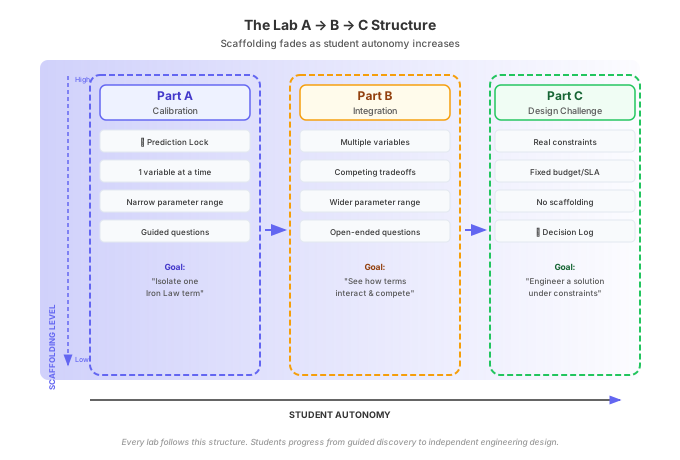
Each lab follows a consistent three-part structure designed to transition students from guided exploration to independent engineering:
- Part A (Calibration): Single-variable interactions. Students learn to isolate one physical concept (e.g., just the \(D_{\text{vol}}\) term of the Iron Law). Heavy scaffolding, narrow parameter ranges.
- Part B (Integration): Multi-variable interactions. Students see how variables compete (e.g., how batch size affects both throughput and memory). Less scaffolding, wider parameter ranges.
- Part C (Design Challenge): Open-ended scenario. Students are given a fixed budget or performance target and must find the optimal configuration across the full stack. No scaffolding — students must transfer what they learned in A and B.
Part A → B Transition: When students finish Part A, ask: “You just learned that increasing X improves metric Y. But what happens to metric Z?” This bridges to Part B’s multi-variable interactions.
Part B → C Transition: When students finish Part B, say: “Now you know the tradeoffs. Here’s a real constraint: 50 ms latency SLA, 256 KB memory budget. Design the best system you can.”
4. Metacognitive Reflection (The Decision Log)
Moving sliders is a lower-order cognitive task. To ensure deep learning, students must articulate why they made certain engineering decisions.
- The Mechanism: The Decision Log requires students to write a formal engineering justification for their recommended configuration in Part C.
- The Standard: Instead of “I made it smaller,” students must write: “I reduced the \(D_{\text{vol}}\) term via INT4 quantization to fit within the 256 KB SRAM constraint, accepting a 1.2% accuracy reduction.”
- The Result: This process of “thinking about their thinking” (metacognition) is what transfers knowledge from the lab session to real-world engineering projects.
When grading Decision Logs, use a simple 3-question rubric: (1) Did they cite specific numbers from instruments? (2) Did they use Iron Law terminology? (3) Did they acknowledge a tradeoff? If yes to all three → full marks. See Assessment for the detailed rubric.
5. The Iron Law Audit
The Iron Law of ML Systems (\(T \approx \frac{D_{\text{vol}}}{\text{BW}} + \frac{O}{R_{\text{peak}} \cdot \eta} + L_{\text{lat}}\)) is the analytical backbone of the entire curriculum.
- The Tactic: Train students to “audit” every performance change. If a model got faster, which term did they manipulate? If a system hit a wall, which term is the bottleneck?
- The Goal: By the end of the course, students should look at any system optimization — pruning, kernel fusion, quantization, batching, parallelism — and instantly map it to the Iron Law variable it affects.
Use this prompt after any optimization lab: “We just saw a 3.5\(\times\) speedup from [technique]. Which Iron Law term changed? Did any other term get worse? Would this technique work on a different hardware platform? Why or why not?”
“Iron Law Journal” (semester-long): Have students maintain a running table that maps every technique they encounter to its Iron Law term. By Week 16, this becomes a personal reference card for their engineering career.
6. Facilitation Cheat Sheet
Quick reference for common lab facilitation patterns:
| Situation | What to Say |
|---|---|
| Student says “it’s faster” | “How much faster? Which Iron Law term changed? Show me the number.” |
| Student gets OOM error | “Good. Now find the exact value where it breaks. What constraint did you hit?” |
| Student doesn’t know what to try | “Start with Part A defaults. Change one variable. What happened? Now change a different one.” |
| Student’s prediction was right | “Interesting — why? What mental model did you use? Does it generalize to a different hardware target?” |
| Student’s prediction was wrong | “Even better. What did you assume that turned out to be false? Update your model.” |
| Student finishes early | “Can you find a configuration that is 2\(\times\) better than your current best? What’s the theoretical limit?” |
| Lab discussion goes silent | “Who had the most wrong prediction? Let’s talk about why.” |