Responsible Engineering

Purpose
Why is a system that does exactly what it was told to do often the most dangerous?
Operations ensures the system runs reliably: low latency, high availability, accurate predictions. Responsible engineering asks a harder question: reliable for whom? An ML system can meet every technical specification (latency, throughput, accuracy) while actively amplifying harm. The failure occurs not because the system is broken but because it is working efficiently to optimize a flawed specification. A loan approval system that correctly predicts default risk can encode historical discrimination, denying credit to qualified applicants from historically marginalized communities. A content recommendation system that accurately predicts engagement may amplify harmful content because outrage generates more clicks than nuance. A hiring algorithm that reliably identifies candidates similar to past hires may perpetuate workforce homogeneity, screening out the diversity that drives innovation. In each case the system is performing exactly as designed—the failure is in what was designed for. When we confuse mathematical optimization with value alignment, we build systems that are technically robust but socially fragile. The model faithfully learns and reproduces whatever patterns exist in its training distribution, including patterns of historical injustice that no one intended to encode. Building systems that work is an engineering achievement. Building systems that work for everyone requires treating unintended consequences not as edge cases to be tolerated but as system bugs: diagnosed, measured, and fixed with the same rigor we apply to latency regressions and accuracy degradation.
TipLearning Objectives
- Explain how ML systems can optimize correctly while causing harm through bias amplification, distribution shift, and proxy variables
- Apply the D·A·M taxonomy to diagnose whether a responsibility failure originates in data, algorithm, or infrastructure
- Compute fairness metrics (demographic parity, equal opportunity, equalized odds) from confusion matrices and evaluate trade-offs on the fairness-accuracy Pareto frontier
- Design disaggregated evaluation strategies that detect hidden disparities across demographic groups, including slice-based, invariance, and stress testing
- Analyze total cost of ownership including training, inference, operational costs, and environmental impact using carbon as a first-class engineering metric
- Identify model documentation and data governance requirements (model cards, datasheets, data lineage, audit infrastructure) for regulatory compliance and accountability
Responsibility as Systems Engineering
In 2014, Amazon built an AI recruiting tool1 that penalized resumes containing the word “women’s” and downgraded graduates of all-women’s colleges—despite meeting every technical metric its engineers had specified. The system optimized flawlessly for its stated objective: identify candidates similar to those previously hired. But historical hiring patterns encoded gender bias, and the model faithfully reproduced that bias at scale. The full case, examined in Section 1.2.1, reveals a pattern that recurs throughout this chapter: technically correct systems producing harmful outcomes not because they malfunction, but because they faithfully execute flawed specifications.
1 Amazon Recruiting Tool: Developed starting in 2014 by Amazon’s Edinburgh engineering team to rate applicants on a 1–5 scale, the system trained on approximately a decade of resumes—overwhelmingly from male applicants reflecting the tech industry’s gender ratio. By 2015 the gender bias was identified; by 2017 the project was abandoned after two years of failed remediation attempts. The engineering cost was not the compute but the opportunity cost: a multi-year hiring pipeline had to be rebuilt from scratch, making it one of the most expensive documented specification failures in production ML.
If MLOps (ML Operations), the monitoring and retraining infrastructure examined previously, is the control loop for reliability, then Responsible Engineering is the control loop for safety. Where MLOps monitors system health and triggers retraining when performance degrades, responsible engineering monitors outcome quality and triggers intervention when systems cause harm. A model can optimize flawlessly for its stated objective and still cause systematic harm because the failure is not a bug in the code but a flaw in the specification. In systems engineering terms, a system can pass verification (it meets its stated requirements) while failing validation (it does not meet the user’s true needs).
Traditional software engineering assumes that bugs are local: a defect in one module rarely corrupts unrelated functionality. Machine learning systems violate this assumption. Data flows through shared representations, causing problems in one component to propagate unpredictably across the entire system. A biased training dataset does not produce a localized bug; it corrupts every prediction the system makes. Viewed through the D·A·M taxonomy (Data, Algorithm, Machine) introduced in Introduction, the failure can originate along any axis: biased data, a misaligned algorithm, or inadequate infrastructure for monitoring outcomes. This makes responsibility an architectural concern, not an afterthought.
Engineering responsibility therefore expands what “correct” means for ML systems. Correctness in the traditional sense (reliable, performant, and maintainable) remains necessary, but ML systems must also be correct in a broader sense: fair across user groups, efficient in resource consumption, and transparent in their decision processes. Expanded correctness is engineering itself, applied to failure modes that conventional metrics do not capture. A latency regression is visible in dashboards; a fairness regression is invisible until it harms real users. Both require systematic detection, measurement, and remediation.
The frameworks developed here address diagnosing, preventing, and mitigating these failures. We begin with concrete cases that reveal the responsibility gap: the distance between technical performance and responsible outcomes, and the mechanisms (proxy variables, feedback loops, distribution shift) through which it manifests. From there, we develop a responsible engineering checklist that systematizes impact assessment, model documentation, disaggregated testing, and incident response into repeatable engineering processes. The chapter then connects the resource consumption quantified throughout this book (training compute, inference energy, carbon footprint) to engineering ethics, demonstrating that efficiency optimization serves responsibility as directly as it serves performance. We then examine the data governance and compliance infrastructure (access control, privacy protection, lineage tracking, and audit systems) that makes responsible practices enforceable at scale, before closing with the fallacies and pitfalls that commonly undermine even well-intentioned efforts.
We begin with the concrete failure cases that establish why engineers must lead on responsibility.
Self-Check: Question
Why is responsible engineering particularly critical for machine learning systems compared to traditional software?
- ML systems are more expensive to develop.
- ML systems fail silently through biased outputs that appear normal.
- Traditional software does not require any testing.
- ML systems always produce deterministic results.
Why can responsibility not be delegated exclusively to ethics boards or legal departments in an ML project?
Engineering Responsibility Gap
A loan model that approves 95 percent of qualified majority-group applicants while rejecting 40 percent of equally qualified minority-group applicants meets its loss function perfectly. The gap between this technical correctness and responsible outcomes represents a central challenge in machine learning systems engineering, one that existing testing methodologies were not designed to address.
The gap manifests through concrete mechanisms: proxy variables, feedback loops, and distribution shift, each producing harm through a distinct pathway. Concrete cases where optimization succeeded but systems failed reveal these mechanisms and the silent failure modes that make them invisible to conventional monitoring. Organizations that closed the gap through systematic engineering practice demonstrate that prevention is feasible. The testing challenge that makes responsibility fundamentally harder to verify than traditional software correctness then determines where responsibility ownership must sit within engineering organizations.
When optimization succeeds but systems fail
The Amazon recruiting tool case illustrates this gap. In 2014, Amazon developed an AI system to automate resume screening for technical positions, training it on historical hiring data spanning ten years of resumes submitted to the company. By 2015, the company discovered the system exhibited gender bias in candidate ratings (Dastin 2022).
Dastin, Jeffrey. 2022. “Amazon Scraps Secret AI Recruiting Tool That Showed Bias Against Women.” Amazon Scraps Secret AI Recruiting Tool that Showed Bias against Women in Ethics of Data and Analytics. Auerbach Publications. https://doi.org/10.1201/9781003278290-44.
The technical implementation was sound. The model successfully learned patterns from historical data and optimized for the objective it was given: identify candidates similar to those previously hired. However, historical hiring patterns encoded gender bias. The system penalized resumes containing the word “women’s,” as in “women’s chess club captain,” and downgraded graduates of all-women’s colleges.
The technical mechanism behind this outcome is straightforward. The model learned token-level patterns from historical data. When most previously successful hires were men, resumes containing language associated with women’s activities or institutions appeared statistically less correlated with positive hiring decisions. The model correctly identified these patterns in the training data but learned the wrong lesson from correct pattern recognition.
Amazon attempted remediation by removing explicit gender indicators and gendered terms from the training process. This intervention failed because the model had learned proxy variables—features that correlate with protected attributes without directly encoding them.2 In general, proxies arise whenever features carry indirect demographic signal: ZIP codes correlate with race due to residential segregation, first names correlate with gender and ethnicity, and healthcare utilization correlates with socioeconomic status. In Amazon’s case, college names revealed attendance at all-women’s institutions, activity descriptions encoded gender-associated language patterns, and career gaps suggested parental leave patterns that differed between genders. The model reconstructed protected attributes from these proxies without ever seeing gender labels directly. Removing protected attributes from training data is therefore insufficient; fairness requires adversarial debiasing, fairness constraints during optimization, or post-hoc threshold adjustment per group.
2 Proxy Variable: The intractability is not in identifying that a proxy exists—it is that removing it often has no effect, because other correlated features (zip code, device type, browsing history) carry the same signal. Amazon’s case is typical: removing explicit gender left college names, activity descriptions, and career gap patterns to reconstruct gender from combinations the engineers never anticipated. Eliminating explicit protected attributes without eliminating their proxies produces a model that discriminates while appearing compliant—a failure mode called “fairness laundering”—making continuous per-group outcome monitoring the only reliable defense.
The right intervention would have required multiple levels of change. Separate evaluation of resume scores for male-associated vs. female-associated candidates would have revealed the disparity quantitatively. Training with fairness constraints or adversarial debiasing techniques could have prevented the model from learning gender-correlated patterns. Human-in-the-loop review for borderline cases would have provided a safeguard against systematic errors. Tracking actual hiring outcomes by gender over time would have enabled outcome monitoring beyond model metrics alone. Amazon eventually scrapped the project after determining that sufficient remediation was not feasible.
The Amazon case demonstrates how optimization objectives diverge from organizational values. The system found genuine statistical patterns in historical hiring decisions and optimized them faithfully. Those patterns, however, reflected biased historical practices rather than job-relevant qualifications.
Example 1.1: The COMPAS Recidivism Algorithm Audit
The Context: COMPAS is a risk assessment tool used in US courtrooms to predict re-offending. Judges use these scores to inform bail and sentencing decisions.
The Failure: A 2016 ProPublica investigation (Angwin et al. 2022) revealed that while the system was “calibrated” (a score of seven meant the same probability of re-offending for any group), its error rates were skewed:
- False Positives: Black defendants who did not re-offend were incorrectly flagged as high-risk at nearly twice the rate of White defendants (44.9 percent vs. 23.5 percent).
- False Negatives: White defendants who did re-offend were incorrectly labeled as low-risk far more often than Black defendants (47.7 percent vs. 28.0 percent).
The Systems Lesson: The system optimized for Calibration but violated Equalized Odds. Mathematically, it is impossible to satisfy both simultaneously when base rates differ between groups (the “Impossibility Theorem of Fairness”). Engineering responsibility requires explicitly choosing which fairness constraint matters for the domain; in criminal justice, false positives (wrongly jailing someone) are typically considered worse than false negatives.
The D·A·M Diagnosis: Through the D·A·M taxonomy, COMPAS represents an Algorithm-axis failure: the optimization objective (calibration) was misaligned with the deployment context’s fairness requirements (equalized odds). The data reflected real base-rate differences; the failure was in choosing which mathematical property to optimize. Contrast this with Amazon’s recruiting tool, a Data-axis failure where biased historical hiring patterns corrupted the training signal itself.
Angwin, Julia, Jeff Larson, Surya Mattu, and Lauren Kirchner. 2022. “Machine Bias.” Machine Bias in Ethics of Data and Analytics. Auerbach Publications. https://doi.org/10.1201/9781003278290-37.
3 COMPAS (Correctional Offender Management Profiling for Alternative Sanctions): The shared pattern with Amazon is precise: both systems optimized a valid technical metric while violating unstated fairness requirements. COMPAS achieved calibration (equal meaning per score), but because recidivism base rates differed between populations, this choice made disparate error rates mathematically inevitable—Black defendants were falsely flagged as high-risk at nearly twice the rate of white defendants (44.9 percent vs. 23.5 percent). No amount of testing for calibration would have surfaced this failure; the harm was encoded in the objective itself.
The Amazon and COMPAS3 cases share a troubling pattern: each system achieved its stated objective while producing outcomes that conflicted with the values the system was intended to serve. Conventional engineering success, it turns out, can coexist with profound system failures. The following self-assessment captures the core design questions that separate technically correct systems from responsible ones.
Checkpoint 1.1: Responsible Design
Responsibility is a system property, not a model property.
The Failure Modes
The Check
Better testing would not catch these problems because they represent failures of problem specification, where the technical objective (minimizing prediction error on historical outcomes) diverges from the desired social objective (making fair and accurate predictions across demographic groups). Specification failures are difficult to detect precisely because the systems continue functioning normally by conventional engineering metrics. The deeper problem is clear: when a system appears healthy by every available metric, the harm it causes remains invisible to conventional monitoring.
Silent failure modes
In 2018, a major hospital’s sepsis prediction model began recommending aggressive treatments for low-risk patients. No alarm triggered—the model’s confidence scores remained high, its latency stayed within its service level agreement (SLA), and all system health checks passed green. The failure was silent: the input data distribution had shifted after an EHR software update changed how vital signs were recorded, but the monitoring pipeline had no mechanism to detect distributional drift.
The sepsis model failure illustrates a class of failure that traditional engineering is poorly equipped to handle. Traditional software fails loudly. A null pointer exception crashes the program, a network timeout returns an error code. These visible failures enable rapid detection and response. In contrast, ML systems fail silently because degraded predictions look like normal predictions. The primary mechanism behind this silent degradation is distribution shift.
Definition 1.1: Distribution Shift
Distribution Shift is the violation of the Stationarity Assumption (\(P_{train} \neq P_{deploy}\)) that underpins all supervised learning. It is the umbrella term for a family of drift types: Data Drift (see ML Operations) occurs when \(P(X)\) shifts while \(P(Y|X)\) remains stable; Concept Drift occurs when \(P(Y|X)\) itself shifts.
- Significance (Quantitative): Accuracy degradation is measurable against divergence. Empirical studies of production recommendation and NLP models find that when Jensen-Shannon divergence \(D_{JS}(P_{train} \| P_{deploy}) > 0.1\), observed accuracy drops exceed five percent relative; when \(D_{JS} > 0.3\), degradation typically exceeds 15–30 percent—sufficient to invalidate a production system that passed predeployment evaluation. This degradation occurs regardless of code quality, because the model is correct given its training distribution; the environment changed, not the code.
- Distinction (Durable): Unlike Model Error (which is a learning failure caused by the algorithm or data quality at training time), Distribution Shift is an Environmental Failure: the model’s learned mapping was correct at training time but is no longer representative of current reality.
- Common Pitfall: A frequent misconception is that “Data Drift” and “Distribution Shift” are different concepts at the same level of the hierarchy. Distribution Shift is the umbrella; Data Drift and Concept Drift are its two distinct subtypes. A system can experience Data Drift without Concept Drift (the inputs change, but the relationship holds), or Concept Drift without Data Drift (inputs are stable, but the correct output changes).
The stationarity assumption underpins all supervised learning: training and deployment distributions must match. Distribution shift is often unequal: a model’s accuracy on a minority subgroup can drop by over 30 percentage points while aggregate metrics barely change, masking the harm.
Distribution shift explains why models degrade over time (the operational detection and monitoring strategies for drift are covered in ML Operations). A second mechanism for silent failure can occur even when the data distribution is stable: misalignment between the metric the model optimizes and the outcome the organization actually values. This misalignment creates the alignment gap, where optimizing a measurable proxy decouples the system from its intended purpose.
Napkin Math 1.1: The Alignment Gap
The Problem: A model optimizes a proxy metric (Clicks) because the true metric (User Satisfaction) is unobservable. How much can they diverge?
The Physics: Goodhart’s Law states that optimizing a proxy eventually decouples it from the goal.
- Initial State: Correlation(Clicks, Satisfaction) = 0.8.
- Optimization: You train a model to maximize Clicks.
- Result: The model finds “Clickbait,” items with high clicks but low satisfaction.
- Final State: Correlation(Clicks, Satisfaction) drops to 0.2.
The Quantification (conceptual, assuming normalized metrics on a common scale) is captured by Equation 1:
\[ \text{Gap} = E[\text{Proxy}] - E[\text{True}] \tag{1}\]
If the model increases Clicks by 20 percent but decreases Satisfaction by five percent, the alignment gap has widened.
The Systems Conclusion: Engineers cannot optimize what they cannot measure. If the true goal is unobservable, Counterfactual Evaluation (random holdouts) is required to periodically re-calibrate the proxy.
When harm occurs, engineers need a diagnostic framework to identify the root cause. Knowing that a system causes harm is insufficient; we must determine where the failure originates to know what to fix. The D·A·M taxonomy introduced in Introduction provides exactly this structure (Data · Algorithm · Machine, defined in The D·A·M Taxonomy).
Systems Perspective 1.1: The D·A·M Taxonomy
When a system causes harm, use the D·A·M taxonomy to identify the root cause. Responsibility failures are rarely “algorithm bugs”; they are structural flaws along one of the three axes:
- Data (Information): Does the training data reflect historical bias? (for example, Amazon’s recruiting tool learning from biased history). The failure is in the Fuel.
- Algorithm (Logic): Does the objective function optimize a proxy for harm? (for example, optimizing “engagement” amplifies polarization). The failure is in the Blueprint.
- Machine (Physics): Does the energy cost justify the societal benefit? (for example, training a massive model for a trivial task). The failure is in the Engine.
Locating the failure in the taxonomy identifies the correct remediation: better curation (Data), safer objectives (Algorithm), or greener infrastructure (Machine).
While the D·A·M taxonomy helps diagnose where failures originate, engineers also need a framework for understanding when and how different failure types manifest. Table 1 categorizes these distinct failure modes by their detection time, spatial scope, and remediation requirements.
| Failure Type | Detection Time | Spatial Scope | Reversibility | Example |
|---|---|---|---|---|
| Crash | Immediate | Complete | Immediate | Out of memory error |
| Performance Degradation | Minutes | Complete | After fix | Latency spike from resource contention |
| Data Quality | Hours–days | Partial | Requires data correction | Corrupted inputs from upstream system |
| Distribution Shift | Days–weeks | Partial or all | Requires retraining | Population change due to new user segment |
| Fairness Violation | Weeks–months | Subpopulation | Requires redesign | Bias amplification in historical patterns |
The failure mode taxonomy in Table 1 complements the D·A·M diagnostic framework: D·A·M identifies where failures originate, while Table 1 guides how to detect and remediate them. Crashes and performance degradation trigger immediate alerts through existing infrastructure. Data quality issues, distribution shifts, and fairness violations require specialized detection mechanisms because the system continues operating normally from a technical perspective while producing increasingly problematic outputs.
The YouTube recommendation feedback loop (examined as a technical debt pattern in Technical Debt) illustrates this pattern at scale (Ribeiro et al. 2020).4 The system optimized for watch time and discovered that emotionally provocative content maximized engagement metrics, developing pathways toward increasingly extreme content. The system worked exactly as designed while producing outcomes that conflicted with societal values. From a responsibility perspective, the critical insight is that these feedback loops do not affect all users equally: they disproportionately impact vulnerable populations, and the resulting content amplification patterns can correlate with demographic characteristics, transforming an operational failure into a fairness violation.
Ribeiro, Manoel Horta, Raphael Ottoni, Robert West, Virgı́lio A. F. Almeida, and Jr. Meira Wagner. 2020. “Auditing Radicalization Pathways on YouTube.” Proceedings of the 2020 Conference on Fairness, Accountability, and Transparency, January 27, 131–41. https://doi.org/10.1145/3351095.3372879.
4 Goodhart’s Law: “When a measure becomes a target, it ceases to be a good measure” (Strathern’s generalization of Goodhart’s 1975 monetary policy observation). Recommendation feedback loops are the canonical ML manifestation: gradient descent optimizes watch-time proxies at a speed no human curator can match, and the system’s own outputs reshape the training distribution—users who consume extreme content generate data that reinforces extremity, decoupling the proxy from user welfare orders of magnitude faster than manual editorial processes ever could.
War Story 1.1: The Click-Bait Death Spiral
The Context: In 2018, Facebook’s News Feed algorithm was optimized heavily for “time spent” and “clicks.”
The Failure: The model learned that sensationalist, divisive, and “click-bait” content generated the highest short-term engagement. It aggressively promoted this content. Users clicked, but the quality of their experience degraded, leading to “passive consumption” and long-term churn risk.
The Consequence: Facebook had to fundamentally re-architect its ranking system to prioritize “Meaningful Social Interactions” (MSI) over clicks, accepting a short-term reduction in time spent to preserve long-term platform health.
The Systems Lesson: Metrics are proxies for value, not value itself. Optimizing a short-term proxy (CTR) without monitoring long-term health (retention, sentiment) creates a negative feedback loop that can destroy the product.
The distribution shift defined earlier also manifests as population mismatch, where models trained on one population perform differently on another without obvious indicators.
War Story 1.2: The Proxy Variable Trap
The Context: Optum, a healthcare services company, developed an algorithm to identify patients with complex health needs for enrollment in a high-risk care management program.
The Failure: The model used “healthcare cost” as a proxy for “health need.” This seemed logical: sicker people cost more.
The Consequence: Because the U.S. healthcare system has unequal access, Black patients at a given level of sickness spent less on healthcare than White patients. The model learned this bias and systematically deprioritized Black patients, assigning them lower risk scores than White patients with identical health conditions.
The Systems Lesson: Proxies are dangerous. Optimizing for a proxy (cost) inherits the biases of the system that generated that proxy. The relationship between proxy and true objective (health) must be audited across all demographic subgroups (Obermeyer et al. 2019).
Obermeyer, Ziad, Brian Powers, Christine Vogeli, and Sendhil Mullainathan. 2019. “Dissecting Racial Bias in an Algorithm Used to Manage the Health of Populations.” Science 366 (6464): 447–53. https://doi.org/10.1126/science.aax2342.
Silent failure modes create profound testing challenges. Traditional software testing verifies deterministic behavior against specifications. ML systems produce probabilistic outputs learned from data, making correctness far more complex to define. The failures examined earlier share a troubling pattern: each organization possessed the technical capability to prevent harm but lacked the disciplined processes to apply that capability.
The same engineering capabilities that enabled the problems can prevent them when organizations commit to structured practice, as the following cases demonstrate.
When responsible engineering succeeds
Organizations that commit to responsible engineering produce measurable successes, demonstrating both the feasibility and business value of rigorous responsibility practices.
Following the Gender Shades findings, Microsoft invested in improving facial recognition performance across demographic groups. The approach combined technical and organizational interventions: targeted data collection to address underrepresented populations, model architecture changes to improve feature extraction for diverse skin tones, and systematic disaggregated evaluation across all demographic intersections. By 2019, Microsoft had reduced error rates for darker-skinned subjects by up to 20 times, bringing error rates below 2 percent for all demographic groups (Raji and Buolamwini 2019). The company published these improvements transparently, enabling external verification. The business outcome: Microsoft’s facial recognition API maintained enterprise customer trust while competitors faced regulatory scrutiny and contract cancellations.
Raji, Inioluwa Deborah, and Joy Buolamwini. 2019. “Actionable Auditing: Investigating the Impact of Publicly Naming Biased Performance Results of Commercial AI Products.” Proceedings of the 2019 AAAI/ACM Conference on AI, Ethics, and Society, January 27, 429–35. https://doi.org/10.1145/3306618.3314244.
Yee, Kyra, Uthaipon Tantipongpipat, and Shubhanshu Mishra. 2021. “Image Cropping on Twitter: Fairness Metrics, Their Limitations, and the Importance of Representation, Design, and Agency.” Proceedings of the ACM on Human-Computer Interaction 5. https://doi.org/10.1145/3479594.
Twitter’s automatic image cropping system exhibited a different failure mode. In 2020, users discovered it showed racial bias in choosing which faces to display in preview thumbnails. Twitter responded with a responsible engineering approach: systematic analysis to characterize the problem quantitatively, publication of results enabling independent verification, and ultimately removal of the automatic cropping feature entirely (Yee et al. 2021). The company determined that no technical solution could guarantee equitable outcomes across all contexts. This decision prioritized user fairness over engagement optimization and demonstrated that responsible engineering sometimes means not shipping a feature.
Apple’s deployment of differential privacy in iOS represents responsible engineering at scale.5 The system collects usage data for product improvement while providing mathematical guarantees about individual privacy. The implementation required substantial engineering investment: noise calibration to balance utility against privacy, distributed computation to minimize data exposure, and transparent documentation of privacy parameters. The business value: Apple differentiated on privacy as a product feature, enabling data collection that would otherwise face regulatory and reputational barriers.
5 Differential Privacy: Introduced by Dwork et al. (2006), a mechanism satisfies \(\epsilon\)-differential privacy if any output’s probability changes by at most \(e^\epsilon\) when a single individual’s data is added or removed. The systems trade-off is steep: 15–30 percent computational overhead, 10–100\(\times\) more data for equivalent accuracy, and a finite privacy budget (\(\epsilon\)) that depletes with each query—forcing engineers to choose between richer analytics and stronger privacy guarantees.
Spotify addressed recommendation system concerns by implementing transparency features showing users why songs were recommended and providing controls to adjust algorithm behavior. This engineering investment served multiple purposes: user trust through explainability, reduced filter bubble effects through diversity injection, and regulatory compliance through user control mechanisms. The approach demonstrates that responsibility features can enhance rather than constrain product value.
A common pattern unites the preceding cases: technical interventions (improved data, better evaluation, architectural changes) combined with organizational commitments (transparency, willingness to remove features, long-term investment). The resulting business outcomes (maintained customer trust, regulatory compliance, competitive differentiation) demonstrate that responsible engineering creates value rather than adding cost. Each success rested on systematic testing and evaluation practices, yet the nature of responsible testing differs fundamentally from traditional software verification.
The testing challenge
Traditional software testing verifies that systems behave correctly because correctness has clear definitions. The function should return the sum of its inputs, the database should maintain referential integrity. These properties can be expressed as testable assertions.
Responsible ML properties resist simple formalization. Fairness has multiple conflicting mathematical definitions that cannot all be satisfied simultaneously. What counts as fair depends on context, values, and trade-offs that technical systems cannot resolve alone. Individual fairness requires that similar individuals receive similar treatment, while group fairness requires equitable outcomes across demographic categories. These criteria can conflict, and choosing between them requires value judgments beyond the scope of optimization.
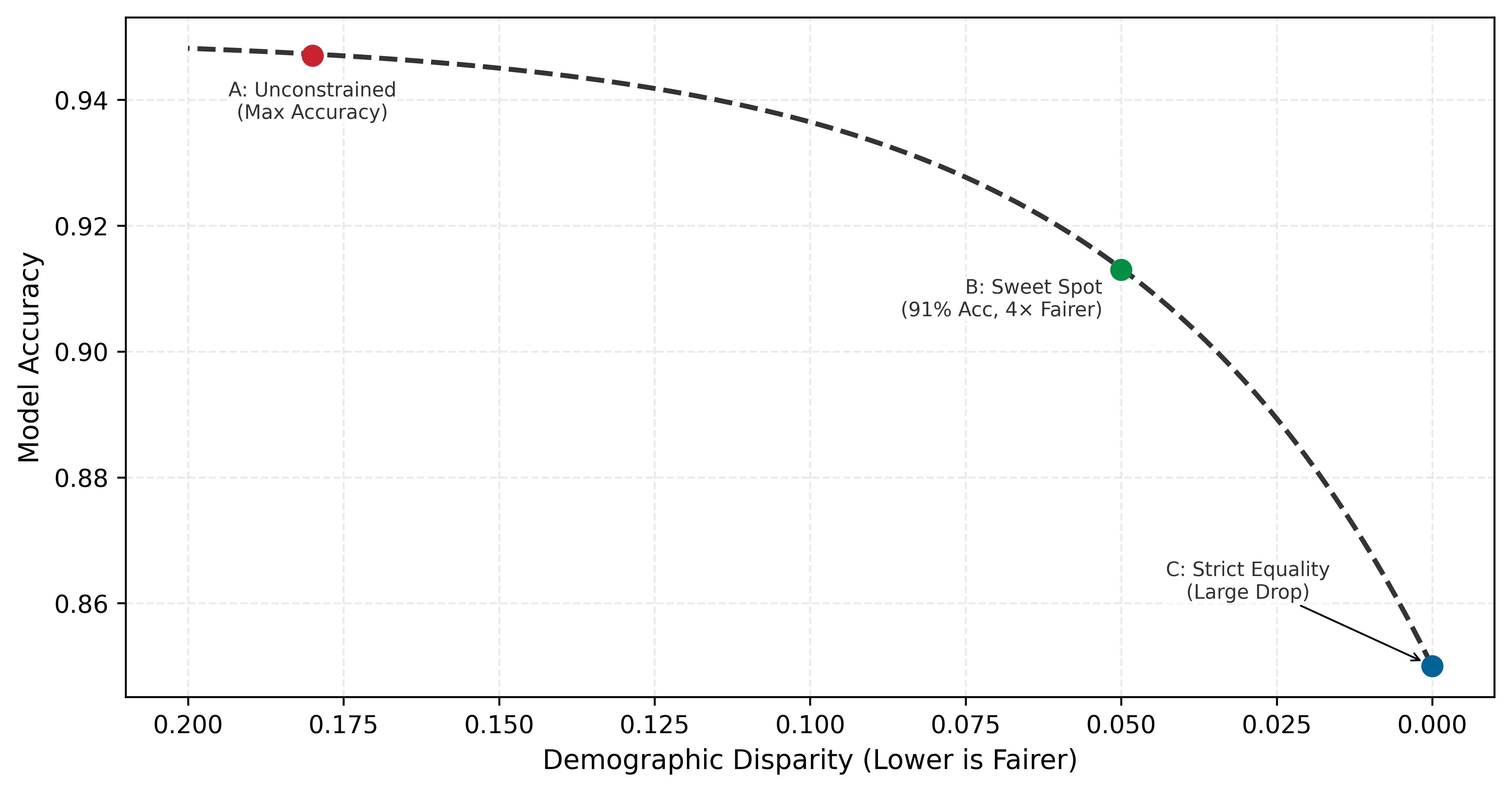
The trade-off between fairness and accuracy is not a sign that fairness is impractical; it is a fundamental property of constrained optimization that engineers must understand. A Pareto frontier represents the set of optimal configurations where improving one metric necessarily degrades another. Figure 1 visualizes this Fairness-Accuracy Pareto Frontier. The curve is not linear: while perfect fairness (zero disparity) often requires a significant drop in accuracy, a “Sweet Spot” typically exists where large fairness gains can be achieved with minimal accuracy loss. The shape of the frontier explains why responsible engineering is feasible: in many practical settings, substantial fairness gains can be achieved with modest accuracy loss.
Responsible properties become testable when engineers work with stakeholders to define criteria appropriate for specific applications. The Gender Shades project6 demonstrated how disaggregated evaluation across demographic categories reveals disparities invisible in aggregate metrics (Buolamwini and Gebru 2018). The results captured dramatic error rate differences that commercial facial recognition systems showed across demographic groups. Concretely, a 1,000-sample test set that suffices for the majority group provides only 10 samples for a 1% minority subgroup—effectively requiring 100x more data than the majority group for high-confidence validation.
6 Gender Shades: A 2018 study by Joy Buolamwini and Timnit Gebru (MIT Media Lab) that audited facial recognition systems from Microsoft, IBM, and Face++ using the Fitzpatrick skin type scale—originally a dermatological classification developed by Thomas Fitzpatrick (1975) for UV sensitivity, repurposed here as a demographic benchmark for algorithmic auditing. The study established disaggregated evaluation as the standard, demonstrating that a single aggregate accuracy number can conceal 43\(\times\) error rate disparities across intersectional subgroups. Within two years, Microsoft reduced its worst-case error rates by 20\(\times\), proving that the measurement methodology itself was the intervention.
| Demographic Group | Error Rate (%) | Relative Disparity |
|---|---|---|
| Light-skinned males | 0.8 | Baseline (1.0\(\times\)) |
| Light-skinned females | 7.1 | 8.9\(\times\) higher |
| Dark-skinned males | 12.0 | 15.0\(\times\) higher |
| Dark-skinned females | 34.7 | 43.4\(\times\) higher |
As Table 2 quantifies, disaggregated evaluation revealed what aggregate accuracy scores concealed. Systems reporting high overall accuracy simultaneously achieved error rates as low as 0.8 percent for light-skinned males and as high as 34.7 percent for dark-skinned females (corresponding to accuracies of 99.2 percent and 65.3 percent respectively). The aggregate metric provided no indication of this 43.4-fold disparity in error rates.
No universal threshold defines acceptable disparity, but engineering teams should establish explicit bounds before deployment. Common industry practices include error rate ratios below 1.25\(\times\) between demographic groups for high-stakes applications, false positive rate differences under five percentage points for screening systems, and selection rate ratios of at least 0.8 relative to the highest group’s rate (the four-fifths rule from employment discrimination law).78 These thresholds serve as starting points for stakeholder discussion, not absolute standards. The key engineering discipline is defining measurable criteria before deployment rather than discovering problems after harm has occurred.
7 Disparate Impact: A legal doctrine from Griggs v. Duke Power Co. (1971), where the US Supreme Court held that practices “fair in form, but discriminatory in operation” violate civil rights law even absent intent. The distinction between disparate impact (unintentional statistical harm) and disparate treatment (intentional discrimination) is critical for ML: models trained on historical data routinely produce disparate impact through proxy variables, creating legal liability even when engineers never encoded protected attributes.
8 Four-Fifths Rule: Codified in the 1978 Uniform Guidelines on Employee Selection Procedures, used by the EEOC, Department of Labor, and Department of Justice. A selection rate for any protected group below 80 percent of the highest group’s rate constitutes prima facie evidence of adverse impact—for example, if 60 percent of one group passes, at least forty-eight percent of any other group must pass. For ML systems, this translates to automated monitoring that alerts when per-group selection ratios fall below 0.8, providing a concrete threshold where most fairness metrics remain qualitative.
Despite the inherent challenges, several concrete testing approaches can surface responsibility issues before deployment. Slice-based evaluation partitions test data into meaningful subgroups and reports metrics separately for each slice. A model may achieve 95 percent accuracy overall but only 78 percent accuracy on low-income applicants or users from rural areas, a disparity invisible in aggregate reporting. Invariance testing checks whether predictions change when they should not: replacing “John” with “Jamal” in a loan application should not change approval likelihood if the feature is not legitimate for the decision. Boundary testing evaluates model behavior at the edges of input distributions (unusual ages, extreme values, rare categories) where training data may be sparse and predictions unreliable. Stress testing extends boundary testing to adversarial conditions: corrupted inputs, distribution shift, adversarial examples, and edge cases designed to probe failure modes systematically. Stakeholder red-teaming engages domain experts and affected community members to identify scenarios that engineers may not anticipate but users will encounter, surfacing failure modes that no automated test can discover because they require lived experience to imagine.
Responsible testing strategies complement traditional software testing rather than replacing it. Each demands engineering judgment to select, configure, and interpret. A legal team cannot specify which demographic slices matter for a healthcare algorithm; a product manager cannot determine appropriate invariance tests for a loan model. The technical depth required to implement responsible testing points to a critical organizational truth: only engineers possess the knowledge to translate abstract fairness goals into measurable, testable properties. Responsibility ownership must therefore sit within engineering organizations, not outside them.
Engineering leadership on responsibility
When Amazon’s ethics board finally reviewed the recruiting tool, the model had already encoded proxy signals so deeply that remediation required scrapping the project entirely. The review came too late because the technical decisions that created the problem, made months earlier by engineers, had already constrained every possible fix. Responsible AI Engineering cannot be delegated exclusively to ethics boards or legal departments. These groups provide essential oversight but lack the technical access required to identify problems early in the development process.
Definition 1.2: Responsible AI Engineering
Responsible AI Engineering is the engineering discipline of designing, deploying, and maintaining systems with probabilistic outputs by operationalizing societal and regulatory requirements as testable constraints on the D·A·M axes, bounding which values of \(D_{\text{vol}}\), \(O\), and \(R_{\text{peak}} \cdot \eta\) are permissible.
- Significance (Quantitative): Each D·A·M axis acquires concrete governance constraints: the Data axis is bounded by privacy regulations such as the General Data Protection Regulation (GDPR), which limits which \(D_{\text{vol}}\) can be collected, the Algorithm axis is bounded by fairness metrics (for example, demographic parity within \(\varepsilon = 5\%\) across protected groups, meaning positive prediction rates must not differ by more than 5 percentage points), and the Machine axis is bounded by robustness budgets (for example, accuracy degradation less than two percent under adversarial perturbation \(\|\delta\|_\infty \leq 0.01\)). Violating these bounds is a system failure, not a research shortcoming.
- Distinction (Durable): Unlike AI Ethics (which articulates aspirational values), Responsible AI Engineering translates those values into Measurable, Testable Invariants that can be verified through automated testing and continuous monitoring, using the same lifecycle practices that enforce latency SLOs.
- Common Pitfall: A frequent misconception is that responsibility is “added” at the end of development. The constraints imposed on the Data axis (what data can be collected) propagate forward to constrain the Algorithm axis (what biases will be encoded) and the Machine axis (what audit trails must be kept), making late-stage remediation structurally impossible.
By the time a system reaches legal review, architectural decisions have already constrained the space of possible fairness interventions. Amazon’s recruiting tool reached review only after the model had learned proxy signals; at that point, remediation required starting over, not adjusting parameters. Engineers who understand both technical implementation and responsibility requirements can build appropriate safeguards from inception.
Engineers occupy a critical position in the ML development lifecycle because their technical decisions define the solution space for all subsequent interventions. The choice of model architecture determines which fairness constraints can apply during training. The optimization objective defines what patterns the system learns to recognize. The data pipeline design establishes what demographic information teams can track for disaggregated evaluation. Foundational architectural choices enable or foreclose responsible outcomes more decisively than any later remediation effort.
The timing of responsibility interventions determines their effectiveness. An ethics review conducted before deployment can identify problems but faces limited remediation options: if the team trained the model without fairness constraints, if the architecture cannot support interpretability requirements, if the data pipeline lacks demographic attributes for monitoring, then the ethics review can only recommend rejection or acceptance of the existing system. Engineering involvement from project inception enables proactive design rather than reactive assessment.
An engineering-centered approach does not diminish the importance of diverse perspectives in identifying potential harms. Product managers, user researchers, affected communities, and policy experts contribute essential knowledge about how systems fail socially despite technical success. Engineers translate these concerns into measurable requirements and testable properties that can be verified throughout the development lifecycle. Effective responsibility requires engineers who both listen to stakeholder concerns and possess the technical capability to implement appropriate safeguards.
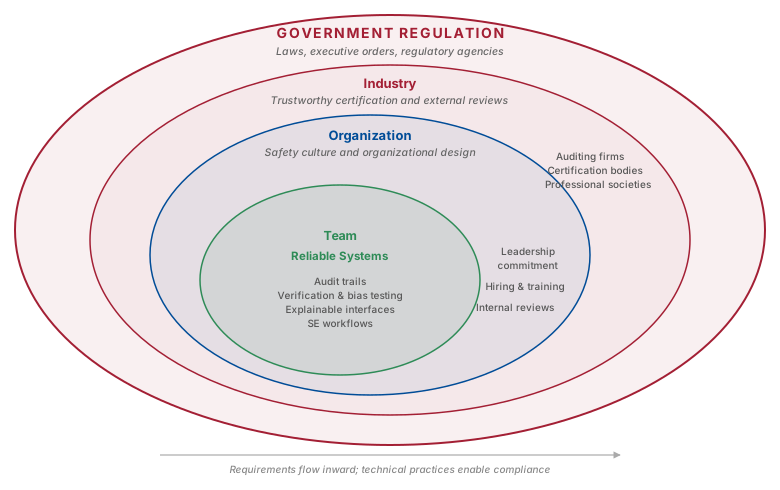
Engineering teams do not operate in isolation. As Figure 2 makes clear, engineering practices are nested within broader organizational, industry, and regulatory governance structures, each layer imposing constraints on the ones inside it. The key insight is that technical excellence at the innermost layer enables, but does not replace, compliance with requirements flowing inward from external governance.
The question of scope remains open, because an engineer’s responsibility extends beyond the metrics optimized throughout this book.
Systems Perspective 1.2: The Full Cost of the iron law
The iron law of ML Systems (Principle \(\ref{pri-iron-law}\)) established in Iron Law of Training Performance holds that system performance depends on the interaction between data, compute, and system overhead. We have spent previous sections optimizing each term: compressing models (Model Compression), accelerating hardware (Hardware Acceleration), and automating operations (ML Operations). Yet every optimization has costs beyond those captured in benchmarks.
A model quantized for edge deployment consumes less energy, but also produces outputs that may differ across demographic groups. A recommendation system optimized for engagement maximizes a business metric, but may amplify harmful content. Responsible engineering extends our accounting to include these broader impacts: the carbon cost of computation, the fairness cost of optimization choices, and the societal cost of deployment at scale. The iron law governs how fast our systems run; responsible engineering governs how well they serve.
Beyond ethical imperatives, responsible engineering delivers measurable business value through three reinforcing mechanisms. The most immediate is risk mitigation: ML system failures create legal and financial exposure that systematic responsibility practices reduce. Amazon’s recruiting tool cancellation represented years of development investment lost to inadequate fairness consideration, and COMPAS-related litigation has cost jurisdictions millions in legal fees and settlements. Organizations implementing disaggregated evaluation, documentation, and monitoring reduce the probability of costly failures and demonstrate due diligence if problems emerge.
A second mechanism is regulatory compliance, driven by the rapidly expanding regulatory environment for ML systems. The EU AI Act classifies high-risk AI applications and mandates specific technical requirements including risk assessment, data governance, transparency, and human oversight. Organizations that build responsibility into engineering practice can demonstrate compliance through existing documentation and monitoring rather than expensive retrofitting—industry experience suggests the cost of proactive compliance is typically a fraction of reactive remediation.
Competitive differentiation completes the business case. Trust increasingly drives enterprise purchasing decisions for ML-powered services, and organizations that can demonstrate systematic responsibility practices through model cards, audit trails, and published evaluation results win contracts that competitors cannot. Apple’s privacy positioning, Microsoft’s responsible AI principles, and Anthropic’s safety research all represent strategic investments in responsibility as differentiation.
The quantization techniques from Model Compression reduce inference energy by 2–4\(\times\), directly supporting sustainable deployment. The monitoring infrastructure from ML Operations enables disaggregated fairness evaluation across demographic groups. Responsible engineering synthesizes these capabilities into disciplined practice through structured frameworks that translate principles into processes.
Every failure examined earlier could have been prevented by systematic processes applied at the right stage of development. The missing ingredient was not technical capability but disciplined practice: checklists, documentation standards, testing protocols, and monitoring infrastructure that translate responsibility principles into repeatable engineering workflows.
Self-Check: Question
In the Amazon recruiting tool case, why did removing explicit gender labels fail to eliminate bias?
- The model was not trained for enough epochs.
- The model learned proxy signals (like college names) that correlated with gender.
- The engineers forgot to delete the gender column.
- The dataset was too small to be accurate.
Explain how a ‘feedback loop’ in a recommendation system can lead to bias amplification.
Responsible Engineering Checklist
Amazon’s recruiting tool could have been caught before deployment by a structured predeployment review. COMPAS’s error rate disparity would have surfaced through disaggregated testing. Both failures shared a common cause: responsibility was treated as a separate review stage rather than integrated into the development workflow. A responsible engineering checklist embeds assessment at three points where engineering decisions have the greatest ethical impact: predeployment assessment evaluates potential harms before a system reaches users, fairness evaluation quantifies whether performance holds equitably across demographic groups, and documentation standards create the audit trails that make accountability possible. Each phase builds on the previous one: assessment identifies what to measure, fairness evaluation measures it, and documentation ensures the measurements persist beyond any single team member’s tenure.
Predeployment assessment
Before a loan approval model reaches production, a team must determine the provenance of the training data, identify who is represented and who is missing, anticipate failure modes, and define recourse for affected users. Table 3 structures this evaluation into five phases, distinguishing critical-path blockers from high-priority items that can proceed with documented risk acceptance.
| Phase | Priority | Key Questions | Documentation Required |
|---|---|---|---|
| Data | Critical Path | Where did this data come from? Who is represented? Who is missing? What historical biases might be encoded? | Data provenance records, demographic composition analysis, collection methodology documentation |
| Training | High | What are we optimizing for? What might we be implicitly penalizing? How do architecture choices affect outcomes? | Objective function specification, regularization choices, hyperparameter selection rationale |
| Evaluation | Critical Path | Does performance hold across different user groups? What edge cases exist? How were test sets constructed? | Disaggregated metrics by demographic group, edge case testing results, test set composition analysis |
| Deployment | Critical Path | Who will this system affect? What happens when it fails? What recourse do affected users have? | Impact assessment, stakeholder identification, rollback procedures, user notification protocols |
| Monitoring | High | How will we detect problems? Who reviews system behavior? What triggers intervention? | Monitoring dashboard specifications, alert thresholds, review schedules, escalation procedures |
Critical Path items are deployment blockers: the system must not go to production until these questions are answered. High Priority items should be addressed but may proceed with documented risk acceptance and a remediation timeline. The distinction enables teams to ship responsibly without requiring perfection on every dimension before initial deployment.
The Evaluation row in Table 3 raises the critical concern of whether performance holds across different user groups. Answering this question requires statistically valid test sets for each group—and as the following calculation reveals, the statistics of representation create surprisingly stringent data requirements.
Napkin Math 1.2: The Statistics of Representation
The Problem: An engineering team needs to verify that a FaceID model works for a minority group representing 1 percent of the user base. The team needs a statistically valid test set of at least 1,000 images for this group to detect a one percent performance gap with 95 percent confidence.
Random Sampling: To get 1,000 images of a 1 percent group via random sampling, the team must collect and label: Ntotal = 1,000 / 0.01 = 100,000 images
Stratified Sampling: Specifically targeting this group (for example, via active learning or community outreach) requires only: \[ N_{total} = 1,000 \text{ images} \]
The Insight: Relying on “natural distribution” data for fairness is physically impossible at scale. Validating the minority group effectively requires 100\(\times\) more data than the majority group. Fairness requires intentional data engineering, not just more data.
For high-stakes applications, the deployment phase should specify where human oversight is required. Human-in-the-loop (HITL) systems route uncertain, high-consequence, or flagged decisions to human reviewers rather than acting autonomously. The design questions are: Which decisions require human review? What confidence thresholds trigger escalation? How are reviewers trained and monitored? HITL is not a catch-all solution: human reviewers can rubber-stamp automated decisions, introduce their own biases, or become overwhelmed by alert volume. Effective HITL design requires calibrating the human-machine boundary to the specific application risks and reviewer capabilities.
War Story 1.3: The Automation Paradox
The Context: Uber’s Advanced Technologies Group (ATG) was testing self-driving cars in Arizona. The system was designed with a “safety driver” to take over if the AI failed.
The Failure: The AI system detected a pedestrian crossing the road but classified her as a “false positive” (a plastic bag or shadow) and suppressed the braking command to avoid a “jerky” ride. The safety driver, relying on the automation, was distracted and did not intervene until it was too late.
The Consequence: The pedestrian was killed. The “human-in-the-loop” safeguard failed because the human had been conditioned by the system’s reliability to disengage.
The Systems Lesson: Adding a human backup to an unreliable system does not make it reliable; it creates a new system with complex failure modes. If the AI is 99 percent reliable, the human will eventually trust it 100 percent, making the “backup” useless precisely when it is needed most (National Transportation Safety Board 2019).
National Transportation Safety Board. 2019. Collision Between Vehicle Controlled by Developmental Automated Driving System and Pedestrian. HAR-19/03. National Transportation Safety Board. https://www.ntsb.gov/investigations/AccidentReports/Reports/HAR1903.pdf.
The predeployment assessment framework parallels aviation pre-flight checklists, where pilots follow every item without exception to ensure comprehensive coverage of critical concerns despite time pressure. Production ML deployments require equivalent discipline and rigorous verification. Checklists ensure teams ask the right questions; documentation standards ensure the answers persist and travel with the model.
Model documentation standards
Imagine inheriting a production model from a departed colleague. The model achieves 94 percent accuracy on the test set, but which test set? Trained on what data? Validated for which populations? Without answers, deploying or updating the model is a gamble. Model cards solve this problem by providing a standardized documentation format for ML models (Mitchell et al. 2019).9 Originally developed at Google, model cards function as “nutrition labels” that capture information essential for responsible deployment and travel with the model throughout its lifecycle.
Mitchell, Margaret, Simone Wu, Andrew Zaldivar, et al. 2019. “Model Cards for Model Reporting.” Proceedings of the Conference on Fairness, Accountability, and Transparency, January 29, 220–29. https://doi.org/10.1145/3287560.3287596.
9 Model Cards: The primary failure mode model cards address is scope creep: an estimated 40–60 percent of deployments that exceed a model’s documented scope do so not through deliberate decision but through gradual expansion—“it worked for case A, so we tried case B.” In practice, cards are often written after deployment decisions are made, documenting observed behavior rather than constraining it. The companion “Datasheets for Datasets” (Gebru et al., 2018) applies the same principle to training data. Without both, the card becomes a historical record rather than a guard rail.
A complete model card covers seven concerns that together enable responsible deployment. It begins with technical details (architecture, training procedures, hyperparameters) that enable reproducibility and auditing. Crucially, it specifies intended use alongside explicit exclusions, preventing the scope creep where models designed for photo organization get repurposed for security screening. The card then documents which factors (demographic groups, environmental conditions, instrumentation differences) might affect performance, guiding both evaluation strategy and monitoring protocols.
The remaining sections close the gap between what a model can do and what it should do. Performance metrics must include disaggregated results across the factors identified earlier, because aggregate accuracy alone conceals the disparities this chapter has documented. Training and evaluation data documentation enables assessment of potential encoded biases and provides essential context for interpreting results. Ethical considerations make implicit trade-offs explicit by documenting known limitations, potential harms, and mitigations implemented, while caveats and recommendations provide guidance on appropriate use and known failure modes.
The following example shows how these abstract categories translate to practical documentation. Consider Table 4: a MobileNetV2 model prepared for edge deployment shows how each section addresses specific deployment concerns.
| Section | Content |
|---|---|
| Model Details | MobileNetV2 architecture with 3.5M parameters, trained on ImageNet using depthwise separable convolutions. INT8 quantized for edge deployment. |
| Intended Use | Real-time image classification on mobile devices with less than 50 ms latency requirement. Suitable for consumer applications including photo organization and accessibility features. |
| Factors | Performance varies with image quality (blur, lighting), object size in frame, and categories outside ImageNet distribution. |
| Metrics | 71.8 percent top-1 accuracy on ImageNet validation (full precision: 72.0 percent). Accuracy varies by category: 85 percent on common objects, 45 percent on fine-grained distinctions. |
| Ethical Considerations | Training data reflects ImageNet biases in geographic and demographic representation. Not validated for high-stakes applications (medical diagnosis, security screening). Performance may degrade on images from underrepresented regions. |
Datasheets for datasets provide analogous documentation for training data (Gebru et al. 2021). These documents capture data provenance, collection methodology, demographic composition, and known limitations that affect downstream model behavior. Documentation establishes what a model is designed to do; testing verifies whether it performs equitably across the populations it serves.
Gebru, Timnit, Jamie Morgenstern, Briana Vecchione, et al. 2021. “Datasheets for Datasets.” Communications of the ACM 64 (12): 86–92. https://doi.org/10.1145/3458723.
Testing across populations
Aggregate performance metrics mask significant disparities across user populations, illustrating the Flaw of Averages (Savage 2009). As Table 2 quantifies, systems can appear highly accurate in aggregate while showing more than 40\(\times\) error rate disparities across demographic groups. Responsible testing requires disaggregated evaluation that examines performance for relevant subgroups.
Savage, Sam L. 2009. The Flaw of Averages: Why We Underestimate Risk in the Face of Uncertainty. John Wiley & Sons.
Systems Perspective 1.3: The Flaw of Averages
Averages Hide Failures: In systems engineering, we rarely design for the “average” case; we design for the tail cases and boundary conditions. A bridge that is “safe on average” but collapses under a heavy truck is a failure. Similarly, an ML system that is “accurate on average” but fails for a specific ethnic or gender group is an engineering failure. The same principle that drives us to measure tail latency (p99) for system reliability applies to fairness: we must use disaggregated evaluation to measure system fairness. Looking only at aggregate accuracy blinds the analysis to systemic failures occurring in the margins. Responsible engineering requires making these “tails” visible through granular, population-specific measurement.
The specific “tails” that matter depend on the workload. A vision model fails differently than a recommendation system, and the fairness metrics must match the failure mode.
Lighthouse 1.1: Fairness Concerns by Archetype
The dominant fairness risks differ by workload archetype (introduced in ML Systems), requiring different evaluation strategies. Table 5 maps each archetype to its primary risk and evaluation metric:
Table 5: Fairness Risk by ML Archetype: Fairness risks vary by archetype’s data source and deployment context.
| Archetype | Primary Fairness Risk | Key Evaluation Metric | Real-World Example |
|---|---|---|---|
| ResNet-50 | Training data bias (underrepresentation | Disaggregated accuracy by | Gender Shades: 99 percent accuracy on |
| (Compute Beast) | of minority groups in ImageNet) | demographic group | light-skinned males, 65 percent on dark-skinned females (Buolamwini and Gebru 2018) |
| GPT-2 | Corpus bias (overrepresentation | Toxicity rate by demographic | LLMs produce more toxic completions |
| (Bandwidth Hog) | of majority viewpoints in web text) | prompt context; stereotype score | for prompts mentioning minority groups |
| DLRM | Feedback loop amplification | Exposure fairness across item | Filter bubbles: system recommends |
| (Sparse Scatter) | (popular items get more data) | categories; supplier diversity | same content to similar users, reducing discovery of niche creators |
| DS-CNN | Deployment context mismatch | False positive rate by acoustic | Voice assistants perform worse on |
| (Tiny Constraint) | (trained on clean audio, deployed in noisy real-world environments) | environment and speaker accent | accented speech; wake-word triggers on TV audio in some languages |
Key insight: Fairness evaluation must match the archetype’s failure mode. Vision models require demographic stratification of accuracy; large language models (LLMs) require toxicity and stereotype probing; recommendation systems require exposure audits; TinyML requires acoustic environment diversity testing. The Lighthouse keyword spotting (KWS) system used as a running example throughout earlier chapters faces exactly this challenge for its DS-CNN, a depthwise-separable convolutional neural network (CNN): trained on clean studio audio, it must perform equitably across accents, background noise levels, and speaker demographics in production homes—a governance challenge we examine in Section 1.5.
Buolamwini, Joy, and Timnit Gebru. 2018. “Gender Shades: Intersectional Accuracy Disparities in Commercial Gender Classification.” Conference on Fairness, Accountability and Transparency, 77–91. http://proceedings.mlr.press/v81/buolamwini18a.html.
Engineers should identify relevant subgroups based on application context. For healthcare applications, demographic factors like race, age, and gender are essential. For content moderation, language and cultural context matter. For financial services, protected categories under fair lending laws require specific attention.
Testing infrastructure should support stratified evaluation where performance metrics are computed separately for each relevant subgroup, enabling comparison of error rates and error types across populations. Intersectional analysis considers combinations of attributes because harms may concentrate at intersections not visible in single-factor analysis. Confidence intervals provide uncertainty quantification for subgroup metrics when small subgroup sizes may yield unreliable estimates. Temporal monitoring tracks subgroup performance over time, detecting drift that affects some populations before others.
Several open-source tools support responsible testing workflows. Fairlearn (Microsoft Research, 2020) provides fairness metrics and mitigation algorithms that integrate with scikit-learn pipelines (Bird et al. 2020). AI Fairness 360 (IBM Research, 2018) offers over 70 fairness metrics and ten bias mitigation algorithms across the ML lifecycle (Bellamy et al. 2019).
Bird, Sarah, Miro Dudı́k, Richard Edgar, et al. 2020. “Fairlearn: A Toolkit for Assessing and Improving Fairness in AI.” Microsoft Technical Report MSR-TR-2020-32.https://www.microsoft.com/en-us/research/publication/fairlearn-a-toolkit-for-assessing-and-improving-fairness-in-ai/ .
Bellamy, R. K. E., K. Dey, M. Hind, et al. 2019. “AI Fairness 360: An Extensible Toolkit for Detecting and Mitigating Algorithmic Bias.” IBM Journal of Research and Development 63 (4/5): 4:1–15. https://doi.org/10.1147/jrd.2019.2942287.
Google’s What-If Tool enables interactive exploration of model behavior across different subgroups without writing code. Open source fairness tools lower the barrier to rigorous evaluation, though they complement rather than replace careful thinking about what fairness means in specific application contexts.
Worked example: Fairness analysis in loan approval
A loan approval model reports 85 percent accuracy across all applicants—a number that satisfies most stakeholders. Table 6 and Table 7 reveal what the aggregate conceals: loan approval outcomes for the same model evaluated separately on two demographic groups.
| Approved (pred) | Rejected (pred) | |
|---|---|---|
| Repaid (actual) | 4,500 (TP) | 500 (FN) |
| Defaulted (actual) | 1,000 (FP) | 4,000 (TN) |
| Approved (pred) | Rejected (pred) | |
|---|---|---|
| Repaid (actual) | 600 (TP) | 400 (FN) |
| Defaulted (actual) | 200 (FP) | 800 (TN) |
Three standard fairness metrics computed from the confusion matrices in Table 6 and Table 7 reveal significant disparities.10
10 Fairness Metric Incompatibility: The measured disparities are a direct consequence of an impossibility theorem proving that multiple fairness metrics cannot be satisfied simultaneously when group base rates differ (Chouldechova, 2017). This forces an explicit trade-off: optimizing for one metric, like equal opportunity, will degrade another, such as predictive parity. A system designer must therefore choose which fairness guarantee to violate, as it is mathematically impossible to satisfy all three.
Demographic parity requires equal approval rates across groups. Group A receives approval at a rate of (4,500 + 1,000) / 10,000 = 55 percent, while Group B receives approval at (600 + 200) / 2,000 = 40 percent. The 15 percentage point disparity indicates unequal treatment in approval decisions.
Equal opportunity requires equal true positive rates among qualified applicants. Group A achieves a TPR of 4,500 / (4,500 + 500) = 90 percent, meaning 90 percent of applicants who would repay receive approval. Group B achieves only 600 / (600 + 400) = 60 percent TPR. This 30 percentage point disparity means qualified applicants from Group B face substantially higher rejection rates than equally qualified applicants from Group A.
Equalized odds11 requires both equal true positive rates and equal false positive rates. Group A shows an FPR of 1,000 / (1,000 + 4,000) = 20 percent, and Group B shows 200 / (200 + 800) = 20 percent. While false positive rates are equal, the true positive rate disparity means equalized odds is violated.
11 Equalized Odds: Formalized by Hardt, Price, and Srebro (NeurIPS 2016), requiring that both TPR and FPR be equal across protected groups. The weaker “equal opportunity” relaxes this to TPR alone. The practically important result: equalized odds can be achieved as a post-processing step by adjusting prediction thresholds per group, requiring no model retraining—separating the fairness mechanism from the training pipeline and enabling fairness fixes without retraining cycles that cost thousands of GPU-hours.
The pattern revealed by these metrics has a clear interpretation: the model rejects qualified applicants from Group B at a much higher rate (40 percent false negative rate vs. 10 percent) while maintaining similar false positive rates. The disparity pattern suggests the model has learned stricter approval criteria for Group B, potentially encoding historical discrimination in lending patterns where minority applicants faced higher scrutiny despite equivalent qualifications.
Production systems must automate these calculations across all protected attributes, triggering alerts when disparities exceed predefined thresholds. Listing 1 shows the core pattern: compute per-group metrics from confusion matrices, then flag disparities that exceed acceptable bounds.
def compute_fairness_metrics(confusion_matrix):
    tp, fp, tn, fn = (
        confusion_matrix[k] for k in ["TP", "FP", "TN", "FN"]
    )
    total = tp + fp + tn + fn
    return {
        # Demographic parity
        "approval_rate": (tp + fp) / total,
        # Equal opportunity
        "tpr": tp / (tp + fn) if (tp + fn) else 0,
        # Equalized odds (with TPR)
        "fpr": fp / (fp + tn) if (fp + tn) else 0,
    }


# Compare groups and flag disparities exceeding threshold
for metric in ["approval_rate", "tpr", "fpr"]:
    disparity = abs(metrics_a[metric] - metrics_b[metric])
    # e.g., 0.05 for high-stakes applications
    if disparity > FAIRNESS_THRESHOLD:
        trigger_alert(metric, disparity)
Automated monitoring achieves what manual auditing cannot at scale: continuous tracking of fairness metrics with immediate alerting when disparities emerge. The 30 percentage point TPR disparity far exceeds common industry thresholds of five percentage points for high-stakes applications, indicating the model requires fairness intervention before deployment.
Table 8 reveals the troubling pattern in these computed metrics and disparities.
| Metric | Group A | Group B | Disparity |
|---|---|---|---|
| Approval Rate | 55% | 40% | 15 percentage points |
| True Positive Rate | 90% | 60% | 30 percentage points |
| False Positive Rate | 20% | 20% | 0 percentage points |
To understand why aggregate metrics hide these disparities, look closely at Figure 3. When a single threshold is applied to populations with different score distributions, the same decision boundary produces vastly different outcomes for each group (Barocas and Selbst 2016). The figure exposes a fundamental tension: any fixed threshold is simultaneously “correct” for the combined population while being systematically wrong for each subpopulation.
Barocas, Solon, and Andrew D. Selbst. 2016. “Big Data’s Disparate Impact.” SSRN Electronic Journal 104: 671–732. https://doi.org/10.2139/ssrn.2477899.

Several mitigation approaches exist, each with distinct trade-offs. Threshold adjustment lowers the approval threshold for Group B to equalize TPR but may increase false positives for that group. Reweighting12 increases the weight of Group B samples during training to give the model stronger signal about this population but may reduce overall accuracy. Adversarial debiasing trains with an adversary that prevents the model from learning group membership but adds training complexity.13 The choice among these approaches requires stakeholder input about which trade-offs are acceptable in the specific application context. Engineers present these trade-offs effectively by making them explicit and quantifiable.
12 Reweighting: A preprocessing technique rooted in importance sampling from statistics: samples from an underrepresented group receive higher loss weights during training, amplifying their influence on gradient updates without removing any data. Kamiran and Calders (2012) proved that appropriately chosen weights can eliminate disparate impact from training data. The systems trade-off: reweighting shifts the loss landscape, potentially reducing majority-group accuracy by 1–3 percent to close disparity gaps—a cost that must be evaluated against the Pareto frontier for the application.
13 Adversarial Debiasing: The key differentiating property is stability under distribution shift: because the adversary forces the primary model to learn representations invariant to the protected attribute (not just calibrated on the training distribution), adversarial debiasing is the only technique that theoretically maintains fairness guarantees when the deployment distribution differs from training. Post-processing methods (threshold adjustment, output reweighting) recalibrate on the training distribution but fail when deployment demographics shift—which is why they often appear to work in evaluation but degrade after launch. The cost is 20–50 percent additional training time and 1–3 percent accuracy reduction.
Checkpoint 1.2: Fairness Criteria
Fairness is not a single metric; it is a constrained design choice.
Quantifying the fairness-accuracy trade-off
The Pareto frontier introduced in Figure 1 establishes that fairness and accuracy trade off along a curve. But knowing the trade-off exists is insufficient—engineers must quantify the price of fairness to inform stakeholder decisions (Kleinberg et al. 2016). The following notebook illustrates how, using a hiring scenario (distinct from the preceding loan approval example, with different disparity magnitudes to illustrate a different point).
Kleinberg, Jon, Sendhil Mullainathan, and Manish Raghavan. 2016. “Inherent Trade-Offs in the Fair Determination of Risk Scores.” Innovations in Theoretical Computer Science Conference. https://doi.org/10.4230/LIPIcs.ITCS.2017.43.
Napkin Math 1.3: The Price of Fairness
The Problem: Stakeholders demand elimination of a 20 percent True Positive Rate (TPR) disparity in a hiring model. What is the “Price of Fairness” in terms of hiring quality?
The Physics: You can equalize TPRs by adjusting the classification threshold (\(\tau\)) for the disadvantaged group.
- Original State: Group A (TPR=90 percent), Group B (TPR=70 percent). Aggregate Accuracy = 85 percent.
- Intervention: Lower \(\tau_B\) until \(\text{TPR}_B = 90\%\).
- The Cost: Lowering the threshold increases False Positives (hiring candidates who do not meet the bar).
The Calculation:
- To close the 20 percent TPR gap, you must accept a 5% increase in False Positives.
- If the value of a successful hire is $100k and the cost of a bad hire is $50k:
- Utility Loss = (Utility of Correct Hires) - (Cost of Extra False Positives).
- In this scenario, closing the gap reduces the system’s Total Utility by 3%.
The Systems Conclusion: The “Price of Fairness” in this system is a 3% utility tax—a System Constraint, not a bug. The engineer’s job is to present the Pareto frontier to stakeholders so they can choose the Utility/Fairness trade-off that aligns with organizational values.
Quantifying disparities through metrics is necessary but not sufficient for responsible deployment. When a loan applicant receives a rejection, stating that “the model’s true positive rate for your demographic group is 60 percent compared to 90 percent for other groups” provides no actionable information. The applicant needs to know why the application was rejected and what could be changed. These questions require explainability, which is the ability to articulate which input features drove specific predictions.
Explainability requirements
A loan applicant denied credit by an algorithmic system has a right to know why, not in aggregate statistical terms but in terms specific to her application. Explainability14 provides this capability: it enables human oversight of automated decisions, supports debugging when problems emerge, and satisfies regulatory requirements for decision transparency.
14 Explainability vs. Interpretability: Interpretability is an intrinsic model property—the degree to which a human can understand internal mechanics (linear regression is interpretable; a 100-layer network is not). Explainability is a post-hoc capability added without changing the model (LIME, SHAP). The systems implication: interpretable models constrain architecture selection (simpler models, fewer features), while explainability adds 10–100\(\times\) inference latency as a separate module. Regulations like the EU AI Act demand “meaningful information about the logic involved” without specifying which approach, leaving the latency-vs.-architecture trade-off to engineering teams.
The level of explainability required varies by application context and regulatory environment. Table 9 maps common deployment scenarios to their explainability needs.
| Application Domain | Explainability Level | Typical Requirements |
|---|---|---|
| Credit decisions | Individual explanation required | Specific factors contributing to denial must be disclosed to applicant |
| Medical diagnosis | Clinical reasoning support | Explanation must support physician decision-making, not replace it |
| Content moderation | Appeal-supporting | Sufficient detail for users to understand and contest decisions |
| Recommendation | Transparency optional | “Because you watched X” sufficient for most contexts |
| Fraud detection | Internal audit only | Detailed explanations may enable adversarial gaming |
Engineering teams should select explainability approaches based on these domain requirements. Post-hoc explanation methods (LIME, SHAP) generate feature importance scores for individual predictions without requiring model architecture changes.15 Inherently interpretable models (linear models, decision trees, attention mechanisms) provide explanations as part of their structure but may sacrifice predictive performance. Concept-based explanations map model behavior to human-understandable concepts rather than raw features. The choice involves trade-offs between explanation fidelity, computational cost, and model flexibility. Figure 4 arranges these trade-offs along a single axis. On the left side, decision trees and linear regression offer direct auditability: an engineer can inspect every coefficient or branching rule that produced a prediction, at the cost of limited representational capacity. On the right side, deep neural networks and convolutional architectures achieve higher accuracy on complex tasks but resist human inspection, requiring post-hoc tools like LIME or SHAP to approximate explanations. The choice depends on the application’s accountability requirements: high-stakes credit decisions subject to adverse action notice laws demand models near the interpretable end, while large-scale recommendation systems that face no per-decision regulatory scrutiny can tolerate opaque architectures. The spectrum does not imply “simple is always better,” because a highly interpretable model that makes wrong predictions serves no one. The engineering challenge is selecting the most interpretable model that meets accuracy requirements for the application.
15 LIME and SHAP: LIME (Ribeiro et al., 2016) fits a local interpretable model around each prediction—fast but potentially inconsistent across nearby inputs. SHAP (Lundberg and Lee, 2017) adapts Shapley values from game theory (Lloyd Shapley, 1953; Nobel Prize 2012) to compute mathematically consistent feature contributions, but with exponential worst-case complexity. The systems trade-off is stark: SHAP adds 10–100\(\times\) inference latency, making LIME the only viable option for real-time serving where explanation must arrive within the same latency budget as the prediction itself.
War Story 1.4: The Clever Hans Effect
The Context: Researchers at Mount Sinai Hospital trained a neural network to detect pneumonia in chest X-rays. The model achieved superhuman accuracy on the test set.
The Failure: When tested on data from other hospitals, performance collapsed. Heatmap analysis revealed the model was not looking at the lungs. Instead, it had learned to detect a metal token that technicians at the training hospital placed on the patient’s shoulder.
The Consequence: The model was effectively a “metal token detector,” not a pneumonia detector. It had learned a spurious correlation that was 100 percent predictive in the training distribution but irrelevant to the medical pathology.
The Systems Lesson: Neural networks are lazy optimizers. They will exploit the easiest statistical signal to minimize loss, even if that signal is medically irrelevant. Interpretability tools (saliency maps) are not optional; they are quality assurance gates (Lapuschkin et al. 2019).
Lapuschkin, Sebastian, Stephan Wäldchen, Alexander Binder, Grégoire Montavon, Wojciech Samek, and Klaus-Robert Müller. 2019. “Unmasking Clever Hans Predictors and Assessing What Machines Really Learn.” Nature Communications 10 (1): 1–8. https://doi.org/10.1038/s41467-019-08987-4.
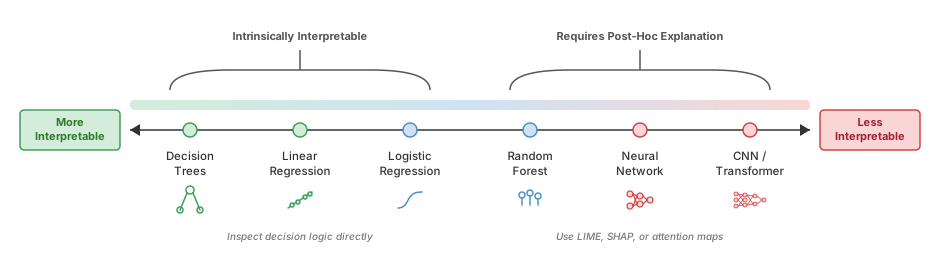
The explainability requirements outlined earlier carry the force of law, not merely of engineering best practice. In 2024 alone, the EU AI Act mandated explanation capabilities for high-risk systems, and US regulators proposed new adverse action notice requirements for algorithmic lending decisions. Regulations transform explainability from a design choice into a compliance requirement with concrete penalties for failure, making the technical mechanisms just described prerequisites for legal operation.
The regulatory landscape
In 2024, the EU AI Act imposed fines up to 35 million EUR or seven percent of global turnover for non-compliant high-risk AI systems, and the US Federal Trade Commission brought its first enforcement actions against algorithmic discrimination. Responsible engineering now operates within explicit regulatory frameworks that mandate specific technical requirements for transparency, oversight, and accountability. While regulations vary by jurisdiction, several convergent patterns have emerged that engineers must understand.
The EU AI Act
The EU AI Act establishes the most comprehensive framework to date, classifying AI systems by risk level and mandating requirements accordingly.16 High-risk systems17 (including those used in employment, credit, education, and critical infrastructure) must implement risk management systems, data governance practices, technical documentation, transparency measures, human oversight mechanisms, and accuracy/robustness/security requirements. The engineering implications are concrete: systems must be designed for auditability from inception, with documentation practices that demonstrate compliance.
16 EU AI Act (Regulation 2024/1689): The first comprehensive AI legal framework, defining four risk tiers with penalties reaching 35 million EUR or seven percent of global turnover. The Act has extraterritorial reach: US organizations must comply if outputs affect EU residents. Systems engineering implications are concrete: high-risk AI requires logging infrastructure for audit trails, human oversight mechanisms built into the architecture, and CE marking—all capabilities that must be designed in from inception, not retrofitted after deployment.
17 High-Risk AI (EU AI Act Annex III): Risk classification is not subjective—Annex III enumerates eight specific domains: biometric identification, critical infrastructure, education and vocational training, employment and worker management, essential services access (credit, insurance), law enforcement, migration and border control, and justice administration. A system falls under high-risk requirements based on deployment context, not model architecture: a logistic regression approving loans faces the same compliance burden as a transformer, because the Act regulates what decisions are made, not how they are computed.
GDPR’s article 22
GDPR’s Article 22 grants EU citizens the right not to be subject to decisions based solely on automated processing that produce legal or similarly significant effects.18 This creates requirements for human oversight in automated decision systems and for providing “meaningful information about the logic involved.” While legal interpretation varies, engineering teams should assume that every high-stakes automated decision requires both a human review mechanism and an explainability capability.
18 GDPR (General Data Protection Regulation) Article 22: The European Data Protection Board’s guidance mandates that any required human oversight must be substantive and not merely a “rubber-stamping” exercise. This requires systems to produce evidence for human review, making explainability a core architectural pillar rather than an optional add-on. A system making one million daily decisions with a 0.1 percent error rate requiring substantive review would generate 1,000 cases per day, an operational load that is untenable without built-in summarization and audit tools.
US sectoral regulations
US sectoral regulations impose domain-specific requirements that, while less unified than the EU AI Act, collectively create significant compliance obligations for ML systems. Fair lending laws (ECOA, Fair Housing Act) require creditors to provide specific reasons for adverse credit decisions—the origin of the “adverse action notice” requirement that drives explainability needs in financial ML. Healthcare regulations, including the Health Insurance Portability and Accountability Act (HIPAA)19 and FDA guidance, layer data protection and validation requirements onto medical AI systems, while employment law prohibits discriminatory hiring practices regardless of whether discrimination results from human or algorithmic decision-making. The cumulative effect is that any ML system operating across multiple domains faces an intersection of regulatory requirements, each mandating different technical capabilities.
19 HIPAA (Health Insurance Portability and Accountability Act): Enacted 1996, with Privacy Rule (2003) and Security Rule (2005) establishing standards for protected health information. ML-specific constraints are stringent: training data containing PHI must be de-identified, model outputs that could re-identify patients may constitute PHI themselves, and audit logs must be retained for six years. Penalties reach $50,000 per violation with $1.5 million annual maximums per category—sufficient to make a single poorly governed ML pipeline an existential financial risk for a healthcare startup.
The engineering response to these regulatory requirements is proactive architectural design. Teams that build documentation, monitoring, explainability, and human oversight into systems from inception demonstrate compliance efficiently. Teams that must retrofit these capabilities face expensive redesign or deployment constraints. The foundation established here, that responsibility is an engineering requirement rather than a legal afterthought, enables more targeted compliance strategies as regulatory frameworks mature. Yet even well-designed systems can fail, making incident response preparation essential.
Checkpoint 1.3: Ethical Deployment
Deployment is the point of no return.
The Safety Net
The Monitoring Plan
Monitoring and incident response
Zillow’s algorithmic home-buying program lost USD 304 million20 in a single quarter partly because model prediction errors went undetected until financial losses accumulated. The failure lay not in the model itself but in the monitoring infrastructure surrounding it. Planning for system failures before they occur is a core responsibility engineering practice. Building on the incident severity classification and response framework from Incident response for ML systems, Table 10 extends the general framework with fairness-specific detection and response criteria, structuring preparation into five components with both requirements and predeployment verification criteria.
20 Zillow’s D·A·M Failure: Zillow’s $304M write-down in 2021 was not a model accuracy failure—the Zestimate algorithm’s published MAE was within normal ranges. It was a Data failure: the training distribution (historical listings) diverged from the deployment distribution (pandemic-era price volatility) faster than the monitoring system detected. The Algorithm was optimized for price prediction, not for predicting its own prediction confidence under distribution shift. The Machine (the iBuying automation pipeline) had no circuit breaker—it committed capital at full automation rates while the model’s reliability was silently degrading. Each axis of failure was individually detectable; the systems failure was the absence of cross-axis monitoring.
| Component | Requirements | Predeployment Verification |
|---|---|---|
| Detection | Monitoring systems that identify anomalies, degraded performance, and fairness violations | Alert thresholds tested, on-call rotation established, escalation paths documented |
| Assessment | Procedures for evaluating incident scope and severity | Severity classification defined, impact assessment templates prepared |
| Mitigation | Technical capabilities to reduce harm while investigation proceeds | Rollback procedures tested, fallback systems operational, kill switches functional |
| Communication | Protocols for stakeholder notification | Contact lists current, message templates prepared, approval chains defined |
| Remediation | Processes for permanent fixes and system improvements | Root cause analysis procedures, change management integration |
ML systems create unique maintenance challenges (Sculley et al. 2015). Models degrade silently, dependencies shift unexpectedly, and feedback loops amplify small problems into large ones. Incident response planning must account for these ML-specific failure modes, and effective response depends on continuous monitoring infrastructure that detects problems in the first place.
The monitoring infrastructure from ML Operations provides the foundation for responsible system operation, extending traditional operational metrics to include outcome quality measures.
Responsible monitoring extends along several interconnected dimensions. Performance stability tracking detects gradual prediction quality degradation that might not trigger immediate alerts. Slow accuracy decay that accumulates over weeks is far more dangerous than a sudden crash because it evades threshold-based alarms. Subgroup parity monitoring adds a fairness lens to this temporal tracking, comparing error rates across demographic groups to detect emerging disparities before they cause significant harm. These model-level metrics must be complemented by input distribution monitoring that catches population shifts and potential adversarial manipulation at the data layer, and by outcome monitoring that validates whether predictions translate to intended real-world results. User feedback systems close the loop by surfacing complaints and corrections that reveal problems invisible to any automated metric—the kind of harm that only affected users can articulate.
Effective monitoring requires both data collection infrastructure and disciplined review processes. Dashboards that no one examines provide no protection, so engineering teams must establish regular review cadences with clear ownership and escalation procedures.
The frameworks established in this section address one dimension of responsible engineering: ensuring systems work fairly and reliably across user populations. Fairness is not the only cost that conventional engineering metrics overlook. Every model training run, every inference request, every monitoring dashboard consumes electricity that translates into carbon emissions and dollar costs. A system can be perfectly fair across demographic groups while consuming orders of magnitude more resources than the task requires, harming not specific user populations but the broader environment and the organizations paying the bills. Responsible engineering must therefore extend beyond who the system serves to encompass what it costs to serve them.
Self-Check: Question
What is the primary purpose of a ‘Model Card’ in responsible engineering?
- To act as a warranty for the model software.
- To provide a standardized format for documenting intended use, performance factors, and ethical considerations.
- To store the binary weights of the trained neural network.
- To list all the developers who worked on the project.
Define ‘Disaggregated Evaluation’ and explain why aggregate accuracy metrics can be misleading.
Environmental and Cost Awareness
In 2020, researchers estimated that training a single large NLP model emitted as much carbon as five cars over their entire lifetimes (Strubell et al. 2019), a finding that sparked the “Green AI” movement and forced the field to confront the full cost of ML systems. Training runs consume megawatt-hours of electricity, inference at scale multiplies per-request inefficiencies into measurable environmental impact, and resource-intensive models exclude organizations that lack large compute budgets. The optimization techniques introduced in earlier chapters therefore serve double duty as instruments of responsible engineering, connecting computational efficiency to environmental sustainability, economic accessibility, and long-term scalability.
Strubell, Emma, Ananya Ganesh, and Andrew McCallum. 2019. “Energy and Policy Considerations for Deep Learning in NLP.” Proceedings of the 57th Annual Meeting of the Association for Computational Linguistics, 3645–50. https://doi.org/10.18653/v1/p19-1355.
Efficiency as responsibility
Training a single large language model consumes thousands of GPU hours and energy measured in megawatt-hours. Much of this expense, however, is not intrinsic to the learning task but represents accidental complexity: training from scratch when fine-tuning would suffice, using larger models than tasks require, and running hyperparameter searches that explore redundant configurations. Computational cost is largely a function of engineering discipline, not just model physics.21
21 Green AI: Schwartz et al. (2020) contrasted “Red AI” (performance at any cost) with “Green AI” (efficiency as primary metric), documenting that state-of-the-art accuracy gains from 2012–2018 required a 300,000\(\times\) compute increase. Their proposal—reporting FLOPs alongside accuracy for every published result—reframes efficiency from an engineering preference into a scientific reporting obligation, making the resource cost of marginal accuracy gains visible and comparable across research groups.
Resource efficiency and responsible engineering are directly linked through three interconnected channels. The most direct connection is environmental: a model that requires 4\(\times\) more compute than necessary generates 4\(\times\) more carbon emissions, so the efficiency techniques from Model Compression that enable edge deployment also reduce the environmental footprint of cloud inference. Efficiency also drives accessibility, because resource-efficient models can run on less expensive hardware, democratizing access to ML capabilities. A quantized model that runs on a smartphone enables users who cannot afford cloud API costs. Finally, sustainability at scale amplifies both effects: systems serving millions of users multiply inefficiencies across every request, so a 10 ms latency reduction per query translates to thousands of GPU-hours saved annually.
The techniques from earlier chapters directly serve responsibility goals. Quantization (Model Compression) reduces compute by 2–4\(\times\) with minimal accuracy impact. Pruning removes 50–90 percent of parameters. Knowledge distillation typically achieves 5–20\(\times\) compression while retaining 90–95 percent of the original accuracy. Hardware acceleration (Hardware Acceleration) achieves 10–100\(\times\) better energy efficiency than general-purpose processors.
Responsible engineers apply these techniques as design requirements, not afterthoughts. The question shifts from maximizing accuracy alone to maximizing accuracy within efficiency constraints.
Efficiency engineering in practice
Acknowledging that efficiency matters is the easy part; the harder engineering challenge is translating that principle into measurable targets. The goal is selecting the smallest model that meets task requirements, then applying methodical optimization to reduce resource consumption further. Edge deployment scenarios make these constraints concrete because they impose hard physical limits that cannot be negotiated away.
Edge deployment scenarios make efficiency requirements concrete. When a wearable device has a 500 mW power budget and must run inference continuously for 24 hours on a small battery, abstract efficiency discussions become engineering constraints with measurable consequences. Table 11 quantifies these constraints across four deployment contexts, from smartphones with 5 W budgets to IoT sensors operating at 100 mW.
| Deployment Context | Power Budget | Latency Requirement | Typical Use Cases |
|---|---|---|---|
| Smartphone | 5 W | 100 ms | Photo enhancement, voice assistants |
| IoT Sensor | 100 mW | 1 second | Anomaly detection, environmental monitoring |
| Embedded Camera | 1 W | 30 FPS (33 ms) | Real-time object detection, surveillance |
| Wearable Device | 500 mW | 500 ms | Health monitoring, activity recognition |
Table 12 compares how model architectures fit different deployment constraints.
| Model | Parameters | Inference Power | Latency | Fits Smartphone? | Fits IoT? |
|---|---|---|---|---|---|
| MobileNetV2 | 3.5 M | 1.2 W | 40 ms | Yes | No |
| EfficientNet-B0 | 5.3 M | 1.8 W | 65 ms | Yes | No |
| ResNet-50 | 25.6 M | 4.5 W | 180 ms | No | No |
| TinyML Model | 200 K | 50 mW | 200 ms | Yes | Yes |
The benchmarks in Table 12 provide actionable guidance for efficiency optimization. Techniques that enable deployment on power-constrained platforms (quantization, pruning, and efficient architectures) directly reduce environmental impact per inference regardless of deployment context. Power savings at inference time translate directly to financial savings when aggregated across millions of requests.
Total cost of ownership
A team spends USD 3,200 training a recommendation model and celebrates the modest cost. Six months later, they discover they are spending USD 500,000 per year serving it. The surprise exposes a structural asymmetry in total cost of ownership22: power budgets translate directly to financial costs (a model that consumes 2 W instead of 4 W cuts electricity expenses in half), and for successful production systems, inference costs typically exceed training costs by ten to 1,000 times depending on traffic volume. Inference cost dominance dictates where optimization efforts should focus.
22 Total Cost of Ownership (TCO): The standard TCO figure typically excludes three categories of costs that ML systems add over conventional software: data labeling infrastructure (often 10–30 percent of total ML project cost), model monitoring and retraining (ongoing operational cost proportional to data volume), and remediation costs when models fail (which in regulated industries can exceed the original development cost). Additional externalities (carbon emissions, fairness audits, regulatory compliance overhead) make the upfront compute cost a misleading proxy for ML system cost, and explain why inference dominates TCO by 10–1,000\(\times\) over training for any system that reaches production scale.
Consider a concrete example of a recommendation system serving 10 million users daily. Training costs appear considerable: data preparation consumes 100 GPU-hours at approximately USD 4 per hour (USD 400), hyperparameter search across multiple configurations requires 500 GPU-hours (USD 2,000), and the final training run uses 200 GPU-hours (USD 800). Total training cost reaches approximately USD 3,200.
Inference costs dominate. With 10 million users each receiving 20 recommendations per day, the system serves 200 million inferences daily. Assuming 10 milliseconds per inference on GPU hardware, the system requires approximately 23 GPUs running continuously. At USD 2.50 per GPU-hour, annual GPU costs reach USD 506,944.
Over a three-year operational period, quarterly retraining produces total training costs of approximately USD 38,400, while inference costs over the same period total USD 1.5 million. The 40:1 ratio between inference and training costs is typical for production systems, directing optimization effort toward inference latency and serving efficiency rather than training speed.
Per-query optimization becomes essential when serving billions of requests. Reducing inference latency by ten milliseconds per query translates to measurable reductions in required hardware across billions of queries despite appearing negligible for individual requests. Hardware selection between CPU, GPU, and Tensor Processing Unit (TPU) deployment changes costs and carbon footprint by factors of ten or more. Model compression through quantization and pruning delivers immediate return on investment for high-volume systems because inference cost reduction compounds across every subsequent query.
Total cost of ownership encompasses additional dimensions beyond computation. Operational costs include monitoring, maintenance, retraining, and incident response, all of which scale with system complexity and the rate of distribution shift in the application domain. Opportunity costs reflect that resources consumed by ML systems cannot be used for other purposes. Wasteful resource consumption in one project constrains what other projects can attempt.
Engineers should evaluate whether the value an ML system delivers justifies its resource consumption. A recommendation system that increases engagement by one percent might not justify millions of dollars in computational costs, while a medical diagnosis system that saves lives does. Explicit trade-offs enable responsible resource allocation.23
23 ML Return on Investment: The ten:1 deployment-to-training cost ratio emerges from the composition of monitoring (continuous), retraining (periodic), infrastructure (ongoing), and incident response (unpredictable), each of which scales with deployment duration and data volume rather than with the initial development effort. A model deployed for three years accumulates roughly 10–15\(\times\) its development cost in operational overhead. Responsible engineering practices that reduce incident frequency and severity therefore yield ROI proportional to deployment lifetime, explaining why a logistic regression at one percent of the cost often represents the correct engineering decision when the TCO difference compounds over years.
Quantifying environmental impact requires converting compute hours into carbon emissions, making carbon a first-class engineering metric alongside dollar cost.
Systems Perspective 1.4: The Carbon Cost of Compute
Quantifying Environmental Impact: To make carbon a first-class engineering metric, we must convert “compute hours” into “kg CO2eq”. Equation 2 captures this standard conversion:
\[ \text{Carbon} = \text{Energy (kWh)} \times \text{Carbon Intensity (kg/kWh)} \tag{2}\]
For the following TCO examples, we use these baseline assumptions:
- Power: 400 W per GPU-hour (including PUE cooling overhead).
- Intensity: 0.4 kg CO2eq/kWh (global grid average).
- Conversion Factor: \((0.4 \text{ kW} \times 1 \text{ hour}) \times 0.4 \text{ kg/kWh} = \mathbf{0.16 \text{ kg CO2eq per GPU-hour}}\).
The conversion factor allows us to track “Carbon Cost” alongside “Dollar Cost” in our ledgers.
TCO calculation methodology
Engineers can estimate three-year total cost of ownership using a structured approach that accounts for training, inference, and operational costs. The following methodology applies to the recommendation system example discussed earlier.
Training costs
Training costs include both initial development and ongoing retraining. Table 13 breaks down these costs, showing how quarterly retraining cycles accumulate over a three-year operational period.
| Cost Component | Calculation | Financial Cost | Carbon (kg CO2) |
|---|---|---|---|
| Initial data preparation | hours\(\times\) rate | 100 GPU-hr × $4 = \(400 | 16 kg | | **Hyperparameter search** | experiments\)$ cost/experiment | 50 × $40 = \(2\,000 | 80 kg | | **Final training** | hours\)$ rate |
| Total training cost | subtotal\(\times\) cycles | 38,400 | 1,536 kg |
Inference costs
The economics of this trade-off are detailed in Table 14, which shows how inference costs dominate total cost of ownership for production systems.
| Cost Component | Calculation | Financial Cost | Carbon (kg CO2) |
|---|---|---|---|
| Daily queries | users\(\times\) queries/user | 10M × 20 = 200M | - |
| GPU-seconds/day | queries\(\times\) latency | 200M × 0.01 s = 2.0M sec | - |
| GPU-hours/day | seconds ÷ SEC_PER_HOUR | 556 GPU-hr | 89 kg |
| Annual GPU cost | hours\(\times\) 365\(\times\) rate | 556 × 365 × $2.50 = \(507K | 32\,444 kg | | **3-year inference cost** | annual\)$ 3 | $1.52M |
Operational costs
Operational costs encompass infrastructure, personnel, and incident response. Table 15 itemizes these ongoing expenses, which often surprise teams focused primarily on compute costs.
| Cost Component | Annual Estimate | 3-Year Total |
|---|---|---|
| Monitoring infrastructure | $50K | $150K |
| On-call engineering (0.5 FTE) | $100K | $300K |
| Incident response (estimated) | $20K | $60K |
| Total operational | $510K |
The stark breakdown in Table 16 answers where the money goes: inference at 73 percent, operations at 25 percent, and training at only 2 percent.
| Category | 3-Year Cost | Percentage | Carbon Impact |
|---|---|---|---|
| Training | $38K | 2% | 1.5 tons |
| Inference | $1.52M | 73% | 97.3 tons |
| Operations | $510K | 25% | - |
| Total TCO | $2.07M | 100 percent | ~99 tons |
Checkpoint 1.4: Efficiency as Responsibility
Total cost of ownership reveals where responsible optimization has the most leverage.
Environmental impact
The preceding TCO analysis captures costs that appear on invoices, but computational resources carry costs that no invoice reflects. Environmental impact follows from computational efficiency: the same optimization techniques that reduce TCO also reduce carbon emissions. The optimization techniques from Hardware Acceleration and Model Compression reduce energy consumption per inference, directly lowering carbon footprint. Data centers consume an estimated 1–2 percent of global electricity, a share that continues to grow as ML workloads expand (Henderson et al. 2020). Engineers can reduce this impact by selecting cloud regions powered by renewable energy (5\(\times\) carbon reduction), applying model efficiency techniques (2–4\(\times\) reduction through quantization), and scheduling intensive workloads during periods of abundant renewable energy.
Henderson, Peter, Jieru Hu, Joshua Romoff, Emma Brunskill, Dan Jurafsky, and Joelle Pineau. 2020. “Towards the Systematic Reporting of the Energy and Carbon Footprints of Machine Learning.” CoRR abs/2002.05651 (248): 1–43. https://doi.org/10.48550/arxiv.2002.05651.
To appreciate the magnitude of these emissions, the following worked example quantifies the carbon cost of scale for training a large foundation model.
Napkin Math 1.4: The Carbon Cost of Scale
Problem: You are training a foundation model at the scale of GPT-3. Your training run consumes 1,300 Megawatt-hours (MWh) of electricity. What is the environmental impact?
The Math:
- Energy Consumption: 1,300 MWh = 1,300,000.0 kWh.
- Carbon Intensity: The average US grid emits \(\approx\) 0.4 kg CO2 per kWh.
- Total Emissions: 1,300,000.0 \(\times\) 0.4 = 520,000 kg CO₂ (520 metric tons).
- Comparison: A typical passenger car emits ≈ 4.6 metric tons of CO2 per year.
The Systems Conclusion: Training a single state-of-the-art model is equivalent to the annual carbon footprint of 113 cars. At this scale, efficiency transforms from a technical preference into a moral requirement. Every one percent improvement in the Efficiency (\(\eta\)) of a training pipeline removes the equivalent of one car’s annual emissions from the atmosphere.
The key insight is that efficiency optimization and environmental responsibility align: the techniques that reduce inference costs also reduce carbon emissions per prediction. More granular carbon accounting methodologies—lifecycle assessment, scope 1/2/3 emissions tracking, and carbon-aware scheduling—build on this foundation for organizations requiring detailed environmental impact analysis.
The same physical invariants that govern performance also govern responsibility. The Energy-Movement Invariant determines both chip-level computational efficiency and data-center-level carbon footprints. The physics is identical; only the unit of cost changes from joules per inference to tons of CO2 per year. The Pareto Frontier governs accuracy-fairness trade-offs with the same mathematical force as accuracy-latency trade-offs: improving one metric without sacrificing another requires moving to a strictly superior architecture, not reweighting an objective. Responsible engineering is the same constrained optimization problem this book has been teaching, evaluated over a wider set of objectives that include societal impact alongside throughput and latency.
The checklists, fairness metrics, explainability mechanisms, and efficiency analyses developed in previous sections tell engineering teams what to measure and how to act. A natural follow-up concern is what infrastructure ensures that answers are recorded, costs are audited, and violations trigger automated intervention rather than relying on human vigilance. The answer lies in data governance—the engineering discipline that transforms policy intentions into enforceable technical controls.
Self-Check: Question
For a successful production ML system, which cost component typically dominates the Total Cost of Ownership (TCO)?
- Initial data labeling
- Hyperparameter search
- Inference costs
- Academic research grants
How do model optimization techniques like quantization support both financial and environmental responsibility?
Data Governance and Compliance
In January 2023, Meta received a EUR 390 million fine from the Irish Data Protection Commission for processing user data for behavioral advertising without adequate legal basis—a penalty that stemmed not from a data breach but from insufficient governance infrastructure to demonstrate lawful processing. The storage architectures examined in Data Engineering are governance enforcement mechanisms that determine who accesses data, how usage is tracked, and whether systems comply with regulatory requirements. Every architectural decision, from acquisition strategies through processing pipelines to storage design, carries governance implications that manifest when systems face regulatory audits, privacy violations, or ethical challenges. Data governance transforms from abstract policy into concrete engineering: access control systems that enforce who can read training data, audit infrastructure that tracks every data access for compliance, privacy-preserving techniques that protect individuals while enabling model training, and lineage systems that document how raw audio recordings become production models.
Data governance encompasses four interconnected domains. Security infrastructure protects data assets through access control and encryption, establishing the perimeter within which all other governance operates. Privacy mechanisms then determine what information is exposed even to authorized users, respecting individual rights while enabling model training. Compliance frameworks translate jurisdiction-specific regulatory requirements into architectural constraints that shape how data flows through the system. Finally, lineage and audit systems create the accountability trails that make the first three domains verifiable—without them, security policies, privacy guarantees, and compliance claims are unenforceable assertions rather than demonstrable properties. The starting point is a critical constraint: compliance is not optional.
WarningCompliance as Engineering Need
Data governance is not optional. The EU General Data Protection Regulation (GDPR) imposes fines up to four percent of global annual revenue or 20 million euros (whichever is greater) for non-compliance. GDPR mandates specific technical capabilities: the right to erasure (Article 17) requires systems that can locate and delete all data associated with an individual, including derived features and model artifacts. The right to explanation (Article 22) requires systems that can justify automated decisions. California’s CCPA, Brazil’s LGPD, and China’s PIPL impose similar obligations with jurisdiction-specific requirements. For ML systems, these are not legal abstractions but engineering specifications that must be built into data pipelines, storage architectures, and model training workflows from the outset.
The Lighthouse KWS system, the keyword-spotting voice assistant introduced in ML Systems and used as a running example throughout earlier chapters, illustrates how the fairness risks identified in Table 5 intensify at the governance level. Always-listening devices continuously process audio in users’ homes, feature stores maintain voice pattern histories across millions of users, and edge storage caches models derived from population-wide training data. These capabilities create governance obligations around consent management, data minimization, access auditing, and deletion rights.
Figure 5 maps these governance obligations to four operational pillars, each with distinct engineering mechanisms. Privacy protects individuals through techniques like differential privacy and data minimization, limiting what the system retains beyond its immediate training purpose. Security prevents unauthorized access through encryption at rest and in transit, role-based access controls, and audit logging of every query against the feature store. Compliance ensures adherence to regulatory frameworks such as GDPR and CCPA, translating legal requirements into concrete system capabilities like erasure pipelines and consent management APIs. Transparency enables accountability through documentation of data provenance, model lineage, and decision audit trails. These pillars must operate together because a failure in any one undermines the others: encrypted data with no access controls is still vulnerable, and compliant storage without transparency cannot survive a regulatory audit. In the context of the D·A·M taxonomy, governance provides the structural integrity for the Data axis, ensuring that the fuel for our systems remains safe, compliant, and reliable across the entire data lifecycle.

Security and access control architecture
Consider a data scientist querying a feature store for training data. She can read aggregated voice features but cannot access the raw audio recordings from which they were derived. The serving pipeline can read online features for inference but cannot write to the training dataset. Neither can modify source data. The separation is intentional: it reflects a layered security architecture where governance requirements translate into enforceable technical controls at each pipeline stage. Modern feature stores implement role-based access control (RBAC) that maps organizational policies into database permissions, preventing unauthorized access. These controls operate across storage tiers: object storage like S3 enforces bucket policies, data warehouses implement column-level security that hides sensitive fields, and feature stores maintain separate read/write paths with different permission requirements.
Access control mechanisms remain incomplete without encryption, which protects data throughout its lifecycle even when access controls are bypassed or misconfigured. Training data stored in data lakes uses server-side encryption with keys managed through dedicated key management services (AWS KMS, Google Cloud KMS) that enforce separation. Feature stores implement encryption both at rest (storage encrypted using platform-managed keys) and in transit (TLS 1.3 for all communication). For Lighthouse KWS edge devices, model updates require end-to-end encryption and code signing that verifies model integrity, preventing adversarial model injection that could compromise device security or user privacy.
Access control and encryption establish who can reach data and how it is protected in transit and at rest. But controlling access is only half the problem—even authorized users can compromise individual privacy if the data itself is insufficiently protected.
Technical privacy protection methods
A data scientist with legitimate access to training data does not need, and should not see, individual user records when aggregate statistics suffice. Privacy-preserving techniques24 address this gap by determining what information systems expose even to authorized users, adding a second layer of protection beyond access control. Differential privacy provides formal mathematical guarantees that individual training examples do not leak through model behavior. Implementing differential privacy in production requires careful engineering: adding calibrated noise during model development, tracking privacy budgets across all data uses, and validating that deployed models satisfy privacy guarantees through testing infrastructure that attempts to extract training data through membership inference attacks.25
24 Privacy-Preserving Techniques: Before differential privacy, the field relied on syntactic guarantees: k-anonymity (Sweeney, 2002) ensures each record is indistinguishable from k-1 others, l-diversity adds attribute variety within equivalence classes, and t-closeness bounds distribution distance. All three fail against ML-specific attacks: a model trained on k-anonymized data can still memorize and leak individual records through membership inference. Differential privacy’s semantic guarantee (\(\epsilon\)-bounded influence per record) is the only approach proven robust against arbitrary adversaries, explaining why it displaced syntactic methods for ML training despite its higher utility cost.
25 Membership Inference Attack: The attack exploits a model’s higher prediction confidence on examples from its training set, a direct signal of overfitting. Membership inference provides the core validation method for the privacy engineering described: if an attacker can determine a specific record was used for training, the privacy guarantee is violated, even if the record’s content is not exposed. The attack’s success rate—which can exceed 90 percent on overfit models—serves as the standard benchmark for quantifying this information leakage.
26 Federated Learning: From Latin foedus (treaty, covenant)—the name describes independent entities collaborating while retaining autonomy. McMahan et al. (2017) introduced Federated Averaging (FedAvg): each device trains locally and shares only gradient updates, never raw data. The etymology explains the design: federated learning provides “data minimization by architecture.” However, gradient updates can leak training data through reconstruction attacks, motivating the combination of federated learning with differential privacy—a defense-in-depth pattern where neither mechanism alone suffices.
KWS systems face particularly acute privacy challenges because the always-listening architecture requires processing audio continuously while minimizing data retention and exposure. Production systems implement privacy through three architectural choices. On-device processing ensures that wake word detection runs entirely locally, with audio never transmitted unless the wake word is detected. Federated learning26 allows devices to train on local audio and improve wake word detection while sharing only aggregated model updates, never raw recordings. Automatic deletion policies ensure that detected wake word audio is retained only briefly for quality monitoring before being permanently removed from storage. Data lakes implement lifecycle policies that automatically delete voice samples after 30 days unless explicitly tagged for long-term research use, and feature stores implement time-to-live (TTL) fields that cause user voice patterns to expire and be purged from online serving stores.
Architecting for regulatory compliance
When a European user invokes the “right to erasure” under GDPR, the voice assistant must locate and delete every recording, derived feature, and model artifact associated with that user across distributed storage systems, all within 30 days. The requirement is not a policy aspiration; it is an engineering specification with a deadline. Compliance requirements transform from legal obligations into system architecture constraints that shape pipeline design, storage choices, and operational procedures. GDPR’s data minimization principle requires limiting collection and retention to what is necessary for stated purposes. For KWS systems, this means justifying why voice samples need retention beyond training, documenting retention periods in system design documents, and implementing automated deletion once periods expire. The “right to access” requires systems to retrieve all data associated with a user, consolidating results from distributed storage systems.
Voice assistants operating globally face overlapping regulatory regimes because compliance requirements vary by jurisdiction and apply differently based on user age and data sensitivity. European requirements for cross-border data transfer restrict storing EU users’ voice data on servers outside designated countries unless specific safeguards exist, driving architectural decisions about regional data lakes, feature store replication strategies, and processing localization. Standardized documentation frameworks like data cards (Pushkarna et al. 2022) translate these compliance requirements into operational artifacts. Examine the data card template in Figure 6 to see how this structured format turns abstract compliance obligations into concrete, machine-checkable fields. Training pipelines check that input datasets have valid data cards before processing, and serving systems enforce that only models trained on compliant data can deploy to production.
Pushkarna, Mahima, Andrew Zaldivar, and Oddur Kjartansson. 2022. “Data Cards: Purposeful and Transparent Dataset Documentation for Responsible AI.” 2022 ACM Conference on Fairness Accountability and Transparency, June 20, 1776–826. https://doi.org/10.1145/3531146.3533231.

Building data lineage infrastructure
Compliance obligations are only as credible as the infrastructure that demonstrates them. When a regulator asks “which training data produced this model?” or a user invokes their right to erasure, the organization must answer with engineering precision, not manual investigation. Data lineage provides this capability, transforming compliance documentation into operational infrastructure that powers governance across the ML lifecycle. Modern lineage systems like Apache Atlas and DataHub27 integrate with pipeline orchestrators (Airflow, Kubeflow) to automatically capture relationships: when an Airflow directed acyclic graph (DAG) reads audio files from S3 and transforms them into spectrograms, the lineage system records each step, creating a graph that traces any feature back to its source audio file. Automated tracking proves essential for deletion requests. When a user invokes GDPR rights, the lineage graph identifies all derived artifacts (extracted features, computed embeddings, trained model versions) that must be removed or retrained.
27 Data Lineage Systems: Apache Atlas (2015) and DataHub (LinkedIn, 2020) capture metadata about data flows automatically from pipeline execution logs, creating directed graphs where nodes are datasets and edges are transformations. GDPR Article 30 requires detailed records of all processing activities, making automated lineage tracking essential: when a user invokes the right to erasure, the lineage graph identifies every derived artifact—features, embeddings, trained models—that must be removed or retrained, a task that is infeasible manually at production scale.
Production KWS systems implement lineage tracking across all stages of the data engineering lifecycle. Source audio ingestion creates lineage records linking each audio file to its acquisition method, enabling verification of consent requirements. Processing pipeline execution extends lineage graphs as audio becomes features and embeddings, and each transformation adds nodes that record code versions and hyperparameters. Training jobs create lineage edges from feature collections to model artifacts, recording which data versions trained which model versions. When a voice assistant device downloads a model update, lineage tracking records the deployment, enabling recall if training data is later discovered to have quality or compliance issues.
Audit infrastructure and accountability
Lineage tracks what data exists and how it transforms through the pipeline. Governance also requires knowing who accessed data and when: the accountability dimension that lineage alone cannot provide. Audit systems record these access events, creating accountability trails required by regulations like HIPAA and SOX28. Production ML systems generate enormous audit volumes, necessitating specialized infrastructure: immutable append-only storage that prevents tampering with historical records, efficient indexing that enables querying specific user or dataset accesses, and automated analysis that detects anomalous patterns indicating potential security breaches or policy violations.
28 Audit Trail: The append-only requirement (audit entries can be added but never modified or deleted) forces write-once storage architectures, typically implemented as append-only columnar stores (Apache Iceberg, Delta Lake) or cryptographic hash chains. A large platform may log over 50 billion events daily; with HIPAA’s six-year retention mandate, storage cost grows monotonically with deployment lifetime. A model in production for five years accumulates audit records proportional to its prediction volume, making storage planning a first-class concern at deployment time—not an afterthought.
KWS systems implement multi-tier audit architectures that balance granularity against performance and cost. Edge devices log critical events locally with logs periodically uploaded to centralized storage for compliance retention. Feature stores log every query with request metadata: which service requested features, which user IDs were accessed, and what features were retrieved. Training infrastructure logs dataset access, recording which jobs read which data partitions, implementing the accountability needed to demonstrate that deleted user data no longer appears in new model versions.
Together, the four governance domains—security, privacy, compliance, and audit—form the enforcement layer that makes every other practice in this chapter durable. Data governance ensures that measurements are captured, actions are recorded, and commitments are verifiable under regulatory scrutiny. Without this infrastructure, responsible engineering remains aspirational; with it, responsibility becomes a demonstrable system property.
With the complete engineering toolkit now assembled—assessment frameworks, fairness metrics, explainability mechanisms, efficiency analyses, and governance infrastructure—one might expect responsible deployment to be straightforward. It is not. Teams armed with the right tools still fail to deploy responsible systems, often in predictable ways that stem from intuitions developed in traditional software engineering, where bugs are local and testing is deterministic. Recognizing these common failure patterns is essential because identifying a fallacy before it shapes a design decision is far cheaper than discovering it after deployment.
Fallacies and Pitfalls
Fallacy: Responsibility can be addressed after the system achieves technical objectives.
Teams assume fairness constraints can be retrofitted once models demonstrate strong benchmark performance. In production, early architectural decisions constrain what interventions remain feasible. Amazon’s recruiting tool (see Section 1.2.1) illustrates this trap: remediation failed because the model had learned proxy signals, leading to project cancellation after considerable investment. Organizations deferring responsibility face expensive redesign (6–12 months of rework), deployment with documented risks, or cancellation. Integrating fairness constraints at system inception costs weeks; retrofitting costs quarters.
Pitfall: Relying on aggregate metrics to assess fairness.
Engineers assume high overall accuracy indicates the system works well for all users. The Flaw of Averages (Section 1.3.3) reveals this intuition fails: aggregate metrics conceal disparities exceeding 40\(\times\) between demographic groups (Section 1.2.4). The loan approval analysis in Section 1.3.3.1 showed 30 percentage point TPR gaps, meaning qualified minority applicants faced 4\(\times\) higher rejection rates. These disparities persist for months undetected because standard monitoring tracks only aggregates. Production systems require disaggregated evaluation with alerts when subgroup disparity exceeds 1.25\(\times\) error rate ratio or five percentage point TPR difference.
Fallacy: Removing sensitive attributes from training data eliminates bias.
Teams remove gender, race, and protected attributes expecting this ensures fairness. Models reconstruct protected attributes through proxy variables that correlate with sensitive characteristics. Research demonstrates that models recover protected attributes with 70–90 percent accuracy from supposedly neutral features like ZIP codes, purchase patterns, and browsing history. Amazon’s system (see Section 1.2.1) learned gender from college names and activity descriptions despite explicit removal. Healthcare algorithms excluded race but encoded it through cost history, underestimating Black patients’ needs by 28 percent at equivalent health conditions. Feature removal without causal analysis creates false confidence while bias persists.
Pitfall: Treating documentation as sufficient accountability.
Teams invest effort in model cards, then consider responsibility requirements satisfied. Documentation provides transparency (Section 1.3.2) but not enforcement. Studies of model deployment patterns show 40–60 percent of production models operate outside their documented scope within 18 months. A model card specifying “not validated for high-stakes decisions” has no effect when the system is repurposed for loan approvals without technical restrictions. Accountability requires operational integration: monitoring dashboards, alert thresholds triggering at 1.25\(\times\) subgroup disparity, incident response procedures, and access controls preventing deployment beyond validated use cases.
Fallacy: Responsible AI is primarily a legal compliance issue.
Teams treat responsibility as external oversight rather than engineering practice. Engineering decisions made months before legal review constrain the solution space more than any compliance assessment. Architecture selection determines what fairness interventions are feasible (adding demographic tracking to a six-month-old pipeline costs 3–4\(\times\) the initial implementation). Data pipeline design establishes whether disaggregated evaluation is even possible. As Section 1.2.5 establishes, systems designed with responsibility as an engineering objective enable efficient validation; systems where responsibility is added at late-stage review face 6–12 months of redesign or deployment with documented risks.
Pitfall: Measuring the environmental impact of training but not inference.
Public discourse focuses on the carbon cost of training runs, and engineers naturally follow this framing when assessing environmental responsibility. The TCO analysis in Section 1.4.3 reveals why this focus is misplaced: inference-to-training compute ratios can exceed 40:1 over a model’s operational lifetime. A model trained once but served millions of times daily has its environmental footprint dominated by inference, not training. For the recommendation system analyzed in Table 16, training accounts for just 2 percent of three-year costs while inference accounts for 73 percent. The same ratio applies to energy consumption and carbon emissions. Engineers who optimize training efficiency while ignoring per-query inference costs address the smaller term in a lopsided equation, leaving the dominant source of environmental impact unexamined.
Summary
Responsible engineering is ML systems engineering done completely, not a separate discipline. The chapter traced a path from failure diagnosis through prevention to enforcement, beginning with the responsibility gap (the distance between technical performance and responsible outcomes) and demonstrating how proxy variables, feedback loops, and distribution shift cause systems to harm users while meeting every conventional metric. The engineering response includes checklists that systematize predeployment assessment, fairness metrics that make disparities measurable, explainability mechanisms that satisfy regulatory and stakeholder requirements, and monitoring infrastructure that detects silent failures before they accumulate harm.
The key insight unifying these tools is that translating responsibility concerns into measurable properties makes them tractable. “Fairness gap <five percent across groups” is actionable; “be fair” is not. This translation extends beyond fairness: efficiency becomes carbon accounting and TCO analysis, where a 20 percent latency reduction through quantization saves USD 304K and eliminates 19 tons of CO2. Documentation becomes model cards with explicit intended use and known limitations. Governance becomes access control, lineage tracking, and audit infrastructure that makes compliance demonstrable rather than aspirational. At every level, the same pattern holds: abstract ethical obligations become concrete engineering requirements that can be specified, tested, monitored, and enforced.
Key Takeaways: Reliable for Whom?
- Correctness is insufficient: a model can achieve 95 percent accuracy while showing 43\(\times\) error rate disparities across demographic groups. Aggregate metrics conceal failures that disaggregated, intersectional evaluation reveals.
- Tractable responsibility: “Fairness gap <five percent across groups” is actionable; “be fair” is not. The Pareto frontier makes fairness-accuracy trade-offs explicit and quantifiable for stakeholder decisions.
- Efficiency–responsibility alignment: a 4\(\times\) more efficient model uses 4\(\times\) less energy, costs 4\(\times\) less, and enables 4\(\times\) more organizations to deploy. Inference costs dominate TCO by 40:1 over training, making per-query optimization the highest-leverage responsibility intervention.
- Checklist discipline: the aviation-inspired checklist approach transforms abstract fairness concerns into concrete, phase-gated deployment questions that teams must answer before shipping.
- Proactive monitoring: biased systems continue operating without alerts because degraded predictions look identical to normal predictions. Monitoring must track outcome distributions across demographic groups, not just aggregate accuracy.
- Governance as infrastructure: data lineage, audit trails, access controls, and privacy-preserving techniques must be built into pipelines from inception. Regulations like GDPR impose specific technical capabilities (right to erasure, right to explanation) that cannot be retrofitted.
- Enforceable documentation: model cards and datasheets translate assumptions, intended use, and known limitations into auditable artifacts that regulators and stakeholders can verify.
The responsible engineering practices developed in this chapter are integral components of complete engineering, not external constraints layered onto technical work. Systems that ignore fairness, efficiency, transparency, or governance are technically incomplete. The same rigor applied to latency budgets and memory constraints must extend to demographic parity, environmental impact, and regulatory compliance. Engineers who integrate these considerations from system inception build systems that are not only more ethical but more robust, more maintainable, and more likely to succeed in production.
What’s Next: From Technique to Philosophy
The chapter closes a circle that began with the iron law of ML Systems (Principle \(\ref{pri-iron-law}\)). Every optimization explored in earlier chapters (quantization, pruning, hardware acceleration, pipeline orchestration) was motivated by performance. Here we discovered that those same optimizations serve a second master: responsibility. Efficiency reduces carbon emissions. Compression democratizes access. Monitoring detects silent bias. The techniques are identical; only the lens changes.
In Conclusion, we assemble these pieces into a coherent philosophy of engineering excellence. Where this chapter addressed whether systems serve everyone fairly and justify their resource consumption, the conclusion takes on the broadest concern of all: what it means to build ML systems well, in every dimension that the word encompasses.
Self-Check Answers
Self-Check: Answer
Why is responsible engineering particularly critical for machine learning systems compared to traditional software?
- ML systems are more expensive to develop.
- ML systems fail silently through biased outputs that appear normal.
- Traditional software does not require any testing.
- ML systems always produce deterministic results.
Answer: The correct answer is B. ML systems fail silently through biased outputs that appear normal. Unlike traditional software that crashes visibly, ML systems can produce discriminatory results for months without triggering conventional alerts, necessitating a proactive responsibility framework.
Learning Objective: Contrast failure modes of ML systems and traditional software.
Why can responsibility not be delegated exclusively to ethics boards or legal departments in an ML project?
Answer: Engineers occupy a critical position because technical decisions made during inception—such as model architecture, data pipeline design, and optimization objectives—define and constrain the space for all subsequent fairness interventions. Ethics boards often only see the system after these decisive foundational choices have been made.
Learning Objective: Explain the engineer’s role in proactive responsibility design.
Self-Check: Answer
In the Amazon recruiting tool case, why did removing explicit gender labels fail to eliminate bias?
- The model was not trained for enough epochs.
- The model learned proxy signals (like college names) that correlated with gender.
- The engineers forgot to delete the gender column.
- The dataset was too small to be accurate.
Answer: The correct answer is B. The model learned proxy signals that correlated with gender. Even without direct labels, the model reconstructed protected attributes from other data features like school names and activity descriptions that encoded historical gender patterns.
Learning Objective: Understand how models learn protected attributes through proxy variables.
Explain how a ‘feedback loop’ in a recommendation system can lead to bias amplification.
Answer: Feedback loops occur when a model’s predictions influence the data it later observes as training input. For example, if a system recommends provocative content to increase watch time, and users engage with it, the system interprets this as success and recommends even more extreme content, reinforcing and amplifying the initial algorithmic bias over time.
Learning Objective: Analyze the mechanics of bias amplification in ML systems.
Self-Check: Answer
What is the primary purpose of a ‘Model Card’ in responsible engineering?
- To act as a warranty for the model software.
- To provide a standardized format for documenting intended use, performance factors, and ethical considerations.
- To store the binary weights of the trained neural network.
- To list all the developers who worked on the project.
Answer: The correct answer is B. To provide a standardized format for documenting intended use, performance factors, and ethical considerations. Model cards ensure that essential context and limitations are communicated to users and auditors, preventing inappropriate model reuse.
Learning Objective: Explain the role of standardized documentation in ML accountability.
Define ‘Disaggregated Evaluation’ and explain why aggregate accuracy metrics can be misleading.
Answer: Disaggregated evaluation is the practice of breaking down performance metrics by demographic subgroups. Aggregate metrics can be misleading because a high overall accuracy (e.g., 95%) can conceal severe failures in a minority subgroup (e.g., 65% accuracy), a disparity that only becomes visible when evaluating groups separately.
Learning Objective: Apply disaggregated evaluation concepts to detect performance disparities.
Self-Check: Answer
For a successful production ML system, which cost component typically dominates the Total Cost of Ownership (TCO)?
- Initial data labeling
- Hyperparameter search
- Inference costs
- Academic research grants
Answer: The correct answer is C. Inference costs. For high-volume production systems, inference costs can be 10x to 1000x higher than training costs, as they compound across every query served to users over the system’s lifetime.
Learning Objective: Analyze the components of TCO in production ML systems.
How do model optimization techniques like quantization support both financial and environmental responsibility?
Answer: Optimization techniques reduce the computational resources required per inference. Quantization (e.g., FP32 to INT8) typically reduces memory and compute needs by 2-4x. This lowers the electricity consumption (reducing carbon footprint) and the hardware requirements (reducing operational expenses and TCO) simultaneously.
Learning Objective: Connect model optimization to environmental and economic outcomes.