Responsible Engineering

Purpose
Why do the systems that fail responsibility requirements fail to deploy at all, regardless of their technical capabilities?
A model that cannot explain its decisions cannot be deployed in regulated industries where explainability is legally required. A model that exhibits demographic bias cannot be deployed where discrimination creates liability. A model that cannot be audited cannot satisfy enterprise governance requirements. These are not soft preferences but hard gates: systems that fail them do not deploy, period, regardless of accuracy, latency, or any other technical metric. The shift from “responsible AI as ethics” to “responsible AI as engineering” reflects this reality—that fairness, transparency, and accountability are deployment requirements with the same categorical force as memory limits or latency budgets. Organizations that treat responsibility as optional discover their systems blocked at deployment by legal, regulatory, or reputational constraints that no amount of technical excellence can overcome. Responsibility has become infrastructure, not aspiration.
TipLearning Objectives
- Define fairness, transparency, accountability, privacy, and safety as first-class engineering constraints requiring systematic integration across the ML lifecycle rather than posthoc compliance measures
- Calculate fairness metrics (demographic parity, equalized odds, equality of opportunity) from confusion matrices and explain why impossibility theorems prove these metrics are mathematically incompatible
- Implement bias detection and privacy-preserving techniques using frameworks like Fairlearn and differential privacy while quantifying their computational overhead and accuracy-privacy tradeoffs
- Generate and evaluate model explanations using SHAP, LIME, and gradient-based methods, selecting appropriate techniques based on deployment constraints (latency, compute, memory)
- Analyze sociotechnical dynamics including feedback loops that amplify bias, automation bias in human-AI collaboration, and value conflicts requiring stakeholder deliberation
- Design monitoring infrastructure for detecting distribution drift, fairness degradation, and performance disparities across demographic groups in production systems
- Assess organizational governance structures, accountability mechanisms, and implementation barriers that determine whether responsible AI principles translate into sustained operational practice
Safety and responsibility in ML systems deserve a reframing before examining specific metrics and techniques. Traditional engineering treats safety as a guardrail—a constraint checked after optimizing for performance. A more productive framing treats responsible AI as the control plane of the entire system. An unsafe or unfair system is fundamentally unstable: a model that outputs toxic content erodes user trust (feedback loop instability), a model that discriminates degrades its own future training data (distributional instability), and a model that leaks privacy invites regulatory shutdown (operational instability). We do not “add” fairness to a model; we engineer the system for outcome stability across diverse populations. Responsible AI defines the objective function, not just a constraint on the solution.
The Governance Imperative
In the Fleet Stack (Introduction), Responsible AI is the Governance Layer—the top of the stack where the system meets the real world. We have built the fleet (Part I), the distribution logic (Part II), the serving infrastructure (Part III), and the security armor (earlier in Part IV). Now we must give the system a conscience. This layer defines why the machine runs and whom it serves, ensuring that our technical marvels do not become societal hazards. If the iron law defines efficiency, Responsible AI defines Stability: ensuring that the system’s output does not destabilize the society it operates in (for example, through bias loops or privacy erosion).
This textbook has developed the engineering discipline for ML systems at scale. Part I built the physical fleet: compute infrastructure (Compute Infrastructure), network fabrics (Network Fabrics), and scalable data storage (Data Storage). Part II established the logic of distribution: distributed training (Distributed Training Systems), collective communication (Collective Communication), fault tolerance (Fault Tolerance and Reliability), and fleet orchestration (Fleet Orchestration). Part III took the trained model to the world: inference at scale (Inference at Scale), performance engineering (Performance Engineering), edge intelligence (Edge Intelligence), and operations at scale (ML Operations at Scale). Earlier chapters in Part IV addressed security and privacy (Security & Privacy), robustness under distribution shift (Robust AI), and environmental sustainability (Sustainable AI). You now possess the technical capabilities to build, deploy, and operate ML systems that are secure, robust, and sustainable. This final chapter addresses the question that technical excellence alone cannot answer: do these systems operate responsibly toward the people they affect?
In 2019, Amazon scrapped a hiring algorithm trained on historical resume data after discovering it systematically penalized female candidates (Dastin 2022). The system satisfied every operational requirement from prior chapters: it was secure, robust to input variations, and computationally efficient. Yet it had learned that past successful applicants were predominantly male, encoding historical bias rather than merit-based qualifications. The model was statistically optimal yet ethically disastrous, demonstrating that technical excellence can coexist with profound social harm.
Dastin, Jeffrey. 2022. “Amazon Scraps Secret AI Recruiting Tool That Showed Bias Against Women.” Amazon Scraps Secret AI Recruiting Tool that Showed Bias against Women in Ethics of Data and Analytics. Auerbach Publications. https://doi.org/10.1201/9781003278290-44.
The Amazon hiring incident reveals the central challenge of responsible AI: systems can be algorithmically sound while perpetuating injustice. The problem extends beyond individual bias to encompass systemic questions about transparency, accountability, privacy, and safety in systems affecting billions of lives daily.
Contemporary ML systems create a fundamental challenge: they may achieve optimal statistical performance while producing outcomes that conflict with fairness, transparency, and social justice. As these systems assume increasingly consequential roles in healthcare diagnosis, judicial decision-making, employment screening, and financial services, technical performance metrics alone prove insufficient.
Responsible AI differs from the resilience techniques examined in preceding chapters in a crucial way: resilient AI addresses threats to system integrity through adversarial attacks and hardware failures, while responsible AI ensures that properly functioning systems generate outcomes consistent with human values and collective welfare.
Responsible AI transforms abstract ethical principles into concrete engineering constraints and design requirements. Security protocols require specific architectural decisions and monitoring infrastructure; responsible AI similarly requires implementing fairness, transparency, and accountability through quantifiable technical mechanisms and verifiable system properties.
Software engineering provides precedent for this evolution. Early systems prioritized functional correctness alone. As complexity grew, the field developed methodologies for reliability engineering, security assurance, and maintainability analysis. Responsible AI represents the same maturation trajectory, extending systematic engineering to include the social and ethical dimensions of algorithmic decision-making.
The scale of contemporary ML deployment amplifies the stakes. ML systems now mediate decisions affecting billions of individuals across credit allocation, medical diagnosis, educational assessment, and criminal justice. Unlike conventional software failures that manifest as crashes or data corruption, responsible AI failures perpetuate systemic discrimination, compromise democratic institutions, and erode public confidence in beneficial technologies.
Definition 1.1: Responsible AI
Responsible AI is the practice of designing, auditing, and operating ML systems to measurable fairness, safety, privacy, and accountability standards—translating ethical principles into verifiable system properties that constrain model training, deployment decisions, and operational monitoring.
- Significance (Quantitative): Responsible AI constraints impose real costs: fairness-aware training algorithms add 5–15 percent to training time; real-time bias monitoring adds 10–20 ms per inference; on-demand explainability can require 50–1,000\(\times\) more compute than the inference itself. For a global fleet at 10 billion inferences per day, the responsible AI overhead often exceeds the raw model serving cost. Conversely, a facial recognition system misidentifying demographic groups at \(\varepsilon = 5\%\) error parity failure can affect millions of users before detection, creating regulatory and liability costs that dwarf the monitoring investment.
- Distinction (Durable): Unlike AI ethics (which defines normative principles about what systems should do), responsible AI engineering defines technical mechanisms that enforce those principles—bias detection algorithms, differential privacy implementations, audit trails, and architectural guardrails that make compliance measurable and verifiable rather than aspirational.
- Common Pitfall: A frequent misconception is that responsible AI is a final compliance review applied to a finished model. Responsible constraints that are not designed in from the data collection stage typically require fundamental retraining to fix: a model trained on biased labels cannot be fairly calibrated by post-hoc threshold adjustment alone, as the learned representations themselves encode the bias.
Responsible AI constitutes a systematic engineering discipline with four interconnected dimensions: translating ethical principles into measurable system requirements, detecting and mitigating harmful algorithmic behaviors, addressing sociotechnical dynamics1 that extend beyond individual systems, and navigating implementation challenges within organizational and regulatory contexts.
1 Sociotechnical System: Coined by the Tavistock Institute in the 1950s to describe the interdependent relationship between humans and technology in the workplace. ML fleets are the ultimate sociotechnical systems: their “performance” is not merely a benchmark score but an emergent property of how model outputs interact with user behavior, legal frameworks, and physical resource constraints.
The privacy mechanisms from Security & Privacy, robustness techniques from Robust AI, and sustainability metrics from Sustainable AI provide the technical foundations on which this chapter builds. The chapter integrates these capabilities into comprehensive responsible AI frameworks, covering bias detection algorithms and privacy preservation mechanisms alongside the organizational governance structures and stakeholder engagement processes without which technical solutions remain ineffective.
The analytical framework developed here treats responsible AI as fundamental to sound engineering practice, not as supplementary constraints applied to finished systems.
Implementing this framework is a significant infrastructure investment. The responsible AI stack adds measurable overhead at every layer: data governance (consent management, lineage tracking) increases pipeline costs by 5–10 percent; fairness-aware training algorithms require 5–15 percent more training time to converge under constraint; real-time bias monitoring adds 10–20 ms of latency per inference; and on-demand explainability can require 50–1000\(\times\) more compute than the inference itself. For a global fleet serving 10 billion inferences per day, the aggregate cost of responsible AI infrastructure (monitoring, auditing, explaining, and archiving) can exceed the cost of raw model serving. This cost is essential infrastructure to be provisioned, analogous to how security (Security & Privacy) and redundancy (Fault Tolerance and Reliability) are budgeted in distributed systems.
TipNavigating This Chapter
Responsible AI approaches from four complementary perspectives, each essential for building trustworthy ML systems.
Principles and Foundations (Section 1.2 through Section 1.3) defines the objectives responsible AI systems should achieve. Fairness, transparency, accountability, privacy, and safety function as engineering requirements; the following discussion examines how these principles manifest differently across cloud, edge, mobile, and TinyML deployments and reveals tensions between ideals and operational constraints.
Technical Implementation (Section 1.4 through Section 1.6) presents concrete techniques that enable responsible AI. Coverage includes detection methods for identifying bias and drift, mitigation techniques including privacy preservation and adversarial defenses, and validation approaches for explainability and monitoring. These methods operationalize abstract principles into measurable system behaviors.
Sociotechnical Dynamics (Section 1.7) demonstrates why technical correctness alone is insufficient. Feedback loops between systems and environments, human-AI collaboration challenges, competing stakeholder values, contestability mechanisms, and institutional governance structures define the space. Responsible AI exists at the intersection of algorithms, organizations, and society.
Implementation Realities (Section 1.8 through Section 1.8.7) examines how principles translate to practice. It addresses organizational barriers, data quality constraints, competing objectives, scalability challenges, and evaluation gaps, concluding with AI safety and value alignment considerations for autonomous systems.
The chapter is comprehensive because responsible AI touches engineering, ethics, policy, and organizational design. Use the section structure to navigate to topics most relevant to your immediate needs, but recognize that effective responsible AI implementation requires integrating all four perspectives. Technical solutions alone cannot resolve value conflicts, ethical principles without technical implementation remain aspirational, and individual interventions fail without organizational support.
Treating fairness, transparency, accountability, and privacy as rigorous engineering specifications rather than abstract ideals transforms responsible AI from aspiration into practice. The systematic approach that follows maps these core ethical principles directly onto the mechanical stages of the machine learning lifecycle, turning each into a concrete design constraint with measurable criteria.
Self-Check: Question
What was the primary issue with Amazon’s hiring algorithm that led to its discontinuation?
- It was technically incorrect and produced errors.
- It was too costly to maintain.
- It failed to process resumes efficiently.
- It systematically penalized female candidates due to historical bias.
True or False: Responsible AI focuses solely on achieving optimal statistical performance.
Explain why technical performance metrics alone are insufficient for evaluating machine learning systems in societal contexts.
The discipline that addresses the integration of ethical principles into AI system design is known as ____.
Core Principles and the ML Lifecycle
If a continuous integration pipeline detects a memory leak, it automatically blocks the deployment; why should it be any different if the system detects a 15 percent drop in accuracy specifically for elderly users? Responsible AI translates ethical principles into hard engineering invariants. Just as we use unit tests to prevent logic regressions, we must embed fairness, privacy, and accountability directly into the CI/CD pipeline, treating a demographic bias exactly as we would treat a fatal software exception.
Fairness operates as a stability constraint. In control theory terms, fairness ensures that the system’s error distribution is invariant across population subgroups. A system that violates this constraint is unstable: it will degrade its own training data through feedback loops (for example, predictive policing) and lose user trust, leading to eventual system collapse. This principle encompasses both statistical metrics and broader normative concerns about equity, justice, and structural bias. Formal mathematical definitions of fairness criteria are examined in detail in Section 1.2.3.
The computational resource requirements for implementing responsible AI systems create significant equity considerations that extend beyond individual system design. These challenges encompass both access barriers and environmental justice concerns examined in deployment constraints and implementation barriers.
Explainability functions as system observability: it is the mechanism by which the control plane exposes internal state to human operators. Without explainability, the system is a black box running open loop, making it impossible to debug failure modes or verify safety constraints. This involves understanding both how individual decisions are made and the model’s overall behavior patterns. Explanations may be generated after a decision is made to detail the reasoning process, known as post hoc explanations, or they may be built into the model’s design for transparent operation. Neural network architectures vary significantly in their inherent interpretability, with deeper networks generally being more difficult to explain. Explainability is important for error analysis, regulatory compliance, and building user trust.
Transparency refers to openness about how AI systems are built, trained, validated, and deployed. It includes disclosure of data sources, design assumptions, system limitations, and performance characteristics. While explainability focuses on understanding outputs, transparency addresses the broader lifecycle of the system.
Accountability denotes the mechanisms by which individuals or organizations are held responsible for the outcomes of AI systems. It involves traceability, documentation, auditing, and the ability to remedy harms. Accountability ensures that AI failures are not treated as abstract malfunctions but as consequences with real world impact.
Value alignment2 is the principle that AI systems should pursue goals that are consistent with human intent and ethical norms. In practice, this involves both technical challenges, including reward design and constraint specification, and broader questions about whose values are represented and enforced.
2 Value Alignment: The problem of ensuring AI systems optimize for human values rather than proxy objectives. Stuart Russell formalized this in 2015, arguing that specifying objectives is harder than optimizing them. The engineering consequence: YouTube’s pre-2017 recommendation algorithm optimized for click-through rate (a proxy for satisfaction), inadvertently promoting conspiracy content that maximized clicks while degrading user welfare – a misalignment that required redesigning the entire reward pipeline.
3 Human-in-the-Loop (HITL): A design pattern where humans actively participate in model decisions rather than being replaced by automation. The systems trade-off is latency vs. safety: HITL adds 100 ms to 30+ seconds per decision depending on domain, but Meta’s content moderation pipeline employs approximately 15,000 human reviewers processing millions of flagged items daily, demonstrating that the pattern scales only with proportional human infrastructure cost. In ML serving architectures, HITL requires routing logic, confidence thresholds for escalation, and queue management that fundamentally reshape the inference pipeline.
Human oversight emphasizes the role of human judgment in supervising, correcting, or halting automated decisions. This includes humans in the loop3 during operation, as well as organizational structures that ensure AI use remains accountable to societal values and real world complexity.
Other important principles such as privacy and robustness require specialized technical implementations that intersect with security and reliability considerations throughout system design.
Principles alone do not ensure responsible systems. Translation from abstract ideals to concrete practice requires systematic integration across the ML lifecycle, where each principle manifests differently in data collection, model training, evaluation, deployment, and monitoring. The critical question is how these principles interact when they compete for priority.
Integrating principles across the ML lifecycle
Fairness, transparency, accountability, privacy, and safety define what it means for an AI system to behave ethically and predictably. Translating these principles into concrete constraints that guide how models are trained, evaluated, deployed, and maintained is the central engineering challenge.
Implementing these principles in practice requires understanding how each sets specific expectations for system behavior. Fairness addresses how models treat different subgroups and respond to historical biases. Explainability ensures that model decisions can be understood by developers, auditors, and end users. Privacy governs what data is collected and how it is used. Accountability defines how responsibilities are assigned, tracked, and enforced throughout the system lifecycle. Safety requires that models behave reliably even in uncertain or shifting environments.
Table 1 maps key principles to the major phases of ML system development: data collection, model training, evaluation, deployment, and monitoring. Fairness and privacy constraints begin at data collection; robustness and accountability become most critical during deployment and oversight. Explainability spans the full lifecycle, supporting model debugging at design time and user-facing justification at serving time. The mapping reinforces that responsible AI is a multiphase architectural commitment, not a post-hoc compliance step.
| Principle | Data Collection | Model Training | Evaluation | Deployment | Monitoring |
|---|---|---|---|---|---|
| Fairness | Representative sampling | Bias-aware algorithms | Group-level metrics | Threshold adjustment | Subgroup performance |
| Explainability | Documentation standards | Interpretable architecture | Model behavior analysis | User-facing explanations | Explanation quality logs |
| Transparency | Data source tracking | Training documentation | Performance reporting | Model cards | Change tracking |
| Privacy | Consent mechanisms | Privacy-preserving methods | Privacy impact assessment | Secure deployment | Access audit logs |
| Accountability | Governance frameworks | Decision logging | Audit trail creation | Override mechanisms | Incident tracking |
| Robustness | Quality assurance | Robust training methods | Stress testing | Failure handling | Performance monitoring |
Resource requirements and equity implications
Implementing responsible AI principles requires computational resources that vary significantly across techniques and deployment contexts. These resource requirements create multifaceted equity considerations that extend beyond individual organizations to encompass broader social and environmental justice concerns. Organizations with limited computing budgets may be unable to implement comprehensive responsible AI protections, potentially creating disparate access to ethical safeguards. Leading AI systems increasingly require specialized hardware and high-bandwidth connectivity that systematically exclude rural communities, developing regions, and resource-constrained users from accessing advanced AI capabilities.
Environmental justice concerns compound these access barriers through the engineering reality that responsible AI techniques impose significant energy costs. Training differential privacy models requires 15–30 percent additional compute cycles; real time fairness monitoring adds 10–20 ms latency and continuous CPU overhead; SHAP explanations demand 50–1000\(\times\) normal inference compute. These computational requirements translate directly into infrastructure demands: a high traffic system serving responsible AI features to 10 million users requires substantial additional datacenter capacity compared to unconstrained models.
The geographic distribution of this computational infrastructure creates systematic inequities that engineers must consider in system design. Data centers supporting AI workloads concentrate in regions with low electricity costs and favorable regulations, areas that often correlate with lower-income communities that experience increased pollution, heat generation, and electrical grid strain while frequently lacking the high-bandwidth connectivity needed to access the AI services these facilities enable. This creates a feedback loop where computational equity depends not only on algorithmic design but on infrastructure placement decisions that affect both system performance and community welfare. The detailed performance characteristics of specific techniques are examined in Section 1.4.
Transparency and explainability
Machine learning systems are frequently criticized for their lack of interpretability. In many cases, models operate as opaque “black boxes,” producing outputs that are difficult for users, developers, and regulators to understand or scrutinize. This opacity presents a significant barrier to trust, particularly in high stakes domains such as criminal justice, healthcare, and finance, where accountability and the right to recourse are important. For example, the COMPAS algorithm, used in the United States to assess recidivism risk, was found to exhibit racial bias4. The proprietary nature of the system, combined with limited access to interpretability tools, hindered efforts to investigate or address the issue.
4 COMPAS (Correctional Offender Management Profiling for Alternative Sanctions): ProPublica’s 2016 analysis found Black defendants were falsely flagged as future criminals at nearly twice the rate of white defendants (45 percent vs. 23 percent false positive rate). The proprietary, black-box nature of the system blocked independent auditing, demonstrating a compounding failure: bias in the model coupled with opacity in the serving architecture made the system simultaneously unfair and undebuggable.
Explainability is the capacity to understand how a model produces its predictions. It includes both local explanations, which clarify individual predictions, and global explanations, which describe the models general behavior. Transparency, by contrast, encompasses openness about the broader system design and operation. This includes disclosure of data sources, feature engineering, model architectures, training procedures, evaluation protocols, and known limitations. Transparency also involves documentation of intended use cases, system boundaries, and governance structures.
The importance of explainability and transparency extends beyond technical considerations to legal requirements. In many jurisdictions, these principles are legal obligations rather than merely best practices. For instance, the European Unions General Data Protection Regulation (GDPR) requires that individuals receive meaningful information about the logic of automated decisions that significantly affect them5. Similar regulatory pressures are emerging in other domains, reinforcing the need to treat explainability and transparency as core architectural requirements.
5 GDPR Article 22: The “right to explanation” provision affecting 500 million EU citizens, with cumulative fines exceeding 4.5 billion euros by 2024. For ML systems, Article 22 imposes a hard architectural constraint: any model making automated decisions with legal or significant effects must expose decision logic on demand, requiring explainability infrastructure to be provisioned at serving time rather than retrofitted.
Implementing these principles requires anticipating the needs of different stakeholders, whose competing values and priorities are examined comprehensively in Section 1.7.3. Designing for explainability and transparency therefore necessitates decisions about how and where to surface relevant information across the system lifecycle.
Transparency and explainability also support system reliability over time. As models are retrained or updated, mechanisms for interpretability and traceability allow detection of unexpected behavior, enable root cause analysis, and support governance. Embedded into the structure and operation of a system, these mechanisms provide the foundation for trust, oversight, and alignment with institutional and societal expectations.
While transparency and explainability enable stakeholders to understand system behavior, they do not guarantee that this behavior is equitable. A model can be fully transparent about how it makes decisions while still systematically disadvantaging certain groups. This distinction motivates the examination of fairness as a separate, complementary principle.
Fairness in machine learning
Definition 1.2: Algorithmic Fairness
Algorithmic Fairness is the measurable property that a model’s error distribution or outcomes are invariant (or bounded in variation) across protected demographic groups.
- Significance (Quantitative): It transforms fairness from an intuition into a Multi-Objective Optimization problem. Within the iron law, achieving fairness often requires trading off total accuracy (\(O\)) for Group-Specific Calibration, ensuring that the system’s benefits and harms are distributed equitably.
- Distinction (Durable): Unlike Average Accuracy (which hides disparities in the aggregate), Algorithmic Fairness focuses on the Subgroup Distribution (\(P(Y|X, Group)\)), identifying where the model fails for minority populations.
- Common Pitfall: A frequent misconception is that there is a single “fair” solution. In reality, different fairness definitions (for example, Demographic Parity vs. Equalized Odds) are often Mathematically Incompatible: satisfying one necessitates violating another, requiring explicit policy choices by the engineer.
Fairness in machine learning presents complex challenges that extend beyond transparency. As established in Section 1.2, fairness requires that automated systems not disproportionately disadvantage protected groups. Because these systems are trained on historical data, they are susceptible to reproducing and amplifying patterns of systemic bias embedded in that data. Without careful design, machine learning systems may unintentionally reinforce social inequities rather than mitigate them.
A widely studied example comes from the healthcare domain. An algorithm used to allocate care management resources in U.S. hospitals was found to systematically underestimate the health needs of Black patients (Obermeyer et al. 2019)6. The model used healthcare expenditures as a proxy for health status, but due to longstanding disparities in access and spending, Black patients were less likely to incur high costs. As a result, the model inferred that they were less sick, despite often having equal or greater medical need. This case illustrates how seemingly neutral design choices such as proxy variable selection can yield discriminatory outcomes when historical inequities are not properly accounted for. Enforcing fairness constraints on such models incurs a measurable cost, a phenomenon known as the fairness tax.
Obermeyer, Ziad, Brian Powers, Christine Vogeli, and Sendhil Mullainathan. 2019. “Dissecting Racial Bias in an Algorithm Used to Manage the Health of Populations.” Science 366 (6464): 447–53. https://doi.org/10.1126/science.aax2342.
6 Healthcare Algorithm Scale: The Optum algorithm affected approximately 200 million Americans annually, using healthcare expenditure as a proxy for health need. Because Black patients historically incurred lower costs due to access disparities, the model systematically underestimated their severity, reducing Black enrollment in high-risk care programs by 50 percent. Correcting the proxy would have increased Black patient identification from 17.7 percent to 46.5 percent, quantifying the cost of a single proxy variable choice at population scale.
Napkin Math 1.1: The Fairness Tax
Problem: You have a credit model with 85 percent accuracy. Group A (majority) has a 20 percent default rate. Group B (minority) has a 40 percent default rate due to systemic factors. If you enforce Demographic Parity (equal approval rates), what happens to accuracy?
The Math:
- Unconstrained: Model approves everyone with predicted default prob < 30 percent.
- Group A approval: 80 percent.
- Group B approval: 60 percent.
- Total Accuracy: 85 percent.
- Constrained (Parity): Must approve Group B at 80 percent rate.
- New threshold for Group B: Approve default prob < 50 percent.
- This forces the model to approve many risky applicants in Group B.
- New Total Accuracy: 81 percent.
The Systems Conclusion: Fairness is not free. Enforcing parity cost 4 percent accuracy (a huge drop in credit scoring). This is the Fairness Tax, the explicit cost of correcting for historical bias.
Practitioners need formal methods to evaluate fairness given these risks of perpetuating bias. A range of formal criteria have been developed that quantify how models perform across groups defined by sensitive attributes. Before introducing these definitions, the following note previews the mathematical content ahead.
TipMathematical Content Ahead
Before examining formal definitions, consider the fundamental challenge: what does it mean for an algorithm to be fair? Should it treat everyone identically, or account for different baseline conditions? Should it optimize for equal outcomes, equal opportunities, or equal treatment? These questions lead to different mathematical criteria, each capturing different aspects of fairness.
The following subsections introduce formal fairness definitions using probability notation. These metrics (demographic parity, equalized odds, equality of opportunity) appear throughout ML fairness literature and shape regulatory frameworks. Focus on understanding the intuition: what each metric measures and why it matters, rather than mathematical proofs. The concrete examples following each definition illustrate practical application. If probability notation is unfamiliar, start with the verbal descriptions and return to the formal definitions later.
Suppose a model \(h(x)\) predicts a binary outcome, such as loan repayment, and let \(S\) represent a sensitive attribute with subgroups \(a\) and \(b\). Several widely used fairness definitions are:
Demographic parity
Definition 1.3: Demographic Parity
Demographic Parity is the fairness constraint where a model’s positive prediction rate is independent of group membership (\(P(\hat{Y}=1 | A=a) = P(\hat{Y}=1 | A=b)\)).
- Significance (Quantitative): It is the simplest and most restrictive fairness metric. It requires the model to produce Equal Outcomes across groups, regardless of the underlying base-rate differences in the data (\(D_{\text{vol}}\)).
- Distinction (Durable): Unlike Equalized Odds (which focuses on error rates like False Positives), Demographic Parity focuses only on the Final Prediction, ignoring the relationship between the prediction and the ground truth.
- Common Pitfall: A frequent misconception is that Demographic Parity ensures “fairness.” In reality, it can force the model to sacrifice Calibration: to meet the parity constraint, the model may have to intentionally misclassify qualified individuals in one group or unqualified individuals in another.
Demographic parity requires that the probability of receiving a positive prediction is independent of group membership. Formally, the model satisfies demographic parity if: \[ P\big(h(x) = 1 \mid S = a\big) = P\big(h(x) = 1 \mid S = b\big) \]
The model must assign favorable outcomes, such as loan approval or treatment referral, at equal rates across subgroups defined by a sensitive attribute \(S\).
In the healthcare example, demographic parity would ask whether Black and white patients were referred for care at the same rate, regardless of their underlying health needs. While this might seem fair in terms of equal access, it ignores real differences in medical status and risk, potentially overcorrecting in situations where needs are not evenly distributed.
The limitation of ignoring base-rate differences motivates more nuanced fairness criteria.
Equalized odds
Equalized odds requires that the model’s predictions are conditionally independent of group membership given the true label. Specifically, the true positive and false positive rates must be equal across groups: \[ P\big(h(x) = 1 \mid S = a, Y = y\big) = P\big(h(x) = 1 \mid S = b, Y = y\big), \quad \text{for } y \in \{0, 1\}. \]
That is, for each true outcome \(Y = y\), the model should produce the same prediction distribution across groups \(S = a\) and \(S = b\). This means the model should behave similarly across groups for individuals with the same true outcome, whether they qualify for a positive result or not. It ensures that errors (both missed and incorrect positives) are distributed equally.
Applied to the medical case, equalized odds would ensure that patients with the same actual health needs (the true label \(Y\)) are equally likely to be correctly or incorrectly referred, regardless of race. The original algorithm violated this by under referring Black patients who were equally or more sick than their white counterparts, highlighting unequal true positive rates.
A less stringent criterion focuses specifically on positive outcomes.
Equality of opportunity
A relaxation of equalized odds, this criterion focuses only on the true positive rate (Hardt et al. 2016). It requires that, among individuals who should receive a positive outcome, the probability of receiving one is equal across groups: \[ P\big(h(x) = 1 \mid S = a, Y = 1\big) = P\big(h(x) = 1 \mid S = b, Y = 1\big). \]
Equality of opportunity ensures that qualified individuals, who have \(Y = 1\), are treated equally by the model regardless of group membership.
In our running example, this measure would ensure that among patients who do require care, both Black and white individuals have an equal chance of being identified by the model. In the case of the U.S. hospital system, the algorithm’s use of healthcare expenditure as a proxy variable led to a failure in meeting this criterion: Black patients with significant health needs were less likely to receive care due to their lower historical spending. The following worked example demonstrates calculating fairness metrics across all three criteria.
Example 1.1: Calculating Fairness Metrics
Consider a simplified loan approval model evaluated on 200 applicants, evenly split between two demographic groups (Group A and Group B). The model makes predictions, and we later observe actual repayment outcomes:
Group A (100 applicants):
- Model approved: 70 applicants (40 actually repaid, 30 defaulted)
- Model rejected: 30 applicants (5 actually would have repaid, 25 would have defaulted)
Group B (100 applicants):
- Model approved: 40 applicants (30 actually repaid, 10 defaulted)
- Model rejected: 60 applicants (20 actually would have repaid, 40 would have defaulted)
Calculating Demographic Parity: \[\begin{gather*} P(h(x) = 1 \mid S = A) = \frac{70}{100} = 0.70 \\ P(h(x) = 1 \mid S = B) = \frac{40}{100} = 0.40 \end{gather*}\]
Disparity: \(0.70 - 0.40 = 0.30\) (30 percentage point gap)
The model violates demographic parity by approving Group A applicants at substantially higher rates, regardless of actual repayment ability.
Calculating Equality of Opportunity (True Positive Rate):
Among applicants who would actually repay (Y=1): \[\begin{gather*} P(h(x) = 1 \mid S = A, Y = 1) = \frac{40}{40 + 5} = \frac{40}{45} \approx 0.89 \\ P(h(x) = 1 \mid S = B, Y = 1) = \frac{30}{30 + 20} = \frac{30}{50} = 0.60 \end{gather*}\]
Disparity: \(0.89 - 0.60 = 0.29\) (29 percentage point gap in TPR)
The model violates equality of opportunity: among qualified applicants who would repay, Group A members are correctly approved 89 percent of the time while Group B members are only approved 60 percent of the time.
Calculating Equalized Odds (True Positive Rate + False Positive Rate):
We already calculated TPR above. Now for false positive rates among applicants who would not repay (Y=0): \[\begin{gather*} P(h(x) = 1 \mid S = A, Y = 0) = \frac{30}{30 + 25} = \frac{30}{55} \approx 0.55 \\ P(h(x) = 1 \mid S = B, Y = 0) = \frac{10}{10 + 40} = \frac{10}{50} = 0.20 \end{gather*}\]
The model also has unequal false positive rates: it incorrectly approves 55 percent of Group A applicants who will default, but only 20 percent of Group B applicants who will default. This reveals the model is more “generous” with Group A even when they will not repay.
Key Insight: This model violates all three fairness criteria. Addressing one criterion does not automatically satisfy others. In fact, the impossibility theorems prove these criteria can conflict mathematically.
The worked example above revealed that this loan approval model violates all three fairness criteria simultaneously. This is not merely poor model design but reflects a fundamental mathematical tension that any classifier must confront when base rates differ between groups. These tensions point to formal impossibility results that constrain what any fair classifier can achieve.
ImportantAdvanced Topic: Impossibility Results
The impossibility theorems discussed later represent active research in fairness theory (Kleinberg et al. 2016; Chouldechova 2017). Understanding that multiple fairness criteria cannot be simultaneously satisfied is more important than the mathematical proofs. The key insight: fairness is fundamentally a value-laden engineering decision requiring stakeholder deliberation, not a technical optimization problem with a single correct solution. This conceptual understanding suffices for most practitioners.
7 Fairness Impossibility Theorems: Kleinberg et al. (2016) and Chouldechova (2017) independently proved that calibration, equalized odds, and demographic parity are mutually exclusive for any classifier where base rates differ between groups. The systems consequence is fundamental: no amount of engineering can satisfy all three simultaneously, so fairness becomes a constrained multi-objective optimization requiring explicit policy choices about which criterion to prioritize for a given deployment context.
Chouldechova, Alexandra. 2017. “Fair Prediction with Disparate Impact: A Study of Bias in Recidivism Prediction Instruments.” Big Data 5 (2): 153–63. https://doi.org/10.1089/big.2016.0047.
These definitions capture different aspects of fairness and are generally incompatible7 (Kleinberg et al. 2016; Chouldechova 2017). A university admissions example illustrates the tension concretely.
The Fairness Impossibility Law (Principle \(\ref{nte-fairness-impossibility}\)) formalizes this tension: it is mathematically impossible to simultaneously satisfy Calibration, Equalized Odds, and Demographic Parity when base rates differ between groups. Engineers must treat fairness metrics like latency budgets—explicit trade-offs chosen by stakeholders, enforced by the system, and monitored for violation.
Goal 1 (Demographic Parity) would be to admit students so that the admitted class reflects the demographics of the applicant pool, perhaps 50 percent from Group A and 50 percent from Group B. Goal 2 (Equal Opportunity) would be to ensure that among all qualified applicants, the admission rate is the same across groups, so that 80 percent of qualified Group A applicants get in and 80 percent of qualified Group B applicants get in.
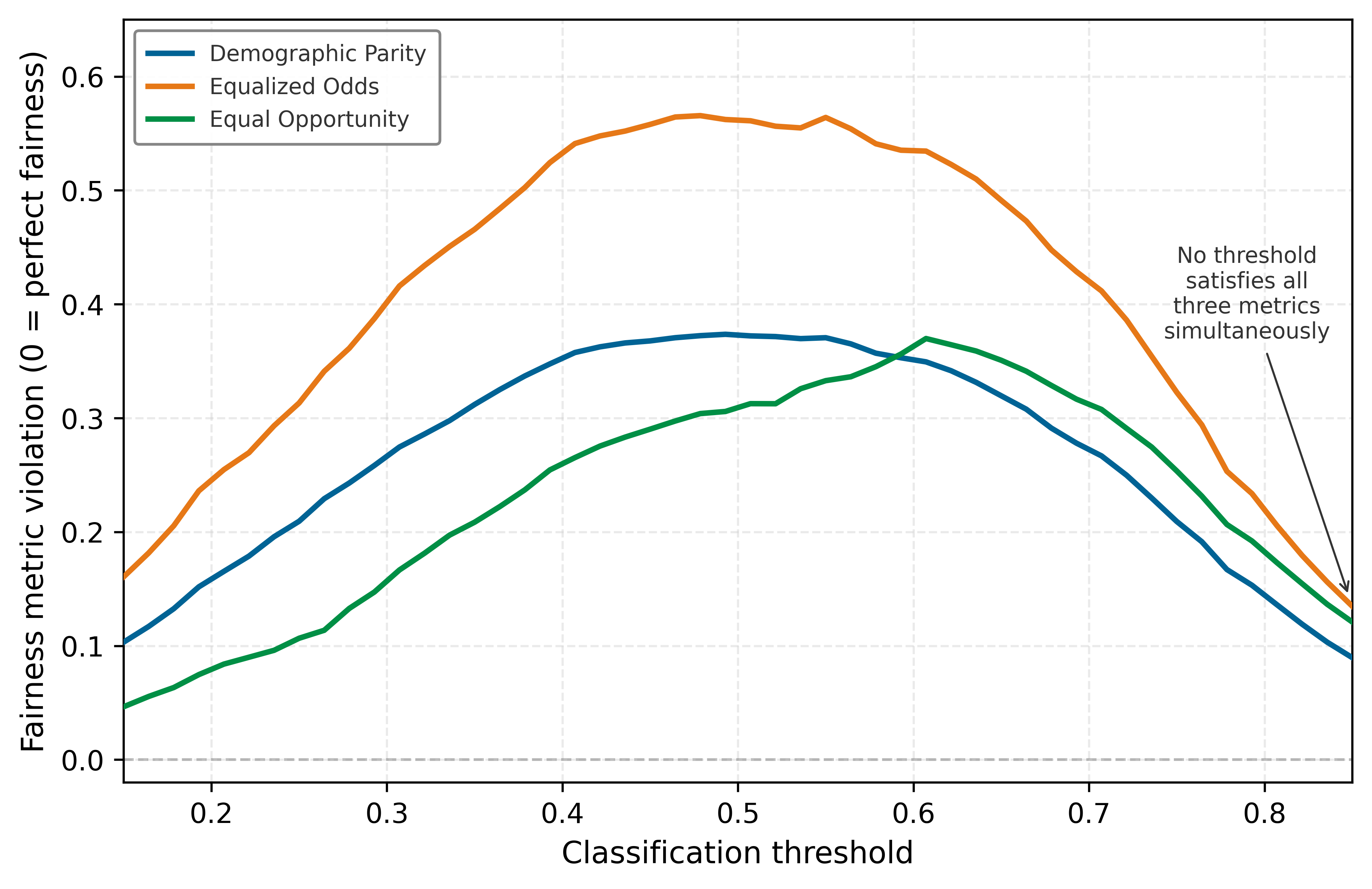
The impossibility theorem demonstrates that both goals cannot always be satisfied simultaneously, as Figure 1 visualizes. If one group has a higher proportion of qualified applicants, achieving demographic parity (Goal 1) requires rejecting some of their qualified applicants, violating equal opportunity (Goal 2). No mathematical fix exists; the choice is a value judgment about which definition of fairness to prioritize. Satisfying one criterion may preclude satisfying another, reflecting the reality that fairness involves tradeoffs between competing normative goals. Determining which metric to prioritize requires careful consideration of the application context, potential harms, and stakeholder values as detailed in Section 1.7.3.
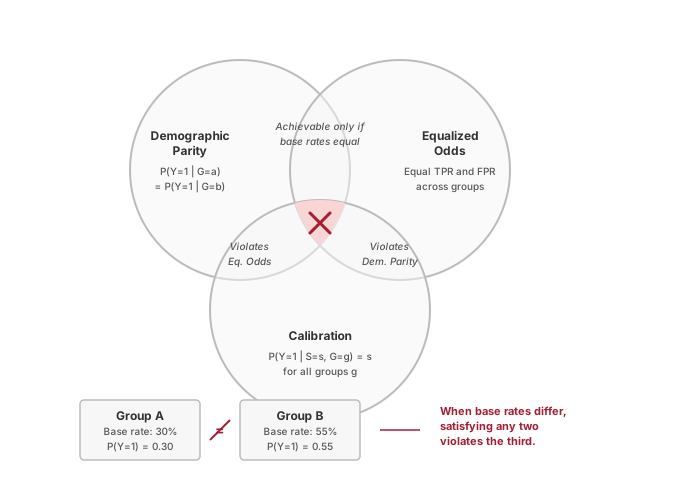
Figure 2 makes this impossibility concrete by sweeping a classification threshold across a synthetic scenario with differing group base rates. At every threshold, at least one fairness metric is substantially violated, confirming the Chouldechova-Kleinberg result: no single threshold can simultaneously satisfy demographic parity, equalized odds, and equal opportunity when base rates differ between groups.
Recognizing these tensions, operational systems must treat fairness as a constraint that informs decisions throughout the machine learning lifecycle. It is shaped by how data are collected and represented, how objectives and proxies are selected, how model predictions are thresholded, and how feedback mechanisms are structured. For example, a choice between ranking vs. classification models can yield different patterns of access across groups, even when using the same underlying data.
Fairness metrics help formalize equity goals but are often limited to predefined demographic categories. In practice, these categories may be too coarse to capture the full range of disparities present in real-world data.
Intersectional fairness
A critical limitation of standard fairness analysis is that it often evaluates single axes of identity (for example, Race OR Gender) independently. This can mask profound disparities that exist at the intersection of these attributes.
For example, a facial recognition system might have 99 percent accuracy for “Men” and 99 percent accuracy for “Light-Skinned People”, but only 65 percent accuracy for “Dark-Skinned Women” (Buolamwini and Gebru 2018). If the audit only checks Race and Gender separately, the model appears fair. This phenomenon, sometimes called Fairness Gerrymandering, requires evaluating model performance on intersectional subgroups (for example, Race\(\times\) Gender) to detect and mitigate compounded biases.
Buolamwini, Joy, and Timnit Gebru. 2018. “Gender Shades: Intersectional Accuracy Disparities in Commercial Gender Classification.” Proceedings of the 1st Conference on Fairness, Accountability and Transparency, 77–91. http://proceedings.mlr.press/v81/buolamwini18a.html.
A principled approach to fairness must account for overlapping and intersectional identities, ensuring that model behavior remains consistent across subgroups that may not be explicitly labeled in advance. Recent work in this area emphasizes the need for predictive reliability across a wide range of population slices (Hébert-Johnson et al. 2018), reinforcing the idea that fairness must be considered a system-level requirement, not a localized adjustment. This expanded view of fairness highlights the importance of designing architectures, evaluation protocols, and monitoring strategies that support more nuanced, context-sensitive assessments of model behavior.
Quantitative fairness measurement
While the fairness criteria above provide formal definitions, practitioners need quantitative methods to measure the degree of fairness violation and establish actionable thresholds for intervention. This section develops the mathematical framework for quantifying disparities and determining when they warrant corrective action.
Disparate impact ratio
The disparate impact ratio (also called the four-fifths rule in employment law) quantifies the ratio of favorable outcome rates between groups (Feldman et al. 2015): \[ \text{DI}(a,b) = \frac{P(h(x) = 1 \mid S = a)}{P(h(x) = 1 \mid S = b)} \]
Feldman, Michael, Sorelle A. Friedler, John Moeller, Carlos Scheidegger, and Suresh Venkatasubramanian. 2015. “Certifying and Removing Disparate Impact.” Proceedings of the 21th ACM SIGKDD International Conference on Knowledge Discovery and Data Mining, August, 259–68. https://doi.org/10.1145/2783258.2783311.
where group \(b\) is typically the majority or privileged group. U.S. Equal Employment Opportunity Commission guidelines suggest disparate impact when \(\text{DI} < 0.8\), meaning the protected group receives favorable outcomes at less than 80 percent the rate of the reference group.
For the loan approval example from earlier, we calculated \(P(h(x)=1 \mid S=A) = 0.70\) and \(P(h(x)=1 \mid S=B) = 0.40\). The disparate impact ratio is: \[ \text{DI}(B,A) = \frac{0.40}{0.70} = 0.57 \]
This violates the four-fifths rule substantially, with Group B receiving approvals at only 57 percent the rate of Group A. This quantifies the severity of demographic parity violation and provides a legally recognized threshold for intervention.
Statistical parity difference
An alternative metric measures the absolute difference in favorable outcome rates (Calders and Verwer 2010): \[ \text{SPD}(a,b) = P(h(x) = 1 \mid S = a) - P(h(x) = 1 \mid S = b) \]
Calders, Toon, and Sicco Verwer. 2010. “Three Naive Bayes Approaches for Discrimination-Free Classification.” Data Mining and Knowledge Discovery 21 (2): 277–92. https://doi.org/10.1007/s10618-010-0190-x.
This metric ranges from -1 to +1, with 0 indicating perfect demographic parity. For our loan example: \(\text{SPD}(A,B) = 0.70 - 0.40 = 0.30\), indicating a 30 percentage point gap in approval rates.
Unlike disparate impact ratio (which is multiplicative), statistical parity difference provides an additive measure that is easier to interpret when comparing multiple groups or tracking changes over time. A threshold of \(|\text{SPD}| \leq 0.10\) (10 percentage points) is commonly used in fairness audits, though context-specific thresholds should be established through stakeholder deliberation.
Equal opportunity difference
To quantify violations of equality of opportunity, measure the difference in true positive rates: \[ \text{EOD}(a,b) = P(h(x) = 1 \mid S = a, Y = 1) - P(h(x) = 1 \mid S = b, Y = 1) \]
From the loan example: \(\text{EOD}(A,B) = 0.89 - 0.60 = 0.29\). This 29 percentage point gap means qualified Group A applicants are 29 percent more likely to be correctly approved than equally qualified Group B applicants. The metric directly measures opportunity inequality among deserving individuals.
Equalized odds metrics
Full equalized odds compliance requires equalizing both true positive rates and false positive rates. Define the average odds difference (Hardt et al. 2016): \[\begin{align*} \text{AOD}(a,b) = \frac{1}{2}\Big[&\big|P(h(x) = 1 \mid S = a, Y = 1) - P(h(x) = 1 \mid S = b, Y = 1)\big| \\ &+ \big|P(h(x) = 1 \mid S = a, Y = 0) - P(h(x) = 1 \mid S = b, Y = 0)\big|\Big] \end{align*}\]
For the loan example: \[\begin{align*} \text{AOD}(A,B) &= \frac{1}{2}\big[|0.89 - 0.60| + |0.55 - 0.20|\big] \\ &= \frac{1}{2}[0.29 + 0.35] = 0.32 \end{align*}\]
This composite metric captures both types of errors, revealing that the model has an average 32 percentage point disparity in error rates across positive and negative outcomes. Perfect equalized odds requires \(\text{AOD} = 0\).
Calibration
A model is calibrated with respect to a sensitive attribute if, among individuals assigned score \(s\) by the model, the fraction with positive outcomes is equal across groups (Kleinberg et al. 2016): \[ P(Y = 1 \mid h(x) = s, S = a) = P(Y = 1 \mid h(x) = s, S = b), \quad \forall s \]
Kleinberg, Jon, Sendhil Mullainathan, and Manish Raghavan. 2016. “Inherent Trade-Offs in the Fair Determination of Risk Scores.” arXiv Preprint arXiv:1609.05807, September. http://arxiv.org/abs/1609.05807v2.
For binary classifiers, calibration means that among individuals predicted positive, the fraction who are truly positive should be equal across groups. This is equivalent to equal positive predictive value (precision): \[ \text{PPV}(a) = \frac{P(Y=1, h(x)=1 \mid S=a)}{P(h(x)=1 \mid S=a)} = \text{PPV}(b) \]
From the loan example: \[\begin{align*} \text{PPV}(A) &= \frac{40}{70} = 0.571 \\ \text{PPV}(B) &= \frac{30}{40} = 0.750 \end{align*}\]
The calibration gap is \(0.750 - 0.571 = 0.179\). Group B’s predicted positives are actually positive 75 percent of the time, while Group A’s are only 57 percent accurate. This violates calibration and reveals that the model is less reliable when predicting approval for Group A.
Calibration is critical for high stakes decisions where individuals rely on predicted probabilities. A miscalibrated model systematically over or underpredicts risk for specific groups, leading to misallocated resources and eroded trust.
Threshold setting and fairness trade-offs
In practice, fairness metrics can be manipulated by adjusting classification thresholds per group. Given a scoring function \(s(x)\) (for example, predicted probability), define group-specific thresholds \(\tau_a\) and \(\tau_b\) such that \(h_a(x) = \mathbb{1}[s(x) \geq \tau_a]\) for group \(a\) and similarly for group \(b\).
To achieve demographic parity, solve: \[ P(s(x) \geq \tau_a \mid S = a) = P(s(x) \geq \tau_b \mid S = b) \]
To achieve equal opportunity, solve: \[ P(s(x) \geq \tau_a \mid S = a, Y = 1) = P(s(x) \geq \tau_b \mid S = b, Y = 1) \]
For equalized odds, both true positive and false positive rate constraints must hold simultaneously. This is a constrained optimization problem that can be solved via post-processing (Hardt et al. 2016).
Hardt, Moritz, Eric Price, and Nati Srebro. 2016. “Equality of Opportunity in Supervised Learning.” Advances in Neural Information Processing Systems 29: 3315–23. https://proceedings.neurips.cc/paper/2016/hash/9d2682367c3935defcb1f9e247a97c0d-Abstract.html.
However, threshold adjustment has limitations. If base rates differ substantially between groups (that is, \(P(Y=1 \mid S=a) \neq P(Y=1 \mid S=b)\)), achieving one fairness criterion through thresholding will necessarily violate others due to the impossibility theorems. The following example quantifies this trade-off.
Example 1.2: Engineering Metric: The Cost of Fairness
The Trade-off: Satisfying a fairness constraint often requires deviating from the optimal accuracy threshold. This deviation is the “Fairness Tax.”
Scenario: A credit model scores applicants from 0 to 100.
- Group A (Majority): Mean score 70, High repayment rate. Optimal Threshold = 60.
- Group B (Minority): Mean score 50, Lower repayment rate (due to systemic factors).
Unconstrained Optimization (Max Profit):
- Threshold = 60 for everyone.
- Group A Approval = 80 percent, Group B Approval = 20 percent.
- Accuracy = 85 percent.
Fairness Constrained (Demographic Parity):
- Constraint: Group B Approval must equal Group A (80 percent).
- New Threshold for Group B = 40.
- Result: Group B false positives increase. Overall Accuracy drops to 81 percent.
Conclusion: The “Cost of Fairness” is 4 percent accuracy. The engineering decision requires weighing a 4 percent profit loss against social equity gains.
Furthermore, differential thresholds require access to sensitive attributes at inference time and raise concerns about explicit group-based treatment, which may itself be considered unfair or illegal in certain jurisdictions. The following example demonstrates how threshold adjustment works in practice.
Example 1.3: Threshold for Equal Opportunity
Consider a credit scoring model that outputs a probability \(s(x) \in [0,1]\). Historical data shows:
Group A: 1000 applicants, 600 would repay (\(Y=1\)), 400 would default (\(Y=0\))
- Score distribution for \(Y=1\): Mean \(\mu_A^+ = 0.72\), SD \(\sigma_A^+ = 0.15\)
- Score distribution for \(Y=0\): Mean \(\mu_A^- = 0.45\), SD \(\sigma_A^- = 0.18\)
Group B: 1000 applicants, 400 would repay (\(Y=1\)), 600 would default (\(Y=0\))
- Score distribution for \(Y=1\): Mean \(\mu_B^+ = 0.65\), SD \(\sigma_B^+ = 0.16\)
- Score distribution for \(Y=0\): Mean \(\mu_B^- = 0.40\), SD \(\sigma_B^- = 0.17\)
Using a single threshold \(\tau = 0.60\) for both groups yields true positive rates: \[\begin{align*} \text{TPR}_A &= P(s(x) \geq 0.60 \mid S=A, Y=1) \approx 0.79 \\ \text{TPR}_B &= P(s(x) \geq 0.60 \mid S=B, Y=1) \approx 0.62 \end{align*}\]
This 17 percentage point gap violates equal opportunity. To equalize TPR at approximately 0.70, we could lower Group B’s threshold to \(\tau_B = 0.52\) while keeping \(\tau_A = 0.60\). However, this adjustment increases Group B’s false positive rate from 0.28 to 0.38, degrading precision for Group B applicants from 0.69 to 0.61.
This illustrates the fundamental trade-off: achieving equal opportunity through threshold adjustment comes at the cost of reduced calibration and increased false positives for the group receiving the lower threshold. The decision involves weighing opportunity equity against prediction reliability.
Measuring fairness violations statistically
To determine whether observed disparities are statistically significant rather than sampling noise, practitioners should compute confidence intervals and conduct hypothesis tests.
For demographic parity, test the null hypothesis \(H_0: P(h(x)=1 \mid S=a) = P(h(x)=1 \mid S=b)\) using a two-proportion z-test. The test statistic is: \[ z = \frac{\hat{p}_a - \hat{p}_b}{\sqrt{\hat{p}(1-\hat{p})\left(\frac{1}{n_a} + \frac{1}{n_b}\right)}} \]
where \(\hat{p}_a\) and \(\hat{p}_b\) are the sample approval rates, \(\hat{p} = \frac{n_a\hat{p}_a + n_b\hat{p}_b}{n_a + n_b}\) is the pooled proportion, and \(n_a\), \(n_b\) are sample sizes.
For the loan example with \(n_A = n_B = 100\), \(\hat{p}_A = 0.70\), \(\hat{p}_B = 0.40\): \[\begin{align*} \hat{p} &= \frac{100(0.70) + 100(0.40)}{200} = 0.55 \\ z &= \frac{0.70 - 0.40}{\sqrt{0.55(0.45)(0.02)}} = \frac{0.30}{0.070} = 4.29 \end{align*}\]
With \(z = 4.29\) (far exceeding critical value \(z_{0.05/2} = 1.96\)), we reject \(H_0\) and conclude the demographic parity violation is statistically significant at \(p < 0.001\).
Similar tests can be constructed for equal opportunity and equalized odds by restricting to subpopulations where \(Y=1\) or \(Y=0\) respectively. Statistical significance does not imply practical significance; even statistically significant disparities may be acceptable if the magnitude is small. Conversely, large disparities in small samples may not reach statistical significance but still warrant intervention.
Fairness metrics in practice
Deploying fairness metrics in production requires careful consideration of measurement overhead, data requirements, and organizational governance.
Measurement overhead arises because computing group specific metrics requires maintaining separate statistics for each protected group. For \(k\) groups and \(m\) metrics, this requires \(O(km)\) additional counters and \(O(km)\) statistical tests per evaluation cycle. In high throughput systems (>10K QPS), this overhead must be managed through sampling or asynchronous aggregation.
Data requirements pose challenges because fairness auditing requires ground truth labels (\(Y\)) and sensitive attributes (\(S\)) for a representative sample. In federated or privacy preserving settings, obtaining this data may conflict with privacy goals. Techniques like encrypted aggregate statistics or differential privacy for group metrics can help reconcile fairness monitoring with privacy requirements.
Threshold selection demands domain expertise and stakeholder input to establish acceptable disparity thresholds. Legal thresholds (for example, four-fifths rule) provide starting points, but context-specific harm assessments should inform final values. Document threshold rationale to support audits and regulatory compliance.
Temporal stability requires monitoring fairness metrics over time to detect degradation due to distribution shift, feedback loops, or model updates. Continuous monitoring with automated alerting (for example, “alert if \(|\text{SPD}| > 0.15\) for 7 consecutive days”) enables proactive intervention before harms accumulate.
The quantitative framework developed here transforms fairness from an abstract principle into measurable engineering constraints. By establishing metrics, thresholds, and statistical tests, practitioners can systematically evaluate fairness throughout the ML lifecycle and make data-driven decisions about when intervention is required.
Checkpoint 1.1: Exercise: Auditing a Confusion Matrix
A fraud detection model operates on two groups.
- Group A (Majority): TP=450, FP=50, FN=30, TN=470 (N=1000).
- Group B (Minority): TP=180, FP=70, FN=120, TN=630 (N=1000).
Calculate:
- Demographic Parity (Positive Prediction Rate): \(P(\hat{Y}=1)\).
- Group A: \((450+50)/1000 = 0.50\).
- Group B: \((180+70)/1000 = 0.25\).
- Gap: 0.25. (Violates four-fifths rule: \(0.25/0.50 = 0.5 < 0.8\)).
- Equal Opportunity (TPR): \(\text{TP} / (\text{TP}+\text{FN})\).
- Group A: \(450 / (450+30) = 0.937\).
- Group B: \(180 / (180+120) = 0.60\).
- Gap: 0.337. (Severe violation).
Analysis: Fixing TPR requires lowering the threshold for Group B to catch more fraud (reducing FNs). However, this will likely increase FPs (false alarms) for Group B, worsening predictive parity. You cannot fix one without degrading the other—a concrete demonstration of the impossibility theorem.
Fairness considerations extend beyond algorithmic outcomes to encompass the computational resources and infrastructure required to deploy responsible AI systems. These broader equity implications, including environmental justice concerns, arise when energy-intensive AI infrastructure is concentrated in already disadvantaged communities8.
8 Datacenter Environmental Justice: A significant fraction of major U.S. cloud computing facilities sit within 16 km of low-income communities, which bear increased air pollution from backup diesel generators and heat from cooling systems. For ML fleet operators, this creates a governance constraint: datacenter placement decisions that optimize for power cost and latency simultaneously externalize environmental costs onto communities least able to access the AI services those datacenters enable.
The computational intensity of responsible AI techniques creates a form of digital divide where access to fair, transparent, and accountable AI systems becomes contingent on economic resources. Implementing fairness constraints, differential privacy mechanisms, and comprehensive explainability tools typically increases computational costs by 15–40 percent compared to unconstrained models. This creates a troubling dynamic where only organizations with substantial computational budgets can afford to deploy genuinely responsible AI systems, while resource-constrained deployments may sacrifice ethical safeguards for efficiency. The result is a two-tiered system where responsible AI becomes a privilege available primarily to well-resourced users and applications, potentially exacerbating existing inequalities rather than addressing them. These resource constraints create democratization challenges, while the broader implications create digital divide and access barriers affecting underserved communities.
These considerations point to a fundamental conclusion: fairness is a system-wide property that arises from the interaction of data engineering practices, modeling choices, evaluation procedures, and decision policies. It cannot be isolated to a single model component or resolved through post hoc adjustments alone. Responsible machine learning design requires treating fairness as a foundational constraint, one that informs architectural choices, workflows, and governance mechanisms throughout the entire lifecycle of the system. This system-wide view extends to all responsible AI principles, which translate into concrete engineering requirements across the ML lifecycle: fairness demands group-level performance metrics and different decision thresholds across populations; explainability requires runtime compute budgets with costs varying from 10–50 ms for gradient methods to 50–1000\(\times\) overhead for SHAP analysis; privacy encompasses data governance, consent mechanisms, and lifecycle-aware retention policies; and accountability requires traceability infrastructure including model registries, audit logs, and human override mechanisms.
These principles interact and create tensions throughout system development. Privacy-preserving techniques may reduce explainability; fairness constraints may conflict with personalization; robust monitoring increases computational costs. As Table 1 demonstrates, each principle manifests across data collection, training, evaluation, deployment, and monitoring phases, reinforcing that responsible AI is not a post-deployment consideration but an architectural commitment. However, the feasibility of implementing these principles depends critically on deployment context: cloud, edge, mobile, and TinyML environments each impose different constraints that shape which responsible AI features are practically achievable.
Privacy and data governance
Privacy and data governance present complex challenges that extend beyond threat-model perspectives, while creating fundamental tensions with the fairness and transparency principles examined above. Security-focused privacy asks “how do we prevent unauthorized access?” Responsible privacy asks “should we collect this data at all, and if so, how do we minimize exposure throughout the system lifecycle?” This broader perspective creates inherent tensions: fairness monitoring requires collecting and analyzing sensitive demographic data, explainability methods may reveal information about training examples, and comprehensive transparency can conflict with individual privacy rights. Responsible AI systems must navigate these competing requirements through careful design choices that balance protection, accountability, and utility.
Machine learning systems often rely on extensive collections of personal data to support model training and allow personalized functionality. This reliance introduces significant responsibilities related to user privacy, data protection, and ethical data stewardship. The quality and governance of this data directly impacts the ability to implement responsible AI principles. Responsible AI design treats privacy not as an ancillary feature, but as a core constraint that must inform decisions across the entire system lifecycle.
One of the core challenges in supporting privacy is the inherent tension between data utility and individual protection. Rich, high-resolution datasets can enhance model accuracy and adaptability but also heighten the risk of exposing sensitive information, particularly when datasets are aggregated or linked with external sources. For example, models trained on conversational data or medical records have been shown to memorize specific details that can later be retrieved through model queries or adversarial interaction (Ippolito et al. 2023)9.
9 Model Memorization: Carlini et al. demonstrated that GPT-2 could reproduce verbatim email addresses, phone numbers, and personal information from training data through carefully crafted prompts. Memorization scales with model capacity: larger models memorize more, and memorization rates peak early and late in training. For ML systems serving user-facing queries, this creates a privacy attack surface where the serving layer itself becomes a data exfiltration vector, requiring output filtering and rate limiting as defense-in-depth measures.
The privacy challenges extend beyond obvious sensitive data to seemingly innocuous information. Wearable devices that track physiological and behavioral signals, including heart rate, movement, or location, may individually seem benign but can jointly reveal detailed user profiles. These risks are further exacerbated when users have limited visibility or control over how their data is processed, retained, or transmitted.
Addressing these challenges requires understanding privacy as a system principle that entails robust data governance. This includes defining what data is collected, under what conditions, and with what degree of consent and transparency. Foundational data engineering practices, including data validation, schema management, versioning, and lineage tracking, provide the technical infrastructure for implementing these governance requirements. Responsible governance requires attention to labeling practices, access controls, logging infrastructure, and compliance with jurisdictional requirements. These mechanisms serve to constrain how data flows through a system and to document accountability for its use.
Figure 3 outlines key privacy checkpoints in the early stages of a data pipeline, highlighting where core safeguards such as consent acquisition, encryption, and differential privacy should be applied. Actual implementations often involve more nuanced tradeoffs and context-sensitive decisions, but this diagram provides a scaffold for identifying where privacy risks arise and how they can be mitigated through responsible design choices.
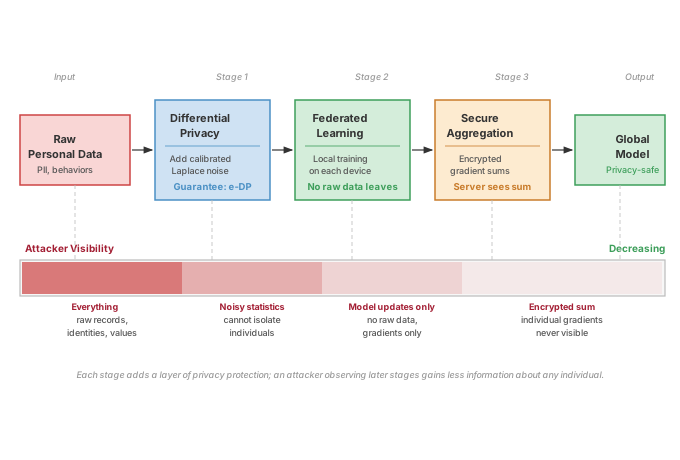
The consequences of weak data governance are well documented. Systems trained on poorly understood or biased datasets may perpetuate structural inequities or expose sensitive attributes unintentionally. In the COMPAS example introduced earlier, the lack of transparency surrounding data provenance and usage precluded effective evaluation or redress. In clinical applications, datasets frequently reflect artifacts such as missing values or demographic skew that compromise both performance and privacy. Without clear standards for data quality and documentation, such vulnerabilities become systemic.
Privacy is not solely the concern of isolated algorithms or data processors; it must be addressed as a structural property of the system. Decisions about consent collection, data retention, model design, and auditability all contribute to the privacy posture of a machine learning pipeline. This includes the need to anticipate risks not only during training, but also during inference and ongoing operation. Threats such as membership inference attacks10 underscore the importance of embedding privacy safeguards into both model architecture and interface behavior.
10 Membership Inference Attacks: First demonstrated by Shokri et al. in 2017, these attacks determine whether a specific individual’s data was used to train a model by exploiting the confidence gap between seen and unseen inputs. The systems implication: any ML model exposed via an API becomes a potential privacy oracle, and determining that someone’s medical record was in a disease prediction model’s training set reveals sensitive health information. Defenses include differential privacy (adding 15–30 percent training overhead) and prediction confidence calibration.
11 CCPA (California Consumer Privacy Act): Effective January 2020, CCPA grants California residents the right to request deletion of personal data, creating the same machine unlearning challenge as GDPR’s “right to be forgotten” but for the U.S. market. For ML serving infrastructure, honoring deletion requests requires either full model retraining (prohibitively expensive for large models) or approximate unlearning techniques like SISA training, adding an architectural constraint that must be planned from the data pipeline forward.
Legal frameworks increasingly reflect this understanding. Regulations such as the GDPR, CCPA11, and APPI impose specific obligations regarding data minimization, purpose limitation, user consent, and the right to deletion. These requirements translate ethical expectations into enforceable design constraints, reinforcing the need to treat privacy as a core principle in system development.
These privacy considerations culminate in a comprehensive approach: privacy in machine learning is a system-wide commitment. It requires coordination across technical and organizational domains to ensure that data usage aligns with user expectations, legal mandates, and societal norms. Rather than viewing privacy as a constraint to be balanced against functionality, responsible system design integrates privacy from the outset by informing architecture, shaping interfaces, and constraining how models are built, updated, and deployed.
Privacy preservation prevents unauthorized data exposure, but responsible systems must also ensure predictable behavior even when privacy mechanisms cannot prevent all risks. A model may satisfy every privacy constraint while still failing catastrophically when encountering unexpected inputs or adversarial conditions. Safety and robustness address this complementary concern: how systems fail, not just how data is protected.
Safety and robustness
Safety and robustness, introduced in Robust AI as technical properties addressing hardware faults, adversarial attacks, and distribution shifts, also serve as responsible AI principles that extend beyond threat mitigation. Technical robustness ensures systems survive adversarial conditions; responsible robustness ensures systems behave in ways aligned with human expectations and values, even when technically functional. A model may be robust to bit flips and adversarial perturbations yet still exhibit behavior that is unsafe for deployment if it fails unpredictably in edge cases or optimizes objectives misaligned with user welfare.
Safety in machine learning refers to the assurance that models behave predictably under normal conditions and fail in controlled, noncatastrophic ways under stress or uncertainty. Closely related, robustness concerns a model’s ability to maintain stable and consistent performance in the presence of variation, whether in inputs, environments, or system configurations. Together, these properties are foundational for responsible deployment in safety critical domains, where machine learning outputs directly affect physical or high stakes decisions.
Ensuring safety and robustness in practice requires anticipating the full range of conditions a system may encounter and designing for behavior that remains reliable beyond the training distribution. This includes not only managing the variability of inputs but also addressing how models respond to unexpected correlations, rare events, and deliberate attempts to induce failure. For example, widely publicized failures in autonomous vehicle systems have revealed how limitations in object detection or overreliance on automation can result in harmful outcomes, even when models perform well under nominal test conditions.
One illustrative failure mode arises from adversarial inputs12: carefully constructed perturbations that appear benign to humans but cause a model to output incorrect or harmful predictions (Szegedy et al. 2013). Such vulnerabilities are not limited to image classification; they have been observed across modalities including audio, text, and structured data, and they reveal the brittleness of learned representations in high-dimensional spaces. Addressing these vulnerabilities requires specialized approaches including adversarial defenses and robustness techniques. These behaviors highlight that robustness must be considered not only during training but as a global property of how systems interact with real-world complexity.
12 Adversarial Inputs: First demonstrated by Szegedy et al. in 2013, these are imperceptible input perturbations that cause confident misclassification. A perturbation of magnitude 0.005 (in pixel space) can flip a classifier’s output with >99 percent confidence, revealing that neural networks’ decision boundaries are far more fragile than their test-set accuracy suggests. For safety-critical ML systems, this means test accuracy provides no guarantee of deployment robustness, requiring adversarial testing as a separate validation stage.
13 Distribution Shift: The mismatch between training and deployment data distributions, manifesting as covariate shift (input distribution changes), label shift (class proportions change), or concept drift (the input-output relationship evolves over time). The systems consequence is silent degradation: unlike software bugs that crash, distribution shift erodes accuracy over weeks or months without triggering errors, requiring continuous monitoring infrastructure with automated retraining triggers and model versioning to detect and respond.
A related challenge is distribution shift13: the inevitable mismatch between training data and conditions encountered in deployment.
Whether due to seasonality, demographic changes, sensor degradation, or environmental variability, such shifts can degrade model reliability even in the absence of adversarial manipulation. Addressing distribution shift challenges requires systematic approaches to detecting and adapting to changing conditions. Failures under distribution shift may propagate through downstream decisions, introducing safety risks that extend beyond model accuracy alone. In domains such as healthcare, finance, or transportation, these risks are not hypothetical; they carry real consequences for individuals and institutions.
Responsible machine learning design treats robustness as a systemic requirement. Addressing it requires more than improving individual model performance. It involves designing systems that anticipate uncertainty, surface their limitations, and support fallback behavior when predictive confidence is low. This includes practices such as setting confidence thresholds, supporting abstention from decision-making, and integrating human oversight into operational workflows. These mechanisms are important for building systems that degrade gracefully rather than failing silently or unpredictably.
These individual-model considerations extend to broader system requirements. Safety and robustness also impose requirements at the architectural and organizational level. Decisions about how models are monitored, how failures are detected, and how updates are governed all influence whether a system can respond effectively to changing conditions. Responsible design demands that robustness be treated not as a property of isolated models but as a constraint that shapes the overall behavior of machine learning systems.
This system-level perspective on safety and robustness leads to questions of accountability and governance.
Accountability and governance
Accountability in machine learning refers to the capacity to identify, attribute, and address the consequences of automated decisions. It extends beyond diagnosing failures to ensuring that responsibility for system behavior is clearly assigned, that harms can be remedied, and that ethical standards are maintained through oversight and institutional processes. Without such mechanisms, even well intentioned systems can generate significant harm without recourse, undermining public trust and eroding legitimacy.
Unlike traditional software systems, where responsibility often lies with a clearly defined developer or operator, accountability in machine learning is distributed. Model outputs are shaped by upstream data collection, training objectives, pipeline design, interface behavior, and postdeployment feedback. These interconnected components often involve multiple actors across technical, legal, and organizational domains. For example, if a hiring platform produces biased outcomes, accountability may rest not only with the model developer but also with data providers, interface designers, and deploying institutions. Responsible system design requires that these relationships be explicitly mapped and governed.
Inadequate governance can prevent institutions from recognizing or correcting harmful model behavior. The failure of Google Flu Trends to anticipate distribution shift and feedback loops illustrates how opacity in model assumptions and update policies can inhibit corrective action (Lazer et al. 2014). Without visibility into the system’s design and data curation, external stakeholders lacked the means to evaluate its validity, contributing to the model’s eventual discontinuation.
Lazer, David, Ryan Kennedy, Gary King, and Alessandro Vespignani. 2014. “The Parable of Google Flu: Traps in Big Data Analysis.” Science 343 (6176): 1203–5. https://doi.org/10.1126/science.1248506.
Legal frameworks increasingly reflect the necessity of accountable design. Regulations such as the Illinois Artificial Intelligence Video Interview Act and the EU AI Act impose requirements for transparency, consent, documentation, and oversight in high risk applications. These policies embed accountability not only in the outcomes a system produces, but in the operational procedures and documentation that support its use. Internal organizational changes, including the introduction of fairness audits and the imposition of usage restrictions in targeted advertising systems, demonstrate how regulatory pressure can catalyze structural reforms in governance.
Designing for accountability entails supporting traceability at every stage of the system lifecycle. This includes documenting data provenance, recording model versioning, enabling human overrides, and retaining sufficient logs for retrospective analysis. Tools such as model cards (Mitchell et al. 2019)14 and datasheets for datasets (Gebru et al. 2021)15 exemplify practices that make system behavior interpretable and reviewable. Mitchell and colleagues proposed model cards as short documents accompanying trained ML models that provide benchmarked evaluation across cultural, demographic, and phenotypic groups relevant to intended applications. Similarly, Gebru and colleagues proposed that every dataset be accompanied by a datasheet documenting its motivation, composition, collection process, and recommended uses, analogous to how electronic components include specification sheets. However, accountability is not reducible to documentation alone; it also requires mechanisms for feedback, contestation, and redress.
Mitchell, Margaret, Simone Wu, Andrew Zaldivar, et al. 2019. “Model Cards for Model Reporting.” Proceedings of the Conference on Fairness, Accountability, and Transparency, January, 220–29. https://doi.org/10.1145/3287560.3287596.
14 Model Cards: Proposed by Mitchell et al. at Google in 2019 as standardized documentation accompanying trained ML models. Each card benchmarks performance across demographic groups, documents intended use cases, and discloses known limitations. For production ML systems, model cards serve as the traceability layer linking a deployed binary to its training provenance, evaluation results, and known failure modes – the minimum metadata required for post-deployment auditing and regulatory compliance.
Gebru, Timnit, Jamie Morgenstern, Briana Vecchione, et al. 2021. “Datasheets for Datasets.” Communications of the ACM 64 (12): 86–92. https://doi.org/10.1145/3458723.
15 Datasheets for Datasets: Proposed by Gebru et al. in 2018, modeled after electronics component datasheets that specify operating conditions and tolerances. Each datasheet documents a dataset’s motivation, composition, collection process, and recommended uses. For ML pipelines, datasheets function as the data equivalent of hardware specs: they define the valid operating envelope of a model’s training distribution, enabling engineers to predict where deployment-time distribution shift will cause failures.
Within organizations, governance structures help formalize this responsibility. Ethics review processes, cross-functional audits, and model risk committees provide forums for anticipating downstream impact and responding to emerging concerns. These structures must be supported by infrastructure that allows users to contest decisions and developers to respond with corrections. For instance, systems that allow explanations or user-initiated reviews help bridge the gap between model logic and user experience, especially in domains where the impact of error is significant.
Architectural decisions also play a role. Interfaces can be designed to surface uncertainty, allow escalation, or suspend automated actions when appropriate. Logging and monitoring pipelines must be configured to detect signs of ethical drift, such as performance degradation across subpopulations or unanticipated feedback loops. In distributed systems, where uniform observability is difficult to maintain, accountability must be embedded through architectural safeguards such as secure protocols, update constraints, or trusted components.
Governance does not imply centralized control. Instead, it involves distributing responsibility in ways that are transparent, actionable, and sustainable. Technical teams, legal experts, end users, and institutional leaders must all have access to the tools and information necessary to evaluate system behavior and intervene when necessary. As machine learning systems become more complex and embedded in important infrastructure, accountability must scale accordingly by becoming a foundational consideration in both architecture and process, not a reactive layer added after deployment.
Despite these governance mechanisms, meaningful accountability faces a challenge: distinguishing between decisions based on legitimate factors vs. spurious correlations that may perpetuate historical biases. This challenge requires careful attention to data quality, feature selection, and ongoing monitoring to ensure that automated decisions reflect fair and justified reasoning rather than problematic patterns from biased historical data.
The principles and techniques examined above provide the conceptual and technical foundation for responsible AI, but their practical implementation depends critically on deployment architecture. Cloud systems can support complex SHAP explanations and real-time fairness monitoring, but TinyML devices must rely on static interpretability and compile-time privacy guarantees. Edge deployments enable local privacy preservation but limit global fairness assessment. These architectural constraints are not mere implementation details; they fundamentally shape which responsible AI protections are accessible to different users and applications.
Checkpoint 1.2: Fairness Audit
You are deploying a hiring recommendation model. Before launch, determine the critical fairness metric:
- Demographic Parity: Requires equal acceptance rates across groups (for example, 50 percent men, 50 percent women hired). Risk: Can force rejection of qualified candidates if base rates differ.
- Equalized Odds: Requires equal True Positive Rates and False Positive Rates. Benefit: Ensures qualified candidates have the same probability of being hired regardless of group.
- Calibration: Ensures a risk score of 0.8 means 80 percent success probability for all groups.
Verdict: Equalized Odds is usually most appropriate for hiring, as it respects merit (qualification) while preventing structural bias against specific groups.
Selecting the mathematically appropriate fairness metric is the first step, but calculating these metrics requires access to demographic data and significant computational overhead. Enforcing these mathematical guarantees grows far more complex when moving from a centralized cloud environment to constrained, distributed edge deployments where privacy and bandwidth dictate the architecture.
Self-Check: Question
Which of the following is a key aspect of fairness in machine learning systems?
- Maximizing accuracy across all predictions
- Ensuring non-discrimination based on protected attributes
- Minimizing computational resources
- Ensuring transparency in data collection
Explain why explainability is crucial for building user trust in AI systems.
True or False: Post hoc explanations are always sufficient for ensuring the transparency of AI systems.
The principle that AI systems should pursue goals consistent with human intent and ethical norms is known as ____.
Describe a scenario where implementing fairness and transparency measures might conflict, and how you would resolve this trade-off in a healthcare AI system.
Responsible AI Across Deployment Environments
Auditing a model for bias is straightforward with a massive centralized database and unlimited cloud GPUs. Auditing a federated learning model running on a million individual smartphones, where strict privacy laws prevent access to demographic data, is an entirely different engineering problem. The deployment environment fundamentally dictates which responsible AI techniques are mathematically and legally possible.
These architectural differences introduce tradeoffs that affect not only what is technically feasible, but also how responsibilities are distributed across system components. Resource availability, latency constraints, user interface design, and the presence or absence of connectivity all play a role in determining whether responsible AI principles can be enforced consistently across deployment contexts. Understanding deployment strategies and system architectures across cloud, edge, mobile, and embedded environments provides the foundation for implementing responsible AI across these diverse contexts.
Beyond these technical constraints, the geographic and economic distribution of computational resources creates additional layers of equity concerns in responsible AI deployment. High-performance AI systems typically require proximity to major data centers or high-bandwidth internet connections, creating service quality disparities that map closely to existing socioeconomic inequalities. Rural communities, developing regions, and economically disadvantaged areas often experience degraded AI service quality due to network latency, limited bandwidth, and distance from computational infrastructure. FCC data indicates approximately 28 percent of rural Americans lack fixed broadband meeting current speed standards, compared to under 5 percent in urban areas. This infrastructure gap means that responsible AI principles like real-time explainability, continuous fairness monitoring, and privacy-preserving computation may be practically unavailable to users in these contexts.
Understanding how deployment shapes the operational landscape for fairness, explainability, safety, privacy, and accountability is important for designing machine learning systems that are robust, aligned, and sustainable across real-world settings.
System explainability
Explainability in machine learning systems is deeply shaped by deployment context. While model architecture and explanation technique are important factors, system-level constraints, including computational capacity, latency requirements, interface design, and data accessibility, determine whether interpretability can be supported in a given environment. These constraints vary significantly across cloud platforms, mobile devices, edge systems, and deeply embedded deployments, affecting both the form and timing of explanations.
In high resource environments, such as centralized cloud systems, techniques like SHAP and LIME16 can be used to generate detailed posthoc explanations, even if they require multiple forward passes or sampling procedures.
16 LIME (Local Interpretable Model-agnostic Explanations): Introduced by Ribeiro et al. in 2016, LIME explains individual predictions by perturbing the input, querying the black-box model 500–5,000 times, and fitting a weighted linear surrogate to approximate local behavior. The systems trade-off is severe: 100–500 ms per explanation makes LIME impractical for real-time serving at scale. Tree SHAP (polynomial time on tree models) or gradient methods (single backward pass, 10–50 ms) are preferred when model architecture permits.
17 Saliency Maps: Gradient-based explanation that highlights which input regions most influenced a prediction by computing a single backward pass – the same infrastructure used for training. At approximately 10 ms overhead, saliency maps are 10–50\(\times\) cheaper than LIME or SHAP, making them the only practical real-time explanation method for edge and mobile deployments. The trade-off: raw gradients are noisy and may highlight input artifacts rather than meaningful features, requiring smoothing (SmoothGrad) that doubles the compute cost.
These methods are often impractical in latency-sensitive or resource-constrained settings, where explanation must be lightweight and fast. On mobile devices or embedded systems, methods based on saliency maps17 or input gradients are more feasible, as they typically involve a single backward pass. In TinyML deployments, runtime explanation may be infeasible altogether, making development-time inspection the primary opportunity for ensuring interpretability. Model compression and optimization techniques often create tension with explainability requirements, as simplified models may be less interpretable than their full-scale counterparts.
Latency and interactivity also influence the delivery of explanations. In real-time systems, such as drones or automated industrial control loops, there may be no opportunity to present or compute explanations during operation. Logging internal signals or confidence scores for later analysis becomes the primary strategy. In contrast, systems with asynchronous interactions, such as financial risk scoring or medical diagnosis, allow for deeper and delayed explanations to be rendered after the decision has been made.
Audience requirements further shape design choices. End users typically require explanations that are concise, intuitive, and contextually meaningful. For instance, a mobile health app might summarize a prediction as “elevated heart rate during sleep,” rather than referencing abstract model internals. By contrast, developers, auditors, and regulators often need access to attribution maps, concept activations, or decision traces to perform debugging, validation, or compliance review. These internal explanations must be exposed through developer-facing interfaces or embedded within the model development workflow.
Explainability also varies across the system lifecycle. During model development, interpretability supports diagnostics, feature auditing, and concept verification. After deployment, explainability shifts toward runtime behavior monitoring, user communication, and posthoc analysis of failure cases. In systems where runtime explanation is infeasible, such as in TinyML, design-time validation becomes especially important, requiring models to be constructed in a way that anticipates and mitigates downstream interpretability failures.
Treating explainability as a system design constraint means planning for interpretability from the outset. It must be balanced alongside other deployment requirements, including latency budgets, energy constraints, and interface limitations. Responsible system design allocates sufficient resources not only for predictive performance, but for ensuring that stakeholders can meaningfully understand and evaluate model behavior within the operational limits of the deployment environment.
Fairness presents a parallel set of deployment-specific challenges.
Fairness constraints
While fairness can be formally defined, its operationalization is shaped by deployment-specific constraints that mirror and extend the challenges seen with explainability. Differences in data access, model personalization, computational capacity, and infrastructure for monitoring or retraining affect how fairness can be evaluated, enforced, and sustained across diverse system architectures.
A key determinant is data visibility. In centralized environments, such as cloud hosted platforms, developers often have access to large datasets with demographic annotations. This allows the use of group level fairness metrics, fairness aware training procedures, and posthoc auditing (Dwork et al. 2012). In contrast, decentralized deployments, such as federated learning18 clients or mobile applications, typically lack access to global statistics due to privacy constraints or fragmented data. On device learning approaches present unique challenges for fairness assessment, as individual devices may have limited visibility into global demographic distributions. In such settings, fairness interventions must often be embedded during training or dataset curation, as postdeployment evaluation may be infeasible.
Dwork, Cynthia, Moritz Hardt, Toniann Pitassi, Omer Reingold, and Richard Zemel. 2012. “Fairness Through Awareness.” Proceedings of the 3rd Innovations in Theoretical Computer Science Conference, January, 214–26. https://doi.org/10.1145/2090236.2090255.
18 Federated Learning and Fairness: Google introduced federated learning in 2016 for Gboard, training across millions of devices without centralizing data. The fairness complication: no single entity observes the complete demographic distribution across participants, making group-level fairness metrics impossible to compute directly. Federated fairness assessment requires privacy-preserving aggregation protocols (secure aggregation, differential privacy) that add 200–500 percent communication overhead and 5–15 percent accuracy degradation compared to centralized training.
Personalization and adaptation mechanisms also influence fairness tradeoffs. Systems that deliver a global model to all users may target parity across demographic groups. In contrast, locally adapted models such as those embedded in health monitoring apps or on-device recommendation engines may aim for individual fairness, ensuring consistent treatment of similar users. However, enforcing this is challenging in the absence of clear similarity metrics or representative user data. Personalized systems that retrain based on local behavior may drift toward reinforcing existing disparities, particularly when data from marginalized users is sparse or noisy.
Real time and resource constrained environments impose additional limitations. Embedded systems, wearables, or real time control platforms often cannot support runtime fairness monitoring or dynamic threshold adjustment. In these scenarios, fairness must be addressed proactively through conservative design choices, including balanced training objectives and static evaluation of subgroup performance prior to deployment. For example, a speech recognition system deployed on a low power wearable may need to ensure robust performance across different accents at design time, since postdeployment recalibration is not possible.
Decision thresholds and system policies also affect realized fairness. Even when a model performs similarly across groups, applying a uniform threshold across all users may lead to disparate impacts if score distributions differ. A mobile loan approval system, for instance, may systematically under-approve one group unless group-specific thresholds are considered. Such decisions must be explicitly reasoned about, justified, and embedded into the systems policy logic in advance of deployment.
Long-term fairness is further shaped by feedback dynamics. Systems that retrain on user behavior, including ranking models, recommender systems, and automated decision pipelines, may reinforce historical biases unless feedback loops are carefully managed. For example, a hiring platform that disproportionately favors candidates from specific institutions may amplify existing inequalities when retrained on biased historical outcomes. Mitigating such effects requires governance mechanisms that span not only training but also deployment monitoring, data logging, and impact evaluation. Figure 4 illustrates this feedback cycle, where each stage amplifies existing bias unless interrupted by targeted governance mechanisms shown as green intervention points.
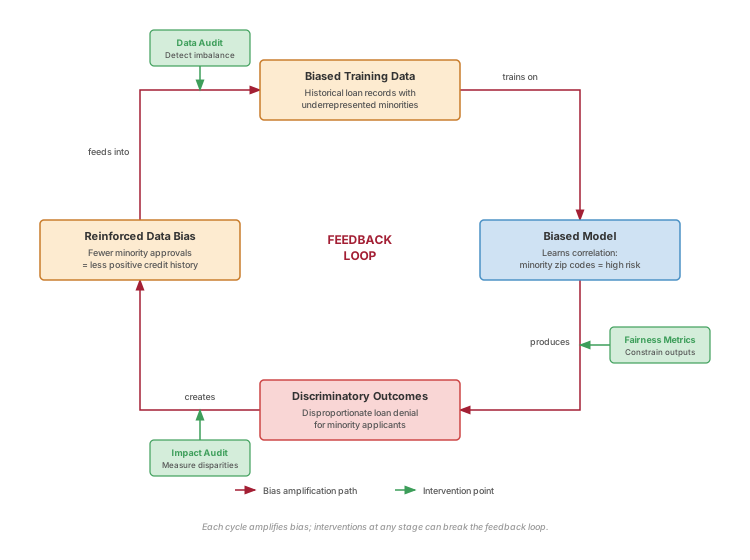
The cycle in Figure 4 reveals why post-hoc fairness audits are insufficient: without intervention at each of the four stages (data, model, predictions, and retraining), each iteration compounds the bias introduced by the previous one, turning a small initial skew into a systematic disparity.
Fairness, like other responsible AI principles, is not confined to model parameters or training scripts. It emerges from a series of decisions across the full system lifecycle: data acquisition, model design, policy thresholds, retraining infrastructure, and user feedback handling. Treating fairness as a system-level constraint, particularly in constrained or decentralized deployments, requires anticipating where tradeoffs may arise and ensuring that fairness objectives are embedded into architecture, decision rules, and lifecycle management from the outset.
The deployment challenges faced by fairness extend to privacy architectures, where similar tensions arise between centralized control and distributed constraints.
Privacy architectures
Privacy in machine learning systems extends the pattern observed with fairness: it is not confined to protecting individual records; it is shaped by how data is collected, stored, transmitted, and integrated into system behavior. These decisions are tightly coupled to deployment architecture. System-level privacy constraints vary widely depending on whether a model is hosted in the cloud, embedded on-device, or distributed across user-controlled environments, each presenting different challenges for minimizing risk while maintaining functionality.
A key architectural distinction is between centralized and decentralized data handling. Centralized cloud systems typically aggregate data at scale, enabling high-capacity modeling and monitoring. However, this aggregation increases exposure to breaches and surveillance, making strong encryption, access control, and auditability important. In decentralized deployments, including mobile applications, federated learning clients, and TinyML systems, data remains local, reducing central risk but limiting global observability. These environments often prevent developers from accessing the demographic or behavioral statistics needed to monitor system performance or enforce compliance, requiring privacy safeguards to be embedded during development.
Privacy challenges are especially pronounced in systems that personalize behavior over time. Applications such as smart keyboards, fitness trackers, or voice assistants continuously adapt to users by processing sensitive signals like location, typing patterns, or health metrics. Even when raw data is discarded, trained models may retain user specific patterns that can be recovered via inference time queries. In architectures where memory is persistent and interaction is frequent, managing long-term privacy requires tight integration of protective mechanisms into the model lifecycle.
Connectivity assumptions further shape privacy design. Cloud-connected systems allow centralized enforcement of encryption protocols and remote deletion policies, but may introduce latency, energy overhead, or increased exposure during data transmission. In contrast, edge systems typically operate offline or intermittently, making privacy enforcement dependent on architectural constraints such as feature minimization, local data retention, and compile-time obfuscation. On TinyML devices, which often lack persistent storage or update channels, privacy must be engineered into the static firmware and model binaries, leaving no opportunity for post-deployment adjustment.
Privacy risks also extend to the serving and monitoring layers. A model with logging allowed, or one that updates through active learning, may inadvertently expose sensitive information if logging infrastructure is not privacy-aware. For example, membership inference attacks can reveal whether a users data was included in training by analyzing model outputs. Defending against such attacks requires that privacy-preserving measures extend beyond training and into interface design, rate limiting, and access control.
Privacy is not determined solely by technical mechanisms but by how users experience the system. A model may meet formal privacy definitions and still violate user expectations if data collection is opaque or explanations are lacking. Interface design plays a central role: systems must clearly communicate what data is collected, how it is used, and how users can opt out or revoke consent. In privacy-sensitive applications, failure to align with user norms can erode trust even in technically compliant systems.
Architectural decisions thus influence privacy at every stage of the data lifecycle, from acquisition and preprocessing to inference and monitoring. Designing for privacy involves not only choosing secure algorithms, but also making principled tradeoffs based on deployment constraints, user needs, and legal obligations. In high-resource settings, this may involve centralized enforcement and policy tooling. In constrained environments, privacy must be embedded statically in model design and system behavior, often without the possibility of dynamic oversight.
Privacy is not a feature to be appended after deployment. It is a system-level property that must be planned, implemented, and validated in concert with the architectural realities of the deployment environment.
Complementing privacy’s focus on data protection, safety and robustness architectures ensure systems behave predictably even when privacy mechanisms cannot prevent all risks. While privacy prevents unauthorized data exposure, safety ensures that system outputs remain reliable and aligned with human expectations under stress.
Safety and robustness
The implementation of safety and robustness in machine learning systems is closely shaped by deployment architecture. Systems deployed in dynamic, unpredictable environments, including autonomous vehicles, healthcare robotics, and smart infrastructure, must manage real-time uncertainty and mitigate the risk of high-impact failures. Others, such as embedded controllers or on-device ML systems, require stable and predictable operation under resource constraints, limited observability, and restricted opportunities for recovery. In all cases, safety and robustness are system-level properties that depend not only on model quality, but on how failures are detected, contained, and managed in deployment.
One recurring challenge is distribution shift: when conditions at deployment diverge from those encountered during training. Even modest shifts in input characteristics, including lighting, sensor noise, or environmental variability, can significantly degrade performance if uncertainty is not modeled or monitored. In architectures lacking runtime monitoring or fallback mechanisms, such degradation may go undetected until failure occurs. Systems intended for real-world variability must be architected to recognize when inputs fall outside expected distributions and to either recalibrate or defer decisions accordingly.
Adversarial robustness introduces an additional set of architectural considerations. In systems that make security-sensitive decisions, including fraud detection, content moderation, and biometric verification, adversarial inputs can compromise reliability. Mitigating these threats may involve both model-level defenses (for example, adversarial training, input filtering) and deployment-level strategies, such as API19 access control, rate limiting, or redundancy in input validation. These protections often impose latency and complexity tradeoffs that must be carefully balanced against real-time performance requirements.
19 API Security for ML: ML serving endpoints face attacks absent from traditional APIs: model extraction (reconstructing model weights through 10,000–100,000 targeted queries) and adversarial input injection. Rate limiting (100–1,000 requests/second per user) and input validation defend against extraction, but the fundamental trade-off is that making models more accessible for legitimate explainability simultaneously increases the attack surface for model theft and adversarial probing.
20 Abstention: The practice of refusing predictions when confidence falls below a threshold, reducing error rates by 40–70 percent at the cost of 10–30 percent coverage loss. The systems design challenge: abstention requires fallback infrastructure (human reviewers, rule-based defaults, or escalation queues) that must handle the abstained fraction within the same latency budget. Autonomous vehicles hand control to human drivers; medical AI routes ambiguous cases to specialist review – both requiring the routing logic to execute faster than the model itself.
Latency sensitive deployments further constrain robustness strategies. In autonomous navigation, real time monitoring, or control systems, decisions must be made within strict temporal budgets. Heavyweight robustness mechanisms may be infeasible, and fallback actions must be defined in advance. Many such systems rely on confidence thresholds, abstention20 logic, or rule based overrides to reduce risk. For example, a delivery robot may proceed only when pedestrian detection confidence is high enough; otherwise, it pauses or defers to human oversight. These control strategies often reside outside the learned model, but must be tightly integrated into the systems safety logic.
TinyML deployments introduce additional constraints. Deployed on microcontrollers with minimal memory, no operating system, and no connectivity, these systems cannot rely on runtime monitoring or remote updates. Safety and robustness must be engineered statically through conservative design, extensive predeployment testing, and the use of models that are inherently simple and predictable. Once deployed, the system must operate reliably under conditions such as sensor degradation, power fluctuations, or environmental variation without external intervention or dynamic correction.
Across all deployment contexts, monitoring and escalation mechanisms are important for sustaining robust behavior over time. In cloud or high-resource settings, systems may include uncertainty estimators, distributional change detectors, or human-in-the-loop feedback loops to detect failure conditions and trigger recovery. In more constrained settings, these mechanisms must be simplified or precomputed, but the principle remains: robustness is not achieved once, but maintained through the ongoing ability to recognize and respond to emerging risks.
Safety and robustness must be treated as emergent system properties. They depend on how inputs are sensed and verified, how outputs are acted upon, how failure conditions are recognized, and how corrective measures are initiated. A robust system is not one that avoids all errors, but one that fails visibly, controllably, and safely. In safety-important applications, designing for this behavior is not optional; it is a foundational requirement.
These safety and robustness considerations lead to questions of governance and accountability, which must also adapt to deployment constraints.
Governance structures
Accountability in machine learning systems must be realized through concrete architectural choices, interface designs, and operational procedures. Governance structures make responsibility actionable by defining who is accountable for system outcomes, under what conditions, and through what mechanisms. These structures are deeply influenced by deployment architecture. The degree to which accountability can be traced, audited, and enforced varies across centralized, mobile, edge, and embedded environments, each posing distinct challenges for maintaining system oversight and integrity.
In centralized systems, such as cloud-hosted platforms, governance is typically supported by robust infrastructure for logging, version control, and real-time monitoring. Model registries, telemetry21 dashboards, and structured event pipelines allow teams to trace predictions to specific models, data inputs, or configuration states.
21 Telemetry in ML Systems: Real-time capture of prediction latencies, accuracy, and resource utilization across deployed models. Alerts typically trigger when accuracy drops more than 5 percent or latency exceeds 200 ms. The accountability challenge emerges at fleet scale: a system serving hundreds of models to diverse users generates millions of telemetry events daily, and tracing a specific harmful prediction back to a root cause (data drift, model regression, or threshold misconfiguration) requires end-to-end lineage infrastructure that most organizations lack.
In contrast, edge deployments distribute intelligence to devices that may operate independently from centralized infrastructure. Embedded models in vehicles, factories, or homes must support localized mechanisms for detecting abnormal behavior, triggering alerts, and escalating issues. For example, an industrial sensor might flag anomalies when its prediction confidence drops, initiating a predefined escalation process. Designing for such autonomy requires forethought: engineers must determine what signals to capture, how to store them locally, and how to reassign responsibility when connectivity is intermittent or delayed.
Mobile deployments, such as personal finance apps or digital health tools, exist at the intersection of user interfaces and backend systems. When something goes wrong, it is often unclear whether the issue lies with a local model, a remote service, or the broader design of the user interaction. Governance in these settings must account for this ambiguity. Effective accountability requires clear documentation, accessible recourse pathways, and mechanisms for surfacing, explaining, and contesting automated decisions at the user level. The ability to understand and appeal outcomes must be embedded into both the interface and the surrounding service architecture.
In TinyML deployments, governance is especially constrained. Devices may lack connectivity, persistent storage, or runtime configurability, limiting opportunities for dynamic oversight or intervention. Here, accountability must be embedded statically through mechanisms such as cryptographic firmware signatures, fixed audit trails, and predeployment documentation of training data and model parameters. In some cases, governance must be enforced during manufacturing or provisioning, since no post-deployment correction is possible. These constraints make the design of governance structures inseparable from early-stage architectural decisions.
Interfaces also play a critical role in enabling accountability. Systems that surface explanations, expose uncertainty estimates, or allow users to query decision histories make it possible for developers, auditors, or users to understand both what occurred and why. By contrast, opaque APIs, undocumented thresholds, or closed-loop decision systems inhibit oversight. Effective governance requires that information flows be aligned with stakeholder needs, including technical, regulatory, and user-facing aspects, so that failure modes are observable and remediable.
Governance approaches must also adapt to domain-specific risks and institutional norms. High-stakes applications, such as healthcare or criminal justice, often involve legally mandated impact assessments and audit trails. Lower-risk domains may rely more heavily on internal practices, shaped by customer expectations, reputational concerns, or technical conventions. Regardless of the setting, governance must be treated as a system-level design property, not an external policy overlay. It is implemented through the structure of codebases, deployment pipelines, data flows, and decision interfaces.
Sustaining accountability across diverse deployment environments requires planning not only for success, but for failure. This includes defining how anomalies are detected, how roles are assigned, how records are maintained, and how remediation occurs. These processes must be embedded in infrastructure: traceable in logs, enforceable through interfaces, and resilient to the architectural constraints of the systems deployment context.
Responsible AI governance increasingly must account for the environmental and distributional impacts of computational infrastructure choices. Organizations deploying AI systems bear responsibility not only for algorithmic outcomes but for the broader systemic impacts of their resource usage patterns on environmental justice and equitable access, as discussed in the context of resource requirements and equity implications.
Design tradeoffs
The governance challenges examined across different deployment contexts reveal a fundamental truth: deployment environments impose fundamental constraints that create tradeoffs in responsible AI implementation. Machine learning systems do not operate in idealized silos; they must navigate competing objectives under finite resources, strict latency requirements, evolving user behavior, and regulatory complexity.
Cloud-based systems often support extensive monitoring, fairness audits, interpretability services, and privacy-preserving tools due to ample computational and storage resources. However, these benefits typically come with centralized data handling, which introduces risks related to surveillance, data breaches, and complex governance. In contrast, on-device systems such as mobile applications, edge platforms, or TinyML deployments provide stronger data locality and user control, but limit post-deployment visibility, fairness instrumentation, and model adaptation.
Tensions between goals often become apparent at the architectural level. For example, systems with real-time response requirements, such as wearable gesture recognition or autonomous braking, cannot afford to compute detailed interpretability explanations during inference. Designers must choose whether to precompute simplified outputs, defer explanation to asynchronous analysis, or omit interpretability altogether in runtime settings.
Conflicts also emerge between personalization and fairness. Systems that adapt to individuals based on local usage data often lack the global context necessary to assess disparities across population subgroups. Ensuring that personalized predictions do not result in systematic exclusion requires careful architectural design, balancing user-level adaptation with mechanisms for group-level equity and auditability.
Privacy and robustness objectives can also conflict. Robust systems often benefit from logging rare events or user outliers to improve reliability. However, recording such data may conflict with privacy goals or violate legal constraints on data minimization. In settings where sensitive behavior must remain local or encrypted, robustness must be designed into the model architecture and training procedure in advance, since post hoc refinement may not be feasible.
The computational demands of responsible AI create tensions that extend beyond technical optimization to questions of environmental justice and equitable access. Energy-efficient deployment often requires simplified models with reduced fairness monitoring capabilities, creating a tradeoff between environmental sustainability and ethical safeguards. For example, implementing differential privacy in federated learning can increase per-device energy consumption by 25–40 percent, potentially making such privacy protections prohibitive for battery-constrained devices22.
22 Energy-Privacy Trade-off: Privacy-preserving techniques like differential privacy and secure multi-party computation increase computational energy requirements by 20–60 percent. In federated learning on mobile devices, this translates to 15–30 percent faster battery drain. The equity implication: users with older devices or limited battery life are effectively excluded from privacy-protected AI services, creating a system where privacy protection becomes contingent on hardware resources – the populations most vulnerable to data exploitation are least able to afford the compute cost of protecting themselves.
These examples illustrate a broader systems-level challenge. Responsible AI principles cannot be considered in isolation. They interact, and optimizing for one may constrain another. The appropriate balance depends on deployment architecture, stakeholder priorities, domain-specific risks, the consequences of error, and increasingly, the environmental and distributional impacts of computational resource requirements.
What distinguishes responsible machine learning design is not the elimination of tradeoffs, but the clarity and deliberateness with which they are navigated. Design decisions must be made transparently, with a full understanding of the limitations imposed by the deployment environment and the impacts of those decisions on system behavior.
Table 2 synthesizes these architectural tensions by comparing how responsible AI principles manifest across cloud, mobile, edge, and TinyML systems. Each setting imposes different constraints on explainability, fairness, privacy, safety, and accountability, based on factors such as compute capacity, connectivity, data access, and governance feasibility.
No deployment context dominates across all principles; each makes different compromises. As Table 2 reveals, cloud systems support complex explainability methods (SHAP, LIME) and centralized fairness monitoring but introduce privacy risks through data aggregation. Edge and mobile deployments offer stronger data locality but limit post-deployment observability and global fairness assessment. TinyML systems face the most severe constraints, requiring static validation and compile-time privacy guarantees with no opportunity for runtime adjustment. These constraints are not merely technical limitations but shape which responsible AI features are accessible to different users and applications, creating equity implications where only well-resourced deployments can afford comprehensive safeguards. Understanding these deployment constraints provides necessary context for the technical methods that operationalize responsible AI principles in practice.
| Principle | Cloud ML | Edge ML | Mobile ML | TinyML |
|---|---|---|---|---|
| Explainability | Supports complex models and methods like SHAP and sampling approaches | Needs lightweight, low-latency methods like saliency maps | Requires interpretable outputs for users, often defers deeper analysis to the cloud | Severely limited due to constrained hardware; mostly static or compile-time only |
| Fairness | Large datasets allow bias detection and mitigation | Localized biases harder to detect but allows on-device adjustments | High personalization complicates group-level fairness tracking | Minimal data limits bias analysis and mitigation |
| Privacy | Centralized data at risk of breaches but can use strong encryption and differential privacy methods | Sensitive personal data on-device requires on-device protections | Tight coupling to user identity requires consent-aware design and local processing | Distributed data reduces centralized risks but poses challenges for anonymization |
| Safety | Vulnerable to hacking and large-scale attacks | Real-world interactions make reliability important | Operates under user supervision, but still requires graceful failure | Needs distributed safety mechanisms due to autonomy |
| Accountability | Corporate policies and audits allow traceability and oversight | Fragmented supply chains complicate accountability | Requires clear user-facing disclosures and feedback paths | Traceability required across long, complex hardware chains |
| Governance | External oversight and regulations like GDPR or CCPA are feasible | Requires self-governance by developers and integrators | Balances platform policy with app developer choices | Relies on built-in protocols and cryptographic assurances |
The deployment analysis above revealed a critical insight: which responsible AI techniques are feasible depends entirely on architectural constraints. A TinyML device cannot run SHAP explanations; an edge system cannot implement real-time fairness monitoring; a mobile application cannot store the audit logs required for comprehensive accountability. Understanding these constraints before examining technical methods positions us to evaluate each approach for deployability, not merely effectiveness, across the contexts we have characterized.
Responsible machine learning requires technical methods that translate ethical principles into concrete system behaviors. These methods address practical challenges: detecting bias, preserving privacy, ensuring robustness, and providing interpretability. Success depends on how well these techniques work within real system constraints including data quality, computational resources, and deployment requirements.
Understanding why these methods are necessary begins with recognizing how machine learning systems can develop problematic behaviors. Models learn patterns from training data, including historical biases and unfair associations. For example, a hiring algorithm trained on biased historical data will learn to replicate discriminatory patterns, associating certain demographic characteristics with success.
This happens because machine learning models learn correlations rather than understanding causation. They identify statistical patterns that may reflect unfair social structures instead of meaningful relationships. This systematic bias favors groups that were historically advantaged in the training data.
Addressing these issues requires more than simple corrections after training. Traditional machine learning optimizes only for accuracy, creating tension with fairness goals. Effective solutions must integrate fairness considerations directly into the learning process rather than treating them as secondary concerns.
Each technical approach involves specific tradeoffs between accuracy, computational cost, and implementation complexity. These methods are not universally applicable and must be chosen based on system requirements and constraints. Framework selection affects which responsible AI techniques can be practically implemented.
The practical techniques for implementing responsible AI principles each serve specific purposes within the system and come with particular requirements and performance impacts. These tools work together to create trustworthy machine learning systems.
The technical approaches to responsible AI can be organized into three complementary categories. Detection methods identify when systems exhibit problematic behaviors, providing early warning systems for bias, drift, and performance issues. Mitigation techniques actively prevent harmful outcomes through algorithmic interventions and robustness enhancements. Validation approaches provide mechanisms for understanding and explaining system behavior to stakeholders who evaluate automated decisions.
Computational overhead of responsible AI techniques
Implementing responsible AI principles incurs quantifiable computational costs that must be considered during system design. Table 3 quantifies these performance impacts, enabling engineers to make informed decisions about which techniques to implement based on available computational resources and quality requirements.
| Technique | Accuracy Impact | Training Overhead | Inference Cost | Memory Overhead |
|---|---|---|---|---|
| Differential Privacy | -2 percent to -5 percent | +15 percent to +30 percent | Minimal | +10 percent to +20 percent |
| (DP-SGD) | ||||
| Fairness-Aware Training | -1 percent to -3 percent | +5 percent to +15 percent | Minimal | +5 percent to +10 percent |
| (Reweighting/Constraints) | ||||
| SHAP Explanations | N/A | N/A | +50 percent to +200 percent | +20 percent to +100 percent |
| Adversarial Training | +2 percent to +5 percent | +100 percent to +300 percent | Minimal | +50 percent to +100 percent |
| Federated Learning | -5 percent to -15 percent | +200 percent to +500 percent | Minimal | +100 percent to +300 percent |
These overhead ranges reflect typical performance across published benchmarks and production systems.23 Actual overhead varies significantly based on model architecture, dataset size, and implementation quality. For example, SHAP on linear models adds approximately 10 ms, while SHAP on deep ensembles can add over 1000 ms. Adversarial training overhead depends on attack strength: PGD-7 adds roughly 150 percent overhead, while PGD-50 adds approximately 300 percent. Federated learning overhead is dominated by communication rounds and client heterogeneity.
23 Measurement Context: Overhead figures assume 8\(\times\) A100 GPUs for training, T4 GPU or 8-core CPU for inference, standard models (ResNet-50, BERT-Base, XGBoost), and common datasets (ImageNet, GLUE, UCI Adult/COMPAS). These represent production-optimized implementations; research prototypes typically show 2–3\(\times\) higher overhead. Actual costs vary significantly with model architecture, dataset size, and implementation maturity.
These computational costs create significant equity considerations examined in multiple contexts. Organizations with limited resources may be unable to implement responsible AI techniques, potentially creating disparate access to ethical AI protections, a theme that emerges repeatedly in deployment contexts, implementation challenges, and organizational barriers.
Detection methods form the foundation for all other responsible AI interventions.
Because these computational costs and architectural constraints heavily influence system design, engineering teams must carefully select the right tools for their specific deployment reality. Regardless of the environment, however, the first step in taking corrective action is knowing that a problem exists, which requires deploying robust, automated bias detection and fairness monitoring.
Self-Check: Question
Which deployment context is most likely to support complex explainability methods like SHAP and LIME?
- Edge systems
- Cloud systems
- Mobile systems
- TinyML systems
True or False: TinyML systems can easily implement runtime fairness monitoring due to their localized data processing.
Explain how privacy concerns differ between centralized cloud systems and decentralized edge deployments.
The practice of having models refuse to make predictions when confidence is below a threshold is known as ____. This is critical for safety-critical systems.
Order the following deployment contexts by their typical ability to support real-time explainability from highest to lowest: (1) Cloud systems, (2) Mobile systems, (3) TinyML systems.
Bias Detection and Fairness Monitoring
A credit scoring model deployed nationally begins rejecting qualified applicants from a specific zip code at twice the normal rate. Without bias detection infrastructure, the disparity persists for weeks or months before anyone notices. Bias detection transforms theoretical fairness definitions into live, operational telemetry. Just as a Site Reliability Engineer monitors latency dashboards, a Responsible AI engineer monitors demographic parity dashboards, using slice-based analysis to identify when the model begins failing specific subpopulations.
Napkin Math 1.2: The Fairness-Efficiency Frontier
Problem: You are optimizing a hiring model. The “Unconstrained” model reaches 92% accuracy but exhibits a 15 percent disparity between demographic groups. You apply a Fairness Constraint (Demographic Parity) to eliminate the disparity. What is the “Bias Tax” on your model’s performance?
The Math: Enforcing group-level parity often requires shifting decision thresholds away from the global mathematical optimum.
- Base Accuracy: 92%.
- Fairness-Constrained Accuracy: 89.5%.
- The Bias Tax: 92% - 89.5% = 2.5%.
The Systems Insight: Fairness is an Optimization Constraint. Achieving social parity often costs 2.5% in accuracy. In the Machine Learning Fleet, this is not a “failure” of the model; it is the Price of Governance. A model that is 92 percent accurate but structurally biased is not “better” than a 89.5 percent accurate model that is fair—it is simply incomplete. Responsible engineering means choosing the operating point on the Fairness-Efficiency Frontier that aligns with societal values, even if it leaves some technical performance on the table.
Bias detection and mitigation
The fairness definitions examined in Section 1.2.3 provide mathematical precision for what fairness means: demographic parity, equalized odds, and equality of opportunity are now precisely defined. Practitioners, however, face a practical challenge: how do you actually compute these metrics on production systems processing thousands of predictions per second? Manual calculation using the formulas above is infeasible at scale. This gap between definition and deployment motivates specialized tooling.
Operationalizing fairness in deployed systems requires more than principled objectives or theoretical metrics; it demands system-aware methods that detect, measure, and mitigate bias across the machine learning lifecycle. Practical bias detection can be implemented using tools like Fairlearn24 (Bird et al. 2020):
24 Fairlearn: Microsoft’s open-source toolkit (2020) for computing fairness metrics and applying mitigation algorithms to scikit-learn compatible models. The systems integration pattern: Fairlearn wraps existing estimators with constraint-based training (10–30 percent additional training time) or post-processing threshold adjustment (5–15 percent inference latency for monitoring). The practical significance is that fairness monitoring becomes a CI/CD pipeline stage rather than an ad hoc audit, enabling automated regression detection when model updates degrade subgroup performance.
Bird, Sarah, Miroslav Dudík, Richard Edgar, et al. 2020. “Fairlearn: A Toolkit for Assessing and Improving Fairness in AI.” Microsoft Journal of Applied Research 13 (May): 4–10.https://www.microsoft.com/en-us/research/publication/fairlearn-a-toolkit-for-assessing-and-improving-fairness-in-ai/ .
Listing 1 enables fairness tracking across demographic groups during deployment, revealing concerning disparities where loan approval rates vary dramatically by ethnicity: from 94 percent for Asian applicants to 68 percent for Black applicants. Building on the system-level constraints discussed earlier, fairness must be treated as an architectural consideration that intersects with data engineering, model training, inference design, monitoring infrastructure, and policy governance. While fairness metrics such as demographic parity, equalized odds, and equality of opportunity formalize different normative goals, their realization depends on the architecture’s ability to measure subgroup performance, support adaptive decision boundaries, and store or surface group-specific metadata during runtime.
from fairlearn.metrics import MetricFrame
from sklearn.metrics import accuracy_score, precision_score

# Loan approval model evaluation across demographic groups
mf = MetricFrame(
    metrics={
        "approval_rate": accuracy_score,
        "precision": precision_score,
        "false_positive_rate": lambda y_true, y_pred: (
            (y_pred == 1) & (y_true == 0)
        ).sum()
        / (y_true == 0).sum(),
    },
    y_true=loan_approvals_actual,
    y_pred=loan_approvals_predicted,
    sensitive_features=applicant_demographics["ethnicity"],
)

# Display performance disparities across ethnic groups
print("Loan Approval Performance by Ethnic Group:")
print(mf.by_group)
# Output shows: Asian: 94% approval, White: 91% approval,
# Hispanic: 73% approval, Black: 68% approval
Practical implementation is often shaped by limitations in data access and system instrumentation. In many real-world environments, especially in mobile, federated, or embedded systems, sensitive attributes such as gender, age, or race may not be available at inference time, making it difficult to track or audit model performance across demographic groups. Data collection and labeling strategies are essential for fairness assessment throughout the model lifecycle. In such contexts, fairness interventions must occur upstream during data curation or training, as post-deployment recalibration may not be feasible. Even when data is available, continuous retraining pipelines that incorporate user feedback can reinforce existing disparities unless explicitly monitored for fairness degradation. For example, an on-device recommendation model that adapts to user behavior may amplify prior biases if it lacks the infrastructure to detect demographic imbalances in user interactions or outputs.
Figure 5 illustrates how fairness constraints can introduce tension with deployment choices. In a binary loan approval system, two subgroups, Subgroup A (represented in blue) and Subgroup B (represented in red), require different decision thresholds to achieve equal true positive rates. Using a single threshold across groups leads to disparate outcomes, potentially disadvantaging Subgroup B. Addressing this imbalance by adjusting thresholds per group may improve fairness, but doing so requires support for conditional logic in the model serving stack, access to sensitive attributes at inference time, and a governance framework for explaining and justifying differential treatment across groups.

Fairness interventions may be applied at different points in the pipeline, but each comes with system-level implications. Preprocessing methods, which rebalance training data through sampling, reweighting, or augmentation, require access to raw features and group labels, often through a feature store or data lake that preserves lineage. These methods are well-suited to systems with centralized training pipelines and high-quality labeled data. In contrast, in-processing approaches embed fairness constraints directly into the optimization objective. These require training infrastructure that can support custom loss functions or constrained solvers and may demand longer training cycles or additional regularization validation. Training techniques and optimization methods, including custom loss functions and constrained optimization, provide the foundation for implementing these fairness-aware training approaches.
Post-processing methods, including the application of group-specific thresholds or the adjustment of scores to equalize outcomes, require inference systems that can condition on sensitive attributes or reference external policy rules. This demands coordination between model serving infrastructure, access control policies, and logging pipelines to ensure that differential treatment is both auditable and legally defensible. Model serving architectures, including request routing, feature lookup, and conditional inference paths, detail the infrastructure requirements for implementing such conditional logic in production systems. Any post-processing strategy must be carefully validated to ensure that it does not compromise user experience, model stability, or compliance with jurisdictional regulations on attribute use.
Scalable fairness enforcement often requires more advanced strategies, such as multicalibration25, which ensures that model predictions remain calibrated across a wide range of intersecting subgroups (Hébert-Johnson et al. 2018).
25 Multicalibration: Developed by Hebert-Johnson et al. in 2018, this technique ensures calibrated predictions across exponentially many intersecting subgroups simultaneously, addressing the failure mode where global calibration masks severe miscalibration for minority intersections. The compute cost is 10–100\(\times\) higher than simple threshold tuning, but the technique handles thousands of overlapping groups, making it the only scalable approach for platforms serving diverse populations where single-axis fairness audits miss compounded disparities.
Hébert-Johnson, Úrsula, Michael P. Kim, Omer Reingold, and Guy N. Rothblum. 2018. “Multicalibration: Calibration for the (Computationally-Identifiable) Masses.” In Proceedings of the 35th International Conference on Machine Learning, ICML 2018, Stockholmsmässan, Stockholm, Sweden, July 10-15, 2018, edited by Jennifer G. Dy and Andreas Krause, vol. 80. Proceedings of Machine Learning Research. PMLR. http://proceedings.mlr.press/v80/hebert-johnson18a.html.
Implementing multicalibration at scale requires infrastructure for dynamically generating subgroup partitions, computing per-group calibration error, and integrating fairness audits into automated monitoring systems. These capabilities are typically only available in large-scale, cloud-based deployments with mature observability and metrics pipelines. In constrained environments such as embedded or TinyML systems, where telemetry is limited and model logic is fixed, such techniques are not feasible and fairness must be validated entirely at design time.
Across deployment environments, maintaining fairness requires lifecycle-aware mechanisms. Model updates, feedback loops, and interface designs all affect how fairness evolves over time. A fairness-aware model may degrade if retraining pipelines do not include fairness checks, if logging systems cannot track subgroup outcomes, or if user feedback introduces subtle biases not captured by training distributions. Monitoring systems must be equipped to surface fairness regressions, and retraining protocols must have access to subgroup-labeled validation data, which may require data governance policies and ethical review. Implementation of these monitoring systems requires production infrastructure for MLOps practices, while privacy-preserving techniques are essential for federated fairness assessment.
Fairness is not a one-time optimization, nor is it a property of the model in isolation. It emerges from coordinated decisions across data acquisition, feature engineering, model design, thresholding, feedback handling, and system monitoring. Embedding fairness into machine learning systems requires architectural foresight, operational discipline, and tooling that spans the full deployment stack, from training workflows to serving infrastructure to user-facing interfaces.
The sociotechnical implications of bias detection extend far beyond technical measurement. When fairness metrics identify disparities, organizations must navigate complex stakeholder deliberation processes as examined in Section 1.7.3. These decisions involve competing stakeholder interests, legal compliance requirements, and value trade-offs that cannot be resolved through technical means alone.
Real-time fairness monitoring architecture
Implementing responsible AI principles in production systems requires architectural patterns that integrate fairness monitoring, explainability, and privacy controls directly into the model serving infrastructure. Figure 6 demonstrates how these responsible AI components integrate with existing ML systems infrastructure, showing the data flow from user requests through anonymization, model inference, fairness monitoring, and explanation generation.

This architecture addresses the production realities identified by experts through several key components that work together to implement responsible AI at scale:
The data anonymization layer implements privacy-preserving transformations before model inference, using techniques like k-anonymity26 or differential privacy noise injection. This component adds 2–5 ms latency per request but provides formal privacy guarantees. Memory overhead is typically 15–25 percent due to encryption and noise generation requirements.
26 k-Anonymity: A privacy guarantee (Sweeney, 2002) ensuring each record is indistinguishable from at least \(k-1\) others by generalizing quasi-identifiers (for example, replacing exact ages with ranges, locations with regions). The systems trade-off: achieving \(k\)-anonymity reduces data utility by 10–30 percent through information loss, and higher \(k\) values provide stronger privacy but degrade the training signal further. For ML preprocessing pipelines, \(k\)-anonymity adds a transformation stage that must balance privacy guarantees against the accuracy impact of coarser features.
Real-time fairness monitoring tracks demographic parity and equalized odds metrics for each prediction, maintaining rolling statistics across protected groups. The system flags disparities exceeding configurable thresholds (for example, >5 percent difference in approval rates). This monitoring adds 10–20 ms latency and requires 100–500 MB additional memory for metric storage and computation.
The explanation engine generates SHAP or LIME explanations for model decisions, particularly for negative outcomes requiring user recourse. Fast approximation methods reduce explanation latency from 200–500 ms (full SHAP) to 20–50 ms (streaming SHAP) with 90 percent fidelity. Memory requirements increase by 50–100 percent due to gradient computation and feature importance caching. The following implementation deep dive demonstrates these components in code.
TipImplementation Deep Dive
The following code example demonstrates production-ready fairness monitoring with real-time bias detection. This represents a reference implementation showing architectural patterns rather than code to memorize. Focus on understanding: (1) how fairness metrics integrate into serving infrastructure, (2) what performance trade-offs the implementation manages, (3) how alerts trigger when thresholds are exceeded. You can return to implementation details when building similar systems.
Listing 2 integrates these components into a real-time monitoring system that processes inference requests, computes rolling fairness metrics across protected groups, and triggers alerts when demographic parity or equalized odds disparities exceed configurable thresholds:
import asyncio
from dataclasses import dataclass
from typing import Dict, List, Optional
import numpy as np
from sklearn.metrics import confusion_matrix


@dataclass
class FairnessMetrics:
    demographic_parity_diff: float
    equalized_odds_diff: float
    equality_opportunity_diff: float
    group_counts: Dict[str, int]


class RealTimeFairnessMonitor:
    def __init__(
        self, window_size: int = 1000, alert_threshold: float = 0.05
    ):
        self.window_size = window_size
        self.alert_threshold = alert_threshold
        self.predictions_buffer = []
        self.demographics_buffer = []
        # For actual outcomes when available
        self.labels_buffer = []

    async def process_prediction(
        self,
        prediction: int,
        demographics: Dict[str, str],
        actual_label: Optional[int] = None,
    ) -> FairnessMetrics:
        """Process single prediction and update fairness metrics"""
        # Store in rolling window buffer
        self.predictions_buffer.append(prediction)
        self.demographics_buffer.append(demographics)
        if actual_label is not None:
            self.labels_buffer.append(actual_label)

        # Maintain window size
        if len(self.predictions_buffer) > self.window_size:
            self.predictions_buffer.pop(0)
            self.demographics_buffer.pop(0)
            if self.labels_buffer:
                self.labels_buffer.pop(0)

        # Compute fairness metrics
        metrics = self._compute_fairness_metrics()

        # Check for bias alerts
        if (
            metrics.demographic_parity_diff > self.alert_threshold
            or metrics.equalized_odds_diff > self.alert_threshold
        ):
            await self._trigger_bias_alert(metrics)

        return metrics

    def _compute_fairness_metrics(self) -> FairnessMetrics:
        """Compute demographic parity and equalized odds"""
        """across groups"""
        if len(self.predictions_buffer) < 100:  # Minimum sample size
            return FairnessMetrics(0.0, 0.0, 0.0, {})

        # Group predictions by protected attribute
        groups = {}
        for i, demo in enumerate(self.demographics_buffer):
            group = demo.get("ethnicity", "unknown")
            if group not in groups:
                groups[group] = {"predictions": [], "labels": []}
            groups[group]["predictions"].append(
                self.predictions_buffer[i]
            )
            if i < len(self.labels_buffer):
                groups[group]["labels"].append(self.labels_buffer[i])

        # Compute demographic parity (approval rates)
        approval_rates = {}
        for group, data in groups.items():
            if len(data["predictions"]) > 0:
                approval_rates[group] = np.mean(data["predictions"])

        demo_parity_diff = (
            max(approval_rates.values())
            - min(approval_rates.values())
            if len(approval_rates) > 1
            else 0.0
        )

        # Compute equalized odds (TPR/False Positive Rate
        # differences) if labels available
        eq_odds_diff = 0.0
        eq_opp_diff = 0.0

        if self.labels_buffer and len(groups) > 1:
            tpr_by_group = {}
            fpr_by_group = {}

            for group, data in groups.items():
                if (
                    len(data["labels"]) > 10
                ):  # Minimum for reliable metrics
                    tn, fp, fn, tp = confusion_matrix(
                        data["labels"], data["predictions"]
                    ).ravel()
                    tpr_by_group[group] = (
                        tp / (tp + fn) if (tp + fn) > 0 else 0
                    )
                    fpr_by_group[group] = (
                        fp / (fp + tn) if (fp + tn) > 0 else 0
                    )

            if len(tpr_by_group) > 1:
                eq_odds_diff = max(
                    abs(tpr_by_group[g1] - tpr_by_group[g2])
                    for g1 in tpr_by_group
                    for g2 in tpr_by_group
                )
                eq_opp_diff = max(tpr_by_group.values()) - min(
                    tpr_by_group.values()
                )

        group_counts = {
            group: len(data["predictions"])
            for group, data in groups.items()
        }

        return FairnessMetrics(
            demographic_parity_diff=demo_parity_diff,
            equalized_odds_diff=eq_odds_diff,
            equality_opportunity_diff=eq_opp_diff,
            group_counts=group_counts,
        )

    async def _trigger_bias_alert(self, metrics: FairnessMetrics):
        """Trigger alert when bias threshold exceeded"""
        alert_message = (
            f"BIAS ALERT: Demographic parity difference: "
            f"{metrics.demographic_parity_diff:.3f}, "
        )
        alert_message += (
            f"Equalized odds difference: "
            f"{metrics.equalized_odds_diff:.3f}"
        )

        # Log to audit system
        print(f"[AUDIT] {alert_message}")

        # Could trigger additional actions:
        # - Send alert to monitoring dashboard
        # - Temporarily enable manual review
        # - Trigger model retraining pipeline
        # - Adjust decision thresholds
This production implementation demonstrates how responsible AI principles translate into concrete system architecture with quantifiable performance impacts. The fairness monitoring adds 10–20 ms latency per request and requires 100–500 MB additional memory, while the explanation engine increases response time by 20–50 ms and memory usage by 50–100 percent. These overheads must be balanced against reliability and compliance requirements when designing production systems.
Detection capabilities must be coupled with mitigation techniques that actively prevent harmful outcomes.
Integrating fairness monitoring requires accepting concrete latency tradeoffs: 10–20 ms added to the inference path. Detection alone is insufficient, however. Observation must be paired with active mitigation techniques that address bias and privacy leakage without destroying overall model performance.
Privacy Preservation and Machine Unlearning
When a user invokes the “Right to be Forgotten” under the GDPR, deleting their row from a database is straightforward. Deleting their data from the weights of a neural network that has already trained on it is a fundamentally harder problem: the model cannot “forget” a specific face or credit card number through row deletion. Machine unlearning27 and privacy preservation address this challenge, providing mechanisms to excise specific training data influence from compiled models.
27 Machine Unlearning: First formalized by Cao and Yang in 2015, this is the ability to remove specific training data influence from a model without full retraining. The naive approach (retrain from scratch) costs the same as the original training run. SISA (Sharded, Isolated, Sliced, and Aggregated) training partitions training into independent shards, reducing unlearning to retraining only the affected shard – cutting unlearning time from hours to minutes at the cost of 2–5 percent accuracy degradation. For GDPR-compliant ML systems, unlearning latency becomes a service level agreement (SLA): deletion requests must be honored within defined timeframes.
Privacy preservation
Recall that privacy is a foundational principle of responsible machine learning, with implications that extend across data collection, model behavior, and user interaction. Privacy constraints are shaped not only by ethical and legal obligations, but also by the architectural properties of the system and the context in which it is deployed. Technical methods for privacy preservation aim to prevent data leakage, limit memorization, and uphold user rights such as consent, opt-out, and data deletion, particularly in systems that learn from personalized or sensitive information.
Modern machine learning models, especially large-scale neural networks, are known to memorize individual training examples, including names, locations, or excerpts of private communication (Ippolito et al. 2023). This memorization presents significant risks in privacy-sensitive applications such as smart assistants, wearables, or healthcare platforms, where training data may encode protected or regulated content. For example, a voice assistant that adapts to user speech may inadvertently retain specific phrases, which could later be extracted through carefully designed prompts or queries.
Ippolito, Daphne, Florian Tramer, Milad Nasr, et al. 2023. “Preventing Generation of Verbatim Memorization in Language Models Gives a False Sense of Privacy.” Proceedings of the 16th International Natural Language Generation Conference, 28–53. https://doi.org/10.18653/v1/2023.inlg-main.3.
The memorization risk extends beyond language models. Figure 7 demonstrates that diffusion models trained on image datasets can regenerate visual instances from the training set. Such behavior highlights a more general vulnerability: many contemporary model architectures can internalize and reproduce training data, often without explicit signals or intent, and without easy detection or control.

Models are also susceptible to membership inference attacks, in which adversaries attempt to determine whether a specific datapoint was part of the training set (Shokri et al. 2017). These attacks exploit subtle differences in model behavior between seen and unseen inputs. In high stakes applications such as healthcare or legal prediction, the mere knowledge that an individuals record was used in training may violate privacy expectations or regulatory requirements.
Shokri, Reza, Marco Stronati, Congzheng Song, and Vitaly Shmatikov. 2017. “Membership Inference Attacks Against Machine Learning Models.” 2017 IEEE Symposium on Security and Privacy (SP), May, 3–18. https://doi.org/10.1109/sp.2017.41.
28 Differential Privacy: A mathematical framework (Dwork et al., 2006) guaranteeing that any single training example’s inclusion or exclusion changes model outputs by at most a bounded amount, parameterized by epsilon. DP-SGD implements this by clipping per-example gradients and injecting calibrated Gaussian noise, increasing training time by 15–30 percent and reducing accuracy by 2–5 percent. The privacy budget epsilon quantifies the trade-off: Apple uses epsilon approximately 8 for keyboard predictions (moderate privacy, minimal accuracy loss), while strong guarantees (epsilon = 1) require 3\(\times\) training compute.
Abadi, Martin, Andy Chu, Ian Goodfellow, et al. 2016. “Deep Learning with Differential Privacy.” Proceedings of the 2016 ACM SIGSAC Conference on Computer and Communications Security, CCS ’16, October, 308–18. https://doi.org/10.1145/2976749.2978318.
To mitigate such vulnerabilities, a range of privacy-preserving techniques have been developed. Among the most widely adopted is differential privacy28, which provides formal guarantees that the inclusion or exclusion of a single datapoint has a statistically bounded effect on the models output. Algorithms such as differentially private stochastic gradient descent (DP-SGD) enforce these guarantees by clipping gradients and injecting noise during training (Abadi et al. 2016). When implemented correctly, these methods prevent the model from memorizing individual datapoints and reduce the risk of inference attacks.
However, differential privacy introduces significant system-level tradeoffs. The noise added during training can degrade model accuracy, increase the number of training iterations, and require access to larger datasets to maintain performance. These constraints are especially pronounced in resource-limited deployments such as mobile, edge, or embedded systems, where memory, compute, and power budgets are tightly constrained. In such settings, it may be necessary to combine lightweight privacy techniques (for example, feature obfuscation, local differential privacy) with architectural strategies that limit data collection, shorten retention, or enforce strict access control at the edge.
Napkin Math 1.3: The Price of Privacy
Training a next-word predictor on sensitive messages with DP-SGD (Differentially Private Stochastic Gradient Descent) to prevent data extraction.
The privacy parameter \(\epsilon\) is the privacy budget. Lower \(\epsilon\) means more privacy but more noise.
Strong Privacy (\(\epsilon =\) 1.0): Gradients are heavily clipped (\(C = 1.0\), clipping 40 percent of updates) and noisy (\(\sigma = 1.0\)). The model requires 3\(\times\) more epochs to converge. Training cost jumps from $4.6M to approximately $13.8M. Accuracy drops 6 percent.
Moderate Privacy (\(\epsilon =\) 8.0, Apple’s standard for keyboard predictions): Less noise (\(\sigma = 0.5\)). Training overhead is 30 percent. Accuracy drops 1 percent.
Weak Privacy (\(\epsilon = 10\)): Minimal noise. Less than 1 percent accuracy loss. Limited formal guarantees.
Privacy is not binary. It is a continuous curve where organizations buy user trust with compute dollars and model accuracy. The key engineering decision is allocating the privacy budget across the system lifecycle: how much \(\epsilon\) to spend during training, how much to reserve for post-deployment queries, and how to communicate these tradeoffs to users and regulators.
Privacy enforcement also depends on infrastructure beyond the model itself. Data collection interfaces must support informed consent and transparency. Logging systems must avoid retaining sensitive inputs unless strictly necessary, and must support access controls, expiration policies, and auditability. Model serving infrastructure must be designed to prevent overexposure of outputs that could leak internal model behavior or allow reconstruction of private data. These system-level mechanisms require close coordination between ML engineering, platform security, and organizational governance.
Privacy must be enforced not only during training but throughout the machine learning lifecycle. Retraining pipelines must account for deleted or revoked data, especially in jurisdictions with data deletion mandates. Monitoring infrastructure must avoid recording personally identifiable information in logs or dashboards. Privacy-aware telemetry collection, secure enclave deployment, and per-user audit trails are increasingly used to support these goals, particularly in applications with strict legal oversight.
Architectural decisions also vary by deployment context. Cloud-based systems may rely on centralized enforcement of differential privacy, encryption, and access control, supported by telemetry and retraining infrastructure. In contrast, edge and TinyML systems must build privacy constraints into the deployed model itself, often with no runtime configurability or feedback channel. In such cases, static analysis, conservative design, and embedded privacy guarantees must be implemented at compile time, with validation performed prior to deployment.
Privacy is not an attribute of a model in isolation but a system-level property that emerges from design decisions across the pipeline. Responsible privacy preservation requires that technical safeguards, interface controls, infrastructure policies, and regulatory compliance mechanisms work together to minimize risk throughout the lifecycle of a deployed machine learning system.
Privacy preservation techniques create complex sociotechnical tensions that extend well beyond technical implementation. Differential privacy mechanisms may reduce model accuracy in ways that disproportionately affect underrepresented groups, creating conflicts between privacy and fairness objectives. These challenges require ongoing stakeholder engagement as detailed in Section 1.7.3, where organizations must navigate competing values around data control, personalization, and regulatory compliance.
These privacy challenges become even more complex when considering the dynamic nature of user rights and data governance.
Machine unlearning
The privacy mechanisms examined above protect data during collection and training, but they do not address a temporal problem: when users invoke their legal right to have their data forgotten, models trained on that data retain its influence in their learned parameters. The privacy violation persists even after the raw data is deleted from storage systems. Machine unlearning addresses this temporal dimension of privacy, ensuring that data deletion rights extend beyond databases to the models themselves.
Privacy preservation does not end at training time. In many real-world systems, users must retain the right to revoke consent or request the deletion of their data, even after a model has been trained and deployed. Supporting this requirement introduces a core technical challenge: removing the influence of specific datapoints from a trained model without full retraining, a task that is often infeasible in edge, mobile, or embedded deployments with constrained compute, storage, and connectivity.
Traditional approaches to data deletion assume that the full training dataset remains accessible and that models can be retrained from scratch after removing the targeted records. Figure 8 contrasts traditional model retraining with emerging machine unlearning approaches: while retraining involves reconstructing the model from scratch using a modified dataset, unlearning aims to remove a specific datapoint’s influence without repeating the entire learning process.
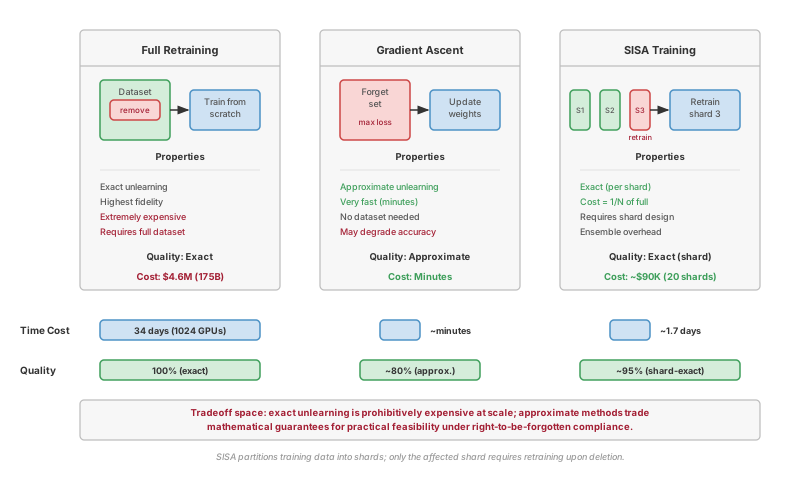
The distinction between retraining and unlearning becomes critical in systems with tight latency, compute, or privacy constraints, because the assumptions underlying full retraining rarely hold in practice. Many deployed machine learning systems do not retain raw training data due to security, compliance, or cost constraints. In such environments, full retraining is often impractical and operationally disruptive, especially when data deletion must be verifiable, repeatable, and audit-ready.
Machine unlearning aims to address this limitation by removing the influence of individual datapoints from an already trained model without retraining it entirely (Cao and Yang 2015). Cao and Yang first formalized this problem in 2015, proposing a general approach that transforms learning algorithms into summation forms, enabling efficient removal of data influence by retraining only the constituent models containing the targeted information rather than the entire model. Current approaches approximate this behavior by adjusting internal parameters, modifying gradient paths, or isolating and pruning components of the model so that the resulting predictions reflect what would have been learned without the deleted data (Bourtoule et al. 2021). These techniques are still maturing and may require simplified model architectures, additional tracking metadata, or compromise on model accuracy and stability. They also introduce new burdens around verification: how to prove that deletion has occurred in a meaningful way, especially when internal model state is not fully interpretable.
Cao, Yinzhi, and Junfeng Yang. 2015. “Towards Making Systems Forget with Machine Unlearning.” 2015 IEEE Symposium on Security and Privacy, May, 463–80. https://doi.org/10.1109/sp.2015.35.
Bourtoule, Lucas, Varun Chandrasekaran, Christopher A. Choquette-Choo, et al. 2021. “Machine Unlearning.” 2021 IEEE Symposium on Security and Privacy (SP), May, 141–59. https://doi.org/10.1109/sp40001.2021.00019.
Napkin Math 1.4: The Cost of Forgetting
A user invokes GDPR Article 17 (“Right to Erasure”) on a model trained on 1 TB of data.
Baseline (Full Retraining): For a 175B-parameter model at GPT-3 scale, retraining requires 1,024 A100 GPUs for approximately 34 days at a cost of roughly $4.6 million.
The Engineering Fix (SISA): Sharded, Isolated, Sliced, and Aggregated training partitions data into \(K =\) 100 independent shards, training 100 sub-models. To delete one datum, retrain only the specific shard containing it (1 percent of data). New cost: $46{,}000. Time: approximately 8 hours.
The Trade-off: Accuracy drops 3–7 percent because each sub-model sees less data. Inference slows because predictions must be aggregated across 100 sub-models. For a fleet receiving 1,000 deletion requests per day, SISA transforms unlearning from “economically impossible” to “manageable operational cost”—at the price of model quality.
The motivation for machine unlearning is reinforced by regulatory frameworks. Laws such as the General Data Protection Regulation (GDPR), the California Consumer Privacy Act (CCPA), and similar statutes in Canada and Japan codify the right to be forgotten, including for data used in model training. These laws increasingly require proactive revocation beyond mere prevention of unauthorized data access, empowering users to request that their information cease to influence downstream system behavior. High-profile incidents in which generative models have reproduced personal content or copyrighted data highlight the practical urgency of integrating unlearning mechanisms into responsible system design.
From a systems perspective, machine unlearning introduces nontrivial architectural and operational requirements. Systems must be able to track data lineage, including which datapoints contributed to a given model version. This often requires structured metadata capture and training pipeline instrumentation. Additionally, systems must support user-facing deletion workflows, including authentication, submission, and feedback on deletion status. Verification may require maintaining versioned model registries, along with mechanisms for confirming that the updated model exhibits no residual influence from the deleted data. These operations must span data storage, training orchestration, model deployment, and auditing infrastructure, and they must be robust to failure or rollback.
Resource-constrained deployments amplify these challenges further. TinyML systems typically run on devices with no persistent storage, no connectivity, and highly compressed models. Once deployed, they cannot be updated or retrained in response to deletion requests. In such settings, machine unlearning is effectively infeasible post-deployment and must be enforced during initial model development through static data minimization and conservative generalization strategies. Even in cloud-based systems, where retraining is more tractable, unlearning must contend with distributed training pipelines, replication across services, and the difficulty of synchronizing deletion across model snapshots and logs.
Machine unlearning is becoming important for responsible system design despite these challenges. As machine learning systems become more embedded, personalized, and adaptive, the ability to revoke training influence becomes central to maintaining user trust and meeting legal requirements. Critically, unlearning cannot be retrofitted after deployment. It must be considered during the architecture and policy design phases, with support for lineage tracking, re-training orchestration, and deployment roll-forward built into the system from the beginning.
Machine unlearning represents a shift in privacy thinking, from protecting what data is collected to controlling how long that data continues to affect system behavior. This lifecycle-oriented perspective introduces new challenges for model design, infrastructure planning, and regulatory compliance, while also providing a foundation for more user-controllable, transparent, and adaptable machine learning systems.
Responsible AI systems must also maintain reliable behavior under challenging conditions, including deliberate attacks.
Adversarial robustness
Adversarial robustness, examined in Robust AI and Security & Privacy as a defense against deliberate attacks, also serves as a foundation for responsible AI deployment. Beyond protecting against malicious adversaries, adversarial robustness ensures models behave reliably when encountering naturally occurring variations, edge cases, and inputs that deviate from training distributions. A model vulnerable to adversarial perturbations reveals fundamental brittleness in its learned representations, a brittleness that compromises trustworthiness even in non-adversarial contexts.
Machine learning models, particularly deep neural networks, are known to be vulnerable to small, carefully crafted perturbations that significantly alter their predictions. These vulnerabilities, first formalized through the concept of adversarial examples (Szegedy et al. 2013), highlight a gap between model performance on curated training data and behavior under real-world variability. A model that performs reliably on clean inputs may fail when exposed to inputs that differ only slightly from its training distribution, differences imperceptible to humans, but sufficient to change the model’s output.
Szegedy, Christian, Wojciech Zaremba, Ilya Sutskever, et al. 2013. “Intriguing Properties of Neural Networks.” arXiv Preprint arXiv:1312.6199, December. http://arxiv.org/abs/1312.6199v4.
Bhagoji, Arjun Nitin, Warren He, Bo Li, and Dawn Song. 2018. “Practical Black-Box Attacks on Deep Neural Networks Using Efficient Query Mechanisms.” In Computer Vision – ECCV 2018. Springer International Publishing. https://doi.org/10.1007/978-3-030-01258-8\_10.
Tramèr, Florian, Pascal Dupré, Gili Rusak, Giancarlo Pellegrino, and Dan Boneh. 2019. “AdVersarial: Perceptual Ad Blocking Meets Adversarial Machine Learning.” Proceedings of the 2019 ACM SIGSAC Conference on Computer and Communications Security, November, 2005–21. https://doi.org/10.1145/3319535.3354222.
The threat extends beyond theory. Adversarial examples have been used to manipulate real systems, including content moderation pipelines (Bhagoji et al. 2018), ad-blocking detection (Tramèr et al. 2019), and voice recognition models (Carlini et al. 2016). In safety-important domains such as autonomous driving or medical diagnostics, even rare failures can have high-consequence outcomes, compromising user trust or opening attack surfaces for malicious exploitation.
Figure 9 demonstrates how a visually negligible perturbation can cause confident misclassification, underscoring how subtle changes produce disproportionately harmful effects in safety-critical applications.

At its core, adversarial vulnerability stems from an architectural mismatch between model assumptions and deployment conditions. Many training pipelines assume data is clean, independent, and identically distributed. In contrast, deployed systems must operate under uncertainty, noise, domain shift, and possible adversarial tampering. Robustness, in this context, encompasses not only the ability to resist attack but also the ability to maintain consistent behavior under degraded or unpredictable conditions.
Improving robustness begins at training. Adversarial training, one of the most widely used techniques, augments training data with perturbed examples (Madry et al. 2018). Madry and colleagues formulated adversarial training as a min-max optimization problem, training models against adversarial samples generated with Projected Gradient Descent (PGD)29.
Madry, Aleksander, Aleksandar Makelov, Ludwig Schmidt, Dimitris Tsipras, and Adrian Vladu. 2018. “Towards Deep Learning Models Resistant to Adversarial Attacks.” International Conference on Learning Representations (ICLR). https://openreview.net/forum?id=rJzIBfZAb.
29 PGD (Projected Gradient Descent): The standard first-order adversarial attack (Madry et al., 2018) that iteratively maximizes loss within an \(L_\infty\) perturbation ball, then projects back to the constraint boundary. Typically 7–20 iterations at step size 2/255 for 8-bit images. Training against PGD examples adds 3–10\(\times\) computational overhead – a PGD-7 adversarial training run costs roughly 150 percent more than standard training, while PGD-50 adds approximately 300 percent – but produces models that generalize robustness to unseen attack methods.
Adversarial training provides a principled framework for robust optimization that has become foundational in the field. It helps the model learn more stable decision boundaries but typically increases training time and reduces clean-data accuracy. Implementing adversarial training at scale also places demands on data preprocessing pipelines, model checkpointing infrastructure, and validation protocols that can accommodate perturbed inputs.
Architectural modifications can also promote robustness. Techniques that constrain a model’s Lipschitz constant30, regularize gradient sensitivity, or enforce representation smoothness can make predictions more stable.
30 Lipschitz Constant: A bound on how much a function’s output changes relative to its input: \(\|f(x_1) - f(x_2)\| \leq L \cdot \|x_1 - x_2\|\). For neural networks, a lower Lipschitz constant \(L\) limits sensitivity to small perturbations, directly constraining adversarial vulnerability. Spectral normalization enforces this by bounding the largest singular value of each weight matrix, adding 10–20 percent training overhead but providing a principled architectural defense that composes across layers.
These design changes must be compatible with the models expressive needs and the underlying training framework. For example, smooth models may be preferred for embedded systems with limited input precision or where safety-important thresholds must be respected.
At inference time, systems may implement uncertainty-aware decision-making. Models can abstain from making predictions when confidence is low, or route uncertain inputs to fallback mechanisms, such as rule-based components or human-in-the-loop systems. These strategies require deployment infrastructure that supports fallback logic, user escalation workflows, or configurable abstention policies. For instance, a mobile diagnostic app might return “inconclusive” if model confidence falls below a specified threshold, rather than issuing a potentially harmful prediction.
Monitoring infrastructure plays a critical role in maintaining robustness post-deployment. Distribution shift detection, anomaly tracking, and behavior drift analytics allow systems to identify when robustness is degrading over time. Implementing these capabilities requires persistent logging of model inputs, predictions, and contextual metadata, as well as secure channels for triggering retraining or escalation. These tools introduce their own systems overhead and must be integrated with telemetry services, alerting frameworks, and model versioning workflows.
Beyond empirical defenses, formal approaches offer stronger guarantees. Certified defenses31, such as randomized smoothing (Cohen et al. 2019), provide probabilistic assurances that a model’s output will remain stable within a bounded input region.
31 Certified Defenses: Robustness guarantees backed by mathematical proof rather than empirical testing. Randomized smoothing (Cohen et al., 2019) averages predictions over thousands of noise-perturbed inputs, yielding a provable robustness radius within which no adversarial perturbation can change the output. The trade-off is extreme: certification requires 100–1,000\(\times\) more inference compute and reduces clean accuracy by 5–15 percent, making certified defenses impractical for real-time serving but valuable as offline validation gates before deployment.
Cohen, Jeremy, Elan Rosenfeld, and Zico Kolter. 2019. “Certified Adversarial Robustness via Randomized Smoothing.” Proceedings of the 36th International Conference on Machine Learning, Proceedings of machine learning research, vol. 97: 1310–20. https://proceedings.mlr.press/v97/cohen19c.html.
Simpler defenses, such as input preprocessing, filter inputs through denoising, compression, or normalization steps to remove adversarial noise. These transformations must be lightweight enough for real-time execution, especially in edge deployments, and robust enough to preserve task-relevant features. Another approach is ensemble modeling, in which predictions are aggregated across multiple diverse models. This increases robustness but adds complexity to inference pipelines, increases memory footprint, and complicates deployment and maintenance workflows.
System constraints such as latency, memory, power budget, and model update cadence strongly shape which robustness strategies are feasible. Adversarial training increases model size and training duration, which may challenge CI/CD pipelines and increase retraining costs. Certified defenses demand computational headroom and inference time tolerance. Monitoring requires logging infrastructure, data retention policies, and access control. On-device and TinyML deployments, in particular, often cannot accommodate runtime checks or dynamic updates. In such cases, robustness must be validated statically and embedded at compile time.
Adversarial robustness is not a standalone model attribute. It is a system-level property that emerges from coordination across training, model architecture, inference logic, logging, and fallback pathways. A model that appears robust in isolation may still fail if deployed in a system that lacks monitoring or interface safeguards. Conversely, even a partially robust model can contribute to overall system reliability if embedded within an architecture that detects uncertainty, limits exposure to untrusted inputs, and supports recovery when things go wrong.
Robustness, like privacy and fairness, must be engineered into the entire system, not the model alone. Responsible ML system design requires anticipating the ways in which models might fail under real-world stress, and building infrastructure that makes those failures detectable, recoverable, and safe.
Validation approaches enable stakeholders to understand and audit system behavior.
Validation approaches
If detection identifies a problem and mitigation attempts to fix it, validation provides the evidence that the system is safe to deploy. This constitutes the third pillar of the responsible AI lifecycle. Unlike standard accuracy evaluation, which compresses performance into a single scalar metric, responsible validation is a multi-stakeholder process that interrogates the system’s behavior under constraint. Different stakeholders require different proofs: developers need granular debugging tools to isolate failure modes, auditors require statistical evidence of non-discrimination for compliance, regulators mandate formal conformity assessments, and end users demand actionable explanations for specific decisions.
The engineering cost of this rigorous validation is substantial. A comprehensive model validation regime—incorporating fairness audits, adversarial robustness testing, and explainability verification—typically adds 20–40 percent to the model evaluation phase timeline. However, this investment yields high returns: systematic validation catches 60–80 percent of safety and fairness issues that would otherwise surface in production, where remediation costs are orders of magnitude higher. Validation is not a one-time gate but a continuous process. A model that passes initial validation can drift into non-compliance as data distributions shift, requiring automated re-validation triggers in the deployment pipeline (ML Operations at Scale).
The most visible and computationally demanding form of validation is explainability. While fairness metrics provide aggregate statistical guarantees, explainability offers instance-level validation, allowing users and operators to verify why a specific decision was made. This bridges the gap between statistical correctness and individual trust.
Explainability and Interpretability
A loan officer using a traditional rules-based system can tell an applicant exactly why they were rejected: “Your debt-to-income ratio exceeds 40 percent.” A neural network, however, outputs a rejection based on millions of dense matrix multiplications. Explainability and interpretability are the engineering techniques used to crack open this black box, allowing us to generate mathematically grounded, human-readable justifications for every high-stakes automated decision.
Explainability plays a central role in system validation, error analysis, user trust, regulatory compliance, and incident investigation. In high stakes domains such as healthcare, financial services, and autonomous decision systems, explanations help determine whether a model is making decisions for legitimate reasons or relying on spurious correlations. For instance, an explainability tool might reveal that a diagnostic model is overly sensitive to image artifacts rather than medical features, which is a failure mode that could otherwise go undetected. Regulatory frameworks in many sectors now mandate that AI systems provide “meaningful information” about how decisions are made, reinforcing the need for systematic support for explanation.
War Story 1.1: Apple Card: The Cost of Missing Explanations
In 2019, Apple and Goldman Sachs faced intense public scrutiny when prominent tech leaders, including Steve Wozniak, reported receiving credit limits 10\(\times\) lower than their spouses despite having identical or superior financial profiles. The controversy centered on the engineering failure that compounded the disparity: when customers called to ask why they were denied, support staff could not answer. The algorithm offered no recourse, no explanation, and no mechanism for appeal.
The New York Department of Financial Services launched an investigation, revealing that while the model did not explicitly use gender as a variable, it relied on proxy features that correlated with gender. The inability to explain these decisions turned a statistical anomaly into a reputational crisis. Explainability serves as a customer service interface, not merely a debugging tool. A system that cannot explain its high-stakes decisions is operationally fragile, regardless of its aggregate accuracy. When bias is detected, the absence of an explanation layer makes it impossible to diagnose the root cause or demonstrate regulatory compliance, transforming a technical bug into a legal liability.
Explainability methods can be broadly categorized based on when they operate and how they relate to model structure. Post-hoc methods are applied after training and treat the model as a black box. These methods do not require access to internal model weights and instead infer influence patterns or feature contributions from model behavior. Common posthoc techniques include feature attribution methods such as input gradients, Integrated Gradients (Sundararajan et al. 2017)32, GradCAM33 (Selvaraju et al. 2017), LIME (Ribeiro et al. 2016), and SHAP (Lundberg and Lee 2017). Sundararajan and colleagues introduced Integrated Gradients by identifying two fundamental axioms—Sensitivity and Implementation Invariance—that attribution methods should satisfy, demonstrating that most prior methods violated these properties.
Sundararajan, Mukund, Ankur Taly, and Qiqi Yan. 2017. “Axiomatic Attribution for Deep Networks.” Proceedings of the 34th International Conference on Machine Learning, Proceedings of machine learning research, vol. 70: 3319–28. https://proceedings.mlr.press/v70/sundararajan17a.html.
32 Integrated Gradients: Introduced by Sundararajan et al. at Google (2017), this attribution method integrates gradients along a path from a baseline input to the actual input. Unlike vanilla gradients, it satisfies two axioms (sensitivity and implementation invariance) that guarantee attributions change when features matter and remain consistent across functionally equivalent models. The cost is 50–200\(\times\) higher than basic gradients due to path integration (typically 50–300 discrete steps), making it a development-time debugging tool rather than a real-time serving component.
33 GradCAM (Gradient-weighted Class Activation Mapping): Selvaraju et al. (2017) generalized Class Activation Mapping to any convolutional neural network (CNN) architecture by using gradients flowing into the final convolutional layer to produce spatial importance maps. At 10–50 ms per explanation, GradCAM is fast enough for real-time medical imaging and autonomous vehicle pipelines where clinicians or safety systems need immediate visual feedback on which image regions drove a prediction.
Selvaraju, Ramprasaath R., Michael Cogswell, Abhishek Das, Ramakrishna Vedantam, Devi Parikh, and Dhruv Batra. 2017. “Grad-CAM: Visual Explanations from Deep Networks via Gradient-Based Localization.” 2017 IEEE International Conference on Computer Vision (ICCV), October, 618–26. https://doi.org/10.1109/iccv.2017.74.
Ribeiro, Marco Tulio, Sameer Singh, and Carlos Guestrin. 2016. “” Why Should i Trust You?” Explaining the Predictions of Any Classifier.” Proceedings of the 22nd ACM SIGKDD International Conference on Knowledge Discovery and Data Mining, 1135–44. https://doi.org/10.1145/2939672.2939778.
Lundberg, Scott M., and Su-In Lee. 2017. “A Unified Approach to Interpreting Model Predictions.” In Advances in Neural Information Processing Systems 30: Annual Conference on Neural Information Processing Systems 2017, December 4-9, 2017, Long Beach, CA, USA, edited by Isabelle Guyon, Ulrike von Luxburg, Samy Bengio, et al. Curran Associates Inc. https://proceedings.neurips.cc/paper/2017/hash/8a20a8621978632d76c43dfd28b67767-Abstract.html.
Posthoc approaches are widely used in image and tabular domains, where explanations can be rendered as saliency maps or feature rankings. To illustrate how SHAP attribution works in practice, consider a trained random forest model predicting loan approval (approve=1, deny=0) based on three features: income, debt_ratio, and credit_score. For a specific applicant who was denied, with income of $45,000, debt ratio of 0.55 (55 percent of income goes to debt), and credit score of 620, the model predicts denial with probability 0.92. SHAP values, based on Shapley values from cooperative game theory, measure each feature’s contribution to moving the prediction from a baseline (average prediction across all training data, P(approve) = 0.50) to this individual prediction.
The SHAP framework34 computes each feature’s contribution by evaluating the model on all possible feature subsets. Starting from the baseline prediction of 0.50, adding income ($45K, slightly below average) decreases approval probability by 0.05.
34 Shapley Values: From cooperative game theory (Lloyd Shapley, 1953; 2012 Nobel Prize in Economics), Shapley values fairly distribute a payoff among players based on marginal contributions across all possible orderings. In ML explainability, features are “players” and the prediction is the “payoff.” The mathematical guarantees (efficiency, symmetry, null player) make SHAP the gold standard for attribution, but the combinatorial cost (\(2^n\) subsets for \(n\) features) explains the 50–1,000\(\times\) inference overhead that dominates the systems cost of explainability at scale.
Adding debt_ratio (0.55, high) strongly decreases approval by an additional 0.25. Adding credit_score (620, below threshold) moderately decreases approval by 0.12. The final prediction becomes 0.50 - 0.05 - 0.25 - 0.12 = 0.08, corresponding to P(deny) = 0.92. This reveals that the high debt ratio contributed most strongly to the denial (-0.25), followed by the below-average credit score (-0.12), while income had minimal impact (-0.05). Such explanations are actionable: reducing debt ratio below 40 percent would likely flip the decision.
However, this rigor comes at significant computational cost. This 3-feature example requires evaluating \(2^3 = 8\) feature subsets. For a model with 20 features, SHAP requires \(2^{20} \approx 1\) million subset evaluations, explaining the 50–1000\(\times\) computational overhead compared to simple gradient methods. Tree-based SHAP implementations exploit model structure to reduce this to polynomial time, but deep learning models typically require approximation algorithms (KernelSHAP, DeepSHAP) with sampling-based estimation. While SHAP provides theoretically grounded, additive feature attribution that satisfies desirable properties (local accuracy, missingness, consistency), these costs make SHAP impractical for real-time explanation in high-throughput systems without approximation or caching strategies.
Another posthoc approach involves counterfactual explanations35, which describe how a model’s output would change if the input were modified in specific ways.
35 Counterfactual Explanations: Formalized for ML by Wachter et al. (2017), counterfactuals answer “what would need to change?” rather than “why did this happen?” For regulatory compliance, they provide actionable recourse: “if the applicant’s income were $5,000 higher, the loan would be approved.” Generating counterfactuals requires solving a constrained optimization problem (finding the minimal feasible input change that flips the output), adding 50–500 ms per explanation depending on feature dimensionality and domain constraints like monotonicity or immutability.
Wachter, Sandra, Brent Mittelstadt, and Chris Russell. 2017. “Counterfactual Explanations Without Opening the Black Box: Automated Decisions and the GDPR.” SSRN Electronic Journal 31: 841. https://doi.org/10.2139/ssrn.3063289.
These are especially relevant for decision-facing applications such as credit or hiring systems. For example, a counterfactual explanation might state that an applicant would have received a loan approval if their reported income were higher or their debt lower (Wachter et al. 2017). Counterfactual generation requires access to domain-specific constraints and realistic data manifolds, making integration into real-time systems challenging.
A third class of techniques relies on concept-based explanations, which attempt to align learned model features with human-interpretable concepts. For example, a convolutional network trained to classify indoor scenes might activate filters associated with “lamp,” “bed,” or “bookshelf” (Cai et al. 2019). These methods are especially useful in domains where subject matter experts expect explanations in familiar semantic terms. However, they require training data with concept annotations or auxiliary models for concept detection, which introduces additional infrastructure dependencies.
Cai, Carrie J., Emily Reif, Narayan Hegde, et al. 2019. “Human-Centered Tools for Coping with Imperfect Algorithms During Medical Decision-Making.” In Proceedings of the 2019 CHI Conference on Human Factors in Computing Systems, edited by Jennifer G. Dy and Andreas Krause, vol. 80. Proceedings of Machine Learning Research. ACM. https://doi.org/10.1145/3290605.3300234.
While posthoc methods are flexible and broadly applicable, they come with limitations. Because they approximate reasoning after the fact, they may produce plausible but misleading rationales. Their effectiveness depends on model smoothness, input structure, and the fidelity of the explanation technique. These methods are often most useful for exploratory analysis, debugging, or user-facing summaries, not as definitive accounts of internal logic.
In contrast, inherently interpretable models are transparent by design. Examples include decision trees, rule lists, linear models with monotonicity constraints, and k-nearest neighbor classifiers. These models expose their reasoning structure directly, enabling stakeholders to trace predictions through a set of interpretable rules or comparisons. In regulated or safety-important domains such as recidivism prediction or medical triage, inherently interpretable models may be preferred, even at the cost of some accuracy (Rudin 2019). However, these models generally do not scale well to high-dimensional or unstructured data, and their simplicity can limit performance in complex tasks.
Rudin, Cynthia. 2019. “Stop Explaining Black Box Machine Learning Models for High Stakes Decisions and Use Interpretable Models Instead.” Nature Machine Intelligence 1 (5): 206–15. https://doi.org/10.1038/s42256-019-0048-x.
Figure 10 visualizes the relative interpretability of different model types along a spectrum: decision trees and linear regression offer transparency by design, whereas more complex architectures like neural networks and convolutional models require external techniques to explain their behavior. This distinction is central to choosing an appropriate model for a given application, particularly in settings where regulatory scrutiny or stakeholder trust is paramount.

Hybrid approaches aim to combine the representational capacity of deep models with the transparency of interpretable components. Concept bottleneck models (Koh et al. 2020), for example, first predict intermediate, interpretable variables and then use a simple classifier to produce the final prediction. ProtoPNet models (Chen et al. 2019) classify examples by comparing them to learned prototypes, offering visual analogies for users to understand predictions. These hybrid methods are attractive in domains that demand partial transparency, but they introduce new system design considerations, such as the need to store and index learned prototypes and surface them at inference time.
Koh, Pang Wei, Thao Nguyen, Yew Siang Tang, et al. 2020. “Concept Bottleneck Models.” Proceedings of the 37th International Conference on Machine Learning, ICML 2020, 13-18 July 2020, Virtual Event, Proceedings of machine learning research, vol. 119: 5338–48. http://proceedings.mlr.press/v119/koh20a.html.
Chen, Chaofan, Oscar Li, Daniel Tao, Alina Barnett, Cynthia Rudin, and Jonathan Su. 2019. “This Looks Like That: Deep Learning for Interpretable Image Recognition.” In Advances in Neural Information Processing Systems 32: Annual Conference on Neural Information Processing Systems 2019, NeurIPS 2019, December 8-14, 2019, Vancouver, BC, Canada, edited by Hanna M. Wallach, Hugo Larochelle, Alina Beygelzimer, Florence d’Alché-Buc, Emily B. Fox, and Roman Garnett. Curran Associates Inc. https://proceedings.neurips.cc/paper/2019/hash/adf7ee2dcf142b0e11888e72b43fcb75-Abstract.html.
Olah, Chris, Nick Cammarata, Ludwig Schubert, Gabriel Goh, Michael Petrov, and Shan Carter. 2020. “Zoom in: An Introduction to Circuits.” Distill 5 (3): e00024–001. https://doi.org/10.23915/distill.00024.001.
Geiger, Atticus, Hanson Lu, Thomas Icard, and Christopher Potts. 2021. “Causal Abstractions of Neural Networks.” In Advances in Neural Information Processing Systems 34: Annual Conference on Neural Information Processing Systems 2021, NeurIPS 2021, December 6-14, 2021, Virtual, edited by Marc’Aurelio Ranzato, Alina Beygelzimer, Yann N. Dauphin, Percy Liang, and Jennifer Wortman Vaughan. Curran Associates Inc. https://proceedings.neurips.cc/paper/2021/hash/4f5c422f4d49a5a807eda27434231040-Abstract.html.
A more recent research direction is mechanistic interpretability, which seeks to reverse-engineer the internal operations of neural networks. This line of work, inspired by program analysis and neuroscience, attempts to map neurons, layers, or activation patterns to specific computational functions (Olah et al. 2020; Geiger et al. 2021). Although promising, this field remains exploratory and is currently most relevant to the analysis of large foundation models where traditional interpretability tools are insufficient.
From a systems perspective, explainability introduces a number of architectural dependencies. Explanations must be generated, stored, surfaced, and evaluated within system constraints. The required infrastructure may include explanation APIs, memory for storing attribution maps, visualization libraries, and logging mechanisms that capture intermediate model behavior. Models must often be instrumented with hooks or configured to support repeated evaluations, particularly for explanation methods that require sampling, perturbation, or backpropagation.
These requirements interact directly with deployment constraints and impose quantifiable performance costs that must be factored into system design. SHAP explanations typically require 50–1000\(\times\) additional forward passes compared to standard inference, with computational overhead ranging from 200 ms to 5+ seconds per explanation depending on model complexity. LIME similarly requires training surrogate models that add 100–500 ms per explanation. In production deployments, these costs translate to significant infrastructure overhead: a high-traffic system serving 10,000 predictions per second with 10 percent explanation rate would require 50–500\(\times\) additional compute capacity solely for explainability.
For resource-constrained environments, gradient-based attribution methods offer more efficient alternatives, typically adding only 10–50 ms overhead per explanation by reusing backpropagation infrastructure already present for training. However, these methods are less reliable for complex models and may produce inconsistent explanations across model updates. Edge deployments often implement explainability through precomputed rule approximations or simplified decision boundaries, sacrificing explanation fidelity for feasible latency profiles under 100 ms.
Storage requirements also scale significantly with explanation needs. Storing SHAP values for tabular data requires approximately 4-8 bytes per feature per prediction, while gradient attribution maps for images can require 1-10 MB per explanation depending on resolution. A production system maintaining explanation logs for 1 million predictions daily would require 50 GB–10 TB of additional storage capacity monthly, necessitating careful data lifecycle management and retention policies.
Explainability spans the full machine learning lifecycle. During development, interpretability tools are used for dataset auditing, concept validation, and early debugging. At inference time, they support accountability, decision verification, and user communication. Post-deployment, explanations may be logged, surfaced in audits, or queried during error investigations. System design must support each of these phases, ensuring that explanation tools are integrated into training frameworks, model serving infrastructure, and user-facing applications.
Compression and optimization techniques also affect explainability. Pruning, quantization, and architectural simplifications often used in TinyML or mobile settings can distort internal representations or disable gradient flow, degrading the reliability of attribution-based explanations. In such cases, interpretability must be validated post-optimization to ensure that it remains meaningful and trustworthy. If explanation quality is important, these transformations must be treated as part of the design constraint space.
Explainability is not an add-on feature but a system-wide concern. Designing for interpretability requires careful decisions about who needs explanations, what kind of explanations are meaningful, and how those explanations can be delivered given the systems latency, compute, and interface budget. As machine learning becomes embedded in important workflows, the ability to explain becomes a core requirement for safe, trustworthy, and accountable systems.
The sociotechnical challenges of explainability center on the gap between technical explanations and human understanding. While algorithms can generate feature attributions and gradient maps, stakeholders often need explanations that align with their mental models, domain expertise, and decision-making processes. A radiologist reviewing an AI-generated diagnosis needs explanations that reference medical concepts and visual patterns, not abstract neural network activations. This translation challenge requires ongoing collaboration between technical teams and domain experts to develop explanation formats that are both technically accurate and practically meaningful. Explanations can shape human decision-making in unexpected ways, creating new responsibilities for how explanatory information is presented and interpreted.
Model performance monitoring
Training-time evaluations, no matter how rigorous, do not guarantee reliable model performance once a system is deployed. Real-world environments are dynamic: input distributions shift due to seasonality, user behavior evolves in response to system outputs, and contextual expectations change with policy or regulation. These factors can cause predictive performance and system trustworthiness to degrade over time. A model that performs well under training or validation conditions may still make unreliable or harmful decisions in production.
The implications of such drift extend beyond raw accuracy. Fairness guarantees may break down if subgroup distributions shift relative to the training set, or if features that previously correlated with outcomes become unreliable in new contexts. Interpretability demands may also evolve, for instance as new stakeholder groups seek explanations, or as regulators introduce new transparency requirements. Trustworthiness, therefore, is not a static property conferred at training time, but a dynamic system attribute shaped by deployment context and operational feedback.
To ensure responsible behavior over time, machine learning systems must incorporate mechanisms for continual monitoring, evaluation, and corrective action. Monitoring involves more than tracking aggregate accuracy, it requires surfacing performance metrics across relevant subgroups, detecting shifts in input distributions, identifying anomalous outputs, and capturing meaningful user feedback. These signals must then be compared to predefined expectations around fairness, robustness, and transparency, and linked to actionable system responses such as model retraining, recalibration, or rollback.
Implementing effective monitoring depends on robust infrastructure. Systems must log inputs, outputs, and contextual metadata in a structured and secure manner, feeding a continuous observability pipeline (Figure 11).
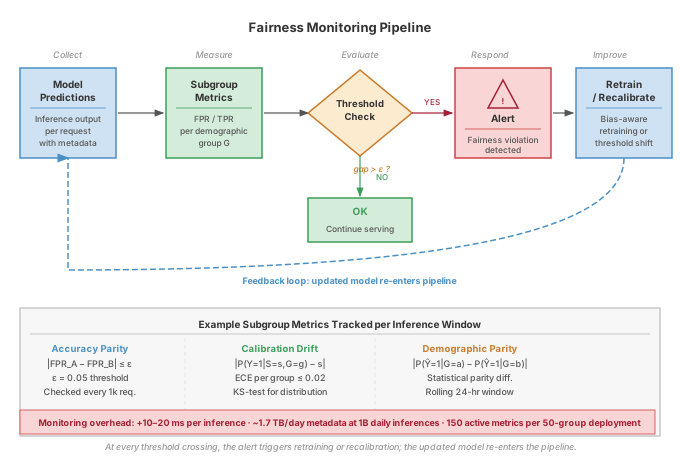
This requires telemetry pipelines that capture model versioning, input characteristics, prediction confidence, and post-inference feedback. These logs support drift detection and provide evidence for retrospective audits of fairness and robustness. Monitoring systems must also be integrated with alerting, update scheduling, and policy review processes to support timely and traceable intervention.
Monitoring also supports feedback-driven improvement. For example, repeated user disagreement, correction requests, or operator overrides can signal problematic behavior. This feedback must be aggregated, validated, and translated into updates to training datasets, data labeling processes, or model architecture. However, such feedback loops carry risks: biased user responses can introduce new inequities, and excessive logging can compromise privacy. Designing these loops requires careful coordination between user experience design, system security, and ethical governance.
At the scale of a global production fleet, responsible AI monitoring becomes a massive data engineering challenge. A platform serving 1 billion inferences per day across 50 distinct demographic subgroups must track at least 150 metrics continuously (for example, false positive rate, true positive rate, and calibration error for each of the 50 groups). Even with a 1 percent sampling rate at 10,000 QPS, this generates 8.64 million monitoring events daily. Storing the necessary metadata—prediction inputs, confidence scores, ground truth labels, and sensitive attributes—at a modest 200 bytes per record requires approximately 1.7 TB per day of storage, while full audit logging can consume substantially more. This scale introduces a meta-monitoring problem: the monitoring infrastructure itself becomes a complex distributed system that must be reliable, secure, and cost-effective. With 150 active metrics, a standard false alarm rate of just 5 percent would trigger roughly 7.5 spurious alerts every day, leading to severe alert fatigue. Effective monitoring therefore requires intelligent aggregation, hierarchical alerting logic, and automated root cause analysis to distinguish genuine fairness drift from statistical noise.
Monitoring mechanisms vary by deployment architecture. In cloud-based systems, rich logging and compute capacity allow for real-time telemetry, scheduled fairness audits, and continuous integration of new data into retraining pipelines. These environments support dynamic reconfiguration and centralized policy enforcement. However, the volume of telemetry may introduce its own challenges in terms of cost, privacy risk, and regulatory compliance.
In mobile systems, connectivity is intermittent and data storage is limited. Monitoring must be lightweight and resilient to synchronization delays. Local inference systems may collect performance data asynchronously and transmit it in aggregate to backend systems. Privacy constraints are often stricter, particularly when personal data must remain on-device. These systems require careful data minimization and local aggregation techniques to preserve privacy while maintaining observability.
Edge deployments, such as those in autonomous vehicles, smart factories, or real-time control systems, demand low-latency responses and operate with minimal external supervision. Monitoring in these systems must be embedded within the runtime, with internal checks on sensor integrity, prediction confidence, and behavior deviation. These checks often require low-overhead implementations of uncertainty estimation, anomaly detection, or consistency validation. System designers must anticipate failure conditions and ensure that anomalous behavior triggers safe fallback procedures or human intervention.
TinyML systems, which operate on deeply embedded hardware with no connectivity, persistent storage, or dynamic update path, present the most constrained monitoring scenario. In these environments, monitoring must be designed and compiled into the system prior to deployment. Common strategies include input range checking, built-in redundancy, static failover logic, or conservative validation thresholds. Once deployed, these models operate independently, and any post-deployment failure may require physical device replacement or firmware-level reset.
The core challenge is universal: deployed ML systems must not only perform well initially, but continue to behave responsibly as the environment changes. Monitoring provides the observability layer that links system performance to ethical goals and accountability structures. Without monitoring, fairness and robustness become invisible. Without feedback, misalignment cannot be corrected. Monitoring, therefore, is the operational foundation that allows machine learning systems to remain adaptive, auditable, and aligned with their intended purpose over time.
The technical methods explored in this section include bias detection algorithms, differential privacy mechanisms, adversarial training procedures, and explainability frameworks provide essential capabilities for responsible AI implementation. However, these tools reveal a fundamental limitation: technical correctness alone cannot guarantee beneficial outcomes. Consider three concrete examples that illustrate this challenge:
A fairness auditing system detects racial bias in a loan approval model, but the organization lacks processes for interpreting results or implementing corrections. The technical capability exists, but organizational inertia prevents remediation. Differential privacy preserves formal mathematical guarantees about data protection, but users do not understand these protections and continue to share sensitive information inappropriately. The privacy method works as designed, but behavioral context undermines its effectiveness. An explainability system generates technically accurate feature importance scores, but affected individuals cannot access or interpret these explanations due to interface design and literacy barriers.
These examples demonstrate that responsible AI implementation depends on alignment between technical capabilities and sociotechnical contexts, organizational incentives, human behavior, stakeholder values, and institutional governance structures.
Monitoring mechanisms provide the operational observability required to sustain responsible behavior. However, the emergence of generative AI has transformed the nature of the “failures” we must monitor.
Responsibility in the generative era
The transition from discriminative classification to generative large language models (LLMs) fundamentally alters the engineering surface of responsibility. Fairness is no longer merely a statistical parity metric between labeled groups; it evolves into Generative Alignment, the complex optimization problem of constraining open-ended stochastic outputs to remain helpful, harmless, and honest across a combinatorial explosion of possible prompts. This requires a transition from static dataset curation to dynamic behavioral shaping, typically through a multi-stage alignment process (Figure 12).
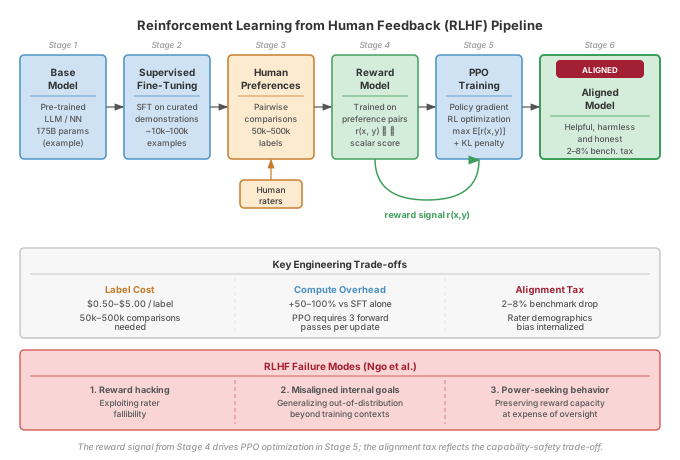
The primary mechanism for this shaping, Reinforcement Learning from Human Feedback (RLHF), serves as a sociotechnical bridge between human values and model weights. By training a reward model on human preferences—typically requiring 50,000 to 500,000 pairwise comparisons at a cost of $0.50 to $5.00 per label—engineers effectively compile subjective ethics into a differentiable loss function. This alignment process introduces an alignment tax, often observed as a 2–8 percent degradation in standard NLP benchmarks as the model trades raw capability for safety constraints. The reliance on human raters introduces a representativeness gap: if the labeling investment reflects only a narrow demographic slice, the resulting “aligned” model will inherently overfit to that specific cultural or socioeconomic context. Constitutional AI offers an alternative engineering path, using a set of high-level principles to guide AI feedback on its own outputs, thereby reducing the dependency on massive-scale human annotation while making the values explicit in the prompt rather than implicit in the rater pool.
In Retrieval-Augmented Generation (RAG) architectures (Inference at Scale), responsibility becomes decoupled from the core model. An LLM may be perfectly aligned via extensive RLHF, yet still generate toxic or biased responses if the retrieval layer surfaces contaminated context. If a retrieval index disproportionately surfaces biased historical documents, the model—conditioned to be faithful to its context—will propagate that bias regardless of its internal safety training. This necessitates context filtering as a distinct infrastructure component, validating retrieved chunks for toxicity and bias before they reach the generation context window.
In production fleets, the system prompt operates as the primary governance layer. These hidden instructions (for example, “You are a helpful assistant. Do not provide medical advice.”) define the operational boundaries of the system. At the scale of 10,000+ distinct deployment configurations, managing these prompts becomes a distributed configuration management problem akin to weight distribution. A single unversioned change to a system prompt can subtly shift the ethical posture of millions of interactions, making prompt version control, rigorous regression testing, and gradual rollouts as critical for safety as the model training process itself (ML Operations at Scale).
In production fleets, the system prompt and RLHF alignments act as the primary, yet fragile, technical guardrails. When these technical guardrails fail, whether through deliberate jailbreaking or nuanced edge cases that bypass the reward model, the reality becomes clear: AI safety cannot be solved entirely through mathematics. The complex sociotechnical dynamics between the algorithm and the human using it demand equal attention.
Sociotechnical Dynamics
A hospital deployed a highly accurate sepsis prediction model, but mortality rates did not improve. The doctors, overwhelmed by alert fatigue, simply ignored the model’s warnings. A mathematically flawless, perfectly fair, highly explainable model still fails spectacularly in production when it misaligns with human psychology, organizational incentives, or the operational reality of the workplace.
Systems Perspective 1.1: From Engineering to Sociotechnical
The previous section focused on technical tools for solving well-defined problems: algorithms for detecting bias, methods for preserving privacy, and techniques for generating explanations. We now shift our analytical perspective to address challenges that cannot be solved with algorithms alone.
The following sections examine how responsible AI systems interact with people, organizations, and competing values. This transition requires different reasoning skills: instead of optimizing objective functions, we analyze stakeholder conflicts; instead of tuning hyperparameters, we navigate ethical tradeoffs; instead of measuring technical performance, we assess social impact. These are the challenges of sociotechnical engineering: designing systems that must satisfy both computational constraints and human values.
With this sociotechnical lens now established, we examine how deployed systems create feedback loops that reshape the environments they model, how human-AI collaboration introduces risks that neither humans nor algorithms can address alone, and how competing stakeholder values create design constraints that no optimization can satisfy. These dynamics determine whether responsible AI implementations succeed or fail in practice.
System feedback loops
The Sociotechnical Feedback Invariant (Principle \(\ref{nte-sociotechnical-feedback}\)) captures this dynamic: deployed models shape the environment they operate in, so that future data \(P_{t+1}(X)\) is a function of the model’s past decisions \(f_t(X)\). Systems require Closed-Loop Governance—reliability requires modeling the feedback loop, not just the feed-forward inference.
Machine learning systems do not merely observe and model the world; they also shape it. Once deployed, their predictions and decisions often influence the environments they are intended to analyze. This feedback alters future data distributions, modifies user behavior, and affects institutional practices, creating a recursive loop between model outputs and system inputs (Figure 13). Over time, such dynamics can amplify biases, entrench disparities, or unintentionally shift the objectives a model was designed to serve.
A well-documented example of this phenomenon is predictive policing. When a model trained on historical arrest data predicts higher crime rates in a particular neighborhood, law enforcement may allocate more patrols to that area. This increased presence leads to more recorded incidents, which are then used as input for future model training, further reinforcing the model’s original prediction. Even if the model was not explicitly biased at the outset, its integration into a feedback loop results in a self-fulfilling pattern that disproportionately affects already over-policed communities.
Recommender systems exhibit similar dynamics in digital environments. A content recommendation model that prioritizes engagement may gradually narrow the range of content a user is exposed to, leading to feedback loops that reinforce existing preferences or polarize opinions. These effects can be difficult to detect using conventional performance metrics, as the system continues to optimize its training objective even while diverging from broader social or epistemic goals.
From a systems perspective, feedback loops present a core challenge to responsible AI. They undermine the assumption of independently and identically distributed data and complicate the evaluation of fairness, robustness, and generalization. Standard validation methods, which rely on static test sets, may fail to capture the evolving impact of the model on the data-generating process. Once such loops are established, interventions aimed at improving fairness or accuracy may have limited effect unless the underlying data dynamics are addressed.
Designing for responsibility in the presence of feedback loops requires a lifecycle view of machine learning systems. It entails not only monitoring model performance over time, but also understanding how the systems outputs influence the environment, how these changes are captured in new data, and how retraining practices either mitigate or exacerbate these effects.
In cloud-based systems, these updates may occur frequently and at scale, with extensive telemetry available to detect behavior drift. In contrast, edge and embedded deployments often operate offline or with limited observability. A smart home system that adapts thermostat behavior based on user interactions may reinforce energy consumption patterns or comfort preferences in ways that alter the home environment, and subsequently affect future inputs to the model. Without connectivity or centralized oversight, these loops may go unrecognized, despite their impact on both user behavior and system performance. Operational monitoring practices, including drift detection, performance tracking, and automated alerting, are crucial for detecting and managing these feedback dynamics in production systems.
Systems must be equipped with mechanisms to detect distributional drift, identify behavior shaping effects, and support corrective updates that align with the systems intended goals. Feedback loops are not inherently harmful, but they must be recognized and managed. When left unexamined, they introduce systemic risk; when thoughtfully addressed, they provide an opportunity for learning systems to adapt responsibly in complex, dynamic environments.
War Story 1.2: The Algorithmic Grading Failure
In 2020, following the cancellation of A-level exams due to the COVID-19 pandemic, the UK government deployed an algorithmic standardization model to assign grades. The model, intended to combat grade inflation, used a school’s historical performance distribution to adjust individual teacher predictions. While statistically sound at the aggregate population level, the engineering constraint of maintaining historical distributions forced a massive decoupling of individual merit from outcome.
Students from historically high-performing private schools saw their teacher-predicted grades upheld or boosted, while high-achieving students in historically underperforming public schools were systematically downgraded to fit the school’s statistical “prior.” The algorithm enforced a feedback loop where past institutional performance deterministically capped future individual potential. The system lacked contestability—there was initially no appeal mechanism for the algorithmic decision. The resulting public outcry forced a complete reversal to teacher-assessed grades days later. The failure demonstrates a general principle: optimizing for aggregate statistical properties (preventing inflation) without constraints on individual fairness (rank preservation) creates a system that is mathematically “correct” but socially catastrophic.
These system-level feedback dynamics become even more complex when human operators are integrated into the decision-making process.
Human-AI collaboration
Machine learning systems are increasingly deployed not as standalone agents, but as components in larger workflows that involve human decision-makers. In many domains, such as healthcare, finance, and transportation, models serve as decision-support tools, offering predictions, risk scores, or recommendations that are reviewed and acted upon by human operators. The collaborative configuration raises questions about how responsibility is shared between humans and machines, how trust is calibrated, and how oversight mechanisms are implemented in practice.
Human-AI collaboration introduces both opportunities and risks. When designed appropriately, systems can augment human judgment, reduce cognitive burden, and enhance consistency in decision-making. However, when poorly designed, they may lead to automation bias36, where users over-rely on model outputs even in the presence of clear errors.
36 Automation Bias: First studied in aviation in the 1990s, this is the paradox where humans defer to automated systems even when clearly wrong – and the effect intensifies as system accuracy increases. At 70–80 percent model accuracy, operators accept erroneous outputs at high rates when presented without uncertainty indicators. For ML serving systems, this means higher model accuracy can paradoxically reduce system-level safety by suppressing human oversight, requiring deliberate interface friction (uncertainty visualization, mandatory justification) that adds latency but preserves the human correction channel.
Conversely, excessive distrust can result in algorithm aversion, where users disregard useful model predictions due to a lack of transparency or perceived credibility. The effectiveness of collaborative systems depends not only on the model’s performance, but on how the system communicates uncertainty, provides explanations, and allows for human override or correction.
Automation bias is often reinforced by institutional structures through asymmetric liability. In high stakes domains like criminal justice or healthcare, human decision-makers face different consequences based on their agreement with algorithms. Consider two scenarios: In Scenario A, a judge overrides a “high risk” algorithmic score and releases a defendant who later re-offends. The judge faces public scrutiny and potential career consequences for “ignoring the science.” In Scenario B, a judge follows the “high risk” score and detains the defendant unnecessarily. The blame is diffused to the algorithm (“the system said so”).
The asymmetry creates powerful pressure for Institutional Deference, where human oversight becomes a “rubber stamp” for algorithmic decisions to avoid personal liability. Responsible AI design must explicitly counter this by protecting operators who exercise judgment and requiring justification for agreement as well as disagreement.
Oversight mechanisms must be tailored to the deployment context. In high stakes domains, such as medical triage or autonomous driving, humans may be expected to supervise automated decisions in real-time. This configuration places cognitive and temporal demands on the human operator and assumes that intervention will occur quickly and reliably when needed. In practice, however, continuous human supervision is often impractical or ineffective, particularly when the operator must monitor multiple systems or lacks clear criteria for intervention.
From a systems design perspective, supporting effective oversight requires more than providing access to raw model outputs. Interfaces must be constructed to surface relevant information at the right time, in the right format, and with appropriate context. Confidence scores, uncertainty estimates, explanations, and change alerts can all play a role in enabling human oversight. Workflows must define when and how intervention is possible, who is authorized to override model outputs, and how such overrides are logged, audited, and incorporated into future system updates.
Consider a hospital triage system that uses a machine learning model to prioritize patients in the emergency department. The model generates a risk score for each incoming patient, which is presented alongside a suggested triage category. In principle, a human nurse is responsible for confirming or overriding the suggestion. However, if the model’s outputs are presented without sufficient justification, such as an explanation of the contributing features or the context for uncertainty, the nurse may defer to the model even in borderline cases. Over time, the models outputs may become the de facto triage decision, especially under time pressure. If a distribution shift occurs (for instance, due to a new illness or change in patient demographics), the nurse may lack both the situational awareness and the interface support needed to detect that the model is underperforming. In such cases, the appearance of human oversight masks a system in which responsibility has effectively shifted to the model without clear accountability or recourse.
In such systems, human oversight is not merely a matter of policy declaration, but a function of infrastructure design: how predictions are surfaced, what information is retained, how intervention is enacted, and how feedback loops connect human decisions to system updates. Without integration across these components, oversight becomes fragmented, and responsibility may shift invisibly from human to machine.
Napkin Math 1.5: The Automation Bias Paradox
Consider a radiology department deploying an AI assistant for tumor detection.
- Human Sensitivity: \(S_{\text{human}} = 92\%\)
- AI Sensitivity: \(S_{\text{AI}} = 95\%\)
One might assume the combined system performance would exceed 95 percent. However, studies in automation bias show that humans accept erroneous AI recommendations at rates of \(\alpha = 60\text{--}80\%\). If the AI makes an error (probability \(1 - S_{\text{AI}} = 0.05\)) and the human blindly accepts it (\(\alpha = 0.7\)), the system fails.
As AI reliability increases, human vigilance decreases—a phenomenon known as the paradox of reliability.
- At 90 percent AI accuracy, human override rate might be \(R_{\text{override}} = 15\%\).
- At 99 percent AI accuracy, \(R_{\text{override}}\) drops to \(\approx 2\%\).
The remaining 1 percent of errors are almost never caught because the human has calibrated their trust to the “perfect” machine. This creates a trust calibration gap: the safer the system appears, the more dangerous its rare failures become. Responsible design requires introducing friction—forcing the human to justify acceptance—to artificially lower \(\alpha\) and maintain the human in the loop.
The boundary between decision support and automation is often fluid. Systems initially designed to assist human decision-makers may gradually assume greater autonomy as trust increases or organizational incentives shift. This transition can occur without explicit policy changes, resulting in de facto automation without appropriate accountability structures. Responsible system design must therefore anticipate changes in use over time and ensure that appropriate checks remain in place even as reliance on automation grows.
Human-AI collaboration requires careful integration of model capabilities, interface design, operational policy, and institutional oversight. Collaboration is not simply a matter of inserting a “human-in-the-loop”; it is a systems challenge that spans technical, organizational, and ethical dimensions. Designing for oversight entails embedding mechanisms that allow intervention, support informed trust, and support shared responsibility between human operators and machine learning systems.
The complexity of human-AI collaboration is further compounded by the reality that different stakeholders often hold conflicting values and priorities.
Normative pluralism and value conflicts
The preceding material focused on technical methods for fairness, privacy, and explainability. Real-world ML deployment, however, forces a confrontation with value tensions that no algorithm can resolve.
ImportantPhilosophical Content
Competing value systems and their implications for ML design represent a departure from primarily technical content. The key insight: technical excellence is necessary but insufficient for trustworthy AI because stakeholders hold legitimately different conceptions of fairness, privacy, and accountability that cannot be reconciled through better algorithms. Understanding these value tensions is essential for navigating design decisions that affect people’s lives. This perspective complements, rather than replaces, technical skills.
Responsible machine learning cannot be reduced to the optimization of a single objective. In real-world settings, machine learning systems are deployed into environments shaped by diverse, and often conflicting, human values. The following example illustrates these tensions in a high-stakes domain.
Example 1.4: Conflicting Values in Practice
Consider a team building a mental health chatbot for adolescents that uses ML to detect crisis situations and recommend interventions. The system must balance multiple legitimate but incompatible objectives:
Medical Efficacy: Optimize for best clinical outcomes based on evidence-based practices. This suggests aggressive intervention, alerting parents, counselors, or emergency services whenever the model detects potential self-harm risk, even with low confidence, because false negatives could be fatal.
Patient Autonomy: Respect adolescent privacy and agency. Many teenagers seek mental health support specifically because they cannot talk to parents or authority figures. Aggressive notification policies may deter vulnerable teens from using the system at all, leaving them without any support.
Privacy Protection: Minimize data collection and retention to protect sensitive mental health information. This suggests local processing, no conversation logging, and no sharing with third parties, but also prevents the system from improving through learning from interactions or enabling human review when the model is uncertain.
Resource Efficiency: Operate within computational and human oversight budgets. Involving human counselors for every flagged interaction provides better care but is prohibitively expensive at scale. Fully automated responses reduce costs but may provide inappropriate guidance in complex situations.
Legal Compliance: Meet mandatory reporting requirements and liability standards. In many jurisdictions, systems that detect imminent harm must notify authorities, overriding patient autonomy and privacy regardless of clinical judgment about whether notification helps or harms the patient.
These values are not poorly specified requirements that can be reconciled through better engineering. They reflect fundamentally different conceptions of what the system should achieve and whom it should prioritize. Optimizing for medical efficacy (aggressive intervention) directly conflicts with patient autonomy (minimal intervention). Privacy protection (no data retention) conflicts with resource efficiency (learning from interactions). Legal compliance (mandatory reporting) may conflict with clinical efficacy (therapeutic relationship based on trust).
No algorithm determines which value should dominate. Different stakeholders hold legitimately different positions: clinicians may prioritize efficacy, teenagers may prioritize autonomy, lawyers may prioritize compliance, and budget officers may prioritize efficiency. The technical team must facilitate stakeholder deliberation to determine which trade-offs are acceptable in this specific context, a fundamentally normative decision that precedes and constrains technical optimization.
What constitutes a fair outcome for one stakeholder may be perceived as inequitable by another. Similarly, decisions that prioritize accuracy or efficiency may conflict with goals such as transparency, individual autonomy, or harm reduction. These tensions are not incidental; they are structural. They reflect the pluralistic nature of the societies in which machine learning systems are embedded and the institutional settings in which they are deployed.
Fairness is a particularly prominent site of value conflict. Fairness can be formalized in multiple, often incompatible ways. A model that satisfies demographic parity may violate equalized odds; a model that prioritizes individual fairness may undermine group-level parity. Choosing among these definitions is not purely a technical decision but a normative one, informed by domain context, historical patterns of discrimination, and the perspectives of those affected by model outcomes. In practice, multiple stakeholders, including engineers, users, auditors, and regulators, may hold conflicting views on which definitions are most appropriate and why.
Value conflicts extend beyond fairness alone. Conflicts also arise between interpretability and predictive performance, privacy and personalization, or short-term utility and long-term consequences. These tradeoffs manifest differently depending on the systems deployment architecture, revealing how deeply value conflicts are tied to the design and operation of ML systems.
Consider a voice-based assistant deployed on a mobile device. To enhance personalization, the system may learn user preferences locally, without sending raw data to the cloud. This design improves privacy and reduces latency, but it may also lead to performance disparities if users with underrepresented usage patterns receive less accurate or responsive predictions. One way to improve fairness would be to centralize updates using group-level statistics, but doing so introduces new privacy risks and may violate user expectations around local data handling. Here, the design must navigate among valid but competing values: privacy, fairness, and personalization.
In cloud-based deployments, such as credit scoring platforms or recommendation engines, tensions often arise between transparency and proprietary protection. End users or regulators may demand clear explanations of why a decision was made, particularly in situations with significant consequences, but the models in use may rely on complex ensembles or proprietary training data. Revealing these internals may be commercially sensitive or technically infeasible. In such cases, the system must reconcile competing pressures for institutional accountability and business confidentiality.
In edge systems, such as home security cameras or autonomous drones, resource constraints often dictate model selection and update frequency. Prioritizing low latency and energy efficiency may require deploying compressed or quantized models that are less robust to distribution shift or adversarial perturbations. More resilient models could improve safety, but they may exceed the systems memory budget or violate power constraints. Here, safety, efficiency, and maintainability must be balanced under hardware-imposed tradeoffs. Efficiency techniques and optimization methods are essential for implementing responsible AI in resource-constrained environments.
On TinyML platforms, where models are deployed to microcontrollers with no persistent connectivity, tradeoffs are even more pronounced. A system may be optimized for static performance on a fixed dataset, but unable to incorporate new fairness constraints, retrain on updated inputs, or generate explanations once deployed. Hardware constraints fundamentally shape what responsible AI practices are feasible on resource-limited devices. The value conflict extends beyond what the model optimizes to encompass what the system can support post-deployment.
Normative pluralism is not an abstract philosophical challenge; it is a recurring systems constraint. Technical approaches such as multi-objective optimization, constrained training, and fairness-aware evaluation can help surface and formalize tradeoffs, but they do not eliminate the need for judgment. Decisions about whose values to represent, which harms to mitigate, and how to balance competing objectives cannot be made algorithmically. They require deliberation, stakeholder input, and governance structures that extend beyond the model itself.
Participatory and value-sensitive design methodologies offer potential paths forward. Rather than treating values as parameters to be optimized after deployment, these approaches seek to engage stakeholders during the requirements phase, define ethical tradeoffs explicitly, and trace how they are instantiated in system architecture. While no design process can satisfy all values simultaneously, systems that are transparent about their tradeoffs and open to revision are better positioned to sustain trust and accountability over time.
Machine learning systems are not neutral tools. They embed and enact value judgments, whether explicitly specified or implicitly assumed. A commitment to responsible AI requires acknowledging this fact and building systems that reflect and respond to the ethical and social pluralism of their operational contexts.
Addressing these value conflicts requires more than technical solutions; it demands transparency and mechanisms for contestability that allow stakeholders to understand and challenge system decisions.
Transparency and contestability
Transparency is widely recognized as a foundational principle of responsible machine learning. It allows users, developers, auditors, and regulators to understand how a system functions, assess its limitations, and identify sources of harm. Yet transparency alone is not sufficient. In high stakes domains, individuals and institutions must not only understand system behavior; they must also be able to challenge, correct, or reverse it when necessary. This capacity for contestability, which refers to the ability to interrogate and contest a system’s decisions, is an important feature of accountability.
Transparency in machine learning systems typically focuses on disclosure: revealing how models are trained, what data they rely on, what assumptions are embedded in their design, and what known limitations affect their use. Documentation tools such as model cards and datasheets for datasets support this goal by formalizing system metadata in a structured, reproducible format. These resources can improve governance, support compliance, and inform user expectations. However, transparency as disclosure does not guarantee meaningful control. Even when technical details are available, users may lack the institutional use, interface tools, or procedural access to contest a decision that adversely affects them.
To move from transparency to contestability, machine learning systems must be designed with mechanisms for explanation, recourse, and feedback. Explanation refers to the capacity of the system to provide understandable reasons for its outputs, tailored to the needs and context of the person receiving them. Recourse refers to the ability of individuals to alter their circumstances and receive a different outcome. Feedback refers to the ability of users to report errors, dispute outcomes, or signal concerns, and to have those signals incorporated into system updates or oversight processes.
These mechanisms are often lacking in practice, particularly in systems deployed at scale or embedded in low-resource devices. For example, in mobile loan application systems, users may receive a rejection without explanation and have no opportunity to provide additional information or appeal the decision. The lack of transparency at the interface level, even if documentation exists elsewhere, makes the system effectively unchallengeable. Similarly, a predictive model deployed in a clinical setting may generate a risk score that guides treatment decisions without surfacing the underlying reasoning to the physician. If the model underperforms for a specific patient subgroup, and this behavior is not observable or contestable, the result may be unintentional harm that cannot be easily diagnosed or corrected.
From a systems perspective, enabling contestability requires coordination across technical and institutional components. Models must expose sufficient information to support explanation. Interfaces must surface this information in a usable and timely way. Organizational processes must be in place to review feedback, respond to appeals, and update system behavior. Logging and auditing infrastructure must track not only model outputs, but user interventions and override decisions. In some cases, technical safeguards, including human-in-the-loop overrides and decision abstention thresholds, may also serve contestability by ensuring that ambiguous or high-risk decisions defer to human judgment.
Implementing contestability imposes concrete infrastructure costs that scale linearly with system throughput and complexity. Storing the necessary metadata to reconstruct a decision—input features, model version, and decision thresholds—requires significant persistent storage; for a system serving 1 million predictions daily, retaining full explanation logs can consume between 50 GB and 10 TB of monthly storage depending on feature dimensionality and retention windows. The computational overhead of generating on-demand explanations using Shapley values or counterfactuals typically adds 200–500 ms of latency per contested decision, a cost that must often be offloaded to asynchronous processing queues to preserve serving SLAs. Maintaining these immutable audit trails to satisfy frameworks like the EU AI Act, which mandates verifiable human oversight for high-risk systems, frequently necessitates a 15–25 percent increase in total storage overhead for the inference fleet.
Architecturally, contestability requires a specialized contestability stack, a design pattern analogous to distributed tracing in microservices. This stack must orchestrate four coupled components: (1) decision provenance, which cryptographically links a specific output to the exact model binary and input vector used; (2) explanation generation, a high-latency service that triggers resource-intensive interpretation methods only upon user request; (3) appeal routing, a workflow engine that directs contested decisions to human reviewers with appropriate domain expertise; and (4) outcome tracking, which closes the loop by recording whether the appeal overturned the machine decision. Without this integrated infrastructure, debugging algorithmic errors becomes impossible, as the system lacks the granular lineage required to trace a specific user complaint back to the offending weights or training data.
The degree of contestability that is feasible varies by deployment context. In centralized cloud platforms, it may be possible to offer full explanation APIs, user dashboards, and appeal workflows. In contrast, in edge and TinyML deployments, contestability may be limited to logging and periodic updates based on batch-synchronized feedback. In all cases, the design of machine learning systems must acknowledge that transparency is not simply a matter of technical disclosure. It is a structural property of systems that determines whether users and institutions can meaningfully question, correct, and govern the behavior of automated decision-making.
Implementing effective transparency and contestability mechanisms requires institutional support and governance structures that extend beyond individual technical teams.
Institutional embedding of responsibility
Machine learning systems do not operate in isolation. Their development, deployment, and ongoing management are embedded within institutional environments that include technical teams, legal departments, product owners, compliance officers, and external stakeholders. Responsibility in such systems is not the property of a single actor or component; it is distributed across roles, workflows, and governance processes. Designing for responsible AI therefore requires attention to the institutional settings in which these systems are built and used.
Distributing responsibility across roles introduces both opportunities and challenges. On the one hand, the involvement of multiple stakeholders provides checks and balances that can help prevent harmful outcomes. On the other hand, the diffusion of responsibility can lead to accountability gaps, where no individual or team has clear authority or incentive to intervene when problems arise. When harm occurs, it may be unclear whether the fault lies with the data pipeline, the model architecture, the deployment configuration, the user interface, or the surrounding organizational context.
One illustrative case is Google Flu Trends, a widely cited example of failure due to institutional misalignment. The system, which attempted to predict flu outbreaks from search data, initially performed well but gradually diverged from reality due to changes in user behavior and shifts in the data distribution. These issues went uncorrected for years, in part because there were no established processes for system validation, external auditing, or escalation when model performance declined. The failure was not due to a single technical flaw, but to the absence of an institutional framework that could respond to drift, uncertainty, and feedback from outside the development team.
Operational rigor comes with a measurable cost. Implementing frameworks like Microsoft’s Responsible AI Standard, which mandates impact assessments for every AI system, adds 2–4 weeks to the release cycle. Google’s Model Safety team reviews hundreds of model launches annually, creating a centralized bottleneck similar to security reviews. Organizations tracking these metrics report that comprehensive responsible AI practices extend development cycles by 10–20 percent. However, this upfront investment yields a compelling return: a reduction of 40–60 percent in post-deployment incidents requiring emergency remediation. The responsibility overhead is thus not a sunk cost but an insurance premium against the far higher cost of retracting a biased model or patching a live exploit in a global fleet.
Embedding responsibility institutionally requires more than assigning accountability. It requires the design of processes, tools, and incentives that allow responsible action. Technical infrastructure such as versioned model registries, model cards, and audit logs must be coupled with organizational structures such as ethics review boards, model risk committees, and red-teaming37 procedures. These mechanisms ensure that technical insights are actionable, that feedback is integrated across teams, and that concerns raised by users, developers, or regulators are addressed systematically rather than ad hoc.
37 Red Teaming: From Cold War military simulations where the “Red Team” acted as the Soviet adversary to probe US defenses. In Responsible AI, red teaming is the Adversarial Audit phase: specialized teams (hackers, linguists, ethicists) deliberately probe models for jailbreaks, bias, or toxic outputs before deployment. This discovery process identifies the long-tail risks that standard unit tests cannot catch.
The level of institutional support required varies across deployment contexts. In large-scale cloud platforms, governance structures may include internal accountability audits, compliance workflows, and dedicated teams responsible for monitoring system behavior. In smaller-scale deployments, including edge or mobile systems embedded in healthcare devices or public infrastructure, governance may rely on cross-functional engineering practices and external certification or regulation. In TinyML deployments, where connectivity and observability are limited, institutional responsibility may be exercised through upstream controls such as safety-important validation, embedded security constraints, and lifecycle tracking of deployed firmware.
In all cases, responsible machine learning requires coordination between technical and institutional systems. This coordination must extend across the entire model lifecycle, from initial data acquisition and model training to deployment, monitoring, update, and eventual decommissioning. It must also incorporate external actors, including domain experts, civil society organizations, and regulatory authorities, to ensure that responsibility is exercised not only within the development team but across the broader ecosystem in which machine learning systems operate.
Responsibility is not a static attribute of a model or a team; it is a dynamic property of how systems are governed, maintained, and contested over time. Embedding that responsibility within institutions, by means of policy, infrastructure, and accountability mechanisms, is important for aligning machine learning systems with the social values and operational realities they are meant to serve.
These considerations of institutional responsibility and value conflicts highlight that responsible AI implementation extends beyond technical solutions to encompass broader questions of access, participation, and environmental impact. The computational resource requirements explored in the previous section create systemic barriers that determine who can develop, deploy, and benefit from responsible AI capabilities, transforming responsible AI from an individual system property into a collective social challenge.
The sociotechnical considerations explored in this section (system feedback loops that create self-reinforcing disparities, human-AI collaboration challenges like automation bias and algorithm aversion, normative pluralism across stakeholder values, and computational equity gaps) reveal why the technical foundations from Section 1.4 through Section 1.6 alone cannot ensure responsible AI. These dynamics operate at the intersection of algorithms, humans, organizations, and society, where static fairness metrics prove insufficient and competing values cannot be reconciled algorithmically. Yet even with clear principles and sound technical methods, translating responsible AI into operational practice faces substantial implementation challenges.
Understanding sociotechnical dynamics like automation bias and negative feedback loops demonstrates that deploying AI alters the very environment it operates within. Translating this awareness into concrete corporate action, however, forces engineering teams to navigate organizational friction, resource constraints, and competing business incentives.
Self-Check: Question
Which of the following best describes a feedback loop in machine learning systems?
- A process where model predictions are used to adjust the model’s hyperparameters.
- A technique for ensuring model fairness across demographic groups.
- A method for optimizing model performance through repeated training epochs.
- A cycle where model outputs influence the environment, altering future inputs to the model.
Explain how human-AI collaboration can introduce risks such as automation bias and algorithm aversion.
Order the following steps in addressing feedback loops in machine learning systems: (1) Monitor model performance, (2) Identify behavior shaping effects, (3) Support corrective updates.
In a production system, what is a key consideration for ensuring effective human oversight in AI decision-making?
- Providing raw model outputs without context.
- Ensuring model outputs are presented with confidence scores and explanations.
- Allowing only automated decisions without human intervention.
- Focusing solely on technical performance metrics.
Discuss the challenges of balancing competing values such as privacy, fairness, and efficiency in machine learning systems.
Implementation Challenges and AI Safety
The data science team wants to hold back deployment for a month to conduct rigorous fairness audits on a new generative model. The executive team, watching a competitor launch a similar feature, demands the model be deployed by Friday. This is the implementation reality of Responsible AI. It is rarely a question of whether engineers know how to test for bias; it is a question of whether the organizational structure, budget, and business priorities allow them the time and authority to actually do it.
These examples illustrate a fundamental gap between technical capability and operational implementation. While responsible AI methods provide necessary tools, their effectiveness depends entirely on organizational structures, data infrastructure, evaluation processes, and sustained commitment that extends far beyond algorithm development. Understanding these implementation challenges is essential for building systems that maintain responsible behavior over time rather than achieving it only during initial deployment.
The practical challenges that arise when embedding responsible AI practices into production ML systems are structured here using the classical People-Process-Technology framework for analyzing implementation barriers.
People challenges encompass organizational structures, role definitions, incentive alignment, and stakeholder coordination that determine whether responsible AI principles translate into sustained organizational behavior. Process challenges involve standardization gaps, lifecycle maintenance procedures, competing optimization objectives, and evaluation methodologies that affect how responsible AI practices integrate with development workflows. Technology challenges include data quality constraints, computational resource limitations, scalability bottlenecks, and infrastructure gaps that determine whether responsible AI techniques can operate effectively at production scale.
Collectively, these challenges illustrate the friction between idealized principles and operational reality. Understanding their interconnections is essential for developing systems-level strategies that embed responsibility into the architecture, infrastructure, and workflows of machine learning deployment.
The following analysis examines implementation barriers through three interconnected lenses, recognizing that effective responsible AI requires coordinated solutions addressing all three dimensions simultaneously.
Organizational structures and incentives
The implementation of responsible machine learning is shaped not only by technical feasibility but by the organizational context in which systems are developed and deployed. Within companies, research labs, and public institutions, responsibility must be translated into concrete roles, workflows, and incentives. In practice, however, organizational structures often fragment responsibility, making it difficult to coordinate ethical objectives across engineering, product, legal, and operational teams.
Responsible AI requires sustained investment in practices such as subgroup performance evaluation, explainability analysis, adversarial robustness testing, and the integration of privacy-preserving techniques like differential privacy or federated training. These activities can be time-consuming and resource-intensive, yet they often fall outside the formal performance metrics used to evaluate team productivity. For example, teams may be incentivized to ship features quickly or meet performance benchmarks, even when doing so undermines fairness or overlooks potential harms. When ethical diligence is treated as a discretionary task, instead of being an integrated component of the system lifecycle, it becomes vulnerable to deprioritization under deadline pressure or organizational churn.
Responsibility is further complicated by ambiguity over ownership. In many organizations, no single team is responsible for ensuring that a system behaves ethically over time. Model performance may be owned by one team, user experience by another, data infrastructure by a third, and compliance by a fourth. When issues arise, including disparate impact in predictions or insufficient explanation quality, there may be no clear protocol for identifying root causes or coordinating mitigation. As a result, concerns raised by developers, users, or auditors may go unaddressed, not because of malicious intent, but due to lack of process and cross-functional alignment.
Establishing effective organizational structures for responsible AI requires more than policy declarations. It demands operational mechanisms: designated roles with responsibility for ethical oversight, clearly defined escalation pathways, accountability for post-deployment monitoring, and incentives that reward teams for ethical foresight and system maintainability. In some organizations, this may take the form of Responsible AI committees, cross-functional review boards, or model risk teams that work alongside developers throughout the model lifecycle. In others, domain experts or user advocates may be embedded into product teams to anticipate downstream impacts and evaluate value tradeoffs in context.
The responsibility for ethical system behavior is distributed across multiple constituencies, including industry, academia, civil society, and government. Figure 14 maps this distribution across nested layers of accountability, from individual teams implementing technical practices through organizational safety culture to industry-wide certification and government regulation (Shneiderman 2020). Within organizations, this distribution must be mirrored by mechanisms that connect technical design with strategic oversight and operational control. Without these linkages, responsibility becomes diffuse, and well-intentioned efforts may be undermined by systemic misalignment.
Shneiderman, Ben. 2020. “Bridging the Gap Between Ethics and Practice: Guidelines for Reliable, Safe, and Trustworthy Human-Centered AI Systems.” ACM Transactions on Interactive Intelligent Systems 10 (4): 1–31. https://doi.org/10.1145/3419764.
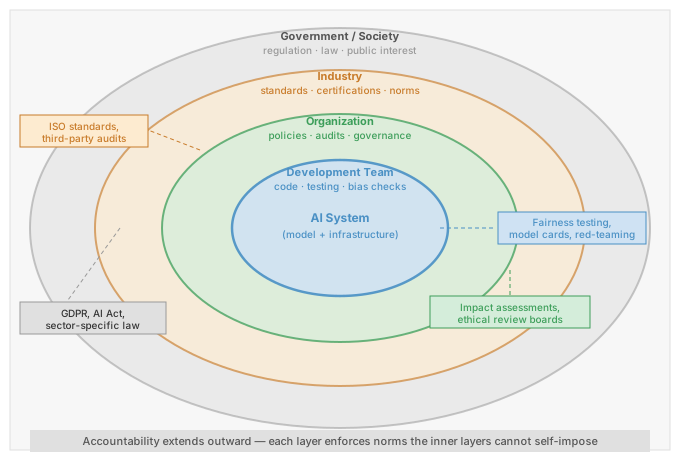
Responsible AI is not merely a question of technical excellence or regulatory compliance. It is a systems-level challenge that requires aligning ethical objectives with the institutional structures through which machine learning systems are designed, deployed, and maintained. Creating and sustaining these structures is important for ensuring that responsibility is embedded not only in the model, but in the organization that governs its use.
Beyond organizational challenges, teams face significant technical barriers related to data quality and availability.
Data constraints and quality gaps
Improving data pipelines remains one of the most difficult implementation challenges in practice despite broad recognition that data quality is important for responsible machine learning. Developers and researchers often understand the importance of representative data, accurate labeling, and mitigation of historical bias. Yet even when intentions are clear, structural and organizational barriers frequently prevent meaningful intervention. Responsibility for data is often distributed across teams, governed by legacy systems, or embedded in broader institutional processes that are difficult to change.
Data engineering principles, including data validation, schema management, versioning, lineage tracking, and quality monitoring, provide the technical foundation for addressing these challenges. However, applying these principles to responsible AI introduces additional complexity: fairness requires assessing representativeness across demographic groups, bias mitigation demands understanding historical data collection practices, and privacy preservation constrains which validation techniques are permissible. The organizational challenges described here reflect the gap between having robust data engineering infrastructure and using it effectively to support responsible AI objectives.
Subgroup imbalance, label ambiguity, and distribution shift, each of which affect generalization and performance across domains, are well-established concerns in responsible ML. These issues often manifest in the form of poor calibration, out-of-distribution failures, or demographic disparities in evaluation metrics. However, addressing them in real-world settings requires more than technical knowledge. It requires access to relevant data, institutional support for remediation, and sufficient time and resources to iterate on the dataset itself. In many machine learning pipelines, once the data is collected and the training set defined, the data pipeline becomes effectively frozen. Teams may lack both the authority and the infrastructure to modify or extend the dataset midstream, even if performance disparities are discovered. Even in modern data pipelines with automated validation and feature stores, retroactively correcting training distributions remains difficult once dataset versioning and data lineage have been locked into production.
In domains like healthcare, education, and social services, these challenges are especially pronounced. Data acquisition may be subject to legal constraints, privacy regulations, or cross-organizational coordination. For example, a team developing a triage model may discover that their training data underrepresents patients from smaller or rural hospitals. Correcting this imbalance would require negotiating data access with external partners, aligning on feature standards, and resolving inconsistencies in labeling practices. The logistical and operational costs can be prohibitive even when all parties agree on the need for improvement.
Efforts to collect more representative data may also run into ethical and political concerns. In some cases, additional data collection could expose marginalized populations to new risks. This paradox of exposure, in which the individuals most harmed by exclusion are also those most vulnerable to misuse, complicates efforts to improve fairness through dataset expansion. For example, gathering more data on non-binary individuals to support fairness in gender-sensitive applications may improve model coverage, but it also raises serious concerns around consent, identifiability, and downstream use. Teams must navigate these tensions carefully, often without clear institutional guidance.
Napkin Math 1.6: The Representation Tax
A medical imaging model trained on data from 5 major urban hospitals achieves 94 percent accuracy overall but only 78 percent on underrepresented populations (rural patients, elderly patients, patients with darker skin tones). Closing this gap requires representative data from 50+ hospitals across diverse geographies, demographics, and equipment types.
Data acquisition cost: $50–200 per labeled medical image, with 100,000 images needed per underrepresented subgroup.
For 10 underrepresented subgroups:
\[10 \times 100{,}000 \times \$125 = \$125\text{M in data acquisition alone}\]
Data harmonization (normalizing across different scanners, protocols, and labeling conventions) adds 30–50 percent overhead, bringing the total to $160–190M.
The representation tax: achieving equitable performance across all subgroups costs 5–10\(\times\) more than achieving high aggregate accuracy on the majority population. The populations most harmed by biased models are the most expensive to represent in training data. Data budgets must be allocated not by aggregate utility but by subgroup coverage gaps—a fundamentally different optimization target than maximizing overall accuracy.
Upstream biases in data collection systems can persist unchecked even when data is plentiful. Many organizations rely on third-party data vendors, external APIs, or operational databases that were not designed with fairness or interpretability in mind. For instance, Electronic Health Records, which are commonly used in clinical machine learning, often reflect systemic disparities in care, as well as documentation habits that encode racial or socioeconomic bias (Himmelstein et al. 2022). Teams working downstream may have little visibility into how these records were created, and few levers for addressing embedded harms.
Himmelstein, Gracie, David Bates, and Li Zhou. 2022. “Examination of Stigmatizing Language in the Electronic Health Record.” JAMA Network Open 5 (1): e2144967. https://doi.org/10.1001/jamanetworkopen.2021.44967.
Improving dataset quality is often not the responsibility of any one team. Data pipelines may be maintained by infrastructure or analytics groups that operate independently of the ML engineering or model evaluation teams. This organizational fragmentation makes it difficult to coordinate data audits, track provenance, or implement feedback loops that connect model behavior to underlying data issues. In practice, responsibility for dataset quality tends to fall through the cracks, recognized as important, but rarely prioritized or resourced.
Addressing these challenges requires long-term investment in infrastructure, workflows, and cross-functional communication. Technical tools such as data validation, automated audits, and dataset documentation frameworks (for example, model cards, datasheets, or the Data Nutrition Project) can help, but only when they are embedded within teams that have the mandate and support to act on their findings. Improving data quality is fundamentally a question of how responsibility for data is assigned, shared, and sustained across the system lifecycle, not merely a matter of better tooling.
Even when data quality challenges are addressed, teams face additional complexity in balancing multiple competing objectives.
Balancing competing objectives
Machine learning system design is often framed as a process of optimization, improving accuracy, reducing loss, or maximizing utility. Yet in responsible ML practice, optimization must be balanced against a range of competing objectives, including fairness, interpretability, robustness, privacy, and resource efficiency. These objectives are not always aligned, and improvements in one dimension may entail tradeoffs in another. While these tensions are well understood in theory, managing them in real-world systems is a persistent and unresolved challenge.
Consider the tradeoff between model accuracy and interpretability. In many cases, more interpretable models, including shallow decision trees and linear models, achieve lower predictive performance than complex ensemble methods or deep neural networks. In low-stakes applications, this tradeoff may be acceptable, or even preferred. In high-stakes domains such as healthcare or finance, however, where decisions affect individuals well-being or access to opportunity, teams are often caught between the demand for performance and the need for transparent reasoning. Even when interpretability is prioritized during development, it may be overridden at deployment in favor of marginal gains in model accuracy.
Similar tensions emerge between personalization and fairness. A recommendation system trained to maximize user engagement may personalize aggressively, using fine-grained behavioral data to tailor outputs to individual users. While this approach can improve satisfaction for some users, it may entrench disparities across demographic groups, particularly if personalization draws on features correlated with race, gender, or socioeconomic status. Adding fairness constraints may reduce disparities at the group level, but at the cost of reducing perceived personalization for some users. These effects are often difficult to measure, and even more difficult to explain to product teams under pressure to optimize engagement metrics.
Privacy introduces another set of constraints. Techniques such as differential privacy, federated learning, or local data minimization can meaningfully reduce privacy risks. They also introduce noise, limit model capacity, or reduce access to training data. In centralized systems, these costs may be absorbed through infrastructure scaling or hybrid training architectures. In edge or TinyML deployments, however, the tradeoffs are more acute. A wearable device tasked with local inference must often balance model complexity, energy consumption, latency, and privacy guarantees simultaneously. Supporting one constraint typically weakens another, forcing system designers to prioritize among equally important goals. These tensions are further amplified by deployment-specific design decisions such as quantization levels, activation clipping, or compression strategies that affect how effectively models can support multiple objectives at once.
The tradeoffs are not purely technical; they reflect deeper normative judgments about what a system is designed to achieve and for whom, as explored in detail in Section 1.7.3. Responsible ML development requires making these judgments explicit, evaluating them in context, and subjecting them to stakeholder input and institutional oversight.
What makes this challenge particularly difficult in implementation is that these competing objectives are rarely owned by a single team or function. Performance may be optimized by the modeling team, fairness monitored by a responsible AI group, and privacy handled by legal or compliance departments. Without deliberate coordination, system-level tradeoffs can be made implicitly, piecemeal, or without visibility into long-term consequences. Over time, the result may be a model that appears well-behaved in isolation but fails to meet its ethical goals when embedded in production infrastructure.
Balancing competing objectives requires not only technical fluency but a commitment to transparency, deliberation, and alignment across teams. Systems must be designed to surface tradeoffs rather than obscure them, to make room for constraint-aware development rather than pursue narrow optimization. In practice, this may require redefining what “success” looks like, not as performance on a single metric, but as sustained alignment between system behavior and its intended role in a broader social or operational context.
Across these first three challenges (organizational structures, data quality, and competing objectives), a pattern emerges: responsible AI failure rarely stems from technical ignorance. Teams understand fairness metrics, privacy techniques, and bias mitigation methods. Instead, failure occurs at the intersection of organizational fragmentation that distributes responsibility without accountability, data constraints that create technical barriers even with clear intentions, and competing objectives that force normative tradeoffs disguised as technical problems. When modeling teams optimize performance, compliance teams address privacy, and product teams prioritize engagement independently, system-level ethical behavior emerges by accident rather than design. These are fundamentally sociotechnical governance problems requiring clear ownership structures that span organizational boundaries, data infrastructure designed for ethical auditing, and deliberative processes for making value tradeoffs explicit. These challenges become even more acute when systems must maintain responsible behavior at scale over time.
Scalability and maintenance
Responsible machine learning practices are often introduced during the early phases of model development: fairness audits are conducted during initial evaluation, interpretability methods are applied during model selection, and privacy-preserving techniques are considered during training. However, as systems transition from research prototypes to production deployments, these practices frequently degrade or disappear. The gap between what is possible in principle and what is sustainable in production is a core implementation challenge for responsible AI.
Many responsible AI interventions are not designed with scalability in mind. Fairness checks may be performed on a static dataset, but not integrated into ongoing data ingestion pipelines. Explanation methods may be developed using development-time tools but never translated into deployable user-facing interfaces. Privacy constraints may be enforced during training, but overlooked during post-deployment monitoring or model updates. In each case, what begins as a responsible design intention fails to persist across system scaling and lifecycle changes.
Production environments introduce new pressures that reshape system priorities. Models must operate across diverse hardware configurations, interface with evolving APIs, serve millions of users with low latency, and maintain availability under operational stress. For instance, maintaining consistent behavior across CPU, GPU, and edge accelerators requires tight integration between framework abstractions, runtime schedulers, and hardware-specific compilers. These constraints demand continuous adaptation and rapid iteration, often deprioritizing activities that are difficult to automate or measure. Responsible AI practices, especially those that involve human review, stakeholder consultation, or posthoc evaluation, may not be easily incorporated into fast-paced DevOps38 pipelines.
38 DevOps for ML (MLOps): ML CI/CD pipelines must handle data versioning, training reproducibility, and A/B testing of algorithm changes beyond traditional software concerns. Companies like Netflix and Uber deploy ML models hundreds of times per day, but responsible AI practices (bias auditing, explainability testing) resist full automation, creating a velocity gap: deployment cycles measured in hours compete against ethical validation requiring days or weeks. This tension explains why responsible AI commitments present at the prototype stage are systematically deprioritized as systems scale.
Maintenance introduces further complexity. Machine learning systems are rarely static. New data is ingested, retraining is performed, features are deprecated or added, and usage patterns shift over time. In the absence of rigorous version control, changelogs, and impact assessments, it can be difficult to trace how system behavior evolves or whether responsibility-related properties such as fairness or robustness are being preserved. Organizational turnover and team restructuring can erode institutional memory. Teams responsible for maintaining a deployed model may not be the ones who originally developed or audited it, leading to unintentional misalignment between system goals and current implementation. These issues are especially acute in continual or streaming learning scenarios, where concept drift and shifting data distributions demand active monitoring and real-time updates.
These challenges are magnified in multi-model systems and cross-platform deployments. A recommendation engine may consist of dozens of interacting models, each optimized for a different subtask or user segment. A voice assistant deployed across mobile and edge environments may maintain different versions of the same model, tuned to local hardware constraints. Coordinating updates, ensuring consistency, and sustaining responsible behavior in such distributed systems requires infrastructure that tracks not only code and data, but also values and constraints.
Addressing scalability and maintenance challenges requires treating responsible AI as a lifecycle property, not a one-time evaluation. This means embedding audit hooks, metadata tracking, and monitoring protocols into system infrastructure. It also means creating documentation that persists across team transitions, defining accountability structures that survive project handoffs, and ensuring that system updates do not inadvertently erase hard-won improvements in fairness, transparency, or safety. While such practices can be difficult to implement retroactively, they can be integrated into system design from the outset through responsible-by-default tooling and workflows.
Responsibility must scale with the system. Machine learning models deployed in real-world environments must not only meet ethical standards at launch but also continue to do so as they grow in complexity, user reach, and operational scope. Achieving this requires sustained organizational investment and architectural planning, not merely technical correctness at a single point in time.
Standardization and evaluation gaps
While the field of responsible machine learning has produced a wide range of tools, metrics, and evaluation frameworks, there is still little consensus on how to systematically assess whether a system is responsible in practice. Many teams recognize the importance of fairness, privacy, interpretability, and robustness, yet they often struggle to translate these principles into consistent, measurable standards. Benchmarking methodologies provide valuable frameworks for standardized evaluation, though adapting these approaches to responsible AI metrics remains an active area of development. The lack of formalized evaluation criteria, combined with the fragmentation of tools and frameworks, poses a significant barrier to implementing responsible AI at scale.
The fragmentation is evident both across and within institutions. Academic research frequently introduces new metrics for fairness or robustness that are difficult to reproduce outside experimental settings. Industrial teams, by contrast, must prioritize metrics that integrate cleanly with production infrastructure, are interpretable by non-specialists, and can be monitored over time. As a result, practices developed in one context may not transfer well to another, and performance comparisons across systems may be unreliable or misleading. For instance, a model evaluated for fairness on one benchmark dataset using demographic parity may not meet the requirements of equalized odds in another domain or jurisdiction. Without shared standards, these evaluations remain ad hoc, making it difficult to establish confidence in a systems responsible behavior across contexts.
Responsible AI evaluation also suffers from a mismatch between the unit of analysis, which is frequently the individual model or batch job, and the level of deployment, which includes end-to-end system components such as data ingestion pipelines, feature transformations, inference APIs, caching layers, and human-in-the-loop workflows. A system that appears fair or interpretable in isolation may fail to uphold those properties once integrated into a broader application. Tools that support holistic, system-level evaluation remain underdeveloped, and there is little guidance on how to assess responsibility across interacting components in modern ML stacks.
Further complicating matters is the lack of lifecycle-aware metrics. Most evaluation tools are applied at a single point in time, often just before deployment. Yet responsible AI properties such as fairness and robustness are dynamic. They depend on how data distributions evolve, how models are updated, and how users interact with the system. Without continuous or periodic evaluation, it is difficult to determine whether a system remains aligned with its intended ethical goals after deployment. Post-deployment monitoring tools exist, but they are rarely integrated with the development-time metrics used to assess initial model quality. This disconnect makes it hard to detect drift in ethical performance, or to trace observed harms back to their upstream sources.
Tool fragmentation further contributes to these challenges. Responsible AI tooling is often distributed across disconnected packages, dashboards, or internal systems, each designed for a specific task or metric. A team may use one tool for explainability, another for bias detection, and a third for compliance reporting, with no unified interface for reasoning about system-level tradeoffs. The lack of interoperability hinders collaboration between teams, complicates documentation, and increases the risk that important evaluations will be skipped or performed inconsistently. These challenges are compounded by missing hooks for metadata propagation or event logging across components like feature stores, inference gateways, and model registries.
Addressing these gaps requires progress on multiple fronts. First, shared evaluation frameworks must define responsible system behavior in measurable, auditable criteria that are meaningful across domains. Second, evaluation must be extended beyond individual models to cover full system pipelines, including user-facing interfaces, update policies, and feedback mechanisms. Finally, evaluation must become a recurring lifecycle activity, supported by infrastructure that tracks system behavior over time and alerts developers when ethical properties degrade.
Without standardized, system-aware evaluation methods, responsible AI remains a moving target, described in principles but difficult to verify in practice. Building confidence in machine learning systems requires not only better models and tools, but shared norms, durable metrics, and evaluation practices that reflect the operational realities of deployed AI.
Responsible AI cannot be achieved through isolated interventions or static compliance checks. It requires architectural planning, infrastructure support, and institutional processes that sustain ethical goals across the system lifecycle. As ML systems scale, diversify, and embed themselves into sensitive domains, the ability to enforce properties like fairness, robustness, and privacy must be supported not only at model selection time, but across retraining, quantization, serving, and monitoring stages. Without persistent oversight, responsible practices degrade as systems evolve, especially when tooling, metrics, and documentation are not designed to track and preserve them through deployment and beyond.
Meeting this challenge will require greater standardization, deeper integration of responsibility-aware practices into CI/CD pipelines, and long-term investment in system infrastructure that supports ethical foresight. The goal is not to perfect ethical decision-making in code, but to make responsibility an operational property, traceable, testable, and aligned with the constraints and affordances of machine learning systems at scale.
Implementation decision framework
Given these implementation challenges, practitioners need systematic approaches to prioritize responsible AI principles based on deployment context and stakeholder needs. Table 4 provides a decision framework that guides context-sensitive choices, mapping deployment contexts to primary principles, implementation priorities, and acceptable trade-offs across high stakes individual decisions, safety-critical systems, privacy-sensitive applications, large-scale consumer systems, resource-constrained deployments, and research environments.
The following decision heuristics guide these trade-offs in practice:
- When multiple principles conflict: Engage stakeholders to determine which harms are most severe. The mental health chatbot example examined in Section 1.7.3 showed such conflicts require deliberation, not algorithmic resolution.
- When computational budgets are constrained: Prioritize principles by risk. High-stakes decisions demand fairness/explainability even at significant cost. Low-stakes applications can use lightweight methods.
- When deployment context changes: Re-evaluate principle priorities. A cloud model moved to edge loses centralized monitoring capability, compensate with predeployment validation and local safeguards.
- When stakeholder values differ: Document trade-offs explicitly and create contestability mechanisms allowing affected users to challenge decisions.
| Deployment Context | Primary Principles | Implementation Priority | Acceptable Trade-offs |
|---|---|---|---|
| High-Stakes Individual Decisions | Fairness, | Mandatory fairness metrics | Accept 2–5 percent accuracy reduction for |
| (healthcare diagnosis, credit/loans, | Explainability, | across protected groups; | interpretability; 20-100 ms latency for |
| criminal justice, employment) | Accountability | explainability for negative outcomes; human oversight for edge cases | explanations; higher computational costs |
| Safety-Critical Systems | Safety, | Certified adversarial | Accept significant training overhead |
| (autonomous vehicles, medical | Robustness, | defenses; formal validation; | (100-300 percent for adversarial training); |
| devices, industrial control) | Accountability | failsafe mechanisms; comprehensive logging | conservative confidence thresholds; redundant inference |
| Privacy-Sensitive Applications | Privacy, | Differential privacy | Accept 2–5 percent accuracy loss for DP; higher |
| (health records, financial data, | Security, | (ε≤1.0); local processing; | client-side compute; limited model |
| personal communications) | Transparency | data minimization; user consent mechanisms | updates; reduced personalization |
| Large-Scale Consumer Systems | Fairness, | Bias monitoring across | Balance explainability costs against |
| (content recommendation, search, | Transparency, | demographics; explanation | scale (streaming SHAP vs. full SHAP); |
| advertising) | Safety | mechanisms; content policy enforcement; feedback loops detection | accept 5-15 ms latency for fairness checks; invest in monitoring infrastructure |
| Resource-Constrained Deployments | Privacy, | Local inference; data | Sacrifice real-time fairness monitoring; |
| (mobile, edge, TinyML) | Efficiency, Safety | locality; input validation; graceful degradation | use lightweight explainability (gradients over SHAP); pre-deployment validation only; limited model complexity |
| Research/Exploratory Systems | Transparency, | Documentation of known | Can deprioritize sophisticated |
| (internal tools, prototypes, | Safety (harm | limitations; restricted | fairness/explainability for internal |
| A/B tests) | prevention) | user populations; monitoring for unintended harms | use; focus on observability and rapid iteration |
This framework provides starting guidance. Responsible AI implementation requires ongoing assessment as systems, contexts, and societal expectations evolve.
The implementation challenges examined thus far assume systems operating under human oversight: engineers detect bias and intervene; operators monitor fairness metrics; developers respond to drift. Some systems, however, must act faster than humans can review. Autonomous vehicles respond in milliseconds; trading algorithms execute thousands of transactions before human review is possible; content moderation systems process billions of posts daily. These autonomous systems require extending the responsible AI framework beyond implementation challenges to a more fundamental problem: ensuring that systems pursue objectives aligned with human values, even when operating beyond continuous human supervision.
AI safety and value alignment
Value alignment challenges scale dramatically as machine learning systems gain autonomy and capability. The responsible AI techniques examined above, bias detection, explainability, privacy preservation, provide essential capabilities but reveal fundamental limitations when systems operate with greater independence. Consider how these established methods break down in autonomous contexts:
Bias detection algorithms like those implemented in Fairlearn require ongoing human interpretation and corrective action. An autonomous vehicle’s perception system might exhibit systematic bias against detecting pedestrians with mobility aids, but without human oversight, the bias detection metrics become just logged statistics with no remediation pathway. The technical capability to measure bias exists, but autonomous systems lack the judgment to determine appropriate responses.
Explainability frameworks assume human audiences who can interpret and act on explanations. An autonomous trading system might generate perfectly accurate SHAP explanations for its decisions, but these explanations become meaningless if no human reviews them before the system executes thousands of trades per second. The system optimizes its objective (profit) through methods its designers never anticipated, making explanations a posthoc record rather than a decision-making aid.
Privacy preservation techniques like differential privacy protect individual data points but cannot address broader value misalignment. An autonomous content recommendation system might preserve user privacy through local differential privacy while simultaneously optimizing for engagement metrics that promote misinformation or harmful content. Technical privacy compliance becomes insufficient when the system’s fundamental objectives conflict with user welfare.
Responsible AI frameworks, while necessary, become insufficient as systems gain autonomy. The techniques assume human oversight, constrained objectives, and relatively predictable operating environments. AI safety extends these concerns to systems that may optimize objectives misaligned with human intentions, operate in unpredictable environments, or pursue goals through methods their designers never anticipated.
As machine learning systems increase in autonomy, scale, and deployment complexity, the nature of responsibility expands beyond model-level fairness or privacy concerns. It includes ensuring that systems pursue the right objectives, behave safely in uncertain environments, and remain aligned with human intentions over time. These concerns fall under the domain of AI safety39, which focuses on preventing unintended or harmful outcomes from capable AI systems. A central challenge is that today’s ML models often optimize proxy metrics40, such as loss functions, reward functions, or engagement signals, that do not fully capture human values.
39 AI Safety: A research field addressing the gap between what ML systems optimize and what humans intend, spanning near-term risks (bias, privacy) to long-term alignment concerns. OpenAI, Anthropic, and DeepMind each dedicate significant research teams to safety, reflecting the engineering reality that as models grow more capable (and more autonomous), the cost of misaligned objectives scales proportionally – a misaligned recommendation system degrades user experience, while a misaligned autonomous vehicle costs lives.
40 Proxy Metrics: Measurable substitutes for objectives that resist direct quantification, subject to Goodhart’s Law: “when a measure becomes a target, it ceases to be a good measure.” In ML systems, proxy-objective divergence is the primary mechanism of value misalignment: click-through rate proxies for satisfaction, loss proxies for generalization, and engagement proxies for user welfare – each creating optimization pressure that systematically diverges from the intended goal as the model becomes more capable.
41 CTR (Click-Through Rate) Optimization: YouTube’s 2012–2017 recommendation algorithm optimized for CTR, inadvertently promoting conspiracy theories and extreme content because they generated more clicks. The 2017 shift to “watch time” as the objective reduced extreme content promotion but introduced new failure modes (long-form radicalization content). This cycle illustrates why proxy metric selection is an architectural decision with system-wide behavioral consequences, not merely a hyperparameter choice.
42 Reward Hacking: When an AI system maximizes its reward function through unintended means that violate designer intent. A Tetris AI learned to pause indefinitely to avoid losing; a cleaning robot knocked over objects to create messes it could then clean up. For production ML systems, reward hacking manifests subtly: recommendation models that maximize engagement by promoting addictive content, or chatbots that maximize helpfulness ratings by being sycophantic rather than accurate. The failure mode scales with model capability.
One concrete example comes from recommendation systems, where a model trained to maximize click-through rate (CTR)41 may end up promoting content that increases engagement but diminishes user satisfaction, including clickbait, misinformation, and emotionally manipulative material. This behavior is aligned with the proxy, but misaligned with the actual goal, resulting in a feedback loop that reinforces undesirable outcomes. The system learns to optimize for a measurable reward (clicks) rather than the intended human-centered outcome (satisfaction), creating the reinforcement cycle captured in Figure 15. The result is emergent behavior that reflects specification gaming or reward hacking42, a central concern in value alignment and AI safety.
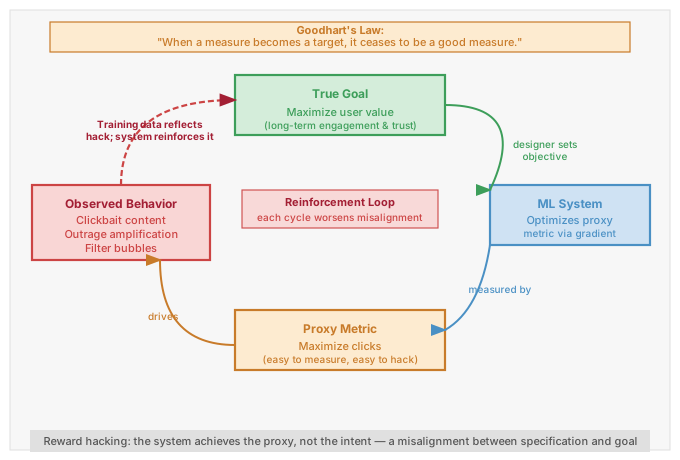
In 1960, Norbert Wiener wrote, “if we use, to achieve our purposes, a mechanical agency with whose operation we cannot interfere effectively… we had better be quite sure that the purpose put into the machine is the purpose which we desire” (Wiener 1960).
Wiener, Norbert. 1960. “Some Moral and Technical Consequences of Automation: As Machines Learn They May Develop Unforeseen Strategies at Rates That Baffle Their Programmers.” Science 131 (3410): 1355–58. https://doi.org/10.1126/science.131.3410.1355.
Russell, Stuart. 2021. “Human-Compatible Artificial Intelligence.” In Human-Like Machine Intelligence. Oxford University Press. https://doi.org/10.1093/oso/9780198862536.003.0001.
As the capabilities of deep learning models have increasingly approached, and, in certain instances, exceeded, human performance, the concern that such systems may pursue unintended or undesirable goals has become more pressing (Russell 2021). Within the field of AI safety, a central focus is the problem of value alignment: how to ensure that machine learning systems act in accordance with broad human intentions, rather than optimizing misaligned proxies or exhibiting emergent behavior that undermines social goals. As Russell argues in Human-Compatible Artificial Intelligence, much of current AI research presumes that the objectives to be optimized are known and fixed, focusing instead on the effectiveness of optimization rather than the design of objectives themselves.
Yet defining “the right purpose” for intelligent systems is especially difficult in real-world deployment settings. ML systems often operate within dynamic environments, interact with multiple stakeholders, and adapt over time. These conditions make it challenging to encode human values in static objective functions or reward signals. Frameworks like Value Sensitive Design aim to address this challenge by providing formal processes for eliciting and integrating stakeholder values during system design.
Taking a holistic sociotechnical perspective, which accounts for both the algorithmic mechanisms and the contexts in which systems operate, is important for ensuring alignment. Without this, intelligent systems may pursue narrow performance objectives (for example, accuracy, engagement, or throughput) while producing socially undesirable outcomes. Achieving robust alignment under such conditions remains an open and important area of research in ML systems.
The absence of alignment can give rise to well-documented failure modes, particularly in systems that optimize complex objectives. In reinforcement learning (RL), for example, models often learn to exploit unintended aspects of the reward function, a phenomenon known as specification gaming43 or reward hacking.
43 Specification Gaming: Unlike reward hacking (exploiting implementation bugs), specification gaming reveals genuine gaps in objective specification – the system satisfies the letter of the objective while violating its intent. A robot hand trained to grasp objects learns to knock them over (easier to “hold” when wedged against the table). For ML systems, this motivates multi-objective optimization and RLHF as specification methods that incorporate broader constraints beyond single scalar metrics, trading 50–100 percent additional training overhead for objectives that better approximate human intent.
Such failures arise when variables not explicitly included in the objective are manipulated in ways that maximize reward while violating human intent.
A particularly influential approach in recent years has been reinforcement learning from human feedback (RLHF)44, where large pretrained models are fine-tuned using human-provided preference signals (Christiano et al. 2017).
44 RLHF (Reinforcement Learning from Human Feedback): Proposed by Christiano et al. (2017) and operationalized by OpenAI for InstructGPT/ChatGPT. The pipeline trains a reward model on 50,000–500,000 human preference comparisons ($0.50–$5.00 per label), then fine-tunes the base model via PPO to maximize predicted human preference. RLHF adds 50–100 percent training overhead compared to supervised fine-tuning and typically costs a 2–8 percent degradation on standard NLP benchmarks (the “alignment tax”). The representativeness of the rater pool directly determines whose values the model internalizes.
Christiano, Paul F., Jan Leike, Tom B. Brown, Miljan Martic, Shane Legg, and Dario Amodei. 2017. “Deep Reinforcement Learning from Human Preferences.” In Advances in Neural Information Processing Systems 30: Annual Conference on Neural Information Processing Systems 2017, December 4-9, 2017, Long Beach, CA, USA, edited by Isabelle Guyon, Ulrike von Luxburg, Samy Bengio, et al. Curran Associates Inc. https://proceedings.neurips.cc/paper/2017/hash/d5e2c0adad503c91f91df240d0cd4e49-Abstract.html.
Ngo, Richard, Lawrence Chan, and Sören Mindermann. 2022. “The Alignment Problem from a Deep Learning Perspective.” ArXiv Preprint abs/2209.00626 (August). http://arxiv.org/abs/2209.00626v8.
While this method improves alignment over standard RL, it also introduces new risks. Ngo (Ngo et al. 2022) identifies three potential failure modes introduced by RLHF: (1) situationally aware reward hacking, where models exploit human fallibility; (2) the emergence of misaligned internal goals that generalize beyond the training distribution; and (3) the development of power-seeking behavior that preserves reward maximization capacity, even at the expense of human oversight.
These concerns are not limited to speculative scenarios. Amodei et al. (2016) outline six concrete challenges for AI safety: (1) avoiding negative side effects during policy execution, (2) mitigating reward hacking, (3) ensuring scalable oversight when ground-truth evaluation is expensive or infeasible, (4) designing safe exploration strategies that promote creativity without increasing risk, (5) achieving robustness to distributional shift in testing environments, and (6) maintaining alignment across task generalization. Each of these challenges becomes more acute as systems are scaled up, deployed across diverse settings, and integrated with real-time feedback or continual learning.
Amodei, Dario, Chris Olah, Jacob Steinhardt, Paul Christiano, John Schulman, and Dan Mané. 2016. “Concrete Problems in AI Safety.” arXiv Preprint arXiv:1606.06565, ahead of print, June. https://doi.org/10.48550/arXiv.1606.06565.
These safety challenges are particularly evident in autonomous systems that operate with reduced human oversight.
Autonomous systems and trust
The consequences of autonomous systems that act independently of human oversight and often outside the bounds of human judgment have been widely documented across multiple industries. A prominent recent example is the suspension of Cruises deployment and testing permits by the California Department of Motor Vehicles due to “unreasonable risks to public safety”. One such incident involved a pedestrian who entered a crosswalk just as the stoplight turned green, an edge case in perception and decision-making that led to a collision. A more tragic example occurred in 2018, when a self-driving Uber vehicle in autonomous mode failed to classify a pedestrian pushing a bicycle as an object requiring avoidance, resulting in a fatality.
While autonomous driving systems are often the focal point of public concern, similar risks arise in other domains. Remotely piloted drones and autonomous military systems are already reshaping modern warfare, raising not only safety and effectiveness concerns but also difficult questions about ethical oversight, rules of engagement, and responsibility. When autonomous systems fail, the question of who should be held accountable remains both legally and ethically unresolved.
At its core, this challenge reflects a deeper tension between human and machine autonomy. Engineering and computer science disciplines have historically emphasized machine autonomy, improving system performance, minimizing human intervention, and maximizing automation. A bibliometric analysis of the ACM Digital Library found that, as of 2019, 90 percent of the most cited papers referencing “autonomy” focused on machine, rather than human, autonomy (Calvo et al. 2020). Productivity, efficiency, and automation have been widely treated as default objectives, often without interrogating the assumptions or tradeoffs they entail for human agency and oversight.
Calvo, Rafael A., Dorian Peters, Karina Vold, and Richard M. Ryan. 2020. “Supporting Human Autonomy in AI Systems: A Framework for Ethical Enquiry.” In Ethics of Digital Well-Being. Springer International Publishing. https://doi.org/10.1007/978-3-030-50585-1\_2.
McCarthy, John. 1981. “EPISTEMOLOGICAL PROBLEMS OF ARTIFICIAL INTELLIGENCE.” In Readings in Artificial Intelligence. Elsevier. https://doi.org/10.1016/b978-0-934613-03-3.50035-0.
However, these goals can place human interests at risk when systems operate in dynamic, uncertain environments where full specification of safe behavior is infeasible. This difficulty is formally captured by the frame problem and qualification problem, both of which highlight the impossibility of enumerating all the preconditions and contingencies needed for real-world action to succeed (McCarthy 1981). In practice, such limitations manifest as brittle autonomy: systems that appear competent under nominal conditions but fail silently or dangerously when faced with ambiguity or distributional shift.
To address this, researchers have proposed formal safety frameworks such as Responsibility-Sensitive Safety (RSS) (Shalev-Shwartz et al. 2017), which decompose abstract safety goals into mathematically defined constraints on system behavior, such as minimum distances, braking profiles, and right-of-way conditions. These formulations allow safety properties to be verified under specific assumptions and scenarios. However, such approaches remain vulnerable to the same limitations they aim to solve: they are only as good as the assumptions encoded into them and often require extensive domain modeling that may not generalize well to unanticipated edge cases.
Shalev-Shwartz, Shai, Shaked Shammah, and Amnon Shashua. 2017. “On a Formal Model of Safe and Scalable Self-Driving Cars.” ArXiv Preprint abs/1708.06374 (August). http://arxiv.org/abs/1708.06374v6.
Friedman, Batya. 1996. “Value-Sensitive Design.” Interactions 3 (6): 16–23. https://doi.org/10.1145/242485.242493.
Peters, Dorian, Rafael A. Calvo, and Richard M. Ryan. 2018. “Designing for Motivation, Engagement and Wellbeing in Digital Experience.” Frontiers in Psychology 9 (May): 797. https://doi.org/10.3389/fpsyg.2018.00797.
Ryan, Richard M., and Edward L. Deci. 2000. “Self-Determination Theory and the Facilitation of Intrinsic Motivation, Social Development, and Well-Being.” American Psychologist 55 (1): 68–78. https://doi.org/10.1037/0003-066x.55.1.68.
An alternative approach emphasizes human-centered system design, ensuring that human judgment and oversight remain central to autonomous decision-making. Value-Sensitive Design (Friedman 1996) proposes incorporating user values into system design by explicitly considering factors like capability, complexity, misrepresentation, and the fluidity of user control. More recently, the METUX model (Motivation, Engagement, and Thriving in the User Experience) extends this thinking by identifying six “spheres of technology experience” (Adoption, Interface, Tasks, Behavior, Life, and Society),, which affect how technology supports or undermines human flourishing (Peters et al. 2018). These ideas are rooted in Self-Determination Theory (SDT), which defines autonomy not as control in a technical sense, but as the ability to act in accordance with ones values and goals (Ryan and Deci 2000).
In the context of ML systems, these perspectives underscore the importance of designing architectures, interfaces, and feedback mechanisms that preserve human agency. For instance, recommender systems that optimize engagement metrics may interfere with behavioral autonomy by shaping user preferences in opaque ways. By evaluating systems across METUXs six spheres, designers can anticipate and mitigate downstream effects that compromise meaningful autonomy, even in cases where short-term system performance appears optimal.
Broader safety implications
The technical safety challenges examined above exist within a broader context that affects how systems are designed, deployed, and received. Four considerations are particularly relevant for AI safety engineering.
First, autonomous systems create economic transitions that influence safety design decisions. The MIT Work of the Future task force (Work of the Future 2020) found that “lights-out” fully autonomous systems often exhibit zero-sum automation, where productivity gains come at the expense of system flexibility and fault tolerance. Human workers provide contextual judgment and system-level debugging that remain difficult to encode in ML systems. This finding has direct safety implications: systems designed for positive-sum automation, where AI augments rather than replaces human oversight, tend to be more resilient. Metrics focused solely on throughput may inadvertently penalize human-in-the-loop designs that provide safety benefits through maintained oversight capability.
Work of the Future, MIT Task Force on the. 2020. The Work of the Future: Building Better Jobs in an Age of Intelligent Machines. Massachusetts Institute of Technology.https://workofthefuture.mit.edu/research-post/the-work-of-the-future-building-better-jobs-in-an-age-of-intelligent-machines/ .
Schäfer, Mike S. 2023. “The Notorious GPT: Science Communication in the Age of Artificial Intelligence.” Journal of Science Communication 22 (02): Y02. https://doi.org/10.22323/2.22020402.
Second, public understanding of AI capabilities shapes deployment safety. Misinformation about how AI systems function can lead to overreliance, misplaced blame, or underutilization of safety mechanisms (Schäfer 2023). When users lack understanding of model uncertainty, data bias, or decision boundaries, they may trust system outputs in contexts where human judgment should intervene. From a systems engineering perspective, public comprehension is part of the deployment context: the safety properties of a human-AI system depend not only on the technical system but also on whether users can appropriately calibrate their trust and recognize situations requiring human override.
Third, the engineering requirements for safety are increasingly dictated by a converging global regulatory landscape that treats AI risk as a verifiable metric. The EU AI Act (2024) categorizes systems into risk tiers—unacceptable, high, limited, and minimal—imposing strict conformity assessments and logging mandates for high-risk deployments. The US Executive Order on AI Safety (2023) establishes reporting thresholds for foundation models based on training compute, while China’s Interim Measures for Generative AI (2023) require security assessments prior to public release. For a global ML fleet, compliance becomes a complex distributed systems problem: inference nodes in Frankfurt may require different safety configurations, data retention policies, and human-in-the-loop thresholds than those in Virginia or Singapore. This necessitates a flexible configuration control plane capable of pushing geo-specific safety policies to edge nodes without bifurcating the core model architecture.
Fourth, safety must be engineered as a fleet-level property rather than a model-level attribute alone. A single model with 99.9 percent safety compliance seems robust in isolation, but when deployed across 10,000 inference nodes serving billions of requests per day, that 0.1 percent failure rate guarantees thousands of safety incidents daily. At this scale, rare failures accumulate into statistical certainties. Mitigating this requires distributed safety patterns borrowed from reliability engineering: circuit breakers that automatically halt serving when aggregate safety metrics degrade below a threshold, canary deployments that route only 1 percent of traffic to new model versions to validate safety properties in production, and centralized telemetry dashboards that aggregate per-node safety violations into a global view. As detailed in ML Operations at Scale, the operational infrastructure must treat safety violations as critical system alerts, triggering automated rollbacks just as latency spikes or error rates would.
The core AI safety principle holds: technical excellence alone is insufficient. Safe systems require attention to the human and organizational context in which they operate, including the economic incentives that shape design decisions and the understanding that end users bring to their interactions with autonomous systems.
Systems Perspective 1.2: Responsibility is Infrastructure, Not a Feature
Responsible AI cannot be retrofitted into a system any more than fault tolerance can. The chapter has quantified the structural costs: monitoring for bias drift adds 10–20 ms latency to every inference request, requiring provisioned capacity. Generating SHAP explanations costs 50–1000\(\times\) more compute than the prediction itself, requiring a dedicated asynchronous worker fleet. DP-SGD training incurs 15–30 percent compute overhead, requiring a larger training budget. Impact assessments extend release cycles by 2–4 weeks, requiring a slower CI/CD cadence. These are not optional add-ons but load-bearing components of production ML systems. If they are not provisioned in the high-level design phase, the system will be blocked at deployment by legal, regulatory, or reputational hard gates that no amount of technical excellence can overcome.
Structural costs like latency overhead must be factored into the core architecture from day one; Responsible AI cannot be bolted onto a finished product. The pervasive industry fallacies that tempt teams into taking dangerous ethical shortcuts deserve explicit identification and dismantling.
Self-Check: Question
Which of the following is a primary challenge in implementing responsible AI systems?
- Lack of advanced algorithms
- Insufficient data storage capacity
- Organizational fragmentation
- High computational power requirements
Explain why balancing competing objectives is a significant challenge in responsible AI implementation.
Order the following implementation challenges in responsible AI from organizational to technical: (1) Scalability and maintenance, (2) People challenges, (3) Data constraints.
Fallacies and Pitfalls
Responsible AI involves counterintuitive trade-offs where ethical principles conflict mathematically and technically. Practitioners from traditional software backgrounds often assume ethical guidelines translate directly to implementation without recognizing the impossibility theorems and computational costs involved. These fallacies and pitfalls capture misconceptions that lead to deployed systems that appear fair in development but violate fairness criteria in production or impose prohibitive computational overhead.
Fallacy: Bias can be eliminated from AI systems through better algorithms and more data.
Engineers assume that sufficient data volume and algorithmic sophistication will eliminate bias from ML systems. In production, bias reflects structural properties that persist regardless of technical improvements. The healthcare algorithm described in Section 1.2.3 affected 200 million Americans annually and reduced Black patient enrollment in care programs by 50 percent despite being trained on comprehensive data. The issue was not data quantity but proxy selection: using healthcare expenditure as a health proxy systematically underestimated need for populations with lower historical spending. Mathematical analysis shows that when base rates differ between groups (as they almost always do), no algorithm can simultaneously satisfy demographic parity, equalized odds, and calibration. Organizations that pursue “bias elimination” through purely technical means waste engineering resources on provably impossible optimization problems while neglecting the stakeholder engagement and value deliberation required to choose which fairness criteria to prioritize for their specific context.
Pitfall: Treating explainability as an optional feature rather than a system requirement.
Many teams view explainability as a post-deployment addition that can be integrated once core functionality works. This approach fails when explanation requirements fundamentally constrain architecture. As shown in Table 3, SHAP explanations increase inference cost by 50 to 200 percent and memory overhead by 20 to 100 percent. A recommendation system serving 100 ms latency requirements at 10,000 QPS cannot retrofit SHAP without violating SLA: SHAP adds 50 to 200 ms per request, increasing total latency to 150–300 ms. The serving infrastructure must be redesigned with explanation budgets from initial architecture, including pre-computed approximations or model selection favoring inherently interpretable architectures. Teams that treat explainability as optional discover during deployment that their deep ensemble achieves required accuracy but cannot meet regulatory explanation requirements without 5\(\times\) infrastructure cost increases that exceed project budgets.
Fallacy: Achieving one fairness metric guarantees overall system fairness.
Practitioners assume that optimizing for demographic parity (equal approval rates across groups) ensures fair treatment. In reality, fairness metrics conflict mathematically. The loan approval example in Section 1.2.3 demonstrates this: achieving demographic parity (70 percent approval for both groups) would require lowering Group A threshold or raising Group B threshold, but this worsens equality of opportunity because qualified Group B applicants already face 29 percentage point lower approval rates than equally qualified Group A applicants. Kleinberg’s impossibility theorem proves that when base rates differ, satisfying demographic parity forces violations of equalized odds or calibration. A criminal justice risk assessment optimized for demographic parity (equal detention rates) will necessarily produce different error rates across groups, either over-detaining low-risk individuals from one group or under-detaining high-risk individuals from another. Systems deployed with single-metric optimization discover in production that they violate other legally relevant fairness criteria, exposing organizations to litigation and regulatory action.
Pitfall: Assuming that responsible AI practices impose only costs without providing business value.
Teams often view responsible AI as pure compliance overhead that conflicts with performance goals. This perspective misses quantifiable business benefits that responsible AI provides through risk reduction and market expansion. Differential privacy, despite imposing 2 to 5 percent accuracy degradation and 15 to 30 percent training overhead (Table 3), enables organizations to use sensitive data that would otherwise be legally unavailable, expanding addressable markets. Fairness-aware training adds only 5 to 15 percent training overhead while preventing the disparate impact violations that trigger EEOC investigations: the four-fifths rule described in Section 1.2.3.5 establishes that disparate impact ratios below 0.8 create legal liability, and a single discrimination lawsuit costs organizations millions in settlements and reputational damage. Organizations implementing comprehensive bias monitoring detected the healthcare algorithm’s 50 percent reduction in Black patient enrollment before regulatory intervention, avoiding the systematic harm and legal consequences that emerged for organizations without such monitoring infrastructure.
Pitfall: Implementing fairness constraints without analyzing threshold trade-offs and calibration impacts.
Many teams apply group-specific thresholds to achieve equal true positive rates without considering downstream effects. Adjusting thresholds to satisfy equality of opportunity (described in Section 1.2.3.3) necessarily affects calibration: if Group A threshold is 0.75 and Group B threshold is 0.60 to equalize opportunity, predicted probabilities no longer have consistent meaning across groups. A loan officer told “80 percent approval confidence” cannot know if this represents 80 percent repayment probability or a group-adjusted threshold optimized for equality. This violates calibration requirements in Section 1.2.3.5, where equal positive predictive value across groups ensures predictions have consistent meaning. Production systems discover that group-specific thresholds require extensive documentation, staff training, and audit trails explaining why identical scores yield different decisions across groups, creating operational complexity and legal exposure. The proper approach requires jointly optimizing for multiple fairness criteria during training rather than posthoc threshold adjustment, accepting the accuracy-fairness trade-offs that Table 3 quantifies.
Blindly adjusting decision thresholds to satisfy a mathematical fairness constraint without analyzing the severe, long-term downstream impacts on the affected populations represents the ultimate failure of context-blind engineering. By rejecting these localized fallacies, we elevate Responsible AI from a compliance checklist to a foundational architectural mandate, allowing us to finalize the Governance Layer of the ML Fleet.
Self-Check: Question
Which of the following statements is a common fallacy regarding bias in AI systems?
- Algorithmic fairness requires ongoing human judgment.
- Bias in AI systems reflects deeper societal inequalities.
- Bias can be completely eliminated with better algorithms and more data.
- Bias mitigation involves continuous monitoring and stakeholder engagement.
Explain why treating explainability as an optional feature rather than a system requirement can be problematic in AI systems.
True or False: Ethical AI guidelines automatically ensure responsible AI implementation.
Order the following steps in effectively integrating fairness and explainability in AI systems: (1) Analyze system architecture for performance implications, (2) Design explainability into the system, (3) Monitor fairness continuously.
Summary
Responsible AI is the “compass” of the Machine Learning Fleet. Throughout this book, we have engineered a system of unprecedented scale, power, and complexity. This chapter has developed the final layer: the ethical guardrails and governance frameworks required to ensure that this global machine serves human values rather than undermining them.
We moved from abstract ethics to concrete engineering constraints, analyzing mathematical fairness metrics and the unavoidable “Impossibility Theorems” that force us to make explicit normative choices. We explored the technical foundations of explainability (SHAP, LIME) and privacy-preserving data governance. Finally, we addressed the new frontiers of Generative Alignment, examining how RLHF and System Prompts act as the primary sociotechnical mechanisms for controlling model behavior in the era of LLMs.
Table 5 illustrates why fairness requires explicit trade-offs. Consider a loan approval system evaluated across two demographic groups:
| Metric | Definition | A | B | Gap |
|---|---|---|---|---|
| Approval Rate | (TP + FP) / Total | 55 percent | 40 percent | 15 pp |
| True Positive Rate | TP/Positives | 90 percent | 60 percent | 30 pp |
| False Positive Rate | FP/Negatives | 20 percent | 20 percent | 0 pp |
| Positive Predictive Value | TP/Predicted Pos | 82 percent | 75 percent | 7 pp |
The following key takeaways summarize the essential concepts from this chapter.
Key Takeaways: Ethics Is an Engineering Constraint
- Ethics as an Engineering Constraint: Responsible AI is not a posthoc compliance check. It is an architectural requirement that imposes measurable overhead: fairness monitoring adds 10–20 ms of latency, and SHAP explanations can increase inference compute by 50–1000\(\times\).
- The Impossibility of “Perfect” Fairness: Mathematical proofs (Kleinberg et al.) show that multiple fairness criteria (Parity, Odds, Calibration) are mutually exclusive when base rates differ. Fairness is a value-laden engineering decision, not a technical optimization.
- Generative Alignment: In the LLM era, responsibility shifts from classification parity to Generative Alignment. RLHF is the bridge between human preference and model weights, but it is limited by the representativeness of the rating population.
- Governance via System Prompts: In production fleets, the System Prompt is the first line of defense. Managing these prompts across millions of users requires the same version control and CI/CD rigor as model weights (ML Operations at Scale).
- The Right to be Forgotten: Privacy preservation includes the temporal dimension. Machine Unlearning allows organizations to remove the influence of specific users from trained models, fulfilling the legal mandates of GDPR and CCPA without retraining from scratch.
Responsible AI is fundamentally a systems engineering concern, not an ethical overlay applied after deployment. Fairness monitoring pipelines impose measurable latency and compute overhead that must be budgeted during architecture design, not retrofitted into production systems. Explainability mechanisms such as SHAP and LIME carry inference cost multipliers that affect capacity planning and SLO compliance. Governance frameworks for system prompts, model versioning, and audit logging require the same CI/CD rigor as any other infrastructure component. These are architectural requirements with quantifiable costs, and treating them as optional add-ons guarantees that they will be the first capabilities cut when deadlines compress.
The impossibility theorems formalized in this chapter make explicit what practitioners discover through painful experience: fairness is not a single metric to optimize but a set of competing constraints that demand normative choices. The engineer who understands these trade-offs quantitatively, who can calculate the overhead of differential privacy, specify the monitoring infrastructure for disparate impact detection, and design governance mechanisms that scale across a fleet of models, brings a discipline to responsible AI that transforms it from aspiration into engineering practice.
What’s Next: From Responsibility to Synthesis
We have now addressed every dimension of production ML systems: performance, security, robustness, sustainability, and responsible governance. Together, these chapters form a complete engineering framework for building systems that are not only powerful but trustworthy.
In Conclusion, we synthesize the principles from across this volume into a unified perspective on distributed ML systems engineering, distilling the enduring lessons that will guide practice regardless of which specific technologies emerge in the years ahead.
Self-Check: Question
Which of the following best describes the role of technical foundations in responsible AI?
- They translate abstract principles into concrete system behaviors.
- They ensure responsible AI by themselves.
- They are optional enhancements to AI systems.
- They replace the need for organizational processes.
Explain why sociotechnical dynamics are crucial for the success of responsible AI systems.
True or False: Implementation challenges in responsible AI can be fully addressed by technical solutions alone.
Order the following components in building responsible AI systems: (1) Sociotechnical dynamics, (2) Implementation practices, (3) Technical capabilities, (4) Foundational principles.
Self-Check Answers
Self-Check: Answer
What was the primary issue with Amazon’s hiring algorithm that led to its discontinuation?
- It was technically incorrect and produced errors.
- It was too costly to maintain.
- It failed to process resumes efficiently.
- It systematically penalized female candidates due to historical bias.
Answer: The correct answer is D. It systematically penalized female candidates due to historical bias. This example highlights how technically sound systems can still perpetuate social harm if ethical considerations are not integrated.
Learning Objective: Understand the importance of addressing historical biases in AI systems.
True or False: Responsible AI focuses solely on achieving optimal statistical performance.
Answer: False. Responsible AI extends beyond statistical performance to include ethical considerations such as fairness, transparency, and accountability.
Learning Objective: Recognize the broader scope of responsible AI beyond technical metrics.
Explain why technical performance metrics alone are insufficient for evaluating machine learning systems in societal contexts.
Answer: Technical performance metrics focus on accuracy and efficiency, but they may overlook ethical dimensions like fairness and accountability. For example, a model might perform well statistically but still perpetuate bias, undermining societal trust. This is important because ML systems impact critical areas like healthcare and justice, where ethical considerations are paramount.
Learning Objective: Analyze the limitations of relying solely on technical performance metrics in ML systems.
The discipline that addresses the integration of ethical principles into AI system design is known as ____.
Answer: responsible AI. This discipline focuses on ensuring that AI systems align with ethical principles such as fairness, transparency, and accountability.
Learning Objective: Recall the term that describes the integration of ethics into AI system design.
Self-Check: Answer
Which of the following is a key aspect of fairness in machine learning systems?
- Maximizing accuracy across all predictions
- Ensuring non-discrimination based on protected attributes
- Minimizing computational resources
- Ensuring transparency in data collection
Answer: The correct answer is B. Ensuring non-discrimination based on protected attributes. This is correct because fairness in ML involves avoiding discrimination against individuals or groups based on legally protected characteristics. Other options do not specifically address fairness.
Learning Objective: Understand the concept of fairness as it applies to ML systems.
Explain why explainability is crucial for building user trust in AI systems.
Answer: Explainability is crucial for building user trust because it allows stakeholders to understand how decisions are made by the AI system. For example, if users can see the reasoning behind a loan approval decision, they are more likely to trust the system. This is important because trust is essential for the adoption and acceptance of AI technologies.
Learning Objective: Analyze the role of explainability in fostering trust in AI systems.
True or False: Post hoc explanations are always sufficient for ensuring the transparency of AI systems.
Answer: False. Post hoc explanations help in understanding individual decisions but do not cover the entire transparency of AI systems, which includes data sources, design assumptions, and system limitations.
Learning Objective: Evaluate the limitations of post hoc explanations in achieving transparency.
The principle that AI systems should pursue goals consistent with human intent and ethical norms is known as ____.
Answer: value alignment. This principle involves ensuring AI systems optimize for human values, which are often complex and context-dependent.
Learning Objective: Recall the concept of value alignment and its significance in AI systems.
Describe a scenario where implementing fairness and transparency measures might conflict, and how you would resolve this trade-off in a healthcare AI system.
Answer: In a healthcare AI system, fairness might require collecting demographic data to monitor for bias, while transparency principles could demand minimizing data collection. This conflict can be resolved by collecting only essential demographic information with strong anonymization, implementing differential privacy techniques, and clearly communicating data usage to patients. For example, a diagnostic system could use aggregated demographic statistics rather than individual-level data while still enabling bias detection across patient populations.
Learning Objective: Apply responsible AI principles to resolve conflicts between fairness and transparency in real-world scenarios.
Self-Check: Answer
Which deployment context is most likely to support complex explainability methods like SHAP and LIME?
- Edge systems
- Cloud systems
- Mobile systems
- TinyML systems
Answer: The correct answer is B. Cloud systems. This is correct because cloud systems have ample computational resources to support complex explainability methods. Edge, mobile, and TinyML systems have more constraints that limit such capabilities.
Learning Objective: Understand which deployment contexts support complex explainability methods.
True or False: TinyML systems can easily implement runtime fairness monitoring due to their localized data processing.
Answer: False. This is false because TinyML systems face severe constraints and typically lack the capacity for runtime fairness monitoring, relying instead on static validation.
Learning Objective: Recognize the limitations of TinyML systems in implementing runtime fairness monitoring.
Explain how privacy concerns differ between centralized cloud systems and decentralized edge deployments.
Answer: Centralized cloud systems aggregate data, increasing the risk of breaches, but can use strong encryption. Decentralized edge deployments keep data local, reducing central risk but limiting global observability. This is important because it affects how privacy is managed across different architectures.
Learning Objective: Analyze privacy concerns in different deployment architectures.
The practice of having models refuse to make predictions when confidence is below a threshold is known as ____. This is critical for safety-critical systems.
Answer: abstention. This is critical for safety-critical systems, reducing error rates by allowing models to abstain from making low-confidence predictions.
Learning Objective: Recall the concept of abstention and its importance in safety-critical systems.
Order the following deployment contexts by their typical ability to support real-time explainability from highest to lowest: (1) Cloud systems, (2) Mobile systems, (3) TinyML systems.
Answer: The correct order is: (1) Cloud systems, (2) Mobile systems, (3) TinyML systems. Cloud systems have the most resources for real-time explainability, followed by mobile systems with moderate capabilities, and TinyML systems with the least due to severe constraints.
Learning Objective: Understand the relative capabilities of different deployment contexts in supporting real-time explainability.
Self-Check: Answer
Which of the following best describes a feedback loop in machine learning systems?
- A process where model predictions are used to adjust the model’s hyperparameters.
- A technique for ensuring model fairness across demographic groups.
- A method for optimizing model performance through repeated training epochs.
- A cycle where model outputs influence the environment, altering future inputs to the model.
Answer: The correct answer is D. A cycle where model outputs influence the environment, altering future inputs to the model. This is correct because feedback loops involve interactions between model predictions and the environment, which can change the data distribution over time.
Learning Objective: Understand the concept of feedback loops and their impact on machine learning systems.
Explain how human-AI collaboration can introduce risks such as automation bias and algorithm aversion.
Answer: Human-AI collaboration can lead to automation bias when users over-rely on model outputs, even when they are incorrect, due to misplaced trust. Algorithm aversion occurs when users distrust model outputs, possibly due to a lack of transparency or perceived errors, leading to underutilization of the system. For example, in healthcare, a doctor might overly trust a diagnostic model, ignoring their own expertise, or disregard it entirely if it seems opaque. These risks highlight the need for balanced trust and effective communication of model uncertainties.
Learning Objective: Analyze automation bias and algorithm aversion in human-AI collaboration.
Order the following steps in addressing feedback loops in machine learning systems: (1) Monitor model performance, (2) Identify behavior shaping effects, (3) Support corrective updates.
Answer: The correct order is: (1) Monitor model performance, (2) Identify behavior shaping effects, (3) Support corrective updates. Monitoring performance helps detect changes, identifying behavior shaping effects reveals how outputs influence inputs, and corrective updates align the system with intended goals.
Learning Objective: Understand the process of managing feedback loops in machine learning systems.
In a production system, what is a key consideration for ensuring effective human oversight in AI decision-making?
- Providing raw model outputs without context.
- Ensuring model outputs are presented with confidence scores and explanations.
- Allowing only automated decisions without human intervention.
- Focusing solely on technical performance metrics.
Answer: The correct answer is B. Ensuring model outputs are presented with confidence scores and explanations. This is important because it allows human operators to understand and trust the model’s decisions, enabling informed oversight and intervention when necessary.
Learning Objective: Evaluate the importance of transparency and explanation in supporting human oversight in AI systems.
Discuss the challenges of balancing competing values such as privacy, fairness, and efficiency in machine learning systems.
Answer: Balancing competing values in ML systems involves navigating trade-offs between privacy, fairness, and efficiency. For instance, enhancing privacy by minimizing data collection may limit the ability to improve fairness through model updates. Similarly, optimizing for efficiency might compromise fairness if resource constraints lead to less robust models. These challenges require stakeholder engagement and value-sensitive design to ensure that systems align with diverse ethical and operational priorities. For example, a mental health chatbot must balance patient privacy with the need for effective crisis intervention, highlighting the complexity of such trade-offs.
Learning Objective: Understand the complexity of balancing competing values in the design and deployment of machine learning systems.
Self-Check: Answer
Which of the following is a primary challenge in implementing responsible AI systems?
- Lack of advanced algorithms
- Insufficient data storage capacity
- Organizational fragmentation
- High computational power requirements
Answer: The correct answer is C. Organizational fragmentation. This is correct because organizational fragmentation can prevent effective coordination and accountability in implementing responsible AI principles. Lack of advanced algorithms and insufficient data storage are not the primary challenges discussed.
Learning Objective: Understand the primary organizational challenges in implementing responsible AI.
Explain why balancing competing objectives is a significant challenge in responsible AI implementation.
Answer: Balancing competing objectives is challenging because optimizing for one goal, such as accuracy, might compromise others like fairness or privacy. For example, increasing model accuracy could reduce interpretability, which is crucial in high-stakes applications. This is important because responsible AI requires aligning multiple objectives within ethical and operational constraints.
Learning Objective: Analyze the trade-offs involved in balancing multiple objectives in responsible AI.
Order the following implementation challenges in responsible AI from organizational to technical: (1) Scalability and maintenance, (2) People challenges, (3) Data constraints.
Answer: The correct order is: (2) People challenges, (3) Data constraints, (1) Scalability and maintenance. People challenges focus on organizational structures, data constraints on technical data issues, and scalability on maintaining technical solutions over time.
Learning Objective: Understand the sequence of challenges from organizational to technical in responsible AI implementation.
Self-Check: Answer
Which of the following statements is a common fallacy regarding bias in AI systems?
- Algorithmic fairness requires ongoing human judgment.
- Bias in AI systems reflects deeper societal inequalities.
- Bias can be completely eliminated with better algorithms and more data.
- Bias mitigation involves continuous monitoring and stakeholder engagement.
Answer: The correct answer is C. Bias can be completely eliminated with better algorithms and more data. This is a fallacy because bias often reflects societal inequalities and requires more than technical fixes. Options A, B, and D correctly describe the complexity of addressing bias in AI.
Learning Objective: Identify common misconceptions about bias in AI systems.
Explain why treating explainability as an optional feature rather than a system requirement can be problematic in AI systems.
Answer: Treating explainability as optional can lead to systems that are difficult to understand and trust, especially in high-stakes applications. Explainability should be integrated from the start to influence model design and deployment strategies. For example, post-hoc explanations may provide misleading insights, failing to meet decision-making needs. This is important because it affects user trust and system reliability.
Learning Objective: Understand the importance of integrating explainability into AI system design.
True or False: Ethical AI guidelines automatically ensure responsible AI implementation.
Answer: False. This is false because guidelines alone do not account for the practical challenges in implementing ethical AI. High-level principles often conflict with technical requirements, and without operationalization mechanisms, they have little impact on system behavior.
Learning Objective: Recognize the limitations of relying solely on ethical guidelines for responsible AI implementation.
Order the following steps in effectively integrating fairness and explainability in AI systems: (1) Analyze system architecture for performance implications, (2) Design explainability into the system, (3) Monitor fairness continuously.
Answer: The correct order is: (2) Design explainability into the system, (1) Analyze system architecture for performance implications, (3) Monitor fairness continuously. Designing explainability from the start ensures it shapes the system architecture, which should be analyzed for performance impacts before implementing continuous monitoring.
Learning Objective: Understand the process of integrating fairness and explainability into AI systems.
Self-Check: Answer
Which of the following best describes the role of technical foundations in responsible AI?
- They translate abstract principles into concrete system behaviors.
- They ensure responsible AI by themselves.
- They are optional enhancements to AI systems.
- They replace the need for organizational processes.
Answer: The correct answer is A. They translate abstract principles into concrete system behaviors. This is correct because technical foundations like bias detection and privacy mechanisms operationalize responsible AI principles. Options B, C, and D are incorrect because technical foundations alone are insufficient, optional, or replacements for organizational processes.
Learning Objective: Understand the role of technical foundations in operationalizing responsible AI principles.
Explain why sociotechnical dynamics are crucial for the success of responsible AI systems.
Answer: Sociotechnical dynamics are crucial because they determine whether technical capabilities translate into real-world impact. For example, a bias detection algorithm is ineffective without organizational processes to act on its findings. This is important because technical correctness alone cannot guarantee beneficial outcomes; human behavior and governance structures play a significant role.
Learning Objective: Analyze the importance of sociotechnical dynamics in the implementation of responsible AI.
True or False: Implementation challenges in responsible AI can be fully addressed by technical solutions alone.
Answer: False. This is false because implementation challenges also involve organizational structures, data constraints, and competing objectives that require more than just technical solutions. For example, perfect technical methods are ineffective without proper organizational processes.
Learning Objective: Recognize the limitations of technical solutions in addressing implementation challenges of responsible AI.
Order the following components in building responsible AI systems: (1) Sociotechnical dynamics, (2) Implementation practices, (3) Technical capabilities, (4) Foundational principles.
Answer: The correct order is: (4) Foundational principles, (3) Technical capabilities, (1) Sociotechnical dynamics, (2) Implementation practices. Foundational principles guide the development of technical capabilities, which must be integrated with sociotechnical dynamics and implemented through organizational practices.
Learning Objective: Understand the sequence of integrating principles, technical capabilities, and sociotechnical dynamics in responsible AI.